Color Fastness Testing Equipment
Testing machinery and equipment for the textile and clothing industry — what it measures, how it works, and the companies that supply it.
Color fastness testing answers a simple question before a customer has to: will this fabric keep its color? A fabric that fades in sunlight, bleeds in the wash or rubs dye onto a wearer's shirt fails at exactly the quality a buyer cannot judge in the store. Colorfastness testing measures a fabric's resistance to fading, bleeding and staining when it is exposed to the things real life will do to it — washing, dry cleaning, perspiration, rubbing and UV light — under controlled, repeatable laboratory conditions. Mills, dye houses, garment makers and retailers use the results to approve fabrics, compare dye recipes and processes, and prove a product meets the color standards its specification promises.
Textile Machinery Directory
What Color Fastness Tests Measure
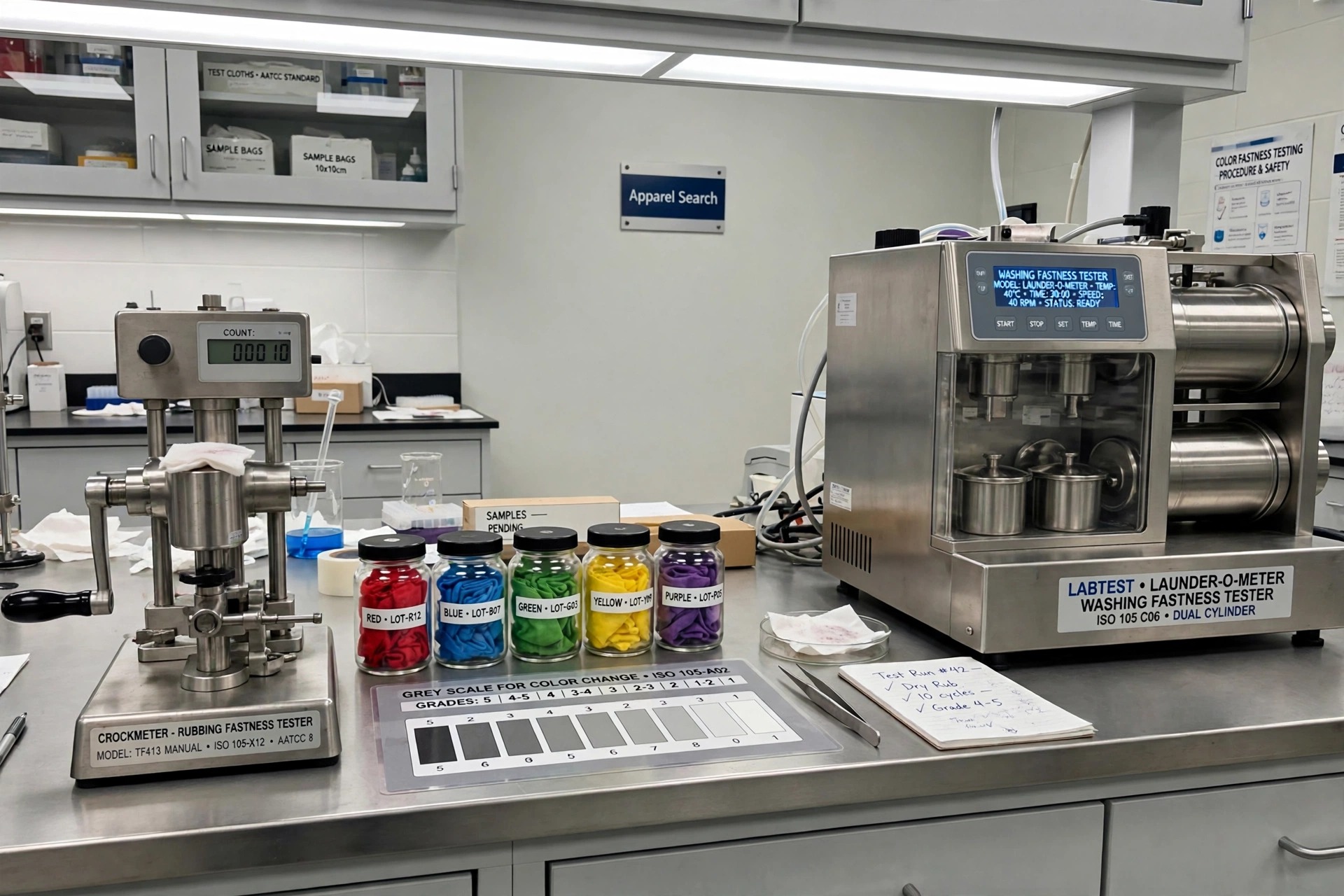
Each fastness test simulates one insult. Wash fastness puts the fabric through standardised laundering with detergent and steel balls for agitation, then grades both the color change of the specimen and the staining it leaves on adjacent undyed fabrics. Rub fastness — crocking — rubs a standard white cloth against the sample, dry and wet, and grades the color transferred; light fastness exposes the fabric beside a fading standard to a controlled light source; and perspiration, water, sea water and dry-cleaning fastness each reproduce their own chemistry. The instruments differ — launderometers, crockmeters, light and weathering cabinets — but the logic is one: apply a measured dose of the real-world stress, then grade the damage on a standard scale.
Grading is deliberately standardised so results travel between laboratories. Color change and staining are assessed against grey scales, step by step from grade 5 (no change) down to grade 1 (severe change), viewed under standard lighting, or measured instrumentally. A specification then becomes a sentence a factory can be held to — wash fastness 4 or better, wet crocking 3 or better — instead of an argument about whether a faded shirt faded too much. Buyers set the grades by end use: swimwear, upholstery and workwear each live under different stresses, and the test programme should match the life the garment will actually lead.
The Crockmeter and the Wider Test Bench
The crockmeter is the emblematic instrument of this bench: it determines how much color can be transferred from the surface of a colored material to other surfaces by rubbing — the handbag that marks a dress, the shoe that marks a trouser leg. SATRA's instrument, listed below, takes its name from 'crocking', the transfer of coloring matter to a wet or dry cloth rubbed against the sample; a grey scale is included for grading the transfer, standard cotton lawn cloth is available for the test, and the method references include SATRA TM167, BS 1006 X12, M&S C8 and AATCC Method 8. Around the crockmeter, a color fastness laboratory assembles the wash, light and perspiration instruments and the standard fabrics, detergents and scales that make results comparable.
ATI Corporation, listed below, supplies this whole bench to the North American market: laboratory and on-line testing machinery with spare parts and consumables, plus calibration and service — its range covers air permeability, water resistance, tearing strength, abrasion, tensile strength, corrosion, light and weathering fastness, color fastness and color matching. Calibration is not a footnote in fastness work: an uncalibrated light cabinet or a worn crockmeter finger produces grades no other laboratory can reproduce, and a fastness result is only worth the standard it was measured against.
Companies Supplying Color Fastness Testing Equipment
ATI Corporation
Advanced Testing Instruments Corporation provides the North American market with state-of-the-art laboratory and on-line testing machinery, as well as spare parts and consumables for all product lines. The ATI Technical Department performs and schedules calibrations and service for all instruments. Their products include testing equipment for air permeability, water resistance, tearing strength, abrasion, tensile strength, corrosion, light & weathering fastness, color fastness, color matching, compression, package integrity, as well as basic laboratory equipment.
Supplies: Color Fastness Testing · Light & Weathering Fastness · Abrasion · Tearing Strength · Tensile Strength · Color Matching · Laboratory Equipment
Satra Technology Centre
SATRA Technology Centre supplies a crockmeter — the instrument used to determine the degree of color which can be transferred from the surface of colored materials to other surfaces by rubbing. Typical examples of color transfer are handbags to clothing and shoes to trousers. The machine takes its name from 'crocking', meaning the transfer of coloring matter from a test sample to a wet or dry cloth rubbed against it. A grey scale is included in the package, and standard cloth (cotton lawn) is available for use with this test, ref. STD 422CL. Relevant test methods: SATRA TM167; BS 1006: X12; M&S C8; AATCC Method 8.
Supplies: Crockmeter · Rubbing Fastness Testing · Grey Scales · Standard Test Cloths
Testing, Inspection & Quality Machinery
Related Guides and Resources
Common Questions
What does color fastness testing actually measure?
It measures how well a fabric's color resists the stresses of real use: fading in light, bleeding and staining in washing or dry cleaning, color loss to perspiration, and color rubbed off onto other surfaces. Each test applies a standardised dose of one stress, and the result is graded against grey scales from 5 (no change) to 1 (severe change).
What is crocking?
Crocking is the transfer of color from a fabric's surface to another surface by rubbing — a dark handbag marking a light dress is the classic case. A crockmeter rubs a standard white cloth against the sample, dry and then wet, and the transferred color is graded on a grey scale. Wet crocking almost always grades worse than dry.
Why are fastness results graded instead of just pass or fail?
Because 'fast enough' depends on the end use. Grades let a buyer write an enforceable specification — for example wash fastness grade 4 or better — matched to the life the product will lead, and let any laboratory reproduce the same grade from the same fabric using the same standard method.