Light Box — Color Assessment Cabinet
Testing machinery and equipment for the textile and clothing industry — what it measures, how it works, and the companies that supply it.
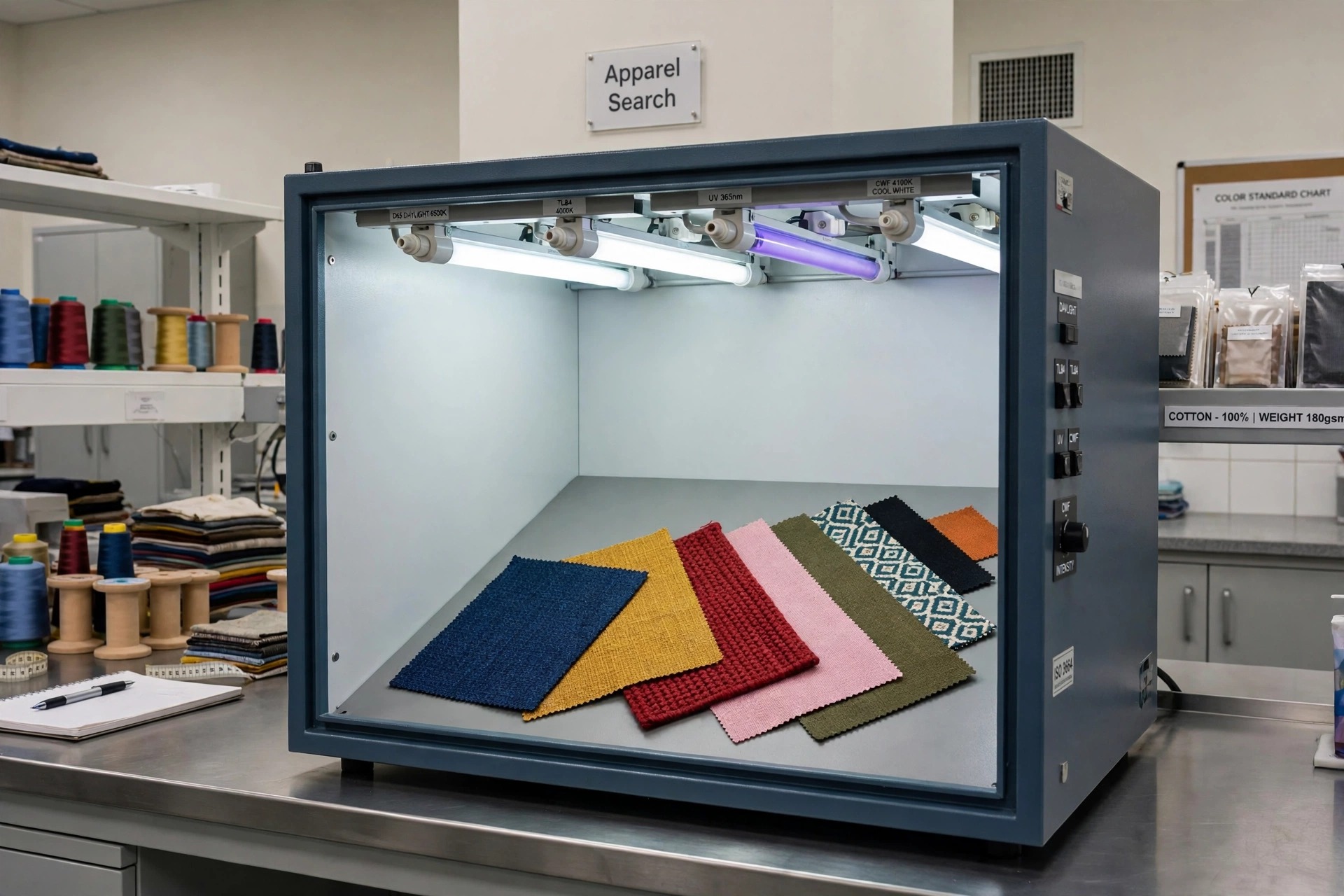
A light box — a color assessment cabinet — is the room where color arguments end. Two fabrics that match perfectly under a factory's fluorescent tubes can disagree completely in daylight or under a shop's warm lamps, a trick of physics called metamerism, and it is the single most common cause of shade disputes between mills, makers and retailers. The cabinet solves it by putting the samples under the same controlled light sources, one after another: a standard daylight, a store or home light, an incandescent light, sometimes an ultraviolet light — each switched in turn while assessors view the samples at a fixed angle against the cabinet's neutral grey interior. If two pieces match under every lamp in the box, they will match wherever the garment is sold and worn.
Textile Machinery Directory
Why Color Must Be Judged Under Standard Light
Color is not a property a fabric carries alone — it is what a particular light source, falling on particular dyes, shows a particular eye. Change the light and the balance of the dyes shifts: that is metamerism, and pairs of samples built from different dye recipes are especially prone to it, matching under one illuminant and splitting under another. A color assessment cabinet therefore carries several standardised sources — typically a daylight simulator (D65), a cool white or store light, a warm incandescent (illuminant A) and a UV source for checking fluorescent whitening agents — mounted over a matt neutral interior that adds no color of its own. Assessment is procedural: samples conditioned, laid flat without shadow, viewed at the standard angle, compared lamp by lamp, and judged against the master standard, not against memory.
ATI's Color Check Cabinet, listed below, was produced to answer exactly these visual color matching needs: it is used for assessing color changes under different light sources and for determining the suitability of materials for industrial applications where color consistency and quality must be maintained, with fluorescent daylight, incandescent and optional black (UV) light usable either individually or in combination. Cabinet discipline matters as much as cabinet hardware — tubes age and shift color, so lamp hours are logged and tubes replaced on schedule, the interior is kept clean and uncluttered, and nothing colored is stored inside the viewing area.
Specifying a Viewing Booth: Sources, Rendering and Standards
A booth is specified by its light sources and how faithfully they render color. Cometech of Taiwan, listed below, supplies a Color Viewing Booth providing various light sources for color comparison across printing, coating, textiles and fluorescence work; its simulated light sources are made according to C.I.E. daylight at color temperatures of 6504 K and 5000 K, with color performance evaluation over RA 96 — a high color-rendering index, meaning the lamps show colors close to how true daylight shows them. Working area size, the number of sources, dimming or instant switching between them, and a lamp-hour meter are the practical specification points; a booth too small for the samples forces assessors to fold or crowd them, and folded samples shade themselves.
Cometech also illustrates the wider testing-instrument trade behind the cabinet: a company with its own design and production department — rather than outsourced design — developing its own software and indicators, and offering machines such as its B series universal testing machines with PC connection for extended data analysis, built to be flexible and modifiable to a customer's specified requirements. For the buyer of a light box the lesson generalises: in color work, the instrument maker's control over its light sources and their calibration is the product. Keep the cabinet's own records — lamp hours, tube changes, and the master standard's identity — with the same care as the assessments made inside it.
Companies Supplying Light Box - Color Assessment Cabinet
ATI Advanced Testing Instruments
The Color Check Cabinet was produced to answer visual color matching needs. It is used for assessing color changes under different light sources, to determine suitability of materials for industrial applications where there is the need to maintain color consistency and quality. Fluorescent daylight, incandescent and optional black light may be used either individually or in combination.
Supplies: Color Check Cabinet · Color Assessment · Light & Weathering Fastness · Laboratory Testing Instruments
Cometech
Cometech (Taiwan) is a testing instrument company with its own design and production department, which is very different from other companies who assign their design and production to others. Through an experienced team, Cometech develops software and indicators and can provide an instant solution for customers; its machines can be standards and can be specified by customer requirement, and the company describes itself as a leader in the field of testing machines, offering competitive prices without compromising quality — including B series universal testing machines with PC connection for data analysis. Cometech supplies a Color Viewing Booth which can provide various light sources for color comparison for printing, coating, textiles, fluorescence, etc. Its simulated light sources are made according to C.I.E. daylight (color temperature 6504 K and 5000 K), with color performance evaluation over RA 96.
Supplies: Color Viewing Booth · Testing Instruments · Abrasion Tester · Impact Tester · Universal Testing Machines
Testing, Inspection & Quality Machinery
Related Guides and Resources
Common Questions
What is metamerism, and how does a light box expose it?
Metamerism is when two samples match under one light source but differ under another, because their dye recipes respond differently to each light. A color assessment cabinet exposes it directly: the samples are viewed in turn under standard daylight, store light, incandescent and UV sources — a pair that splits under any lamp in the box is metameric.
Which light sources should a color assessment cabinet have?
At minimum a standard daylight simulator such as D65, a store or cool-white light, and a warm incandescent source; a UV (black light) source is added for checking fluorescent whitening agents on whites. Cometech's booth, for example, simulates C.I.E. daylight at 6504 K and 5000 K with color rendering over RA 96.
Why do light box lamps need replacing on a schedule?
Lamp output and color shift as tubes age, so an old tube no longer produces the standard illuminant the cabinet promises — assessments quietly drift with it. Logging lamp hours and replacing tubes on the maker's schedule keeps the daylight in the box the same daylight every other laboratory is using.