Fabric Strength Testers
Testing machinery and equipment for the textile and clothing industry — what it measures, how it works, and the companies that supply it.
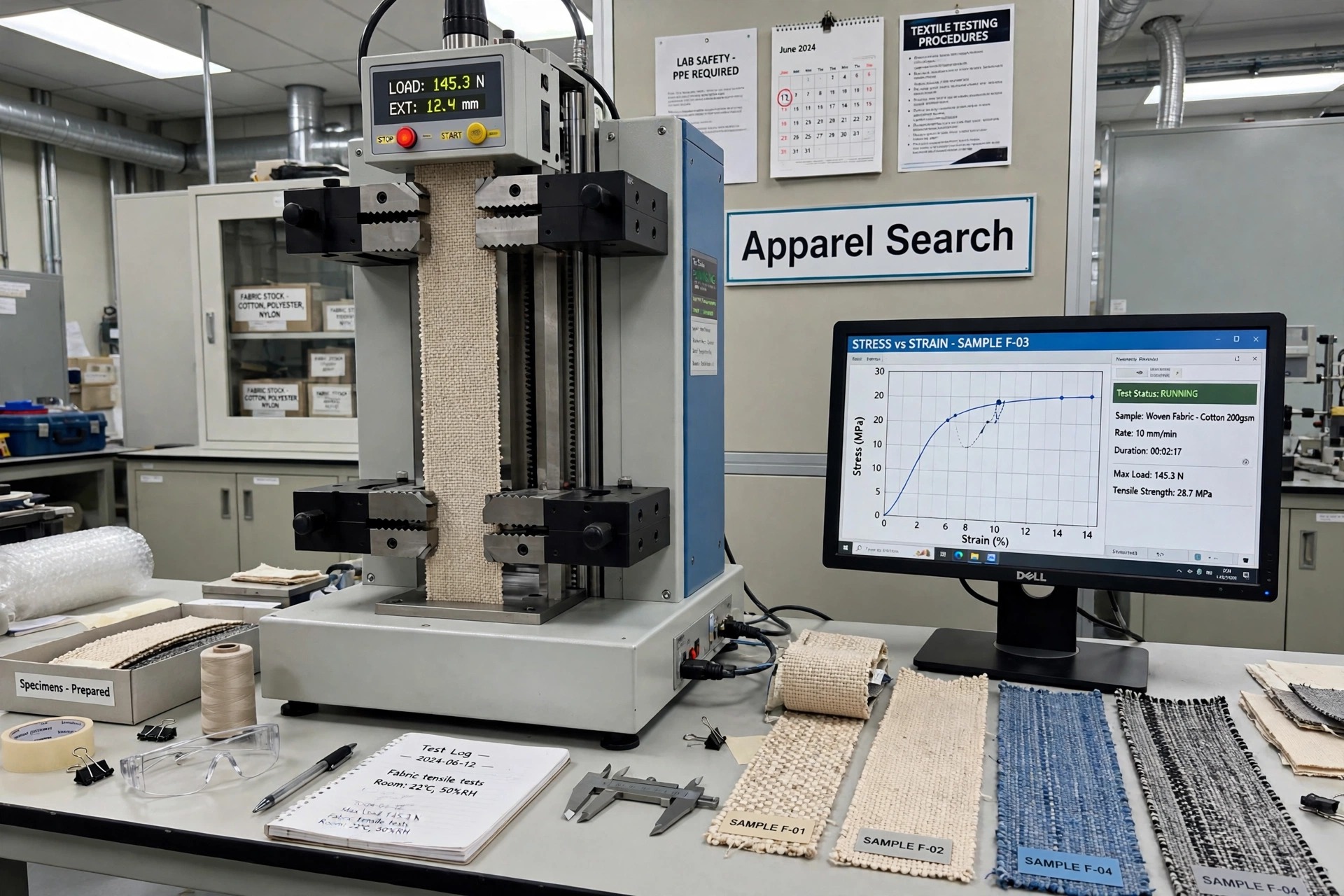
A fabric strength tester finds out, in the laboratory, what a garment would otherwise find out on a body: how much force the cloth can take before it stretches, tears or bursts. The core instrument is the universal testing machine — a frame that pulls, tears, compresses or punctures a prepared specimen at a controlled rate while measuring force and extension, and records the exact load at which the fabric fails. Tensile testing is the most commonly applied of these methods for analysing the mechanical properties of fabric materials, but strength is a family of questions — a fabric can pass a straight pull and still fail at a seam, a tear or a point load — so a strength laboratory runs several distinct test methods, each shaped to a different way cloth breaks in use.
Textile Machinery Directory
Tensile Testing: Strip and Grab Methods
In a tensile test the direction of applied force is always tension; the methods differ in how the specimen is held and loaded. In the strip test, the full width of the test specimen is gripped in the jaws of the testing machine and tensile force is applied until the fabric ruptures — the result is a breaking load and an elongation figure for that width of cloth, comparable across fabrics and laboratories. In the grab test, only the centre of a wider specimen is gripped, which loads the yarns unevenly in a way that resembles how cloth is actually pulled in wear, and gives a different — often more realistic — strength picture. Running warp and weft directions separately matters: most fabrics are noticeably stronger one way than the other, and a specification that only tests the strong direction certifies the fabric's best behaviour, not its worst.
Modern universal machines are computer controlled, so a test can be run and recorded against displacement, load, stress or strain, with the force–extension curve kept as data rather than a single breaking figure. That curve is diagnostic gold: it shows yarn slippage, coating cracking and the point where a fabric begins to fail long before it parts, and it lets a mill compare dyeing, finishing or coating changes against the untreated cloth objectively.
Tear, Seam, Burst and the Rest of the Strength Family
Around the tensile core sit the specialist methods. The tongue tear method and the trapezoidal tear method measure how much force continues a tear once one has started — the property that decides whether a snagged trouser leg becomes a hole or a write-off. Seam strength testing loads a stitched seam until the thread, the fabric or the stitching gives, because in a finished garment the seam is usually the weakest assembly. Adhesion and coating tests peel a coating from its base fabric; puncture and burst testing push a probe or a diaphragm through the cloth, modelling point loads and pressure; shear testing measures the fabric's resistance to distortion. A strength specification names the methods that match the product's real failure modes — testing everything is waste, testing the wrong thing is worse.
Two suppliers below frame the market. ADMET has spent over 25 years solving material testing challenges, beginning with software and controller technology for older testing machines before expanding into building high-feature testing systems and offering full system retrofits — the upgrade path for laboratories whose frames are sound but whose controls are not. Measurements Technology Inc. (MTI) offers electromechanical universal testing machine systems in ten standard force capacities from 1,000 pounds to 100,000 pounds (5 kN to 450 kN), all fully computer controlled with data-acquisition, database analysis and networking, and a full testing programs library included with each system.
Companies Supplying Fabric Strength Tester
Admet
For over 25 years, ADMET has been helping companies solve their material testing challenges. Beginning with development of software and controller technology for older testing machines, the company subsequently expanded its capabilities to building high feature testing systems and offering full system retrofits.
Supplies: Universal Testing Machines · Fabric Strength Testing · Testing System Retrofits · Controllers & Software
Measurements Technology Inc.
MTI electromechanical universal testing machine systems are offered in ten standard force capacities ranging from 1,000 pounds to 100,000 pounds (5 kN to 450 kN) force. All systems are fully computer controlled, and include a computer data-acquisition and control system with full features and capability including database analysis and networking. All testing, such as tensile testing, can be controlled based upon displacement, load, stress or strain. The full MTI Testing Programs library is included with each system.
Supplies: Universal Testing Machines · Tensile Testing · 5 kN to 450 kN Capacities · Test Program Library
Testing, Inspection & Quality Machinery
Common Questions
What is the difference between the strip test and the grab test?
In the strip test the full width of the specimen is gripped in the machine's jaws and pulled until it ruptures, giving a clean breaking load for that width. In the grab test only the centre of a wider specimen is gripped, loading the yarns unevenly as happens in real wear. The two methods give different figures, so a specification must name which one it means.
Why test tear and seam strength as well as tensile strength?
Because garments rarely fail by a straight, even pull. They fail where a tear propagates from a snag, or at a seam — usually the weakest part of the assembly. Tongue and trapezoidal tear tests measure resistance to a running tear, and seam strength tests load a stitched joint to failure; together they cover the ways cloth actually breaks in use.
What force capacity does a fabric testing machine need?
Most fabric work sits at the lower end of universal machine ranges — MTI's line, for example, starts at 1,000 pounds (5 kN). Capacity should comfortably exceed the strongest specimen expected, including seams and coated fabrics, without being so large that ordinary fabric loads read at the noisy bottom of the range.