Children's Athletic Uniforms Guide
Children's athletic uniforms are the matching kits teams wear for sport — jersey, shorts and socks in team colors, numbered and named, for soccer, baseball, softball, basketball, track and polo.
Shop Children's Athletic Uniforms Now
Shop Children's Athletic Uniforms on Amazon Shop Children's Athletic Uniforms on eBayThe Amazon and eBay links on this page are affiliate links. If you make a purchase through them, Apparel Search may earn a commission.
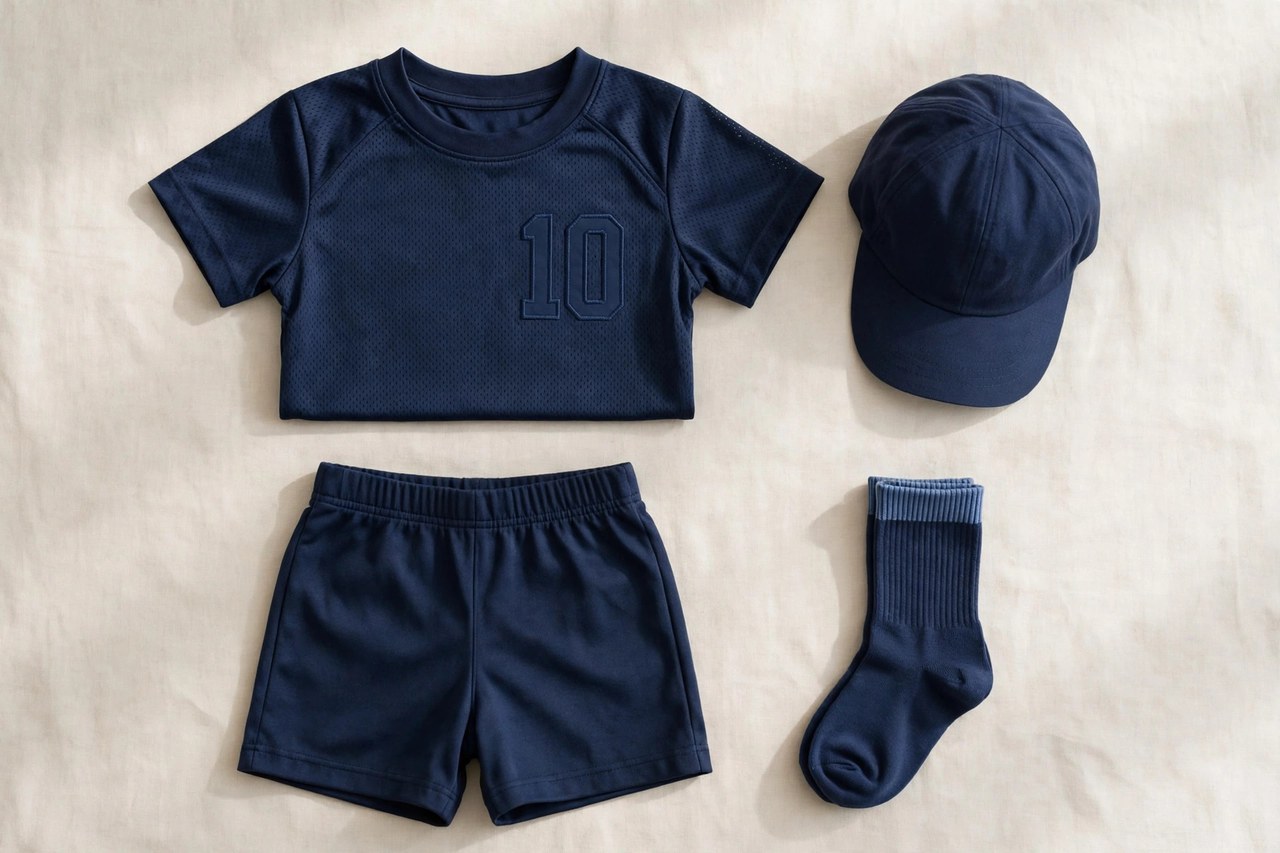
A uniform is a type of clothing worn by members of an organization while participating in that organization's activity. Athletic uniforms are worn for the activity of sport. A team uniform is used for many different sports including soccer, baseball, track, softball, basketball and polo. That definition captures the category exactly: the uniform is not simply sportswear but the organization's clothing, identical across the team, marking every wearer as a member while the activity lasts.
That membership job explains the uniform's features. Team colors identify the side at a glance, numbers and names identify the individual player to officials and spectators, and the kit is specified by the league or club rather than chosen piece by piece. This guide covers what a children's team kit contains, how the sports differ, and how sizing, fabrics and care work when a whole team has to match.
What a Team Kit Contains
The standard children's kit is a jersey or shirt, shorts, and socks in the team's colors, with the details set by the sport. Numbers on the back are near-universal in league play; names above the number, a club crest on the chest and a sponsor mark complete the standard layout. Goalkeepers wear a contrasting jersey by rule, and many kits include a training or warm-up top in the same colors for the sideline.
Baseball and softball add a cap and often a belt to the shared uniform, with stirrup or baseball socks in team colors; basketball kits use a sleeveless jersey and longer shorts; track kits favor a singlet and short shorts built for unimpeded stride; polo and soccer share the collared or crew jersey and shorts pattern with their own socks and conventions. Underneath, the activewear rules from this letter apply unchanged: wicking base layers in cold weather, nothing that shows beyond the uniform where league rules require it.
Sizing and Fit for a Whole Team
Team orders are placed by size run rather than by individual fitting, which makes the maker's size chart the most important page in the process. Children's uniforms are sold by age and chest or height ranges, and a team spanning two school years will span at least three sizes; ordering a few extra mid-size kits covers late joiners and the inevitable mid-season growth. Numbers are assigned once sizes are known, so the roster, the sizes and the numbering list travel together.
Fit follows the sport. A uniform should allow the full movement of its game — a soccer kit that survives a sliding reach, a basketball jersey that allows arms fully overhead — without the excess fabric of a size too large, which catches, tangles and looks wrong in the team photograph. Youth cuts differ from adult cuts in proportion, not just scale, so a small adult size is a poor substitute for the largest youth size where both exist.
Fabrics: Built for a Season of Washes
Modern children's uniforms are almost entirely polyester, chosen for the same properties as activewear — moisture wicking, quick drying, color that survives repeated washing without fading, because a faded jersey no longer matches the team. Mesh panels ventilate the back and sides; interlock knits give a smoother surface for printing numbers and crests. Sublimation printing, where the design is dyed into the fabric, has become the standard for full-color kits because it cannot crack or peel, unlike older heat-applied numbers, which eventually do both.
Durability is judged at the stress points: reinforced stitching at shoulders and side seams, drawstring or elastic waistbands that survive a season of pulling, and socks with cushioned feet that hold their elastic. A uniform is washed after every game, so its real lifespan is counted in washes, not wears — fifty or more in a long season, which is why league kits are built heavier than fashion sportswear.
Care, Names and Numbers
Wash uniforms inside out in cool water to protect numbers, names and crests, skip fabric softener on wicking fabrics, and dry on low heat or air-dry, since high heat is what lifts heat-applied lettering and ages elastic. Mud comes out better soaked promptly than scrubbed later. Numbered kits are returned, recorded and reissued in many school and club programs, so a name label inside the collar — where it does not show — keeps a season of identical kits sorted.
Bought to the chart, washed inside out and kept as a set, a children's athletic uniform does the double job the definition promises: it equips a child for the sport, and it makes a group of children into a team on sight. Are you ready for the game?
Common Questions
What makes athletic clothing a uniform?
A uniform is a type of clothing worn by members of an organization while participating in that organization's activity, and athletic uniforms are worn for the activity of sport. The whole team wears identical colors and design, specified by the club or league rather than chosen individually, with numbers - and often names and a crest - identifying each player. Ordinary activewear becomes a uniform when the organization, not the wearer, decides what it looks like.
Which sports use children's team uniforms?
A team uniform is used for many different sports, including soccer, baseball, track, softball, basketball and polo. The kit follows the sport: soccer, softball, basketball and polo share the jersey-and-shorts pattern with their own socks and conventions, baseball adds a cap and often a belt, basketball uses a sleeveless jersey, and track favors a singlet built for unimpeded stride.
How are children's athletic uniforms sized for a team order?
By the maker's size chart, ordered as a size run. Children's uniforms are sold by age and chest or height ranges, and a team spanning two school years will span at least three sizes. Order a few extra mid-size kits for late joiners and mid-season growth, assign numbers once sizes are known, and prefer the largest youth size over a small adult size - youth cuts differ in proportion, not just scale.
More in Children's Clothes Guide A
The other A topics, and the full A letter, are gathered here:
More to Explore on Apparel Search
References & Further Reading
Looking for Children's Clothing Stores?
This guide helps you choose children's athletic uniforms and team kits. To browse where to buy, visit our children's clothing store directory, where you can find retailers that carry them.