Apparel Search Consumer Guides
Dressing Aids & Tools
The small tools of dressing, explained one by one — what each does, how it is used, and which dressing problem it solves.
Every guide in this section eventually mentions a small tool: a hook that does up buttons, a frame that puts socks on, a horn that finishes a shoe from a chair. Dressing aids are the hardware half of adaptive dressing — inexpensive, unglamorous objects that stand in for a second hand, a stronger grip, or an extra foot of reach. This page is their catalogue: what each one is, how it works, and which dressing problem it answers. It supports the whole medical dressing family in our post-surgery and medical dressing guide and the broader adaptive clothing guide, and it is the page to read alongside dressing with arthritis, dressing after stroke and dressing with Parkinson’s, where the same kit keeps appearing.
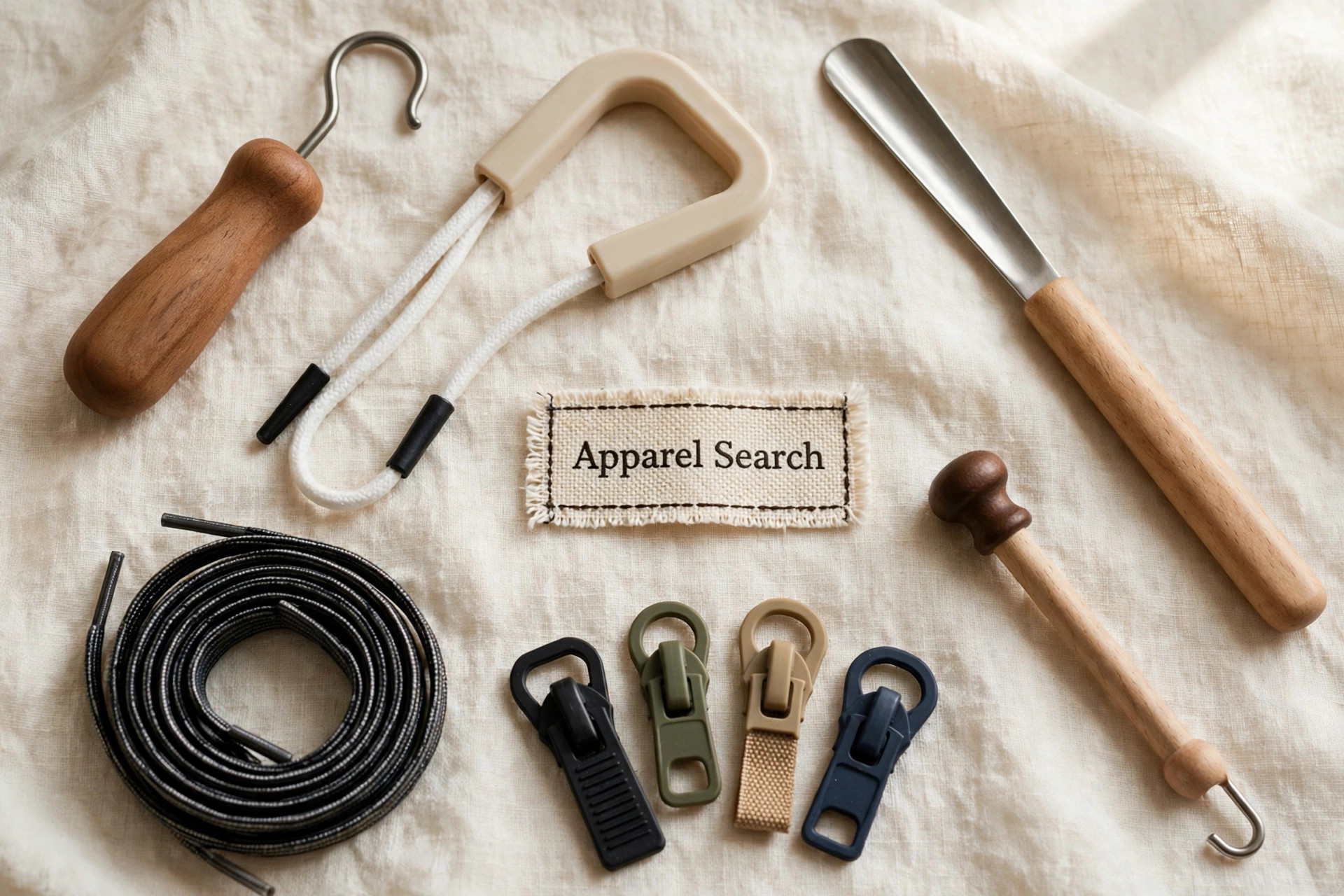
Button Hooks and Zipper Pulls
A button hook is a handle with a wire loop at one end. The loop passes through the buttonhole, catches the button on the far side, and draws it back through the hole as you pull — the whole job done with one whole-hand grip, which is why it is the standard answer to buttons for arthritic fingers, tremor, and one-handed dressing alike. Handles come in standard and large-grip, cushioned, and built-up versions; the built-up grips are worth choosing whenever holding a pencil-thin handle is itself a problem. A zipper pull is simpler still: a ring, tab or cord that clips onto an existing zip tab and gives a finger — or a hook, or teeth in a pinch — something generous to draw on. Fit them to coats, trousers and boots and the zips stay, only their handles grow.
Sock Aids and Stocking Aids
A sock aid is a flexible trough, usually plastic or fabric-lined, with long cords. The sock is stretched over the trough, the trough is lowered to the floor by its cords, the foot slides in along it, and a pull on the cords draws the sock up the leg and the trough out — socks on, seated, without bending double or gripping a heel. Variants handle both feet’s worth of mornings equally well, and firmer framed stocking aids do the same job for the tighter fit of support hosiery; the garments themselves are covered in our compression garments guide. A related small tool, the shoe remover or boot jack, levers shoes off at the end of the day without bending.
Long Shoehorns, Elastic Laces and Shoe Removers
A long-handled shoe horn — typically 18 inches and upward, metal or plastic — guides the heel into a shoe from a chair, protecting the shoe’s heel counter and sparing the bending that a short horn demands. Elastic laces are laces with stretch, fitted and knotted once at the tension you like; from then on the shoe is a slip-on that still looks laced. They are the single cheapest upgrade in this catalogue, and they convert shoes you already own — a point that matters for one-handed dressing after a stroke and for anyone whose hands find bows a daily tax. Coil and toggle lacing systems do the same job in a more technical style.
Dressing Sticks and Reachers
A dressing stick is a rod with a hook at one end and a pusher at the other. The hook catches straps, loops and hems and draws them within reach; the pusher nudges a sleeve off a shoulder or a trouser leg down into place. It is the tool that guides clothing around a limb you are not moving much — while dressing one-handed, around a cast, or after an amputation, where it also fetches garments and guides hems over a prosthesis. A reacher or grabber — a trigger handle with a gripping jaw — fetches clothes from shelves and floors and helps guide trouser legs, and the two tools between them cover most of the reaching that dressing asks for.
Choosing and Setting Up a Kit
- Start from the hardest task, not a catalogue. Buttons defeat you — a button hook. Socks are the battle — a sock aid. Buy for the task that actually costs you, first.
- Match the grip to your hand. Built-up, cushioned and loop handles exist because the tool is only useful if holding it is easy; when in doubt, size the grip up.
- Singles before kits. Combination kits are good value once you know which tools you use; start with the two or three that answer your routine.
- Keep the kit where dressing happens. On the dressing chair or in the top drawer beside it — an aid in a cupboard across the room is an aid that gets skipped.
- For caregivers, add the second set. When dressing is a two-person job — as in our dementia-friendly dressing guide — a shoe horn and dressing stick at the chair help the helper as much as the wearer.
Most of these tools are sold by the retailers in our adaptive clothing retail directory alongside the garments they support, and none of them asks anything of the clothes you already own — that is their virtue. They change the dressing, not the wardrobe.
A Garment Guide, Not Medical Advice
This page covers clothing: features, fit, fastenings and dressing technique. Questions about your condition, your medication or your care belong to your own doctor and care team, and their guidance outranks anything in a product description — including the ones described here.
Shop Dressing Aids on Amazon
Ready to shop? Product links are kept in one place on the Apparel Search shopping guide:
Shop Clothing on AmazonThis link opens the Apparel Search shopping guide for Amazon, where the product links are kept in one place.
Common Questions
What is a button hook and how does it work?
A button hook is a handle with a wire loop. Push the loop through the buttonhole, catch the button on the far side of the fabric, and pull back — the button comes through the hole and the garment is fastened, all with one whole-hand grip. It is the standard tool for buttons when pinching is hard, hands shake, or only one hand is available.
What does a sock aid do?
A sock aid holds a sock open on a flexible trough with long cords. You lower the trough to the floor, slide your foot in, and pull the cords to draw the sock up your leg — socks on while seated, without bending double or gripping the heel. Framed stocking aids do the same for tighter support hosiery.
Do elastic laces really turn lace-up shoes into slip-ons?
Yes. Elastic laces are fitted and knotted once, at the tension you like, and their stretch lets the shoe open for your foot and close again — from then on the shoe goes on like a slip-on while still looking laced. They are the cheapest upgrade in the dressing toolkit and work on shoes you already own.
Which dressing aid should I buy first?
The one that answers your hardest dressing task. Buttons: a button hook. Socks: a sock aid. Shoes: a long-handled shoe horn and elastic laces. Reaching and guiding garments: a dressing stick or reacher. Start from the task that costs you most, and add tools as new tasks appear.
Back to the Post-Surgery & Medical Dressing Guide
Front closures, soft seams and step-in styles — plus the mastectomy, ostomy and compression guides.
More to Explore
Search Apparel Search
Please note: Apparel Search is a fashion and clothing guide, not a medical authority. Pages in this section describe clothing features and dressing ideas only. We make no claim that any garment or special product will improve, treat, or help with any medical condition, and descriptions of product features reflect how those products are designed and marketed, not a medical endorsement. Please check with your own doctor or care team about what is right for you.