Apparel Search Consumer Guides
Dressing When Blind or Low Vision
Identifying clothes by touch, organizing a closet your hands can read, and choosing closures that confirm themselves by feel.
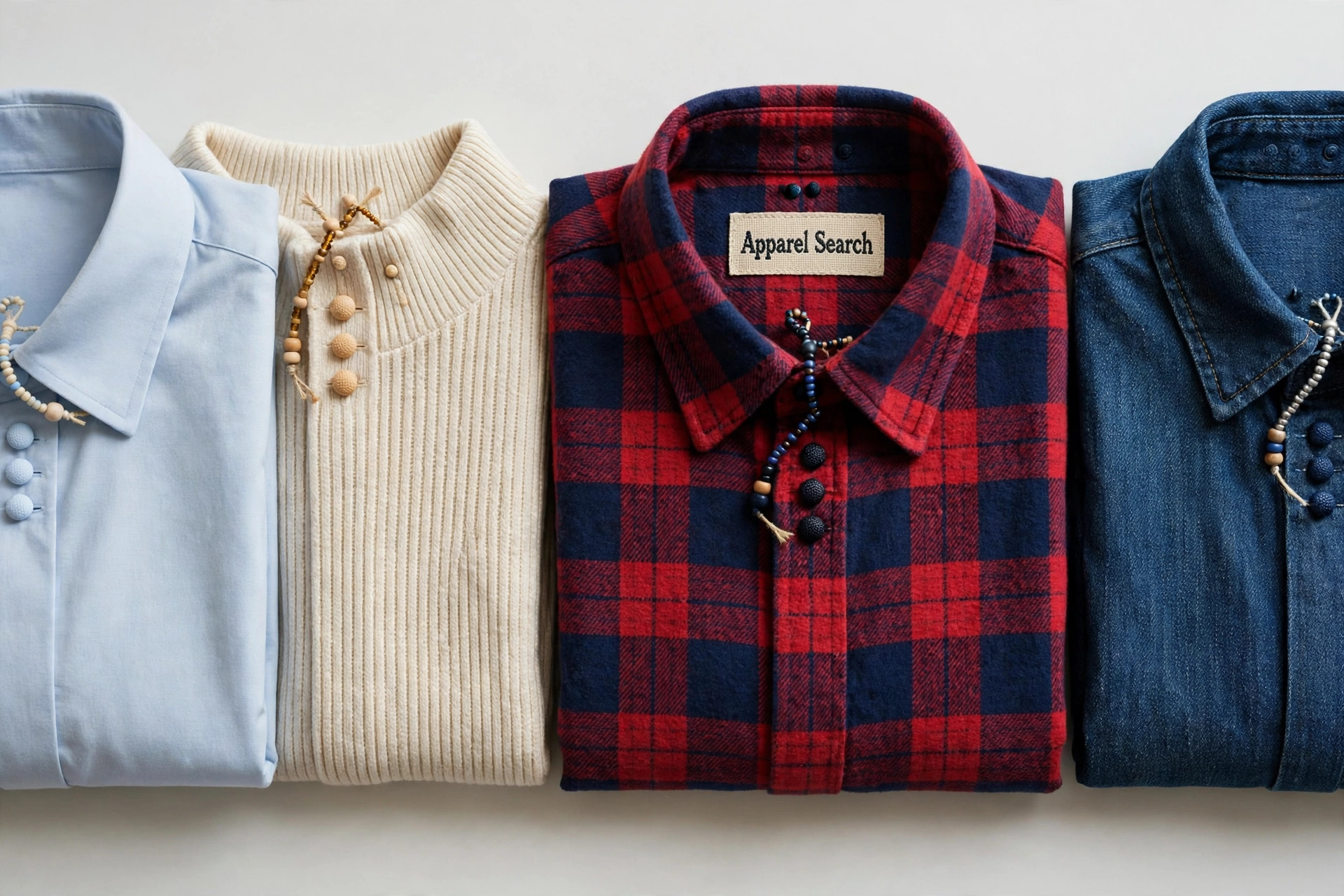
Getting dressed without relying on sight is mostly a systems problem, and clothing is half of the system. The other half is information: knowing which garment is in your hand, what color it is, what it goes with, and whether it is fastened — all without looking. This guide covers the garment side of that system: the textures and shapes that identify clothing by touch, the tactile and braille labels sold to name what touch cannot, the closet order that keeps outfits findable, and the closures that tell your fingers when the job is done. It sits in the same family as our adaptive clothing guide and our adaptive clothing features guide, and it approaches dressing by touch as a design brief rather than an afterthought.
Identifying Clothes by Touch
Fabric is the first language. A smooth cotton poplin feels cool and flat; a ribbed knit runs in ridges; denim has a diagonal grain; flannel is brushed and warm; corduroy is corded; a chunky sweater knit reads differently from a fine one. A wardrobe in which each garment has its own fabric is a wardrobe you can read. The hard case is the opposite one — five identical T-shirts in five colors — because identical construction carries no information. Shoppers who dress by touch solve it in one of two ways: they buy the same style in deliberately different fabrics and textures, or they add markers, covered in the next section.
Shape is the second language. Collar styles, neckline depth, sleeve length, pocket shape and placement, the weight of a hem, the feel of a cuff — all of these are consistent within a garment and different between garments. Design details help too: a row of stitching, an appliqué, a distinctive button shape. When you buy, choose details your fingers can find, and note them as part of the garment’s identity: the shirt with the square pocket, the dress with the heavy hem.
Labels and Markers That Speak to Your Fingers
Tactile labels. Raised-print labels and tags put information on the garment itself: color, size, sometimes care, in letters or symbols you can feel. For low vision, the parallel products are large-print, high-contrast labels — bold type on a plain ground, readable at arm’s length in good light.
Braille clothing labels. Sew-in and iron-on braille labels are sold in sets naming colors and garment types, and single braille tags can be attached at a hem or inside a waistband. They turn the question “which blue is this?” into a ten-second check, and because they are small and flat they disappear into ordinary clothing.
Coded markers. The long-standing home system is a small object sewn where only the wearer knows to look: a button, a bead, a knot of thread inside a hem, coded by count or position — one bead for navy, two for black, a knot for the shirt that matches the grey trousers. Adhesive raised dots do the same job without sewing. The system matters more than the object: one code, used every time, on every garment.
Audio labels. Pen-style label readers and talking tags record a spoken note on a small tag or sticker — “navy cardigan, wear with the grey skirt” — and play it back when scanned. Color-identifying phone apps are the other product category in this space. Both are sold as dressing aids, and both belong in the same drawer as the markers above: they are how a wardrobe talks.
A Closet Organized by Touch
A fixed order does the work that eyes do elsewhere. Garments live in set places — work shirts here, in this sequence; dresses there — and return to the same place after washing, so position itself becomes information. Outfits can be hung together, trousers and top on one hanger or neighboring hangers, which removes matching from the morning entirely. One garment per hanger keeps shapes distinct; mixed hanger shapes — wood for jackets, slim for shirts — add another layer of identification.
Drawers and shelves follow the same rule: dividers keep categories apart, folding is consistent so a stack reads by height and texture, and shoes are stored as pairs — clipped or pinned together, toes out — so a pair is found as one object. The laundry loop closes the system: garments are sorted into the wash by texture, and small items like socks travel in pairs, pinned or clipped, so they come back as pairs. Our dressing aids and tools guide covers the hooks, pulls and reachers that support all of this; the closet’s fixed order is what makes those tools worth having.
Closures You Can Confirm by Feel
The test of a closure, dressing by touch, is whether your fingers can confirm it is done. Magnetic closures pass easily: the two sides find each other and seat with a pull you can feel, behind a front that looks conventionally buttoned. Hook-and-loop announces itself by sound and grip. Zips with ring pulls or large tabs can be located and drawn without searching, and big, widely spaced buttons are findable one by one in a way that small, close buttons are not. Snaps seat under direct pressure, which is its own confirmation.
The closures to avoid are the ones that hide: back zips, tiny hook-and-eye fastenings, long rows of identical small buttons, and anything that fastens where your hands cannot comfortably reach to check it. Front fastenings, elastic waists and pull-on styles remove the question altogether — the same feature logic as our sensory-friendly clothing page, where garments are judged by what they feel like rather than how they look.
A Garment Guide, Not Medical Advice
This page covers clothing: how the garments are designed, organized, fitted and worn. It describes what products are made of and how they are put together — nothing here is a claim about what any garment does for a medical condition, and questions about your own situation belong to your own doctor or care team, whose guidance outranks any product description — including the ones described here.
Shop Adaptive Clothing on Amazon
Ready to shop? Product links are kept in one place on the Apparel Search shopping guide:
Shop Clothing on AmazonThis link opens the Apparel Search shopping guide for Amazon, where the product links are kept in one place.
Common Questions
How can you tell clothes apart without seeing them?
By texture, shape and markers. Fabrics feel distinct — smooth cotton, ribbed knit, denim, flannel — and so do collars, pockets, hems and buttons. Where two garments feel the same, a tactile or braille label, a raised dot, or a bead or button sewn inside a hem gives each one a name your fingers can check.
What are braille clothing labels?
Small sew-in or iron-on labels embossed with braille, sold in sets that name colors and garment types. Attached at a collar, hem or waistband, they let the wearer confirm a garment’s color and identity by touch in seconds. Raised-print tactile labels and large-print, high-contrast labels are the parallel products for shoppers who do not read braille.
How do you keep outfits matched without sight?
By system rather than by checking. Keep every garment in a fixed place, hang complete outfits together, and code colors with markers — a bead, button or tactile label whose meaning never changes. A wardrobe built mostly on neutrals, with texture and pattern doing the varying, also makes most combinations safe by default.
Which closures are easiest to confirm by feel?
Magnetic closures, which seat with a pull you can feel; hook-and-loop, which announces itself by sound and grip; zips with ring pulls or large tabs; and large, widely spaced buttons or snaps that fasten under direct pressure. Back zips, tiny hooks and long rows of small identical buttons are the hardest to verify by touch.
More to Explore
Search Apparel Search
Please note: Apparel Search is a fashion and clothing guide, not a medical authority. Pages in this section describe clothing features and dressing ideas only. We make no claim that any garment or special product will improve, treat, or help with any medical condition, and descriptions of product features reflect how those products are designed and marketed, not a medical endorsement. Please check with your own doctor or care team about what is right for you.