Apparel Search How-To Guides
How to Tie a Scarf
The handful of knots that cover almost everything — around the neck, on your head, on a bag and as a belt — and how to match each one to the scarf you own.
A scarf is the hardest-working rectangle in a wardrobe — one length of cloth that can be a warm layer, a head covering, a belt, a bag decoration or the single finished note on a plain coat. What separates a scarf that looks thrown on from one that looks deliberate is rarely the scarf itself; it is the knot, and whether the knot suits the cloth. This guide covers the styles that between them handle almost every occasion: five ways around the neck, two on the head, and the bag and belt tricks — with a note for each on the scarf it needs and the neckline or outfit it flatters.
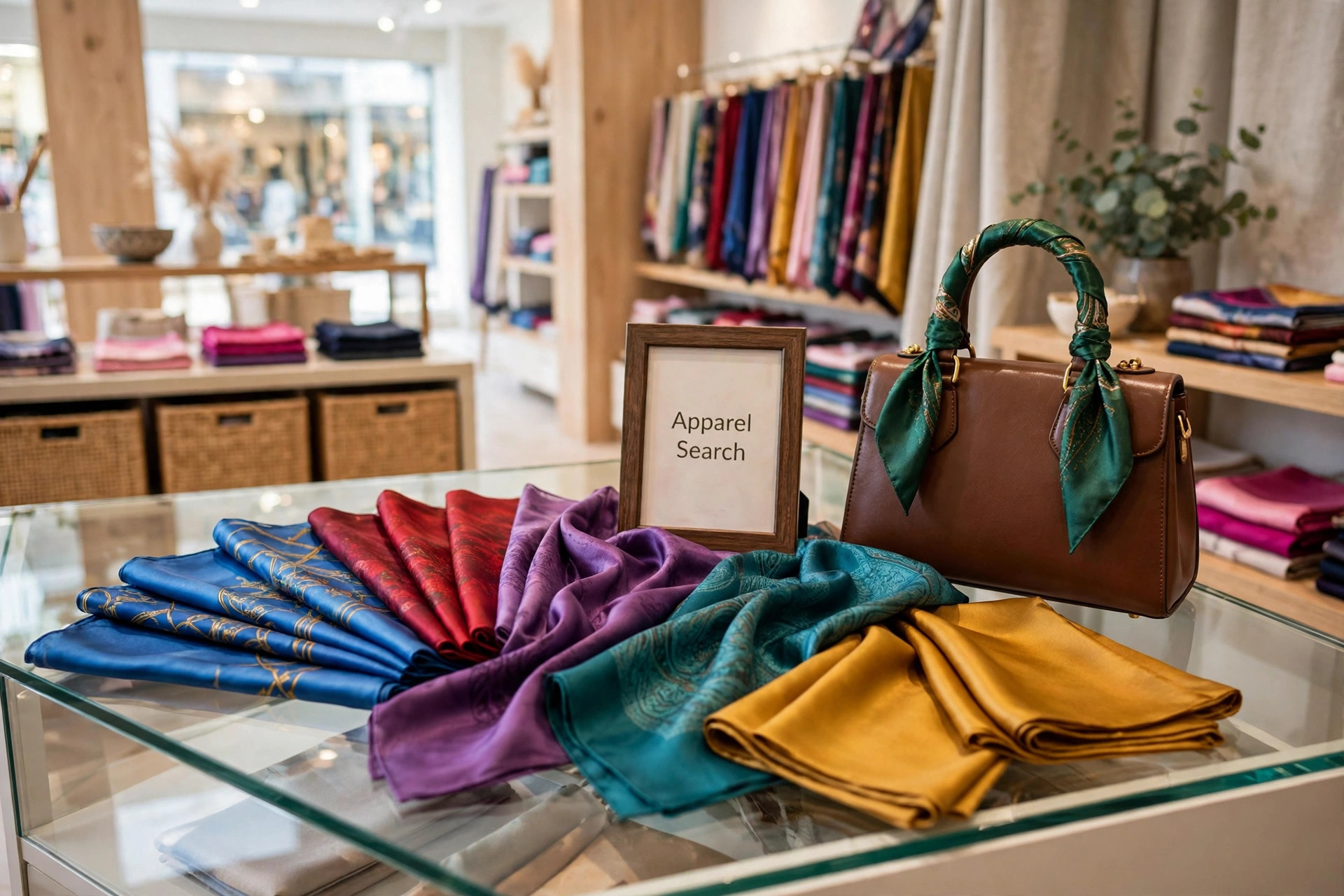
First, Match the Knot to the Scarf
Two properties decide what a scarf can do: its shape and its grip. Long rectangles are the versatile shape — they loop, wrap and drape. Squares are the specialists: folded on the diagonal they become headscarves, ascots and bag ties. Grip is about surface. Silk and satin are slippery — beautiful, but they need knots that lock the fabric against itself. Wool, cashmere, cotton and textured weaves grip as they go, so they hold bulky wraps and simple drapes that would slide apart in silk. Length matters last: a knot that wraps twice needs a genuinely long scarf, around 180 centimetres, while a square worn as an ascot works at 55 centimetres. Judge each style below against the scarf in your hand.
Around the Neck
The Simple Drape
Lay the scarf around your neck with the ends hanging evenly down the front, no knot at all. It suits open coats and jackets, adds a vertical line of color to a plain outfit, and takes two seconds. It needs grip to behave — wool and cashmere stay put; in silk, expect to re-settle it through the day. Best with long rectangles.
The European Loop
Fold the scarf in half lengthwise to make a loop, lay it around your neck, and pull the two loose ends through the loop, then settle the loop snugly. This is the warmest of the common knots — the doubled cloth seals the neckline against wind — and the most secure, because the ends are trapped. It is the reliable knot for silk as much as for wool, works with any coat, and is the default winter arrangement for scarves of medium length and up.
The Single Loop Wrap
Start with one end short at your chest and the long end in hand; wrap the long end once fully around your neck and let both ends hang at the front. Looser and softer than the European loop, it gives volume at the neck without a knot, and suits high collars, roll necks and cold days when you want the scarf to fill the V of a coat. Needs a long scarf and a fabric with some body.
The French Twist
Drape the scarf around your neck with the ends at the front, twist the two ends together once to form a short rope, then tie a simple knot below the twist and fluff the ends. The twist locks the knot, which is why this style flatters silk scarves that refuse every other arrangement. It sits neatly at the throat, keeps the ends short and tidy, and looks best with blouses, fine knits and tailored jackets rather than heavy coats.
The Ascot Knot
Fold a square scarf into a triangle, then roll or fold it into a band. Lay it around your neck with the ends at the front, cross them once, bring one end up through the loop at your throat, and flatten the resulting knot so it sits like a soft cravat. Worn low and loose it dresses up a plain sweater or an open collar; it is also the classic way to wear a small silk square, and the style needs the least length of any here.
On Your Head
The Classic Fold
Fold a square scarf into a triangle, place the long edge across your forehead with the point falling behind, and tie the two corners under your chin — or, for a cleaner line, cross them at the nape and tie at the back. It is the full-coverage arrangement: sun, wind, rain and bad-hair days all handled by the same fold.
The Wrap and Tuck
Center a long scarf at the nape of your neck, bring both ends up and cross them at the front hairline, then twist or cross again at the back and tuck the ends in. It gives a turban-like wrap with real staying power, covers the hair completely, and works with rectangles too stiff or long for the classic fold.
On a Bag — and as a Belt
A scarf tied on a bag is the fastest way to make a plain handbag look styled. Handle wrap: fold a long narrow scarf into a band, knot it at one end of the handle, wind it tightly along the handle's length and knot the other end — it protects pale leather handles and adds color at once. The bow: tie a square or short scarf in a soft bow at the strap ring for a simpler version. As a belt: thread a long scarf through trouser or jean belt loops and knot or bow it at the front, or fold a large square into a band and wear it as a sash over a plain dress or long shirt, tied at the side. Fabric with grip behaves best in belt duty; silk sashes should be tied over, not threaded, so they are not abraded by the loops.
A Note on Care
Knots are where scarves wear. Tie silk loosely rather than wrenching knots tight — pulled silk creases and can tear at fold lines — and untie knots before storing rather than leaving a scarf knotted in a drawer, which sets permanent creases. Rolling scarves for storage beats folding them for the same reason. Wool and cashmere forgive more, but every scarf lasts longer unknotted, untwisted and at rest.
Shop Scarves
Ready to shop? Product links are kept in one place on the Apparel Search shopping guide:
Shop Scarves on AmazonThis link opens the Apparel Search shopping guide for Amazon, where the product links are kept in one place.
Common Questions
Which scarf knot stays put in slippery silk?
Knots that lock the fabric against itself. The European loop is the most reliable: the folded loop traps the ends, so even polished silk has nowhere to slide. The French twist also holds well because the scarf is wound around its own tail before knotting. Avoid a simple loose drape or a single casual knot in silk — both will work themselves undone within the hour, especially against a smooth coat or jacket.
What size scarf do I need for a headscarf?
For the classic folded headscarf, a square of roughly 70 to 90 centimetres (about 28 to 35 inches) works for most heads: large enough to cover the hair and tie under the chin or at the nape, small enough not to swamp the face. Larger squares, 90 centimetres and up, fold down the same way and give longer tails and more coverage; very small squares under 60 centimetres are better kept for neck, wrist and bag duties.
How do I stop a scarf slipping off my shoulders?
Give the drape an anchor. A simple knot low at the front, a twist before draping, or a brooch pinned through both layers into the garment beneath will all hold a wrap in place. Fabric matters too: wool, cashmere and textured weaves grip each other and stay where silk slides, so a shoulder drape for a whole evening is a job for a matte, textured scarf, with the ends crossed at the front before they hang.
Can men wear these knots too?
Yes — most of them began as unisex or menswear styles. The drape, the European loop and the single wrap are the standard ways to wear a winter scarf with a coat regardless of who is wearing it, and the ascot knot has a long menswear history worn inside an open shirt collar. The only real difference is usually the scarf itself: plainer weaves, darker colors and less volume in the knot.