Semi-Precious Gemstones
The wide, colorful majority of gemstones
Semi-precious gemstones are every gemstone outside the traditional Big Four of diamond, ruby, sapphire and emerald, and the group holds most of the color in jewelry. Amethyst brings purple in shades from pale lilac to deep violet, citrine brings yellow to golden quartz, and garnet is best known in deep red but spans many colors. Aquamarine offers serene blue-green beryl, peridot a bright lime green, and topaz a range headed by its popular blue. Opal shows play of color, turquoise an opaque blue-green with a long history in Native American jewelry, moonstone a soft floating glow called adularescence, and jade, in its jadeite and nephrite forms, a prized green stone central to many Asian cultures. These stones are valued for beauty and character rather than for matching the Big Four's rarity and prices, which makes them accessible in larger sizes and bolder designs. The precious and semi-precious distinction is somewhat arbitrary and has shifted over time: it describes tradition, not quality, and a fine semi-precious stone can be a superb gem. This guide introduces the best-known members of the group, what each is prized for, and how to choose among them for rings, necklaces, earrings and bracelets.
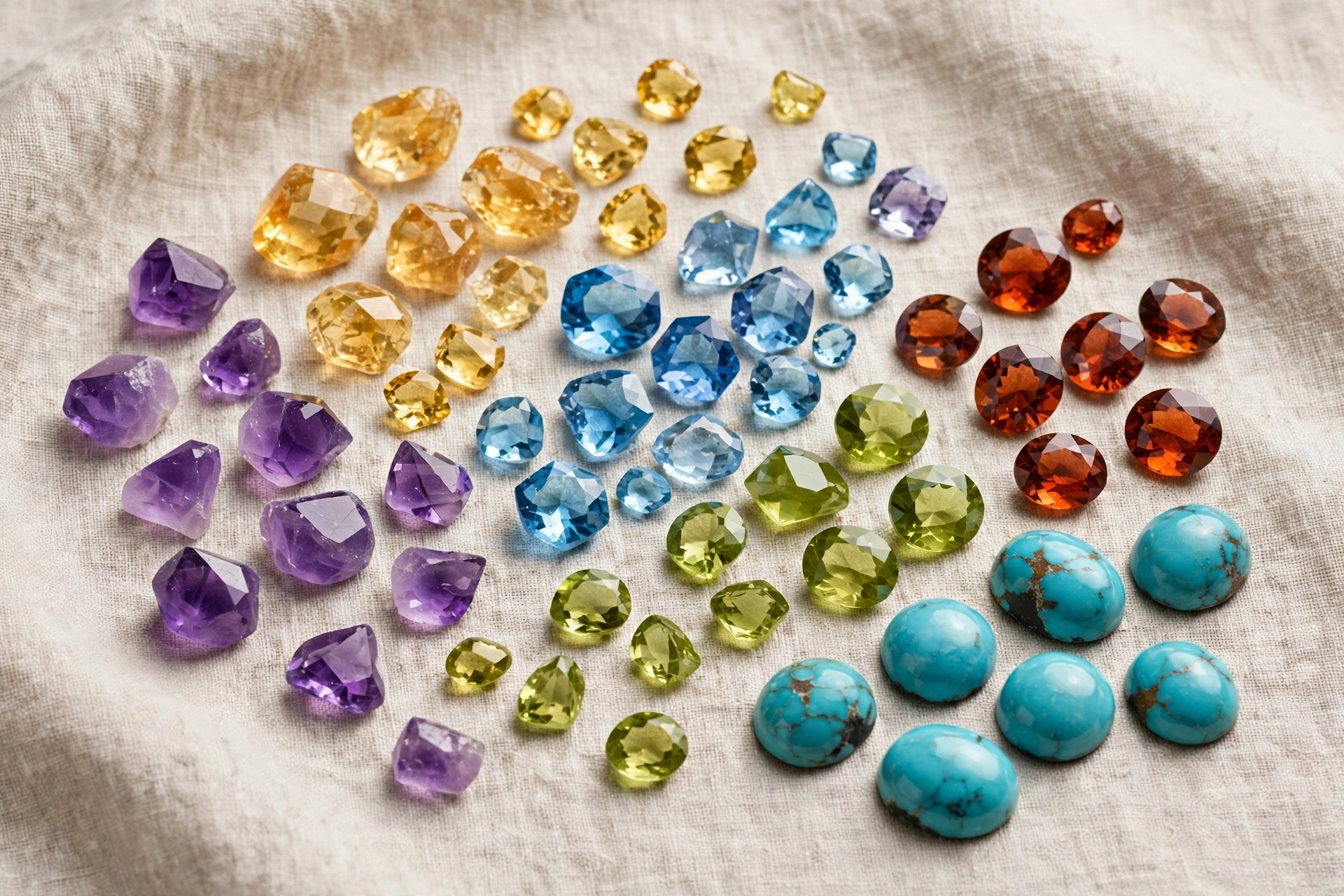
Semi-precious gemstones, often referred to simply as "semi-precious stones," are a category of gemstones that are valued for their beauty and rarity but are considered less valuable than precious gemstones like diamonds, rubies, sapphires, and emeralds. Semi-precious stones encompass a wide variety of minerals and gems, each with its own unique characteristics and appeal. Here are some common examples of semi-precious gemstones:
Amethyst: A purple variety of quartz, amethyst is known for its calming and spiritually significant properties. It is a popular choice for jewelry and comes in various shades of purple.
Citrine: Also a type of quartz, citrine ranges in color from pale yellow to deep golden hues. It is often associated with positivity and abundance.
Garnet: Garnets come in a range of colors, but the deep red variety is the most well-known. They are often associated with passion and love.
Aquamarine: Aquamarine is a blue or greenish-blue variety of beryl. It is prized for its serene, ocean-like color and is associated with tranquility and clarity.
Peridot: Peridot is a green gemstone, often with a bright, lime-green hue. It is believed to bring good luck and healing properties.
Topaz: Topaz comes in various colors, with the blue variety being one of the most sought-after. It symbolizes loyalty and fidelity.
Opal: Opals are known for their mesmerizing play of colors, or "fire." They are believed to enhance creativity and spontaneity.
Turquoise: Turquoise is an opaque, blue-green stone known for its cultural significance in Native American jewelry. It is associated with protection and wisdom.
Moonstone: Moonstones exhibit a glowing, adularescent effect that resembles the moon's soft light. They are often associated with intuition and emotional balance.
Jade: Jade comes in two forms, jadeite and nephrite. It is highly prized in many Asian cultures and is associated with wisdom, harmony, and protection.
Semi-precious gemstones are used in various forms of jewelry, from rings and necklaces to earrings and bracelets. While they may not have the same rarity or value as precious gemstones, they offer a wide range of colors, textures, and metaphysical properties that make them popular choices for both ornamental and spiritual purposes. The distinction between precious and semi-precious stones is somewhat arbitrary and has evolved over time, but both categories contribute to the world of gemology and jewelry design.
You should also learn about precious gemstones.
Getting to Know the Group
Several semi-precious stones are varieties of two workhorse minerals. Amethyst and citrine are both quartz, colored by trace impurities and, for much citrine, by heating amethyst, which is why the two are affordable in large, clean crystals. Aquamarine is beryl, the same family as emerald, in a blue-green that is usually far cleaner than its green cousin. Garnet is a family of related minerals rather than one stone, which is why its colors run from red through orange and green.
The organic and opaque members behave differently again: turquoise and jade are cut as cabochons and carved pieces rather than faceted gems, moonstone is valued for its optical glow rather than transparency, and opal's play of color comes from its internal silica structure. That variety is the group's strength. Between faceted, cabochon, carved and glowing stones, semi-precious gemstones cover every color, finish and price a jewelry design can call for.
Common Questions
Does semi-precious mean lower quality?
No. The term is a traditional category, not a grade. It says a stone is not one of the Big Four, nothing about the quality of the individual gem. A clean, vivid amethyst or a fine piece of jadeite can be an excellent gemstone and can cost more than a dull, included commercial-grade ruby or emerald. Judge any stone on its own color, clarity, cut and condition, and treat the precious and semi-precious labels as history rather than as a quality ranking.
Which semi-precious gemstones are hard enough for rings?
The quartz family, amethyst and citrine at Mohs 7, garnet at 6.5 to 7.5, topaz at 8 and aquamarine at 7.5 to 8 all serve well in rings, with topaz needing care against hard knocks because it can cleave. Peridot at 6.5 to 7 suits protected settings. Opal at 5.5 to 6.5, turquoise at 5 to 6 and moonstone at 6 to 6.5 are better in earrings, pendants and occasional-wear rings, and jade is unusually tough for its hardness because of its interlocking crystal structure.
Why are semi-precious stones used for larger, bolder jewelry?
Because fine material is more available and less expensive per carat than the Big Four, jewelers can cut semi-precious stones large and use them as the centerpiece of cocktail rings, pendants and statement earrings without an extreme price. That affordability is also why these stones carry so much fashion jewelry: a designer can build a piece around a 20 carat amethyst or a carved turquoise in a way that would be impossible with an equivalent ruby, and buyers get genuine gemstone material at an accessible price.