Every grand prix weekend now has two competitions: the race, and the walk into the paddock. The second one belongs to Lewis Hamilton. The seven-time world champion spent a decade turning his arrival at the circuit — fifty meters of tarmac between the car park and the motorhome — into the most-watched style moment in sport, and then built the fashion career to match it: collections with Tommy Hilfiger, a guest-designer capsule for Dior, a Met Gala co-chairmanship, and a label of his own.
Hamilton belongs in this series of signature-look profiles with a twist: where Jensen Huang, Mark Zuckerberg and Steve Jobs built identities out of wearing one thing, Hamilton built his out of never wearing the same thing twice. The uniform is that there is no uniform — except intent.
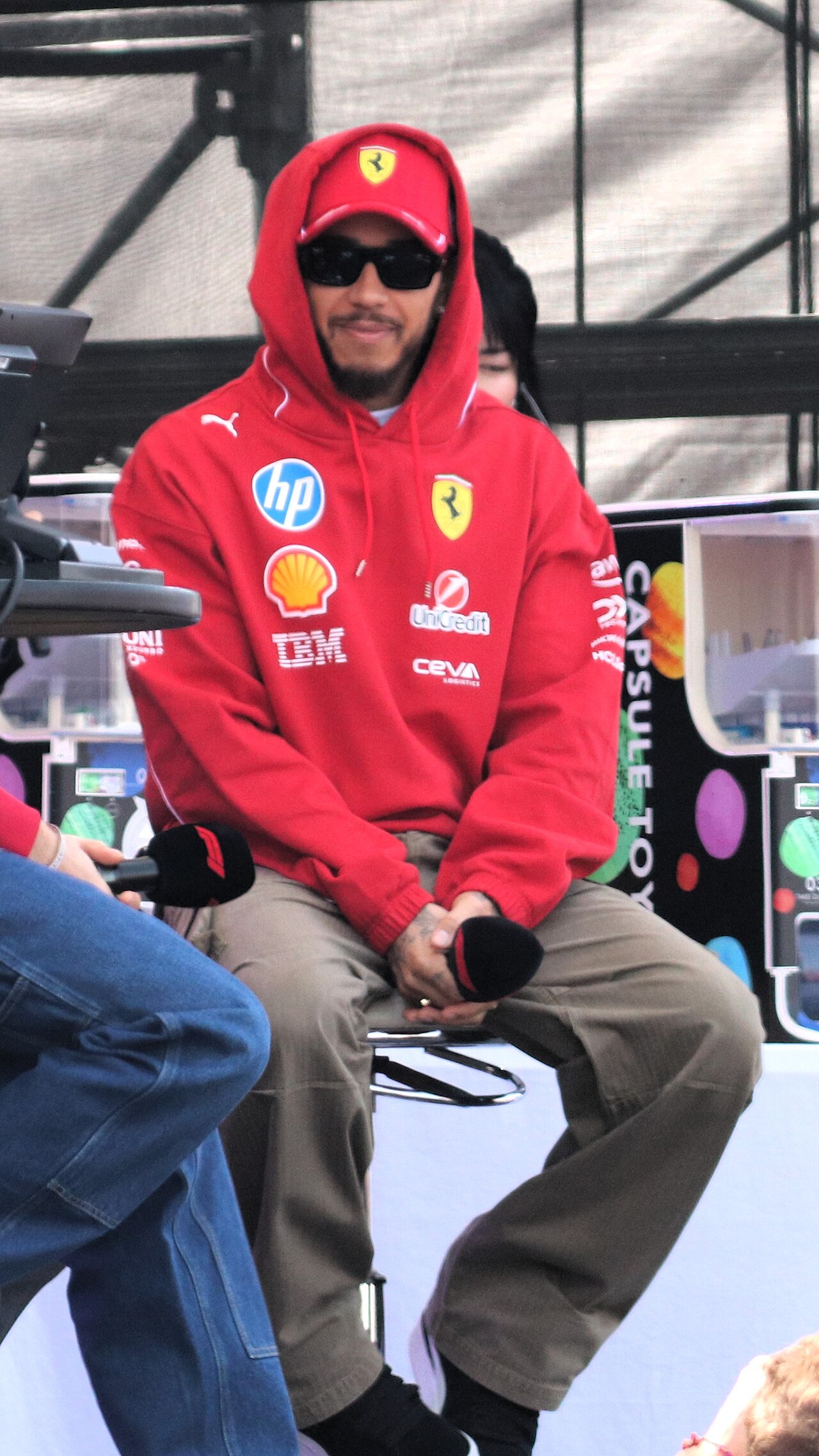
The Arrival as Runway
Hamilton's paddock style became a story in the mid-2010s, as his taste outgrew the team polo: tailored coats over knitwear, wide trousers, statement sunglasses, jewelry, braided hair under designer caps — looks assembled with the same deliberateness as a front-row appearance at fashion week, which in a sense they were. Photographers began shooting the arrivals; fashion media began filing them as coverage; other drivers, and then other sports entirely, followed. The tunnel walks of the NBA and the arrival fits of the WNBA — covered in our athlete tunnel fashion guide — run on a template Hamilton helped prove in the paddock: the walk to work is a media product, and a personal brand is built on it.
His own account of the clothes has always been about expression rather than endorsement: dressing as a way of arriving as himself in a sport that issues its participants identical team kit. In a garage where everyone wears the same red or silver, Hamilton's walk-in look was the one piece of individual identity the regulations could not standardize.
The Collaborations: From Wearing It to Designing It
The commercial fashion career began in earnest in 2018, when Hamilton — then a Mercedes driver — launched the first of a series of TommyXLewis collections co-designed with Tommy Hilfiger, applying his own wardrobe's codes (streetwear volume, bold graphics, his number and iconography) to a global high-street-luxury line. The collections ran for multiple seasons and established the athlete-as-co-designer model that the Cadillac F1 team's 2026 Hilfiger partnership — covered in our Formula 1 fashion feature — now applies at team scale.
In 2024 came the step into the highest tier: Hamilton was named an ambassador for Dior and guest-designed a capsule collection for the house — a racing driver not modeling luxury but authoring it. Between the two poles of Hilfiger and Dior sits the full range of modern fashion, and Hamilton has worked credibly at both ends of it.
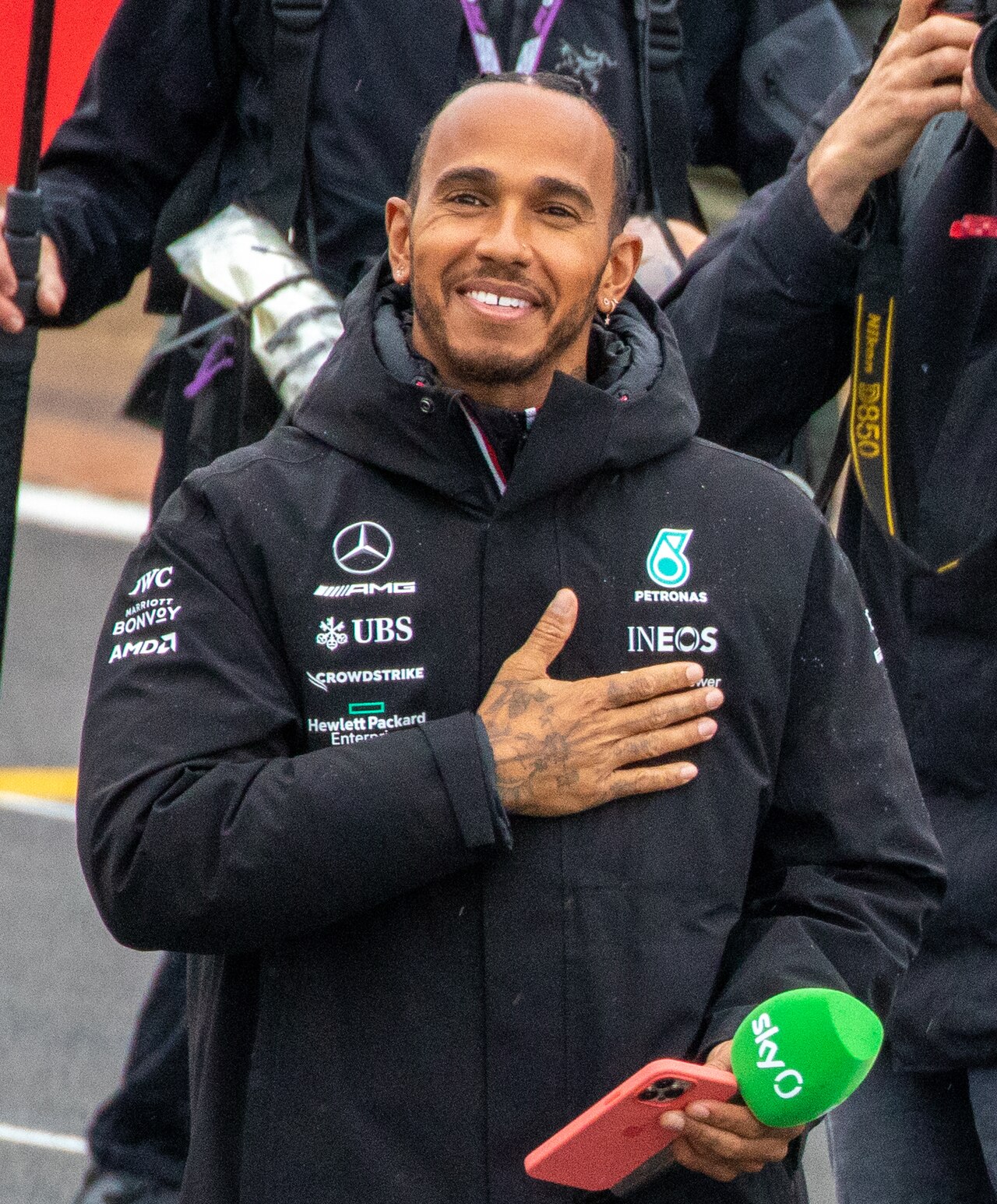
Plus 44: A House of His Own
In 2022 Hamilton launched Plus 44 (+44), his own label, named for the number he has raced under since childhood karting. The label works in streetwear's grammar — graphic pieces, drops, artist collaborations including work with Takashi Murakami — and it completes the arc his career traces for every athlete watching: wear the clothes, then co-design the clothes, then own the company that makes them. Where the signature-look subjects of our other profiles used clothing to remove decisions, Hamilton used it to multiply them, and then to build equity in the multiplication.
The Style Codes
Across a decade of arrivals, a Hamilton grammar emerged. Tailoring with volume: wide trousers, long coats, soft shoulders — the silhouette of a man who treats the paddock like a boulevard. Knitwear as a statement: textured, oversized or brightly patterned knits where another driver wears a team fleece. Jewelry, always: chains, rings and earrings worn in open defiance of the sport's periodic attempts to police them — in 2022, when the governing body moved to enforce its old ban on jewelry in the car, Hamilton arrived wearing three watches and as much jewelry as he could carry, and made the press conference a fashion protest. Color without fear: full monochrome looks, pastels, prints — the palette of a front-row regular, not a man hoping to blend into a garage.
The influence is measurable in the paddock's behavior: arrival photography is now standard, younger drivers dress for it deliberately, and teams that once issued identical polos for every appearance have learned to let their drivers arrive as themselves. Hamilton did not just win the tunnel before the tunnel had a name — he demonstrated, season after season, that a driver's image could be an asset class. Every athlete-stylist economy that followed, from the NBA tunnel to the WNBA's, runs on that demonstration.
The Met Gala Platform
Hamilton's most consequential fashion appearances have been acts of patronage. At the 2021 Met Gala he bought a table and filled it with emerging Black designers, reasoning publicly that fashion's biggest night should be spent on the people fashion overlooks. In 2025 he co-chaired the Gala itself, for the Costume Institute's “Superfine: Tailoring Black Style” exhibition — a show about Black dandyism, tailoring and self-fashioning that could have been curated from his own thesis. The through-line of his style life is there: clothes as identity, craft and argument, worn by a man who happens to drive racing cars faster than almost anyone who has lived.
He races on, in Ferrari red since 2025, still arriving like the weekend is a fashion week with a race attached. On the evidence of the paddock's transformation — the LVMH deal, the kit economy, the arrival photographers — he was simply early. Read the full landscape in our Formula 1 fashion feature.
Common Questions
What fashion brands has Lewis Hamilton worked with?
Hamilton's design résumé is the deepest of any active athlete. He co-designed a series of TommyXLewis collections with Tommy Hilfiger beginning in 2018. In 2024 he became an ambassador for Dior and guest-designed a capsule collection for the house. And he runs his own label, Plus 44 (+44) — named for his racing number — launched in 2022, which has produced collaborations with artists including Takashi Murakami. Alongside the design work, his paddock arrivals and red-carpet appearances are covered by fashion media as style events in themselves.
Was Lewis Hamilton a Met Gala co-chair?
Yes. Hamilton co-chaired the 2025 Met Gala, which accompanied the Costume Institute exhibition 'Superfine: Tailoring Black Style' — an exhibition about Black dandyism and tailoring that sat squarely inside his long advocacy for Black designers. Four years earlier, at the 2021 Met Gala, he had bought a table specifically to host emerging Black designers, using his seat at fashion's biggest night as a platform for designers the industry had overlooked.
Which team does Lewis Hamilton drive for?
Ferrari. Hamilton won six of his seven world championships with Mercedes (his first title came with McLaren in 2008) before making the most famous transfer in the sport's history to Ferrari for the 2025 season. The move paired the most successful driver of the era with the most storied team in racing — and, not incidentally, put the paddock's leading fashion figure in its most fashionable garage, where our Formula 1 fashion feature picks up the story.
What is Plus 44?
Plus 44 (styled +44) is Hamilton's own clothing label, launched in 2022 and named for the racing number he has carried since karting. It produces streetwear-inflected collections and artist collaborations, and it represents the third stage of his fashion career: after wearing fashion, and then co-designing it with established houses, Hamilton built a house of his own.
Related Reading
Search Apparel Search