Custom Embroidery
Embroidery services that put company logos and custom designs on apparel and accessories.
Custom embroidery turns a company logo into needle and thread: a stitched mark on a polo shirt, fleece jacket, cap or towel that survives washing, looks more substantial than a print, and reads as a uniform rather than a giveaway. Businesses order it for staff apparel, corporate gifts, team clothing and promotional products, because a well-digitized logo embroidered in quality thread holds its color and shape for the life of the garment.
This page explains how ordering custom embroidery works, from sending artwork to approving a stitched sample, and what separates a clean result from a puckered one. The service listings below cover company and corporate logo embroidery, embroidery digitizing, and custom clothing work that combines embroidery with printing.
Custom Embroidery Resources
How a Custom Embroidery Order Works
Every order starts with artwork. The customer sends a logo or design, and the embroidery service converts it into a stitch file — a process called digitizing — in which a technician maps out the stitch types, directions and densities the machine will follow. A logo drawn for paper does not automatically sew well: very small lettering, fine gradients and thin lines may need to be simplified or enlarged so the stitches can form them cleanly, and a good service explains those changes before production rather than after.
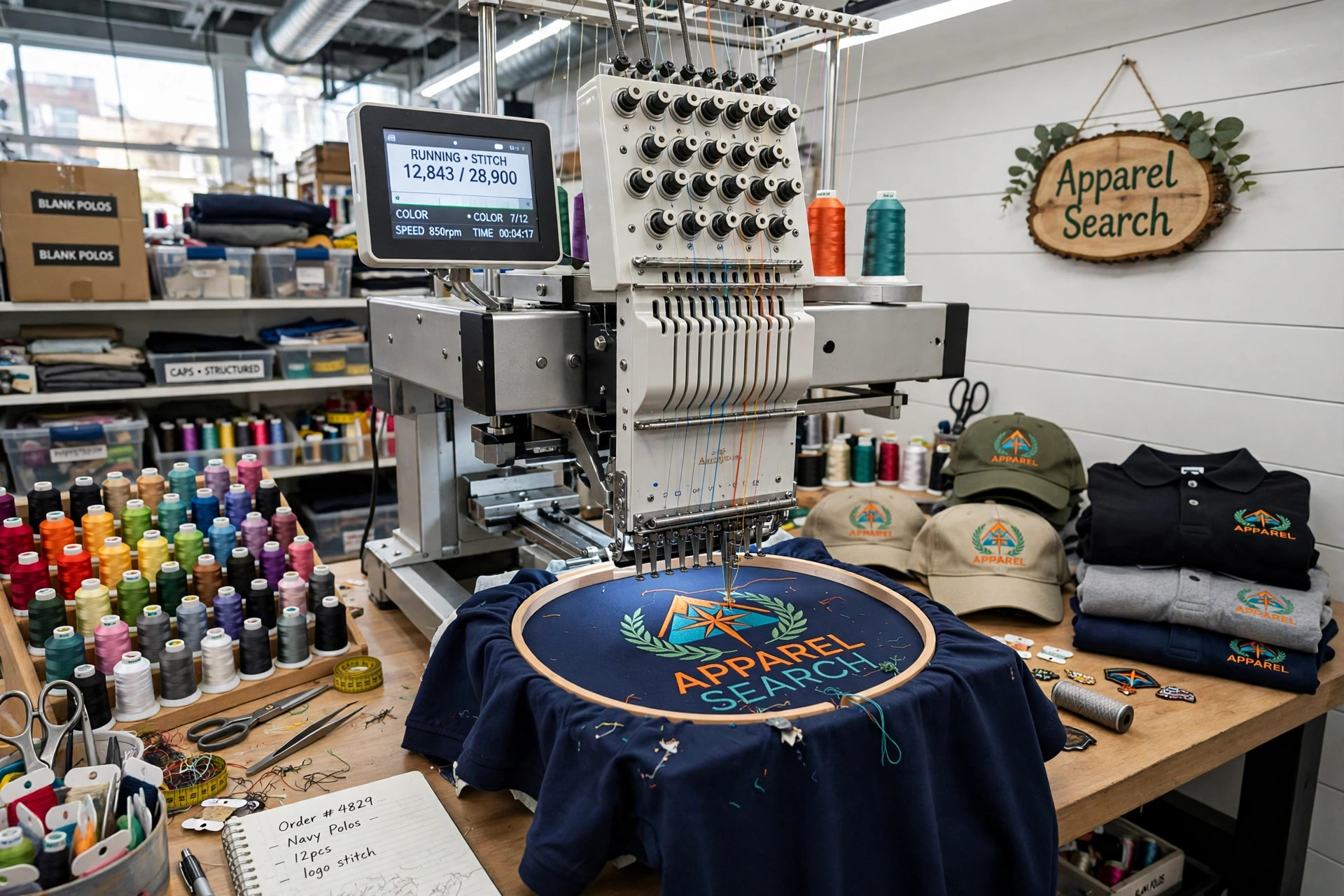
Next comes a sew-out: the digitized design stitched onto a sample of the actual garment fabric for approval. This is the moment to check size, placement and thread colors, because changes are cheap at sample stage and expensive across a finished run. Once approved, garments are hooped with backing, stitched head by head, trimmed, inspected and folded. Multi-head machines run the same design on several garments at once, which is why larger orders cost less per piece than one-off work.
Choosing Garments for Logo Embroidery
Embroidery suits structured, stable fabrics best. Polo shirts, twill work shirts, fleece, jackets, caps and hats are the classic corporate choices, and the services below also embroider bath robes, towels and blankets. Size ranges matter for uniform programs: one listing here fits men and women from XXS to 5XL, with custom sizing available in some products, so a whole staff can wear the same program. Very stretchy, very thin or heavily textured fabrics are harder — the stitches need a fabric that will not distort under thousands of needle penetrations, and the right stabilizer behind it.
Placement follows convention for a reason. A left-chest logo on a shirt, a front-panel design on a cap and a monogram on a towel cuff are sized and positioned so the embroidery sits flat and reads at a glance. Larger back designs on jackets carry more detail and more stitches, and are priced accordingly, since stitch count — not just garment count — drives the cost of a job.
Quality Checks and Thread
Quality shows in the details a buyer can check on the sample. Lettering should be legible at its intended size, edges should be smooth rather than jagged, and the fabric around the design should lie flat with no puckering. One service listed here describes a 14-touchpoint inspection process and the use of high quality embroidery thread, which matters because rayon and polyester embroidery threads differ in sheen, strength and colorfastness; polyester generally tolerates bleach and frequent laundering better, which suits workwear.
Ask how the service handles repeat orders before the first run ships. A shop that keeps your digitized file, thread colors and placement notes on record can restitch the same logo months later without a new setup, and can apply it consistently across shirts, caps and jackets as a program grows. That record-keeping, plus on-time delivery and in-house production, is what turns a single order into a standing uniform program.
Custom Embroidery Service Listings
Companies offering custom and corporate logo embroidery on clothing and accessories.
Embroidery Authority
Embroidery Authority is a family owned business specializing in company and corporate logo embroidery on a wide variety of clothing and accessories – including several styles of embroidered shirts, fleece, jackets, caps, hats, bath robes, towels, blankets and more.
Lands' End Business Outfitters
Their apparel is designed to fit men and women from XXS to 5XL. Beyond that, there's custom sizing in some products, should you need it. Their in-house team of embroidery experts has translated thousands of company logos to needle-and-thread works of art. A 14-touchpoint inspection process and the highest quality embroidery thread ensures excellence every time. Your logo can be received by their CAD team and converted to vector format. Their team will map out the embroidery stitches. Learn more about Lands' End here on Apparel Search.
Needleworks
Needleworks is a custom embroidery service serving customers for over 25 years. They have hundreds of embroidery designs. They can also use your custom design or logo with their embroidery digitizing.
Speedy Tees NY
Speedy Tees NY LLC is a quality custom clothing and digital printing company specializing in custom t-shirt printing, custom screen printing, custom embroidery designs, cad cut vinyl printing, direct to garment printing, wide/large format printing, web design & development services, located in Bronx, New York, NY. Speedy Tees NY LLC keeps all production in-house, which means customization at its best.
Speedy Tees NY LLC is committed to providing the best customer service, on-time deliveries, high quality pre-made designs for your team, group or event to use, and providing our clients with a vast selection of apparel. Speedy Tees NY's friendly team will help their clients with planning, promoting and perfecting their upcoming marketing campaigns, school fundraisers, Frosh week, and events. As promotional products experts, they stand behind their quality products and services.
T-shirt Printers, Digital Printing (Direct to Garment Printing), Custom Embroidery, New York Garment Printing Factory.
Address: 3601 Bronxwood Ave, Bronx, NY 10469, USA. E-mail: Info@speedyteesny.com
More Manufacturing Resources
Common Questions
What is digitizing, and why does a logo need it?
Digitizing converts artwork into a stitch file the embroidery machine can follow, mapping stitch types, directions and densities. A paper logo cannot be sewn directly; the digitizer adjusts small lettering, fine lines and gradients so they form cleanly in thread, which is why a stitched sample is approved before production.
Which garments are best for custom logo embroidery?
Stable, structured items: polo shirts, twill work shirts, fleece, jackets, caps and hats, plus robes, towels and blankets. Fabrics need enough body to hold thousands of stitches without puckering, and very stretchy or very thin fabrics are the hardest to embroider cleanly.
What drives the price of a custom embroidery order?
Stitch count, garment count and setup. A larger, denser design uses more stitches and more machine time, while multi-head production spreads setup across a run, so cost per piece falls as quantity rises. Approving size, placement and colors at the sew-out stage avoids costly rework.