Sustainability for the Apparel & Textile Industry
Balancing the needs of the clothing and textile industry with the needs of environmental conservation.
Sustainability is an important aspect of the apparel and textile industry — as it is for all industries that wish to continue living on the planet Earth. What is sustainability? In summary, it is the ability to be maintained at a certain rate or level. In regard to the environment, the idea is for clothing and textile businesses to do their best to NOT make matters worse. The concept refers generally to the capacity for the biosphere and human civilization to coexist: we need to balance the needs of industry and the needs of environmental conservation.
This guide gathers the role of the fashion and textile industry regarding sustainability into one place: what the word means in practice for a clothing business, where environmental impacts actually occur along the supply chain, how recycling and measurement fit in, and how a buyer or manufacturer can check a sustainability claim before relying on it. The Higg Index page linked at the top covers the industry's best-known measurement tool in depth.
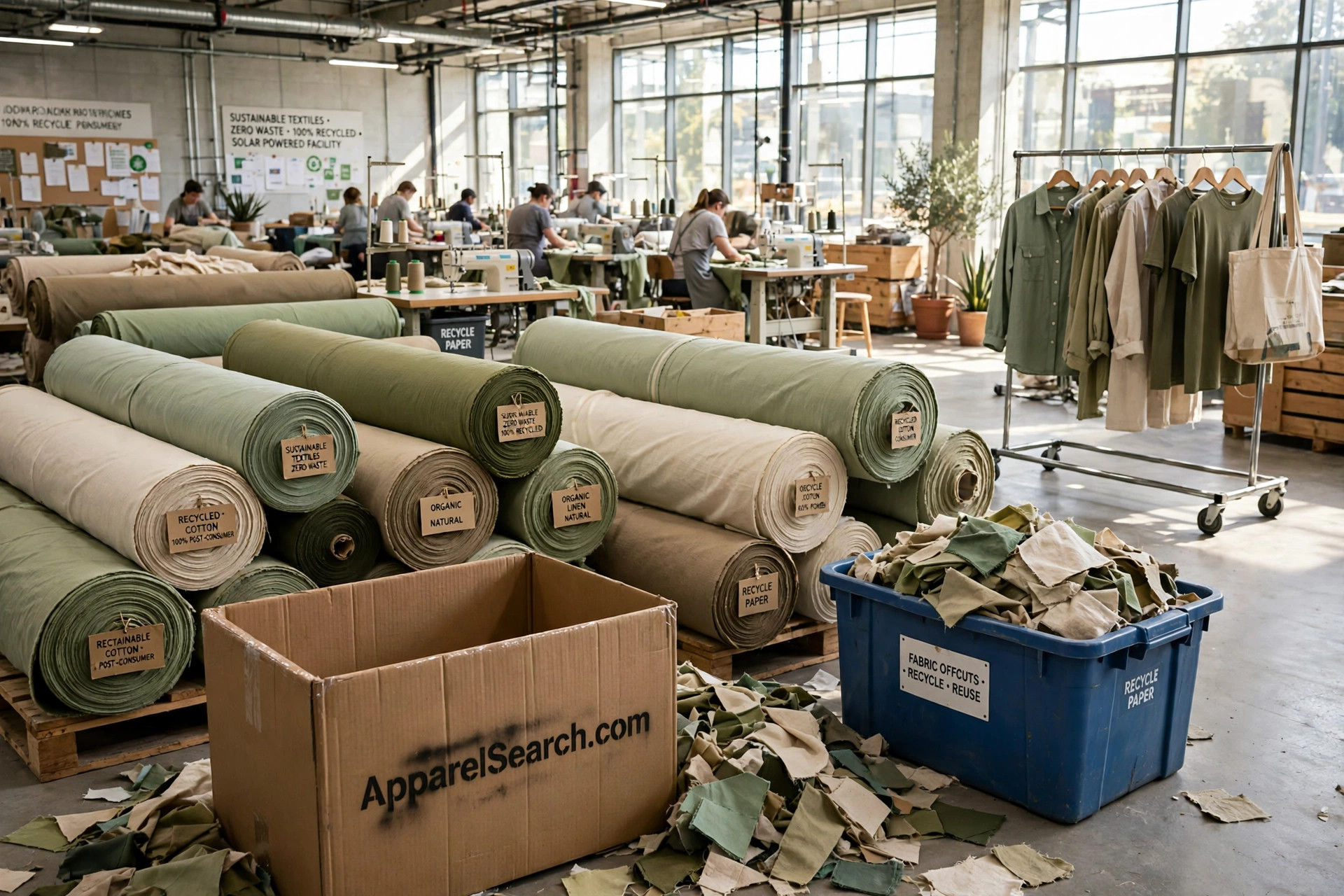
Sustainability Guides & Measures
What Sustainability Means in Practice
For a clothing or textile business, sustainability is not a single product feature; it is a way of running the whole operation so it can continue without steadily degrading the resources it depends on. That includes the raw materials in the garments, the water and energy used to make them, the chemicals used in dyeing and finishing, the conditions of the people who sew them, and what happens to the product when its owner is done with it. A business that improves one of those areas while quietly worsening another has moved the problem, not solved it, which is why serious sustainability work starts by mapping the full supply chain rather than by choosing a single photogenic initiative.
The practical test is maintenance over time. Can the fiber supply be renewed or recycled at the rate it is consumed? Can the factory's water use and wastewater quality be sustained by the local watershed? Can production volumes be maintained without depending on excessive working hours? Framing the questions that way turns sustainability from a slogan into a set of engineering, sourcing and management decisions — and it explains why the industry has invested in shared measurement tools and inspections instead of relying on each company's own definition of green.
Where the Impacts Sit in the Supply Chain
Impacts begin with fiber. Natural fibers draw on land, water and agricultural inputs; synthetic fibers draw on petrochemical feedstocks and shed microfibers; recycled and next-generation fibers try to reduce one or more of those burdens, each with its own trade-offs. Fabric production adds energy for spinning, weaving and knitting, and wet processing — dyeing, printing and finishing — is typically the most water- and chemical-intensive stage, which is why wastewater treatment and chemicals management carry so much weight in facility assessments. Garment factories add energy for cutting and sewing and generate fabric offcut waste; distribution adds transport and packaging; and the use phase adds laundering, while the end of a garment's life adds the disposal problem that recycling exists to address.
No single stage tells the whole story, and improvements are often about choosing the least damaging workable option at each stage: more efficient dye machinery and heat recovery in a mill, better cutting layouts that leave less offcut waste in a factory, packaging that protects the product with less material, and designs that last longer and can be repaired or recycled. The environmental sustainability and going green guides linked at the top of this page explore those choices in more detail.
Recycling and the End of a Garment’s Life
Recycling is where sustainability becomes visible at the end of the chain. Textile recycling covers several different routes: garments reused as clothing, worn textiles converted into wiping cloths and insulation, fabric offcuts returned to fiber, and, increasingly, fiber-to-fiber recycling that turns old clothing back into raw material for new clothing. The textile industry recycling guide linked above is the directory for that side of the trade, and the clothing recycling fact sheet in the resources below explains how sewing skills can be used to recycle and remake clothing instead of discarding it.
Design and sourcing decisions made years earlier decide how recyclable a garment can be. Single-fiber garments are easier to recycle than complex blends; trims, coatings and laminates complicate every route; and durable construction keeps a garment in use longer, which is usually the largest saving of all. Manufacturers who want their products recycled at end of life have to design for it at the beginning — a point where sustainability stops being a waste-management topic and becomes a product-development one.
Measuring Progress: Standards, Tools and Inspections
Claims need measurement behind them. The apparel industry's shared measurement suite is the Higg Index, developed by the Sustainable Apparel Coalition: a self-assessment standard that lets brands, retailers and facilities measure and score environmental and social performance throughout the supply chain, including the Higg Facility Environmental Module (Higg FEM) completed by factories and mills. Alongside measurement tools, factory inspections verify conditions on the ground — environmental practices, safety and labor conditions — in the facilities where clothing is actually made. The two approaches complement each other: tools organize self-reported data into comparable scores, and inspections test whether practice in the building matches what the paperwork says.
For an individual company, the working pattern is measure, improve, and measure again. A facility completes its assessment, uses the section scores to find its weakest areas — energy, water, wastewater, waste, chemicals or labor practices — invests where the assessment points, and demonstrates the improvement at the next assessment. Buyers increasingly ask suppliers for exactly that cycle, which is why sustainability has become part of ordinary manufacturer selection rather than a separate marketing exercise.
Checking Sustainability Claims
Sustainability language is easy to write and harder to substantiate, so claims deserve the same checking as any other specification. A claim should name what was measured, by what method, and over what scope: a recycled-content claim should state the percentage and the certifying scheme, an energy claim should state the baseline year, and a facility claim should identify the facility and the assessment or inspection behind it. Vague words — eco-friendly, green, conscious — with no standard, score or inspection behind them are marketing, not evidence.
Standards, certifications and assessment tools in this field are administered by their own governing organizations, and their rules and versions change. Before relying on a certification mark, a Higg score or any other sustainability credential in a sourcing or purchasing decision, check the current requirements and the validity of the specific claim with the organization that administers it.
More Sustainability & Industry Resources
Common Questions
What is sustainability in the apparel industry?
The ability of clothing and textile businesses to operate at a level that can be maintained without making environmental matters worse — balancing the needs of industry with the needs of environmental conservation, so the biosphere and human civilization can coexist. In practice it covers fibers, water, energy, chemicals, working conditions and end-of-life disposal.
How can a clothing manufacturer become more sustainable?
Start by measuring: map the supply chain, assess the facility with a shared tool such as the Higg Facility Environmental Module, then invest where the scores are weakest — energy and water efficiency, wastewater treatment, chemicals management, offcut waste reduction and recyclable packaging — and re-measure to prove the improvement.
How can a buyer check a sustainability claim?
Ask what was measured, by what method and over what scope. A substantiated claim names its standard, assessment or inspection and its baseline; a vague claim does not. Certifications and scores should be verified as current with the organization that administers them before they are relied on.