01 — The Idea
What Counts as a Matching Family Outfit?
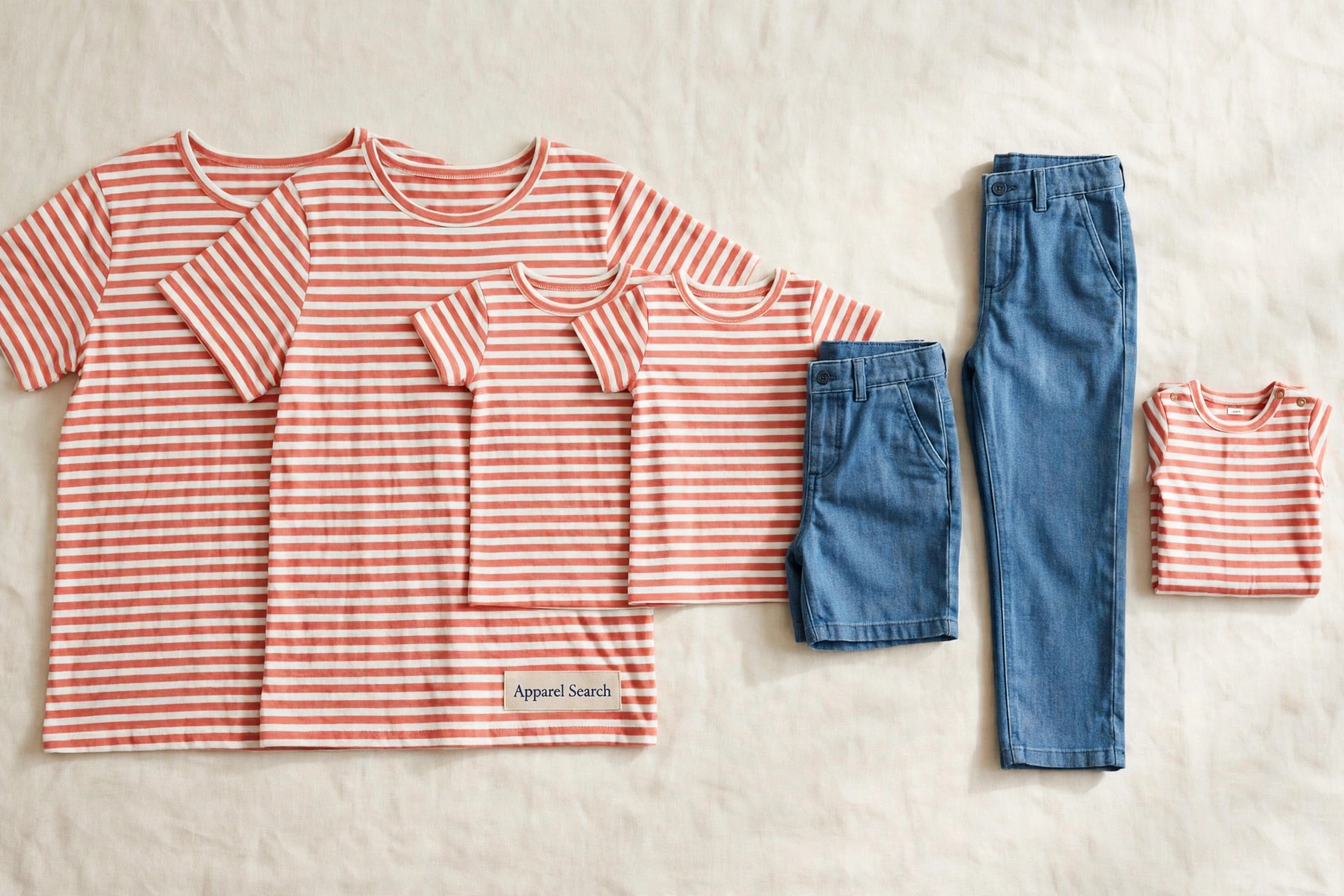
A matching family outfit is a set of garments made in the same fabric, print or colour story, cut separately for each wearer: adult tops and bottoms, children's sizes, toddler sizes and a baby romper or sleeper that coordinates rather than copies. The strongest sets share one clear element — a stripe, a plaid, a chambray, a single coral or sky-blue colour — and let the garment types differ, so a dress, a button shirt and a romper still read as one family in a photograph.
Three set types cover nearly every occasion. Pajama sets are the year-round staple, covered in depth in our matching family pajamas guide. Photo outfits are coordinated day clothes chosen for portraits and holidays. Holiday sets are seasonal prints and colours bought for one celebration and reworn as ordinary clothes afterwards.
Search Apparel Search
02 — Set Types
Pajamas, Photo Outfits and Holiday Sets
Each set type asks something different of the fabric. Pajamas need softness and washability above all: cotton jersey, flannel in winter and bamboo blends in warm houses. Photo outfits need fabrics that hold their shape for an hour and photograph without shine — matte cotton, chambray, linen blends and light knits. Holiday sets add a print or colour with a short season, so price per wear matters more than durability.
- Identical print, different cuts — the classic: one fabric, each person in the garment that suits them.
- Coordinating colours — two or three shared colours distributed across different garments; the most forgiving option for large groups.
- One shared piece — everyone in the same scarf, hat or striped top over their own clothes; the lowest-cost way in.
03 — Sizing
One Set, Four Size Charts
A family set spans at least three size charts, and they do not agree with each other. Order by measurements rather than usual sizes, fit the hardest-to-fit wearer first, and size up for children between sizes — a slightly generous set photographs as relaxed, while a tight one reads as a mistake. Baby pieces in a set are usually a romper or sleeper in the same print, sized by weight and length rather than age. Order the whole set in one go: popular prints sell out in baby, plus and tall sizes first, and a missing size cannot be matched later.
04 — Step by Step
Planning a Family Photo Outfit Set
Pick the anchor
Choose the one shared element first: a print, a stripe or a two-colour palette. Everything else is chosen to serve it.
Assign the garments
Give each person the garment type that suits them in that fabric or palette: dress, shirt, romper, tee or pajama set.
Check the sizes
Measure everyone against each range's own chart, size up for growing children, and order all sizes together.
Lay it flat
Arrange the full set flat before the day. Gaps in colour, a clashing extra print and a missing size are all visible at once.
05 — Care & Wear
Keeping the Set Matched, Wash After Wash
Matching sets age as a group or not at all: wash every piece the same way — together, inside out, in cool water — so colours fade at the same rate and the set still matches next season. Store the set folded in one place rather than scattered through separate drawers. For milestone occasions that sit next to matching, see the flower girl dress guide and the christening outfits guide, and browse the full children's clothing guide for the ranges each set is drawn from.
Questions
Common Questions
How do matching family outfits handle so many different sizes?
Each garment in the set is cut from its own range's pattern: adult, children's, toddler and baby sizes each follow their own size chart. Order by measurements for each person, fit the hardest-to-fit wearer first, and buy the complete set at once, because prints and colours cannot be matched again once a size sells out.
What is the difference between matching and coordinating outfits?
Matching sets use the identical fabric or print on every garment. Coordinating outfits share a colour palette or one element, such as a stripe or a sash, while the garments themselves differ. Coordinating is easier across wide age ranges and photographs just as clearly as a group.
How should matching sets be washed so they stay matching?
Wash all the pieces together, inside out, in cool water, and dry them the same way every time. Pieces washed separately fade and soften at different rates, and after a few months the set no longer matches. Storing the set folded together keeps it complete.