Military Uniforms · British Ceremony
British Ceremonial Uniforms
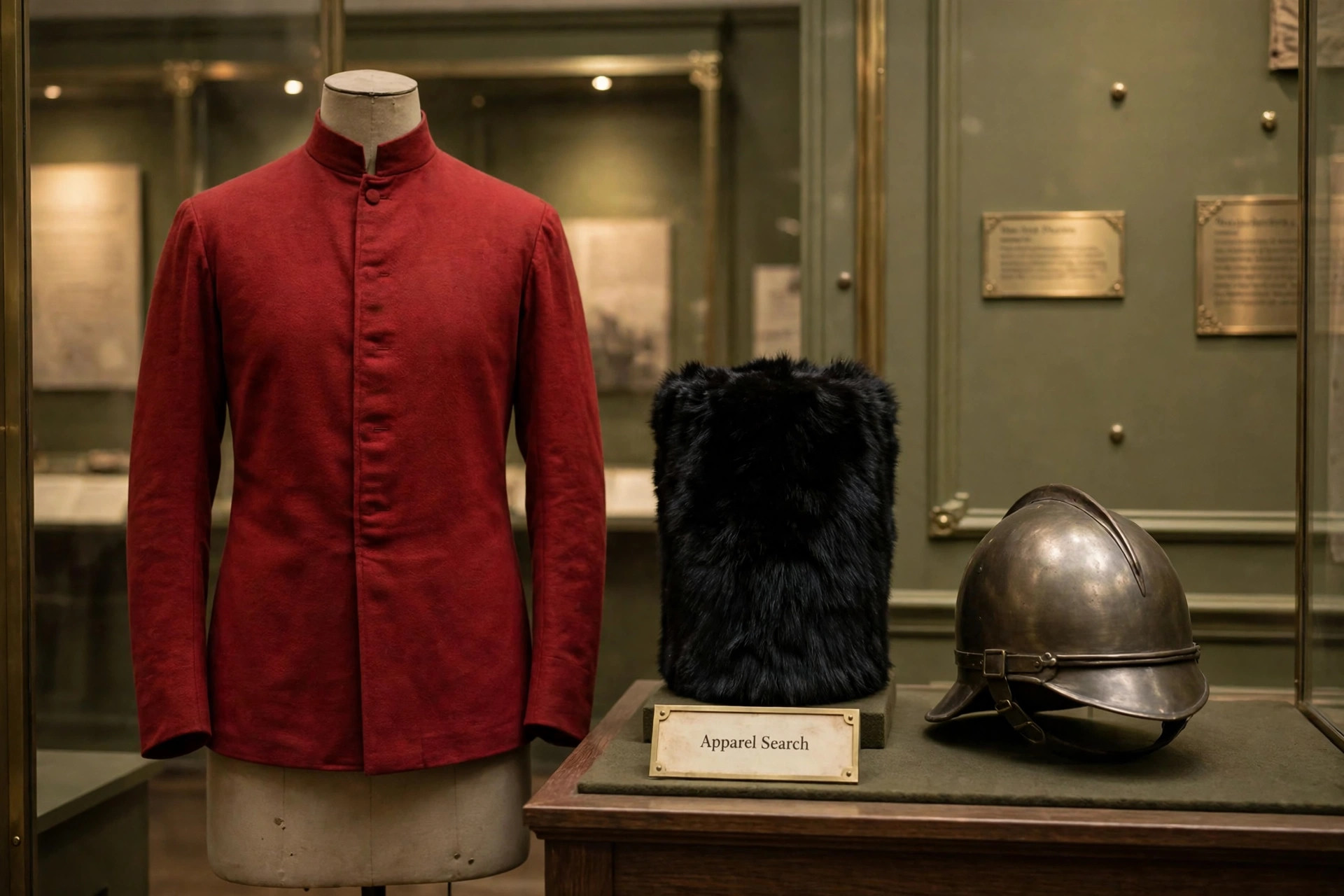
Scarlet tunics, tall bearskins, steel cuirasses and cloth of gold: British ceremonial dress is the most watched uniform system in the world, and one of the most precisely coded. Five Foot Guards regiments that look identical at a distance are told apart by the spacing of their buttons — singly, in pairs, in threes, in fours, in fives — by the colour and side of a plume, and by a badge. This guide explains that code, traces scarlet from the New Model Army of 1645 to the palace forecourt, gives the documented story of the bearskin cap and reports its material debate neutrally, and follows the Household Cavalry, the Yeoman Warders and the Gentlemen at Arms through the ceremonies where the public sees them.
At a Glance — Telling the Guards Apart
- Buttons
- Grenadier singly, Coldstream in pairs, Scots in threes, Irish in fours, Welsh in fives
- Plumes
- Grenadier white, left; Coldstream red, right; Scots none; Irish blue, right; Welsh white-green-white, left
- Bearskin
- About 18 inches tall, about 1.5 pounds, built around a wicker frame; Canadian black bear fur
- Household Cavalry
- Life Guards scarlet with white plumes; Blues and Royals dark blue with scarlet plumes
The Foot Guards
Five Regiments in Scarlet
The Household Division's infantry is the five regiments of Foot Guards — Grenadier Guards, formed in 1656; Coldstream Guards, 1650; Scots Guards, with origins in 1642; Irish Guards, raised in 1900; and Welsh Guards, 1915 — famous for ceremonial duties at Buckingham Palace, their tall bearskin caps and scarlet tunics, and also operational infantry regiments. The soldiers in scarlet are not actors in costume: ceremonial excellence combined with genuine combat capability is the Household Division's defining characteristic.
The red coat's official adoption dates from February 1645, when Parliament passed the New Model Army ordinance; infantry wore Venetian red with white, blue or yellow facings, and a contemporary comment stated that the men are Redcoats all, distinguished only by the several facings of their coats. Red predates that in royal service: the Yeomen of the Guard and Yeomen Warders, both formed in 1485, wore the Tudor colours, red and gold. Why red stuck was circumstance — cheap red dyes that were fast and less inclined to fade; grey and blue coats were also worn at first. From the mid-17th century most soldiers wore madder red; from 1873 the more vivid scarlet was adopted for all ranks.
Facings carried the regiment: red coats were lined with contrasting colours turned out as lapels, cuffs and collars — blue, green, yellow or buff by regiment; after the Childers Reforms of 1881 English and Welsh regiments had white facings, Scottish yellow, Irish green and Royal regiments dark blue, though some later regained historic colours. Scarlet left the battlefield at Gennis in the Sudan on 30 December 1885; even after khaki service dress was adopted in 1902, most infantry regiments kept scarlet on parade and for walking out until 1914. Scarlet then ceased to be general issue; the Brigade of Guards resumed it in 1920, but for the rest of the Army red coats were authorised only for bands and officers on limited occasions — primarily because scarlet cloth requires expensive cochineal dye.
Reading the Uniform
Buttons, Plumes and Badges
Across a parade square, the five regiments look identical — deliberately so, and yet each is precisely coded. The classic identification method is button spacing on the tunic: Grenadier Guards evenly spaced, singly; Coldstream Guards in pairs; Scots Guards in threes; Irish Guards in fours; Welsh Guards in fives. Officers' buttons are gilt; other ranks' were historically brass, now anodised aluminium. Count the grouping and you have the regiment before you can see a face.
Plumes and badges complete the code. The Grenadier Guards wear a white plume on the left of the bearskin, the Coldstream a red plume on the right, the Scots no plume, the Irish a blue plume on the right, and the Welsh a white-green-white plume on the left. The cap badges are the Grenadiers' flaming grenade, the Coldstream's Garter star, the Scots' Thistle star, the Irish Guards' St Patrick star with shamrock, and the Welsh Guards' leek. Precedence anecdotes are regimental tradition: the Coldstream motto Nulli Secundus — Second to None — preserves that regiment's side of a seniority dispute with the Grenadiers.
British full dress presents the most differentiation between units of any order of dress — the Army Dress Regulations call it the key to all other orders — and that grammar of buttons, feathers and badges lets an informed spectator read exactly who is on parade.
The Bearskin
The Bearskin Cap: Grant, Construction and Debate
The tall bearskin cap is made from the fur of the Canadian black bear, stands approximately 18 inches tall and weighs about 1.5 pounds; it was originally worn only by grenadier companies as a mark of elite status. After Waterloo in 1815 the First Foot Guards were restyled the Grenadier Guards and granted the bearskin cap for the whole regiment, in commemoration of their defeat of Napoleon's Imperial Guard grenadiers, who wore tall fur caps of the same type. The regiment's own history records the order of 29 July 1815: the Prince Regent approved that the regiment be made a Regiment of Grenadiers in commemoration of their having defeated the Grenadiers of the French Imperial Guards at Waterloo, and that each man was to wear the bearskin cap. To create uniformity in the Brigade of Guards, in 1832 King William IV granted the Coldstream and Scots Guards the bearskin cap. The popular version in which soldiers collected bearskins from the fallen as trophies is a tour-guide retelling, not what the regimental record says.
Today bearskins are worn by all five Guards regiments, the Royal Scots Dragoon Guards and the Honourable Artillery Company, and by officers of the Royal Regiment of Fusiliers. The caps are built around a wicker frame; the Welsh Guards say they are brushed, steamed and even shampooed, and with proper care a cap can remain in service for decades — some in use are more than 40 years old. The UK government said in April 2026 that each cap costs about £2,460 to procure; an older figure is £650.
The material is publicly debated, and this guide reports both sides neutrally, from their own records. The caps are made from the fur of Canadian black bears, from pelts the Ministry of Defence states are by-products of a licensed Canadian cull and are never hunted to order for the MoD. Campaigners, including PETA UK, call for the caps to be replaced with faux fur; the MoD says it supports replacement in principle but that an alternative must first pass five tests — water absorption, water penetration, appearance, drying rate and compression — and be approved by serving guards. In the Westminster Hall debate of 11 July 2022, campaigners put forward a faux-fur fabric developed by ECOPEL, while the Government position recorded was that no non-animal alternative then met the essential criteria. Readers should not take from this page either that bears are hunted for the caps — the MoD denies that — or that a replacement is ready, which is not established.
The Ceremony
Trooping the Colour
Regimental flags were historically described as Colours because they displayed the uniform colours and insignia of different units. Their principal role was a rallying point on the battlefield — without modern communications troops easily became separated from their unit — so the Colours were displayed regularly, by young officers marching between the ranks with them held high. This is the origin of trooping: a vital, practical parade to aid unit recognition before battle.
The Guards have served as the Sovereign's personal bodyguards since 1660, and Trooping the Colour is believed to have been performed first under Charles II. In 1748 the parade was assigned to mark the Sovereign's official birthday, and it became annual after George III became King in 1760; today it is held on Horse Guards Parade in early June, with approximately 1,400 officers and soldiers, 200 horses and 400 musicians, and one Foot Guards regiment's Colour trooped each year.
The Household Cavalry
Life Guards and Blues and Royals
The Household Cavalry consists of the Life Guards and the Blues and Royals. The Life Guards, the senior regiment, were formed in 1660 as a personal guard to Charles II. They wear scarlet tunics, white helmet plumes and white saddlecloths. The Blues and Royals — formed in 1969 by amalgamating the Royal Horse Guards and the Royal Dragoons — wear dark blue tunics, scarlet plumes and black saddlecloths: two colour schemes, readable at a glance.
Both regiments wear stainless steel cuirasses, adopted in the 1820s after the effectiveness of French heavy cavalry in the Napoleonic Wars, worn from April until October. The white crossbelt, with a black cartouche box at the back, originally held gunpowder and musket balls. Soldiers wear thigh-high jackboots and elbow-length gauntlets of tough leather originally designed so swords would glance off; the helmet chin strap is worn across the chin by the Life Guards and under the chin by the Blues and Royals.
The helmets — and, for officers, collars and sleeves — are engraved with oak and laurel leaves; in the Household Cavalry Museum's account, the oak commemorates Charles II's escape after Worcester in 1651, when he hid in an oak tree. Farriers wear black tunics and black helmet plumes and carry a ceremonial poleaxe in place of a sword. The Band's musicians wear State Dress of cloth of gold, crimson velvet and lace, only in the presence of senior royalty — the Museum describes it as the oldest continually worn uniform in the British Army, dating from the Restoration and largely unchanged since the 17th century apart from a new royal cipher for each monarch.
Other Wearers
Yeoman Warders and the Gentlemen at Arms
The Yeoman Warders — the Beefeaters — have guarded the Tower of London since the Tudor period; today's Warders are drawn from the Armed Forces, needing at least 22 years' service, a specified rank and the Long Service and Good Conduct medal. They show the dress system in miniature, in two uniforms: red State Dress for state occasions, and the durable dark blue undress uniform, introduced in the 19th century, for daily wear. Blue Undress carries a large royal crown below the reigning monarch's cypher — changed to CIIIR for Charles III from 24 April 2023 — in a tradition Historic Royal Palaces dates to Elizabeth I in 1570; each new uniform takes a minimum of 30 hours to complete.
The Honourable Corps of Gentlemen at Arms, instituted by Henry VIII in 1509, consists of five Officers and 27 Gentlemen, and provides a bodyguard to the Sovereign at state arrivals, the Garter service at Windsor, the State Opening of Parliament and the Diplomatic Corps reception. Its uniform is that of a Heavy Dragoon Guards officer of the 1840s — a skirted red coat with Garter blue velvet cuffs and facings embroidered with the Portcullis; helmets with white swan feather plumes are worn on duty, even in church, and long ceremonial battle-axes, over 300 years old, are carried by all the Gentlemen.
Where to See It
Changing the Guard and the Ceremonial Calendar
Changing the Guard, also known as Guard Mounting, is seen by millions each year at Buckingham Palace and Windsor Castle, carried out by soldiers on active duty from the Foot Guards, who have guarded the Sovereign and the Royal Palaces since 1660; it marks the moment when the Old Guard exchanges places with the New Guard, accompanied by a full military band. At Buckingham Palace the Old Guard forms up at 10:30 at St James's Palace; the New Guard enters the forecourt at approximately 11:00, and after both Guards present arms the Captain of the Old Guard hands over the key to the Palace — a symbolic transfer of responsibility for its security. Guard duties are normally provided by the Household Division, but Commonwealth regiments, the Royal Air Force and the Royal Navy also regularly perform the ceremony. The wider calendar includes the State Opening of Parliament, state funerals, Remembrance Sunday and the Garter Ceremony.
A Myth, Corrected
Was Red Chosen to Hide Blood?
Red was adopted for practical reasons — cheap, colour-fast madder dye — and became England's military colour with the New Model Army in 1645. The popular claim that red was chosen to hide blood is a myth: blood shows on red cloth as a dark stain. A 16th-century historian, Julius Ferretus, made the blood claim, but Clifford Elliott Walton described it as questionable for exactly that reason, and the standard account of the red coat calls it a myth with no basis.
Common Questions
Questions & Answers
How can you tell the five Foot Guards regiments apart?
By button spacing, plumes and badges. On the tunic, Grenadier Guards buttons are evenly spaced singly, Coldstream Guards in pairs, Scots Guards in threes, Irish Guards in fours and Welsh Guards in fives. The Grenadier Guards wear a white plume on the left of the bearskin, the Coldstream a red plume on the right, the Scots no plume, the Irish a blue plume on the right, and the Welsh a white-green-white plume on the left.
Why did British soldiers wear red coats?
Red was adopted for practical reasons — cheap, colour-fast madder dye — and became England's military colour with the New Model Army in 1645. The popular claim that red was chosen to hide blood is a myth: blood shows on red cloth as a dark stain. From 1873 onwards the more vivid shade of scarlet was adopted for all ranks, having previously been worn only by officers, sergeants and all ranks of some cavalry regiments.
What is Trooping the Colour?
It is the ceremony, held on Horse Guards Parade in early June, that marks the Sovereign's official birthday. Regimental flags were called Colours because they displayed a unit's uniform colours and insignia, and their principal role was a rallying point on the battlefield, so they were trooped — carried by young officers marching between the ranks with the Colours held high — to aid unit recognition before battle. The parade involves approximately 1,400 officers and soldiers, 200 horses and 400 musicians.
Are the Guards' bearskin caps made from real bear fur?
The caps are made from the fur of Canadian black bears, from pelts the Ministry of Defence states are by-products of a licensed Canadian cull and are never hunted to order for the MoD. Campaigners, including PETA UK, call for the caps to be replaced with faux fur; the MoD says it supports replacement in principle but that an alternative must first pass five tests — water absorption, water penetration, appearance, drying rate and compression — and be approved by serving guards.
More in Military Uniforms
British ceremony in context — the section hub and the closest sibling guides.
Search Apparel Search