Olympic Fashion · The Section Hub
Olympic Fashion: Ceremony Dress, Games by Games
The opening ceremony's Parade of Nations is the largest runway in fashion: more than two hundred delegations, each dressed to be recognised as its country in a two-second television shot. This hub gathers Apparel Search's Olympic fashion guides — Games by Games, designer by designer, from the first athletes' parade in 1908 to Los Angeles 2028 — together with the site's existing Milano Cortina 2026 features, a designer index and a timeline of how ceremony dress became a discipline of design in its own right.
At a Glance
- The subject
- Ceremony dress: opening and closing parade outfits, podium and village wear — distinct from competition kit
- The guides
- Nine guides: Paris 2024, London 2012, Tokyo 2020, Rio 2016, the Winter Games, Ralph Lauren and Team USA, History, Craft, and LA 2028
- Featured
- Milano Cortina 2026 — the site's two existing features, linked in full below
- The designers
- Ralph Lauren, Stella McCartney, Berluti, Telfar, Michel and Amazonka and more — indexed below
- The span
- 1908, the first athletes' parade, to Los Angeles 2028
- The brief
- Be your country at a glance, in clothes an athlete can stand in for hours
Search Apparel Search
The Thesis
The Parade of Nations Is Fashion's Largest Runway
Every two years, summer and winter in turn, the Olympic Games stage the biggest fashion show on earth, and almost nobody calls it that. The opening ceremony's Parade of Nations sends more than two hundred delegations past the cameras in a single evening, each one dressed to answer the same impossible brief: be recognisably your country from the back of a stadium, in a two-second television shot, in clothes an athlete can stand in for hours. No couture week, no red carpet and no awards night gathers so many national dress codes, so many designers and so many viewers into one procession. That is the premise of this section of Apparel Search: Olympic fashion is not a novelty sidebar to the Games. It is a discipline of design with its own history, its own craft problems and, increasingly, its own star names.
Paris 2024 proved the point at scale. For the first time in Olympic history the ceremony left the stadium entirely, and the Parade of Nations travelled by boat along the Seine, past 206 delegations' worth of tailoring, embroidery and national colour. A luxury group, LVMH, stood as a premium partner of the Games — the first luxury group in that role — while the night's most talked-about outfits came from a two-sister couture label in Ulaanbaatar whose embroidered, deel-inspired ensembles for Mongolia had gone viral weeks before a single boat moved. Between those two poles — the largest luxury conglomerate in fashion and a 42-person workshop that made 120 sets in three months — lies the whole modern story this section tells.
The guides collected here follow that story Games by Games and theme by theme. There are game guides for Paris 2024, London 2012, Tokyo 2020 and Rio 2016, a guide to the Winter Games, a history of ceremony dress from the first athletes' parade in 1908 to the designer era, a craft guide to how ceremony uniforms are actually designed and made, a profile of the longest-running outfitter relationship in the field, and a forward look at Los Angeles 2028. Each guide is built from the verified record of its Games: who designed what, what it was made of, how much of it there was, and why it mattered beyond the stadium.
Two hundred delegations, one procession, and a single brief: be your country, at a glance, from two hundred metres.
How It Works
How Ceremony Dress Works
A ceremony uniform is not a team kit, and the distinction organises everything in this section. Competition kit is engineered for a single sport and worn for minutes or hours of exertion. Ceremony dress is engineered for waiting, walking and being photographed: hours on foot — a flag bearer at Tokyo noted that ceremonies keep athletes on their feet for four, five or six hours — in weather the designer cannot control, in front of cameras that will judge the result in seconds. It must carry national identity in colour and symbol, because Olympic rules tightly limit the commercial marks that may appear on athlete clothing at the Games; with logos restrained, design has to work through cut, colour, motif and craft instead.
The scale is unlike anything else in fashion. For Paris 2024, Berluti made 1,500 opening-ceremony outfits for the French Olympic and Paralympic teams and expanded its size range to 14 sizes, from 3XS to 6XL, with shoe sizes from 1 to 22, so that one design could fit every athlete. Le Coq Sportif, dressing France for everything from competition kit to village wear, produced about 150,000 items. At London 2012, adidas supplied more than 900 British athletes with about 175,000 items of clothing. A ceremony wardrobe is a capsule collection that must also be a uniform system, a national statement and, very often, a retail range that goes on sale to the public the day it is unveiled.
Time is the other hidden ingredient. Ralph Lauren, the longest-serving outfitter in this section, starts each Team USA wardrobe about two and a half years before the Games, with athlete consultation built in from the first sketches. Climate is engineered as seriously as silhouette: heated parkas for the cold of PyeongChang, a self-regulating cooling device for the heat of Tokyo, insulation that adapts its loft for Beijing, a kit made about ten percent lighter for the tropics of Rio. Our craft guide, Opening Ceremony Uniform Design, takes that whole discipline apart piece by piece; the game guides show it applied, city by city.
The Guides, Games by Games
The Guide Index
Nine guides make up the section. Read them in Games order for the story as it unfolded, or start with the history and the craft guide for the background that makes each Games legible. Every guide stands on its own, with its own designers, garments and numbers.
Paris 2024 Olympic Fashion — The Seine parade, Berluti's midnight-blue tuxedo for France, LVMH as the first luxury premium partner, and Mongolia's viral deel-inspired ensembles.
London 2012 Olympic Fashion — Stella McCartney's deconstructed Union Jack for Team GB, the first time a leading fashion designer dressed a whole nation's Olympic and Paralympic teams.
Tokyo 2020 Olympic Fashion — A Games held in 2021 without spectators, Telfar Clemens dressing Liberia single-handed, AOKI's ceremony suits for Japan, and cooling technology in a flag bearer's jacket.
Rio 2016 Olympic Fashion — Christian Louboutin's tailored closing looks for Cuba, McCartney's second Games for Britain, Dsquared2 for Canada and H&M's recycled-fabric flag bearer dress for Sweden.
Winter Games Olympic Fashion — Sochi's made-in-America knitted cardigan, PyeongChang's heated parkas, Beijing's adaptive insulation and Lululemon's red debut for Canada.
Ralph Lauren and Team USA — The tenure since Beijing 2008: nine Games to Paris, a tenth at Milano Cortina 2026, the made-in-America rebuild, and the technology woven into the parade wardrobes.
Olympic Fashion History — From athletes in their own clothes in 1908 to Roots selling a reported half a million caps in 1998 and the designer era that followed: how ceremony dress became design.
Opening Ceremony Uniform Design — The craft guide: reading at stadium distance, fitting gymnasts and weightlifters with one design, climate engineering, and the retail mirror that follows every unveiling.
LA 2028 Olympic Fashion — Los Angeles hosts for the third time, Ralph Lauren dresses Team USA for an eleventh Games, and the open questions a home Games poses for American ceremony style.
Featured
Featured: Milano Cortina 2026
This section did not begin with these guides. Apparel Search's coverage of Olympic ceremony fashion started with the Winter Games of Milano Cortina 2026, and the two features published for those Games remain the section's anchor reading. They are presented here as what they are — the existing features that the new guides were built to sit alongside — and they carry the full, detailed treatment of the 2026 ceremonies, which the guides in this section deliberately point to rather than repeat.
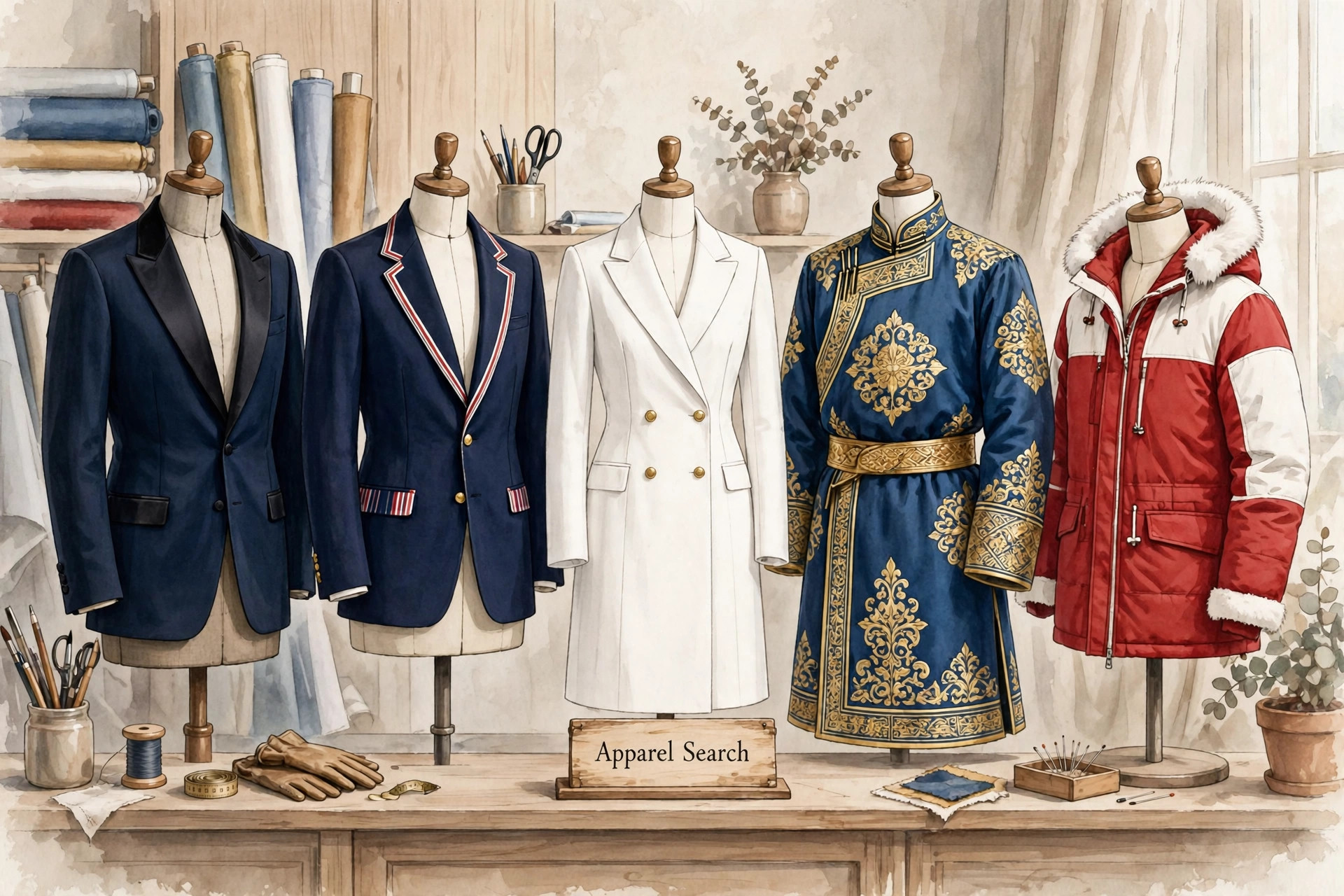
Olympic Opening Ceremony Fashion — Milano Cortina 2026 — the site's feature on the 2026 Winter Games opening ceremony: the looks, the designers and the stories of the night itself, told in full.
Team USA at Milano Cortina 2026 — the companion feature on the American team's 2026 uniforms, Ralph Lauren's tenth consecutive Games dressing Team USA, including the closing ceremony puffer jackets made by Better Team USA in Clifton, New Jersey.
Who Dresses the Games
A Designer Index
Twelve names account for most of the ceremony dressing in this section — couture houses, sportswear giants, national retailers and one two-sister label from Ulaanbaatar. The index below names each designer or house, the teams and Games it dressed, and the guide in this section where its work is treated in full. Between them they mark the field's range: a single designer, Telfar Clemens, producing an entire delegation's wardrobe of about 70 pieces in roughly four months as Liberia's sole sponsor, and a global sportswear company supplying about 175,000 items to one team at one Games.
| Designer or house | Teams and Games | Guide |
|---|---|---|
| Ralph Lauren | Team USA, Beijing 2008 to LA 2028 | Ralph Lauren and Team USA |
| Stella McCartney | Team GB, London 2012 and Rio 2016 | London 2012 and Rio 2016 |
| Berluti | France, Paris 2024 | Paris 2024 |
| Emporio Armani | Italy, from London 2012 onward | Paris 2024 and London 2012 |
| Telfar (Telfar Clemens) | Liberia, Tokyo 2020 | Tokyo 2020 |
| Christian Louboutin | Cuba closing ceremony, Rio 2016 | Rio 2016 |
| Lululemon | Canada, Beijing 2022 and Paris 2024 | Winter Games and Paris 2024 |
| Michel and Amazonka | Mongolia, Tokyo 2020, Beijing 2022 and Paris 2024 | Paris 2024 |
| Dsquared2 (Dan and Dean Caten) | Canada ceremony looks, Rio 2016 | Rio 2016 |
| H&M | Sweden, Rio 2016 | Rio 2016 |
| Lacoste | France ceremonies, podium and village, Rio 2016 | Rio 2016 |
| AOKI | Japan ceremony uniform, Tokyo 2020 | Tokyo 2020 |
Two patterns run through the list. The first is tenure: the strongest ceremony dressing comes from relationships that last — Ralph Lauren with Team USA since 2008, Emporio Armani with Italy since London 2012, Michel and Amazonka designing for Mongolia across three Games before their Paris moment. The second is range: the same parade can hold a Paris couture house working with a former French Vogue editor, a suit retailer dressing its home team, and an independent label printing a painter's canvas across a skirt. Ceremony fashion is the one runway where all of those are competing on equal terms, judged in the same two seconds of television.
The Long View
A Short Timeline of Ceremony Dress
| Year | Turning point |
|---|---|
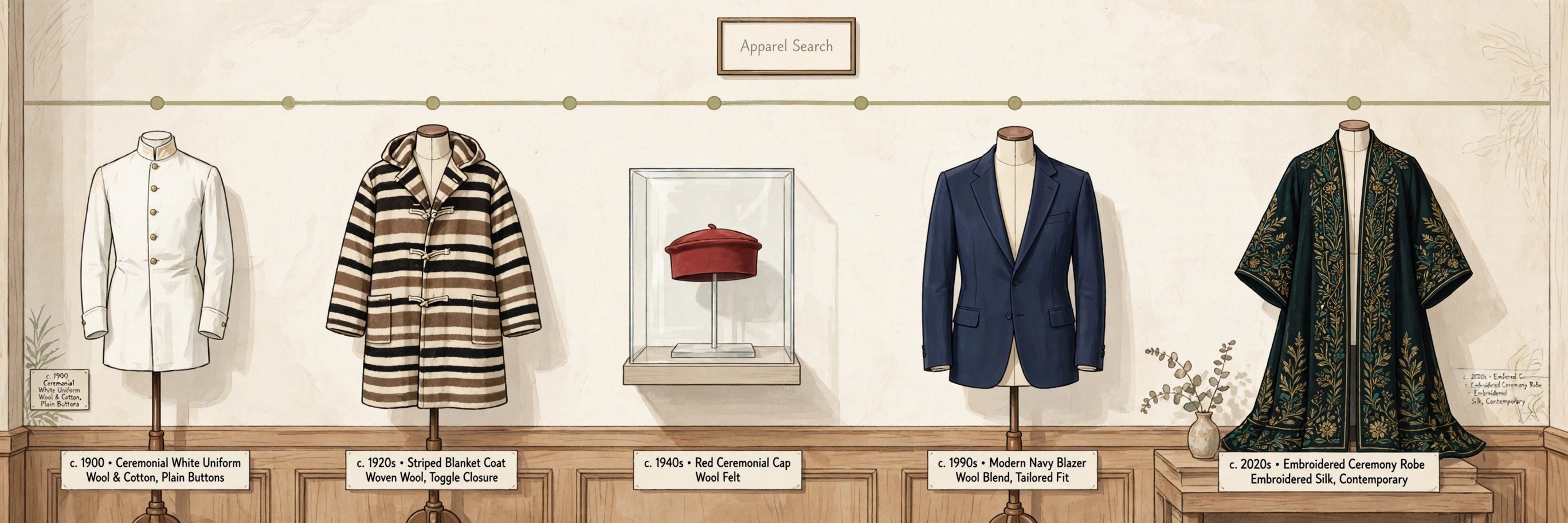
| 1908 | London introduces the athletes' parade; teams begin dressing as units rather than in their own clothes. |
| 1936 | Hudson's Bay Company outfits Canada for the first time, in the multistripe Point Blanket Coat. |
| 1998 | Roots outfits Canada at Nagano; its red poorboy cap becomes a retail phenomenon, a reported 100,000 sold a day at its peak. |
| 2008 | Ralph Lauren begins dressing Team USA at Beijing, succeeding Roots and opening the modern designer era. |
| 2012 | adidas appoints Stella McCartney creative director for Team GB at London — a leading designer across an entire nation's kit. |
| 2024 | Paris takes the parade onto the Seine; a luxury group is a premium partner and an independent Mongolian label wins the night online. |
| 2028 | Los Angeles hosts for the third time; Ralph Lauren dresses Team USA for an eleventh consecutive Games. |
Read as a single line, the timeline is a story of professionalisation. In the earliest modern Games athletes generally wore their own clothing; the parade itself, once introduced, pushed teams toward a unified look, and national outfitters — Hudson's Bay for Canada from 1936, Roots from 1998 — turned that look into national branding and, in the Roots cap, into a genuine retail phenomenon. The handover in 2008, when the United States Olympic Committee replaced Roots with Polo Ralph Lauren, began the era this section mostly covers: named fashion designers, appointed years in advance, treating the parade wardrobe as a collection. By Paris 2024 the transformation was complete enough that a luxury group could sponsor the Games themselves while the most celebrated outfit of the night came from Ulaanbaatar. The history guide tells that century in full.
Common Questions
Questions & Answers
What is Olympic fashion?
Olympic fashion is the clothing designed for the Games beyond competition kit: above all the opening and closing ceremony parade outfits, together with podium and village wear. Ceremony dress has to identify a country in a two-second television shot, keep athletes comfortable through hours of waiting and marching, and work within Olympic rules that tightly limit commercial marks on athlete clothing, so designers work through colour, cut and symbol rather than logos.
Who designs Olympic opening ceremony outfits?
National teams appoint their own designers and outfitters, and the field ranges from couture houses to sportswear companies. Ralph Lauren has dressed Team USA since Beijing 2008, Berluti designed France's Paris 2024 ceremony outfits, Stella McCartney was Team GB creative director for London 2012 and Rio 2016, Telfar Clemens designed Liberia's entire Tokyo 2020 wardrobe, and Michel and Amazonka designed Mongolia's Paris 2024 ensembles.
Where can I read about the Milano Cortina 2026 ceremonies?
Apparel Search's existing features cover Milano Cortina 2026 in full: the opening ceremony fashion feature and the Team USA uniforms companion, both linked from this hub. The guides in this section cover Paris 2024, London 2012, Tokyo 2020, Rio 2016 and the Winter Games, plus the history and craft of ceremony dress, and they point to the 2026 features rather than repeating them.
Olympic Fashion on Apparel Search
The section's existing Milano Cortina 2026 features, plus the traditional dress guides this section draws on.