Olympic Fashion · Winter Games
Winter Olympic Fashion: Dressing for the Coldest Runway on Earth
A summer opening ceremony asks a uniform to look good. A winter opening ceremony asks it to perform. The Winter Games parade happens outdoors, at night, in genuine cold, and the clothes have to keep hundreds of athletes warm through a long evening while still reading as a country in a two-second television shot. That double demand has made the winter ceremony wardrobe the most technical branch of Olympic fashion: a knitted cardigan that forced a superpower to rebuild its supply chain, parkas heated by printed ink, insulation that expands and contracts with the temperature, and a Canadian debut written in a single colour. This guide follows the winter story Games by Games, from Sochi 2014 to Beijing 2022, and points onward to the site's own Milano Cortina 2026 coverage.
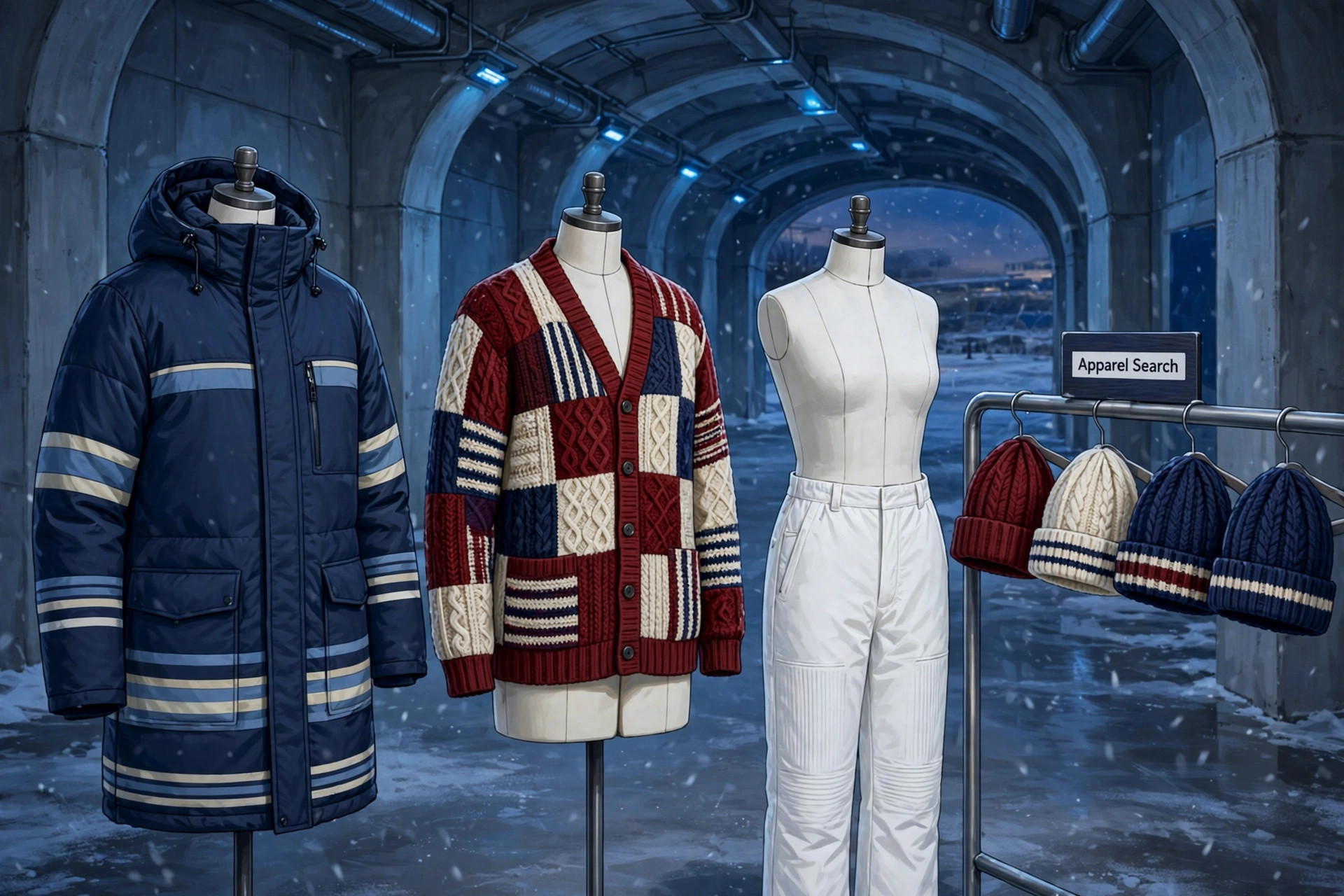
At a Glance
- The test
- An outdoor night ceremony in real winter cold — reported temperatures as low as 11 degrees Fahrenheit, with Siberian winds, during the PyeongChang 2018 Games period
- The reset
- Sochi 2014 — Team USA's ceremony wardrobe made in the United States by about 40 American vendors
- The heater
- PyeongChang 2018 — opening parkas heated by printed conductive ink, up to 11 hours of heat on the lowest setting
- The thinking fabric
- Beijing 2022 — Intelligent Insulation that expands or contracts in response to temperature
- The debut
- Beijing 2022 — Lululemon outfits Canada for the first time, succeeding Hudson's Bay
- The next chapter
- Milano Cortina 2026 — covered in depth by the site's own features, linked from this guide
The Winter Problem
A Runway Where the Weather Is the Opponent
Every ceremony uniform has to solve the same basic equation: national identity, carried in colour and symbol, on bodies of every size and shape, in front of the largest audience fashion ever gets. Winter adds a second equation on top of the first, and it is not negotiable. The athletes are standing outside, in the dark, in February. A design that photographs beautifully but leaves a delegation shivering has failed at its first job, and a design that is merely warm — anonymous technical outerwear, interchangeable between teams — has failed at its second. Winter ceremony dress lives in the narrow space where engineering and identity overlap, and the Games of the last decade are best read as a series of attempts to widen that space.
The conditions explain the direction of travel. At PyeongChang 2018, temperatures during the Games period were reported as low as 11 degrees Fahrenheit, with Siberian winds cutting across the open ceremony stadium; the opening ceremony itself was held on February 9, 2018. Designers were not dressing athletes for a photograph. They were dressing them for hours of waiting and marching in weather that punishes exposed skin and thin fabric alike, and they were doing it under the same restraint that governs all Olympic clothing: the design has to speak through colour, cut and symbol, because the stage does not belong to any brand. The three Winter Games that follow in this guide each answered the problem differently — with a supply chain, with a battery, and with a fabric that reacts — and together they trace how winter ceremony dress became the most inventive corner of the Olympic wardrobe.
Sochi 2014
The Made-in-USA Reset
The winter story really begins at a summer Games. The Team USA uniforms for London 2012 were made in China, and the discovery set off a political firestorm in the United States: a senator introduced the Team USA Made In America Act of 2012, which would have required the team's uniforms to be sewn or assembled in the United States. The bill did not become law — but Ralph Lauren, Team USA's outfitter since Beijing 2008, followed its intent anyway, and rebuilt an American supply chain in time for the Sochi 2014 Winter Games. That decision, more than any single garment, is what Sochi is remembered for: the moment the world's most visible national wardrobe became an argument about where clothes are made.
The rebuilt chain was deliberately, demonstrably American, and it ran through small specialist firms across the country. The wool came from Imperial Stock Ranch in Oregon, run by ranch owner Jeanne Carver. Kraemer Textiles spun about 6,000 pounds of merino yarn; Longview Yarns in North Carolina dyed it; assembly included Ball of Cotton in California. About 40 American vendors contributed in all. Andari Fashion of El Monte, California, began a run that continues today — it has made the team's Olympic knit sweaters and beanies ever since Sochi. The face of the whole effort was a single garment: the opening look's knitted patchwork cardigan, a homespun-looking mosaic of American knitting traditions, which became the most talked-about American garment of those Games precisely because it looked like the supply chain behind it — many hands, many places, one flag's worth of colours worked into a single piece of knitwear.
This guide keeps the Sochi story in brief, because it belongs to a larger one. The full account of how the London controversy reshaped the way Team USA is dressed — the two-and-a-half-year design process, the athlete consultation, and every Games of the tenure from Beijing 2008 onward — is told in our companion guide to Ralph Lauren and Team USA. What matters for the winter thread is the precedent Sochi set: from 2014 on, a winter ceremony wardrobe could be judged not only on how it looked, but on how — and where — it was made.
PyeongChang 2018
The Parka That Plugged In
If Sochi's answer to winter was a supply chain, PyeongChang's was a battery. Facing a ceremony in reported temperatures as low as 11 degrees Fahrenheit, Ralph Lauren's team produced the most literally technical garment in Olympic ceremony history: an opening-ceremony parka with its own heating system. The heat did not come from wires. Conductive silver and carbon inks, using DuPont technology, were printed onto the jacket's interior in the shape of the American flag — the heating element was itself the national symbol, hidden inside the garment where only the wearer knew it was working. Butler Technologies of Butler, Pennsylvania did the printing, and the system ran off a slim battery pack: up to 11 hours of heat on the lowest setting, and about 5 hours on high.
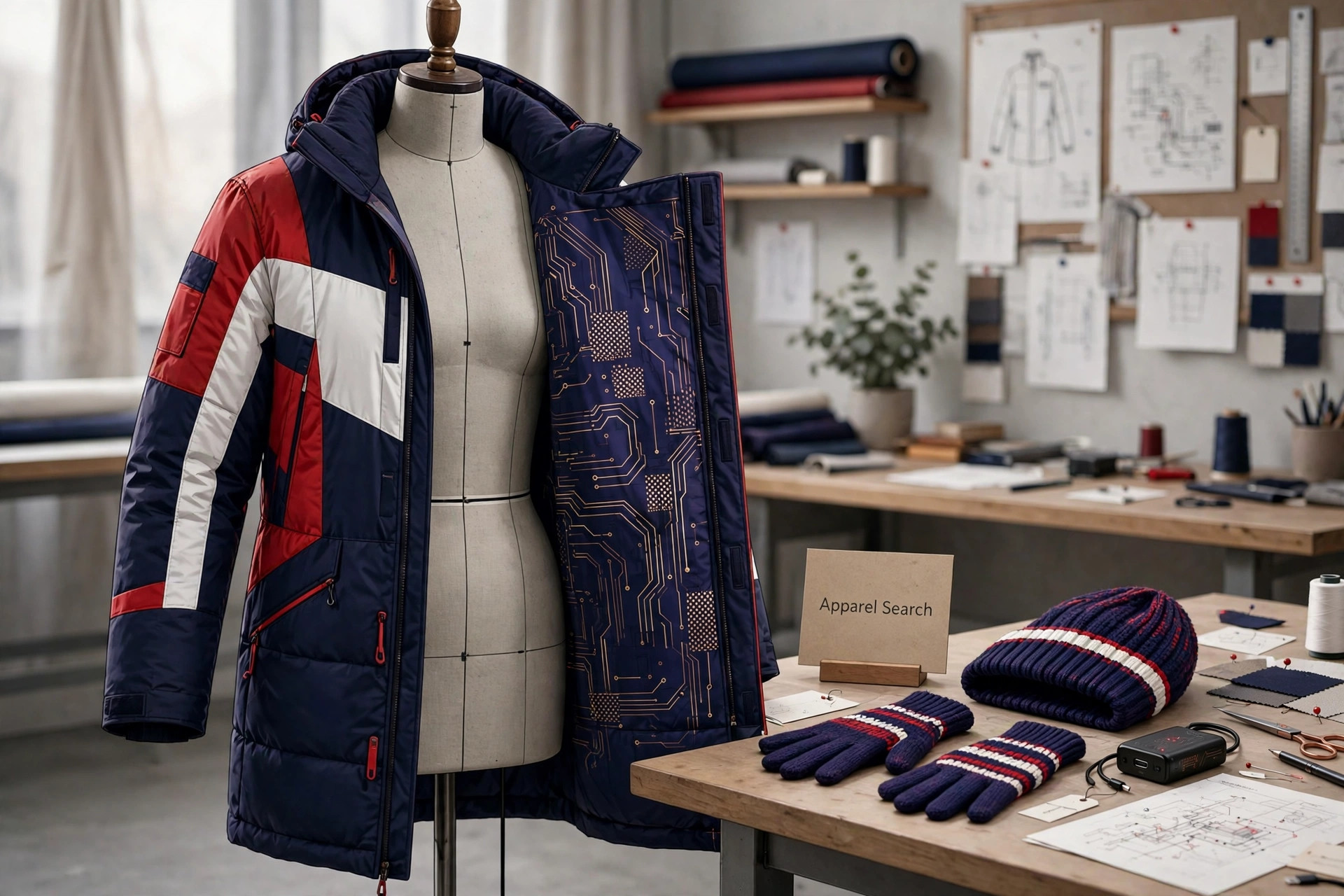
The parkas were made by Better Team USA of Clifton, New Jersey — a maker whose role in the winter wardrobe only grows from here, and which returns in the Milano Cortina story linked at the end of this guide. Nor was the parka a flag-bearer-only flourish: the whole 2018 wardrobe outfitted more than 700 athletes and staff, which meant the technology had to work at production scale, in sizes and shapes across an entire delegation, in real Siberian wind. Read against Sochi, PyeongChang marks the winter wardrobe's second turn. The question was no longer only where a ceremony garment was made. It was what a ceremony garment could do — and a parka that heats its wearer for eleven hours had moved the ceremony uniform decisively into the territory of wearable technology, without changing its silhouette by a single visible line.
Beijing 2022
Insulation That Thinks, Fill From Bottles
Beijing 2022 produced the winter wardrobe's third answer: not a heater added to a garment, but a material that responds on its own. The opening-ceremony anorak Ralph Lauren designed for Team USA used Intelligent Insulation, a fabric technology that expands or contracts in response to temperature — lofting up as the cold deepens, settling as it eases — so a single garment could regulate its wearer through a ceremony whose conditions change by the hour. It is the logical next step from PyeongChang: instead of powering warmth with a battery, build the judgement into the cloth itself.
The rest of the Beijing kit worked the same seam of ingenuity and responsibility. The polyester fill used throughout the collection was made from recycled post-consumer plastic bottles, so the warmth in the parkas began life as drinks containers. And the closing-ceremony look traded the anorak's quiet technology for pure Americana: buffalo-plaid puffer jackets worn over flag intarsia turtlenecks, the flag knitted into the garment rather than printed on it. Between the opening and closing looks, Beijing summarised where the American winter wardrobe had arrived in a decade — a supply chain rebuilt at Sochi, heating proven at PyeongChang, and by 2022 a kit that could claim recycled fill, adaptive insulation and hand-knit symbolism in the same wardrobe. The winter Games had become the place where Team USA's outfitter tested its most advanced ideas, because winter is where the ideas are needed most.
Canada in Winter
From the Point Blanket Coat to the Maple-Leaf Metamorphosis
No country's winter identity is older, or more recognisable, than Canada's — and no country's changed hands more dramatically at Beijing. The story starts in 1936, when Hudson's Bay Company first outfitted Canada at the Winter Games in its Point Blanket Coat, the heavy multistripe wool coat that became a fixture of Canadian winter dress. The company returned to dress Canada again from the 2006 Turin Games onward, and its simplest product became its most beloved: the Hudson's Bay red mittens grew into a lasting Team Canada staple and a memorabilia favourite, proof that a ceremony wardrobe's most powerful item is sometimes the smallest and cheapest one in it.
At Beijing 2022 the commission passed, for the first time, to Lululemon — the Canadian athletic brand succeeding Hudson's Bay as the country's outfitter. A debut against that history needed a statement, and Lululemon made it in a single colour: an all-red opening-ceremony look built on a maple-leaf "metamorphosis" print, the national symbol broken down and rebuilt as a pattern that shifts across the fabric. The wardrobe, led by creative director Audrey Reilly, played transformation as its theme in the garments themselves — most memorably a transformable parka that converts in length and can be carried like a backpack once the ceremony's cold is done with. The closing ceremony answered red with restraint: a winter-white story, the snow itself worn as the second national colour.
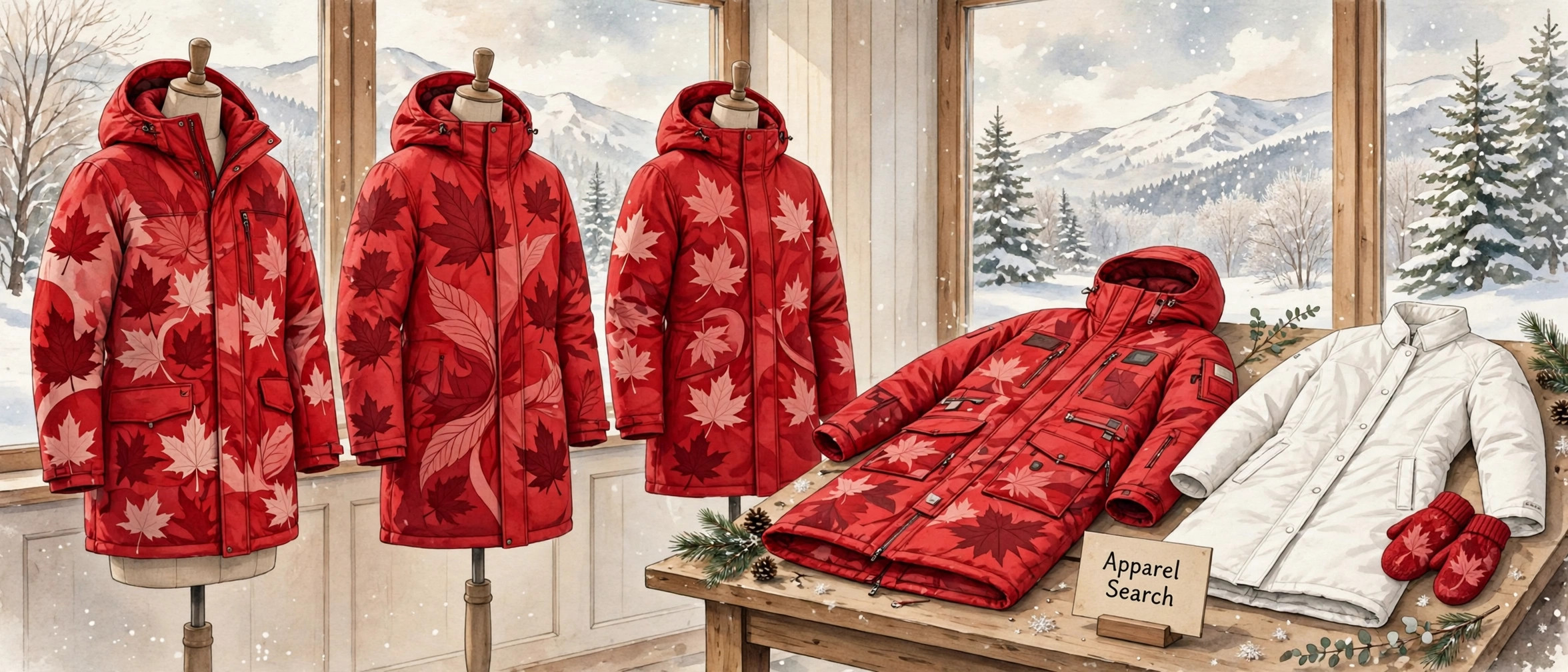
Set the two Canadian eras side by side and the winter argument of this whole guide comes into focus. The Point Blanket Coat said Canada through a traded material and a stripe pattern recognised across a stadium. The red mittens said it through an object anyone could buy and keep. The Lululemon wardrobe said it through print, colour and convertible construction — the tools of a modern athletic brand. The symbol never changed; the maple leaf and the red were there in 1936 and in 2022 alike. What changed, Games by Games, is how much work the garments around the symbol are asked to do.
Milano Cortina 2026
The Next Winter Chapter, Covered in Depth
The winter story continues at Milano Cortina 2026, and this guide deliberately does not retell it — Apparel Search already covers those Games in depth, and the 2026 wardrobes deserve their full treatment rather than a summary here. Start with the site's feature on the Milano Cortina 2026 opening ceremony fashion, which reads the whole ceremony field, and then its companion deep-dive on the Team USA Milano Cortina 2026 uniforms, the tenth Games of the Ralph Lauren tenure that runs through every section of this guide. Read together, they bring the thread from Sochi's cardigan and PyeongChang's heated parka to the present — and they are the natural next page after this one.
Common Questions
Questions & Answers
What changed about Team USA uniforms at Sochi 2014?
Sochi 2014 was the made-in-USA reset. After the London 2012 uniforms were found to be made in China, Ralph Lauren rebuilt an American supply chain for the Sochi ceremony wardrobe, working with about 40 vendors in the United States, from merino wool raised at Imperial Stock Ranch in Oregon to yarn spun by Kraemer Textiles and dyed by Longview Yarns in North Carolina. The opening look was built around a knitted patchwork cardigan that became the most talked-about American garment of those Games.
How did the heated parkas at PyeongChang 2018 work?
The opening ceremony parkas carried heating elements printed in conductive silver and carbon inks, using DuPont technology, in the shape of the American flag on the jacket interior. A slim battery powered the system for up to 11 hours on the lowest setting and about 5 hours on high. Butler Technologies of Butler, Pennsylvania printed the elements, and Better Team USA of Clifton, New Jersey made the jackets.
When did Lululemon first outfit Canada at the Winter Games?
Lululemon made its Canadian debut at Beijing 2022, succeeding Hudson's Bay, which had dressed Canada since the 2006 Turin Games. The Beijing wardrobe opened with an all-red ceremony look built on a maple-leaf metamorphosis print, included a transformable parka that converts in length and can be carried like a backpack, and closed with a winter-white story, under creative director Audrey Reilly.
Olympic Fashion
The section hub and the guides closest to the winter story: the Ralph Lauren tenure behind it, the history it grows out of, and the home Games ahead.
Search Apparel Search