Olympic Fashion · Los Angeles 2028
LA 2028 Olympic Fashion: The Home Games, Dressed
In July 2028, Los Angeles hosts the Summer Games for the third time, after 1932 and 1984, with about 15,000 athletes expected. A home Games is the rarest brief in ceremony fashion: the host nation's team walks into its own stadium, in its own city, wearing clothes the home crowd feels it owns. Some of the LA 2028 story is already confirmed and is set out here as fact — the outfitter, the emblem, the factory groundwork. The rest — what Americana will mean this time, whether the city's streetwear and entertainment culture bends ceremony dress in a new direction, whether the field of designers widens — is genuinely undecided, and this guide treats it that way: as open questions, not predictions dressed up as news.
At a Glance
- The Games
- Los Angeles, July 2028 — the city's third Summer Games, after 1932 and 1984
- The scale
- About 15,000 athletes expected
- Team USA outfitter
- Ralph Lauren — its 11th consecutive Games dressing the team
- The emblem
- A custom LA28 emblem launched July 26, 2023: a black and red winged "A" reimagining the 1990s P-Wing symbol
- The first product
- An LA28 jean jacket at US$298, sold through the RL app and the Beverly Hills flagship
- The groundwork
- Andari Fashion of El Monte, Los Angeles County, already preparing for the 2028 ceremonial knitwear
The Verified Core
Ralph Lauren's Eleventh Games
The central fact of LA 2028 fashion is settled years in advance: Ralph Lauren will dress Team USA. The company has stated that it "will be dressing the team for the upcoming 2028 Summer Olympic and Paralympic Games in Los Angeles", and LA28 describes the relationship as "nearly 20 years" old by 2028. Count the run and it is remarkable: an official outfitter of the US Olympic and Paralympic Teams since Beijing 2008, designing the opening and closing ceremony parade outfits plus Villagewear, the exclusive Official Parade Outfitter. Paris 2024 was the ninth consecutive Games, Milano Cortina 2026 the tenth, and Los Angeles will be the eleventh — a tenure with no parallel in modern ceremony fashion, spanning two decades of American teams walking into stadiums in one house's clothes.
A home Games raises the stakes of that tenure in a specific way. Every previous Ralph Lauren wardrobe was designed for a team travelling to someone else's city — Beijing, London, Rio, Tokyo, Paris. Los Angeles reverses the geometry: the crowd in the stadium is the team's own, the television audience's home viewers are watching their neighbours, and the clothes will be judged not as visitors' dress but as a statement about the country made on its own ground. Whether that changes the design is one of the open questions below. What is certain is the process behind it: the design team starts each Games wardrobe about two and a half years out, with athlete consultation built in from the first sketches — which means the LA wardrobe's formative work belongs to the middle of this decade, long before any garment is photographed.
Eleven consecutive Games, one house, and for the first time the stadium is home.
Continuity runs through the supply chain as well as the design studio. The American vendor network Ralph Lauren rebuilt after the London 2012 made-in-China controversy — the discovery that those uniforms were made in China set off a political firestorm and a Senate bill — still underpins the wardrobes: Ferrara Manufacturing in New York City has made uniform pieces since 2014, Better Team USA in Clifton, New Jersey has made the winter jackets since 2018, and the knitwear story leads directly to Los Angeles County, as the groundwork section below describes.
The Emblem
July 2023: A Winged A and a Jean Jacket
The first piece of LA 2028 fashion the public could actually buy arrived five years before the Games. On July 26, 2023, LA28 and Ralph Lauren launched a custom LA28 emblem: a black and red winged "A" that reimagines the brand's 1990s P-Wing symbol. The detail that makes it historic is the customisation itself — it was only the second time in Olympic and Paralympic history that a commercial brand had customised a Games emblem. Games emblems are normally the organising committee's own territory; a brand's mark woven into one is a measure of how deep this particular partnership runs.
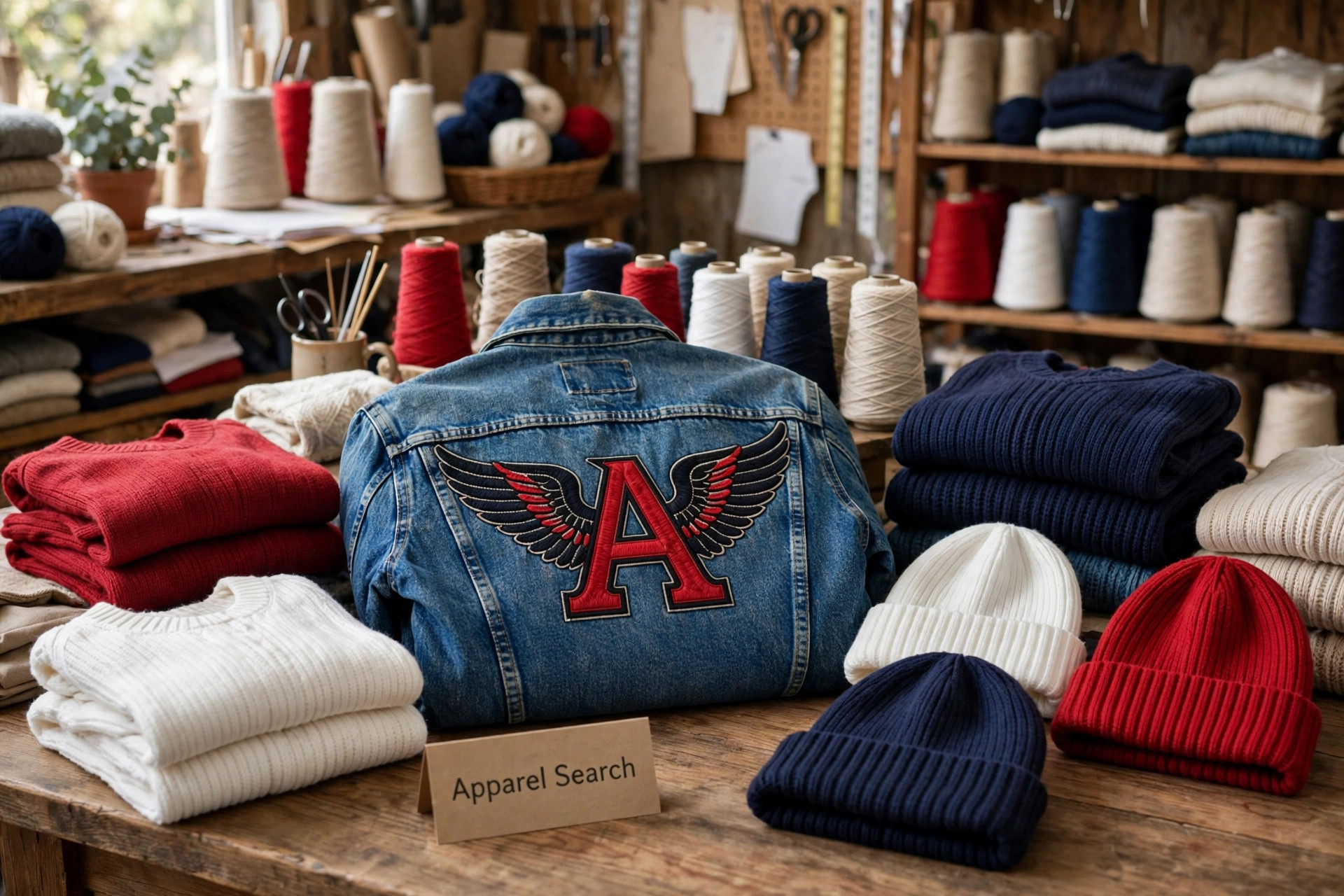
The first product carrying it set the tone: an LA28 jean jacket, priced at US$298, sold through the RL app and the Beverly Hills flagship. Denim is a deliberate choice of canvas — the most American of fabrics, and a Los Angeles wardrobe staple — and the channel was deliberate too, a flagship in the host city rather than a generic launch. Further capsule releases are planned in the run-up to the Games. Read as a pattern rather than a promise, it extends what Ralph Lauren has done at every recent Games: the ceremony wardrobe anchors a public collection, sold from unveiling day. The emblem program simply starts that retail story years earlier than the uniforms themselves can.
The Groundwork
Already in the Making: El Monte's Knitwear
The LA28 wardrobe is not a sketch waiting for a start date; pieces of its production groundwork are already being laid, close to home. Andari Fashion, a knitwear factory in El Monte, in Los Angeles County, has made the US team's Olympic knit sweaters and beanies since Sochi 2014 — through the made-in-USA supply chain built for those Games — and it is already laying groundwork for the 2028 ceremonial items. There is a satisfying symmetry in it: for a Los Angeles Games, some of Team USA's most recognisable garments will again be knitted a few miles from the stadium, by a factory that has been part of the wardrobe for a decade and a half by the time the team walks out.
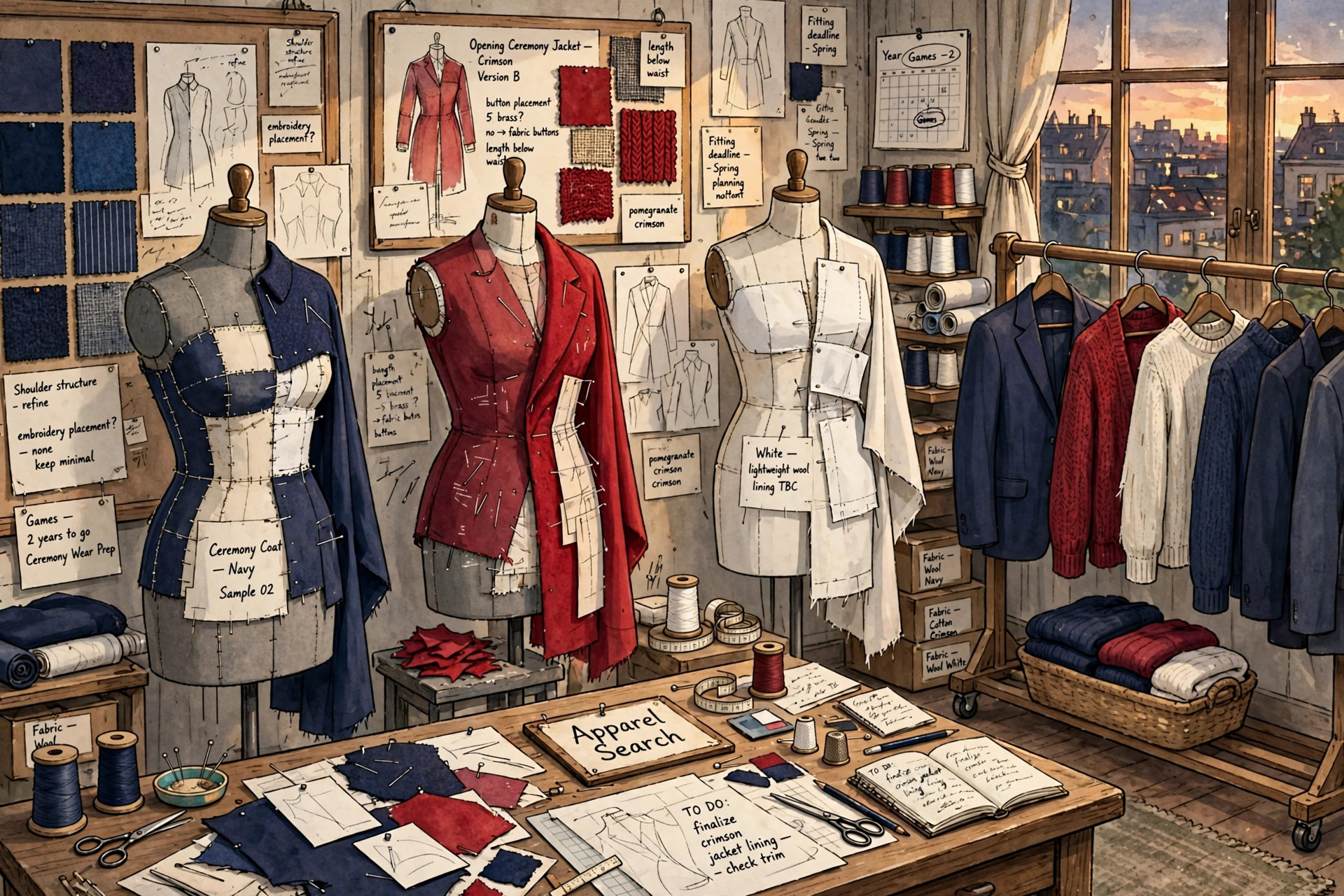
The two-and-a-half-year rhythm explains why the groundwork matters now. A ceremony wardrobe at this scale is an industrial program as much as a design one — earlier Games in this series involved about 40 American vendors for a single winter wardrobe, and volumes across a full kit program run into six figures of individual items. Yarn, capacity and factory time are committed long before a design is unveiled. So while the public story of LA 2028 fashion will appear to begin at an unveiling event, the truer beginning is quieter: looms and order books in El Monte, and a design studio working to a deadline that, in fashion terms, is already close.
The Setting
A Third Home Games: 1932, 1984, 2028
Los Angeles is not a first-time host learning the ceremony's grammar. The city staged the Summer Games in 1932 and again in 1984, and July 2028 makes it a three-time host — a small club in Olympic history. That inheritance cuts into the fashion story in one verifiable way: the city, its organisers and its audience have seen the Parade of Nations at home twice before, and the 2028 ceremony will be staged for a crowd that includes people who remember the last one. About 15,000 athletes are expected — the largest cast any ceremony wardrobe program, across more than two hundred delegations, will have to dress, each team solving the same brief of identity, endurance and range in its own way.
Beyond those facts, honest framing matters. It is tempting to declare what a Los Angeles ceremony will look like — the light, the landscape, the entertainment industry on the doorstep — but none of that is a fact yet; it is a set of influences whose weight nobody can measure until the designs exist. The sections that follow therefore separate the two registers this guide has kept apart throughout: what is confirmed is stated plainly, and everything forward-looking is posed as the open question it actually is. Readers who want the confirmed record of how we got here — ten Games of one house's tenure — will find it in this section's Ralph Lauren guide; the questions below are the part of LA 2028 that is still genuinely unwritten.
Open Questions
What Nobody Knows Yet — and Why That Is the Interesting Part
What will Americana mean at a home Games? Ralph Lauren's Team USA wardrobes have always traded in a recognisable American vocabulary — blazers and denim, moto jackets and buck shoes, buffalo plaid and flag intarsia. On foreign ground, that vocabulary reads as identity. On home ground, in front of a home crowd, the same vocabulary could read as something else: a celebration, a cliché, or a starting point to be pushed somewhere new. Which of those the LA wardrobe chooses — polish the classics, or stretch them — is the single biggest unanswered design question of the Games, and it will not be answered until the unveiling.
Will Los Angeles pull ceremony dress toward streetwear and entertainment? The host city is a global capital of both. Paris 2024 showed a ceremony absorbing its city's fashion identity wholesale, with a luxury group as premium partner and the host team's tuxedo made by one of its own heritage houses. Whether Los Angeles exerts a comparable pull — whether the city's casual, entertainment-driven style loosens the blazer-and-denim formality of recent American wardrobes — is an expectation many observers hold, but it remains an expectation. Ceremony dress has surprised forecasters before, in both directions.
Will the field of designers widen? Paris set two precedents at once: an established luxury structure at the top, and, in Mongolia's Michel and Amazonka, a small independent label winning the night's attention before the ceremony began — as Telfar had done for Liberia at Tokyo. If those precedents generalise, LA 2028 could feature more independent and unexpected names across the delegations than any previous Games. If they were Paris-specific, the established houses will hold the field. Both readings are honestly available from the record; the answer arrives team by team, unveiling by unveiling.
What to Watch
The Road From Here to the Ceremony
For readers following this story as it develops, the confirmed milestones are the capsule releases: further LA28 emblem capsules are planned in the run-up to the Games, each one a small, purchasable clue about the visual language being built around 2028. The pattern from recent Games suggests — and it is a pattern, not an announcement — that the full Team USA ceremony wardrobe will anchor a public collection when it is unveiled, as the Paris wardrobe did from its unveiling day. Expect the unveiling itself to be treated as a fashion event in its own right; that, too, is a Paris-era precedent whose repetition is likely but not guaranteed.
Between now and Los Angeles sits one more chapter of the confirmed story: Milano Cortina 2026, the tenth consecutive Games of the Ralph Lauren tenure and the immediate predecessor to LA. The sequence matters for followers of the fashion as much as the sport, because each wardrobe in this run has answered the one before it — heated parkas answered PyeongChang's cold, a cooling device answered Tokyo's heat, adaptive insulation answered Beijing. What question Los Angeles asks, and what garment answers it, is the thread to follow through the winter Games first. The athletes, at least, will have their say in it: consultation with the team is built into the design process from the first sketches, years before any unveiling.
The other thing to watch is the rest of the parade. A home Games is judged as a whole field, not a single team: more than two hundred delegations will each present their answer to the ceremony brief, and the recent trend — traditional dress modernised, painters and couture labels and streetwear founders all working the same tunnel — points toward the most varied ceremony fashion ever staged. Points toward, not guarantees. This guide will be updated as confirmations replace questions; until then, the honest summary of LA 2028 fashion is a short confirmed core, a working factory in El Monte, a winged A already on a jean jacket — and a stadium's worth of open questions walking toward July 2028.
Common Questions
Questions & Answers
Who will design Team USA's uniforms for LA 2028?
Ralph Lauren will dress Team USA at the Los Angeles Games, its 11th consecutive Games as the team's official outfitter. The company has stated it will be dressing the team for the 2028 Summer Olympic and Paralympic Games in Los Angeles, and LA28 describes the relationship as nearly 20 years old by 2028.
What was the custom LA28 emblem Ralph Lauren launched in 2023?
On July 26, 2023, LA28 and Ralph Lauren launched a custom LA28 emblem: a black and red winged A reimagining the brand's 1990s P-Wing symbol. It was only the second time in Olympic and Paralympic history that a commercial brand had customised a Games emblem. The first product was an LA28 jean jacket priced at US$298.
Has work on the LA 2028 uniforms already started?
The groundwork is under way. Ralph Lauren's design process starts about two and a half years before a Games, and Andari Fashion, the El Monte knitwear factory in Los Angeles County that has made the team's Olympic sweaters and beanies since Sochi, is already laying groundwork for the 2028 ceremonial items.
Olympic Fashion
The road to Los Angeles runs through the Games that set its precedents — Paris's river parade, the winter tradition, and the full Ralph Lauren tenure.
Search Apparel Search