Olympic Fashion · Paris 2024
Paris 2024: The Ceremony That Sailed
On July 26, 2024, the Parade of Nations left the stadium for the first time in Olympic history and travelled by boat along the Seine — 206 delegations dressed for bridges, banks and evening light. Paris answered with luxury built into the Games themselves, a midnight-blue Berluti tuxedo for the hosts, and the most open fashion contest the Olympics has staged: won, before it started, by two sisters embroidering deels in Ulaanbaatar. This guide covers the night garment by garment.
At a Glance
- The Games
- Paris 2024 Summer Olympics; opening ceremony July 26, 2024, on the Seine
- The first
- First opening ceremony held outside a stadium; 206 delegations paraded by boat
- France
- Berluti ceremony tuxedo, 1,500 outfits; Le Coq Sportif made about 150,000 items of kit and village wear
- The partner
- LVMH, first luxury group as premium partner; sponsorship reported at about 150 million euros
- The medals
- Designed by Chaumet, first jeweller to design Olympic medals; 18 grams of Eiffel Tower iron in each
- The sensation
- Mongolia, by Michel and Amazonka: deel-inspired, embroidered, viral weeks before the ceremony
The Setting
A Ceremony That Left the Stadium
On July 26, 2024, Paris did something no host city had done before: it took the opening ceremony out of the stadium. For the first time in Olympic history, the Parade of Nations travelled by boat along the Seine, 206 delegations moving through the centre of the city rather than around a running track. The change rewrote the fashion problem of the night. A stadium parade is read from fixed seats and a broadcast gantry; a river parade is read from bridges, banks and balconies, at changing distances, in evening light, against the most recognisable cityscape in the world. Ceremony dress in Paris had to work as street spectacle as much as stadium uniform — and the designers who understood that best owned the night.
Paris also changed who stood behind the clothes. LVMH was a premium partner of the Games, the first luxury group ever to hold that role, in a sponsorship reported at about 150 million euros. The group's presence ran through the ceremony's material culture: Chaumet, the Paris jeweller, designed the medals — the first jeweller ever to design Olympic medals — and each medal carries 18 grams of iron from the Eiffel Tower, across about 5,000 medals in total. Louis Vuitton made the medal trays and the torch and medal trunks in its Damier canvas. Luxury was not dressing one team in Paris; it was built into the furniture of the Games themselves, and that set the register every delegation's clothes were judged against.
A river instead of a track, a luxury group behind the medals, and 206 delegations dressed for the bridges of Paris.
France
Berluti Dresses the Hosts
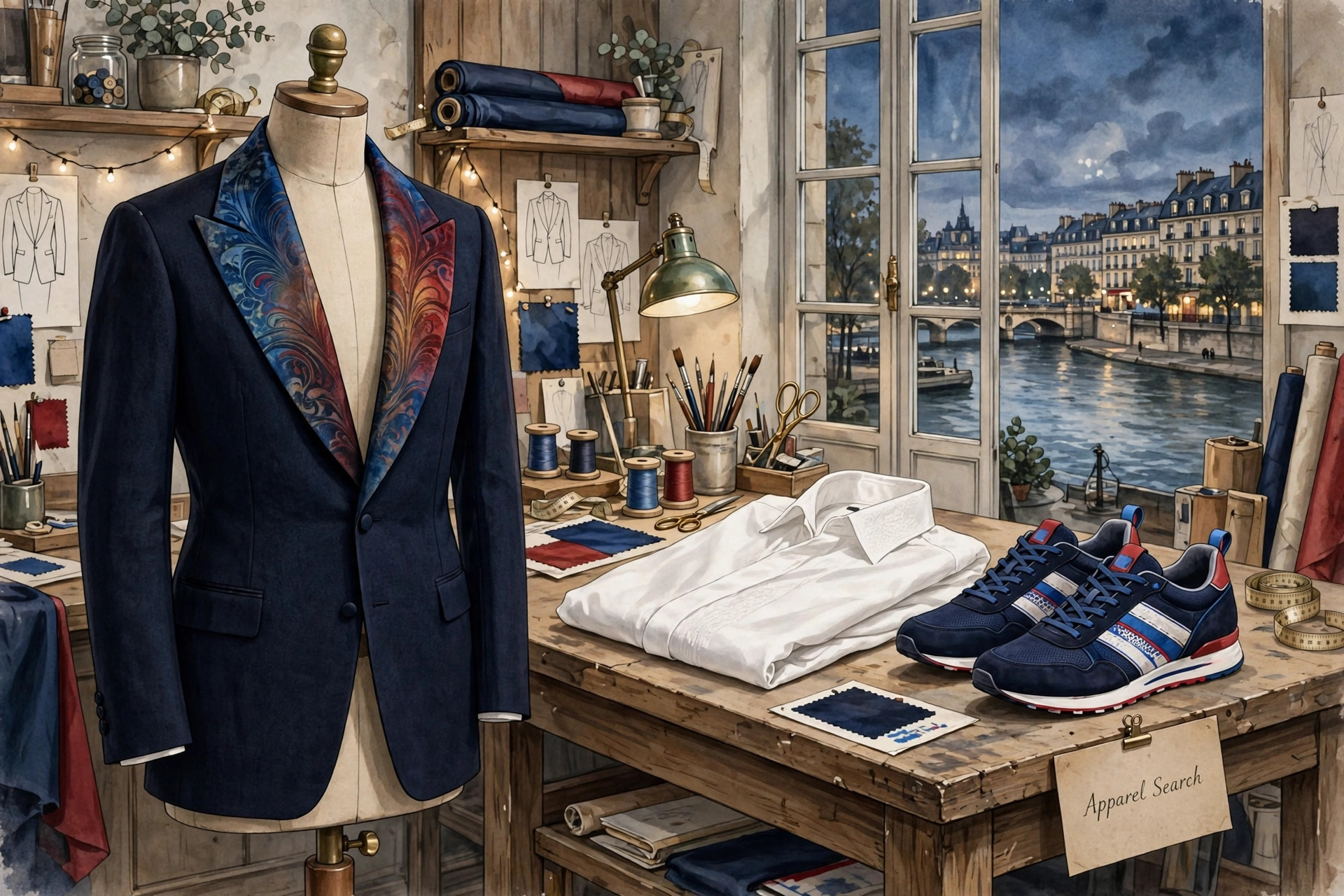
The host team's opening-ceremony outfits were designed by Berluti, the Paris menswear and footwear house, working with former French Vogue editor Carine Roitfeld as a consultant. The commission was large by any couture standard: 1,500 outfits for the Olympic and Paralympic teams together, covering athletes and coaches and staff. The look was a study in dressing a host nation in its own tailoring language. The central garment was a midnight-blue wool tuxedo — formal, unmistakably Parisian, and cut to read as evening dress rather than sportswear on the boats of the Seine.
The details carried the national reference without a flag print. The tuxedo's shawl collar carried a motif inspired by a new French flag patina in blue and red, so the tricolour appeared as a painterly gradient at the neck rather than as a banner across the chest. Underneath went a white cotton-silk shirt. On the feet, Berluti's Shadow trainers were reimagined in the colours of the French flag — a luxury house putting its athletes in trainers, and making the trainer itself the patriotic element. The women's version of the outfit was sleeveless, a considered variation rather than a scaled copy of the men's look.
The least glamorous fact about the commission may be the most impressive. Berluti expanded its size range to fit every athlete: 14 sizes, running from 3XS to 6XL, and shoe sizes from 1 to 22. A fashion house's normal range does not have to accommodate both gymnasts and weightlifters in the same design; a ceremony outfitter's does. That expansion — couture pattern-cutting stretched across the full range of athletic bodies — is the hidden craft of the Paris look, and it is why the French team could wear a tuxedo, the least forgiving garment in menswear, as a uniform.
France, Head to Toe
Le Coq Sportif and the 150,000 Items
Berluti dressed France for one night. Everything else the French teams wore — competition kit, podium wear and village wear — came from Le Coq Sportif, the French sportswear house, under artistic director Stephane Ashpool, founder of the Paris streetwear label Pigalle. The scale dwarfs the ceremony commission: about 150,000 items, made in France, for 560 Olympians, 280 Paralympians and 2,400 coaches and support staff. Where Berluti's brief was a single image — the host team on the river — Ashpool's was a complete wardrobe system that had to perform in competition and still read as one nation's design language across three weeks of Games.
The pairing of the two houses is the Paris model in miniature. France split its dressing between a luxury house for the ceremony and a domestic sportswear house with a streetwear artistic director for everything else, and made both halves in a French idiom: tailoring for the image, home manufacture for the substance. It is a division of labour other hosts have used in part, but Paris stated it most cleanly, because the ceremony half was so unapologetically formal. A tuxedo is a claim about what your country thinks elegance is; France made that claim on home water.
The Night's Winner
Mongolia: The Deel, Embroidered
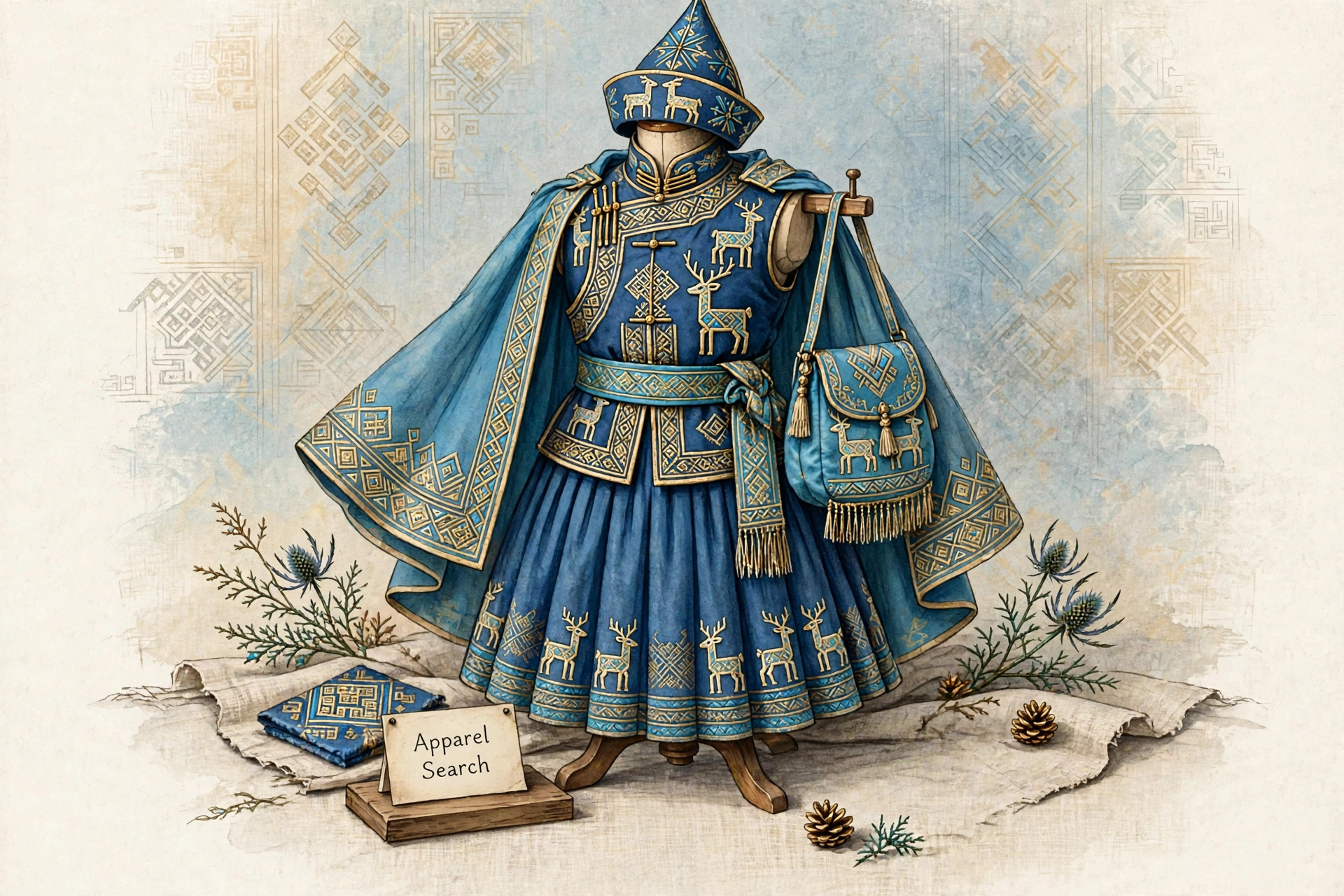
If one delegation won Paris 2024 fashion before the ceremony began, it was Mongolia. The outfits were designed by Michel and Amazonka, the Ulaanbaatar couture label founded in 2015 by sisters Michel and Amazonka Choigaalaa, and the unveiling went viral weeks before the ceremony — the rare ceremony wardrobe that arrived in Paris already famous. The ensembles were deel-inspired, built on Mongolia's traditional garment and elaborated to couture density: intricately embroidered vests, pleated skirts, draped capes and sash belts, with embroidered bags, earrings and pointed hats, and gutal boots for the men.
The embroidery carried the meaning. Its motifs included the Soyombo symbol, the mythological Gua Maral deer, references to the Naadam festival and an Olympic torch — national identity, mythology, the country's great sporting festival and the Games themselves worked into a single decorative system. It was reported that about 20 hours of work went into each outfit, and the label's chief executive, Munkhjargal Choigaalaa, told TIME that the team produced 120 sets in three months with 42 people. Those numbers explain the density: this was not a printed motif but hand-finished embroidery produced at workshop scale against a Games deadline.
Paris was not the sisters' first Games. They had already designed Mongolia's outfits for Tokyo 2020 and Beijing 2022, and the Paris set is best read as the third iteration of a developing language — the traditional garment modernised a little further each time, until at Paris it met the moment exactly: a host city staging fashion as national culture, and a small label demonstrating that embroidery, symbolism and silhouette could beat any logo. Mongolia's own traditional garment has a full guide elsewhere on Apparel Search, linked at the foot of this page; this guide's subject is what two couturiers did with it on the Seine.
Small Delegations, Large Statements
Haiti, and the Art of the Small Team
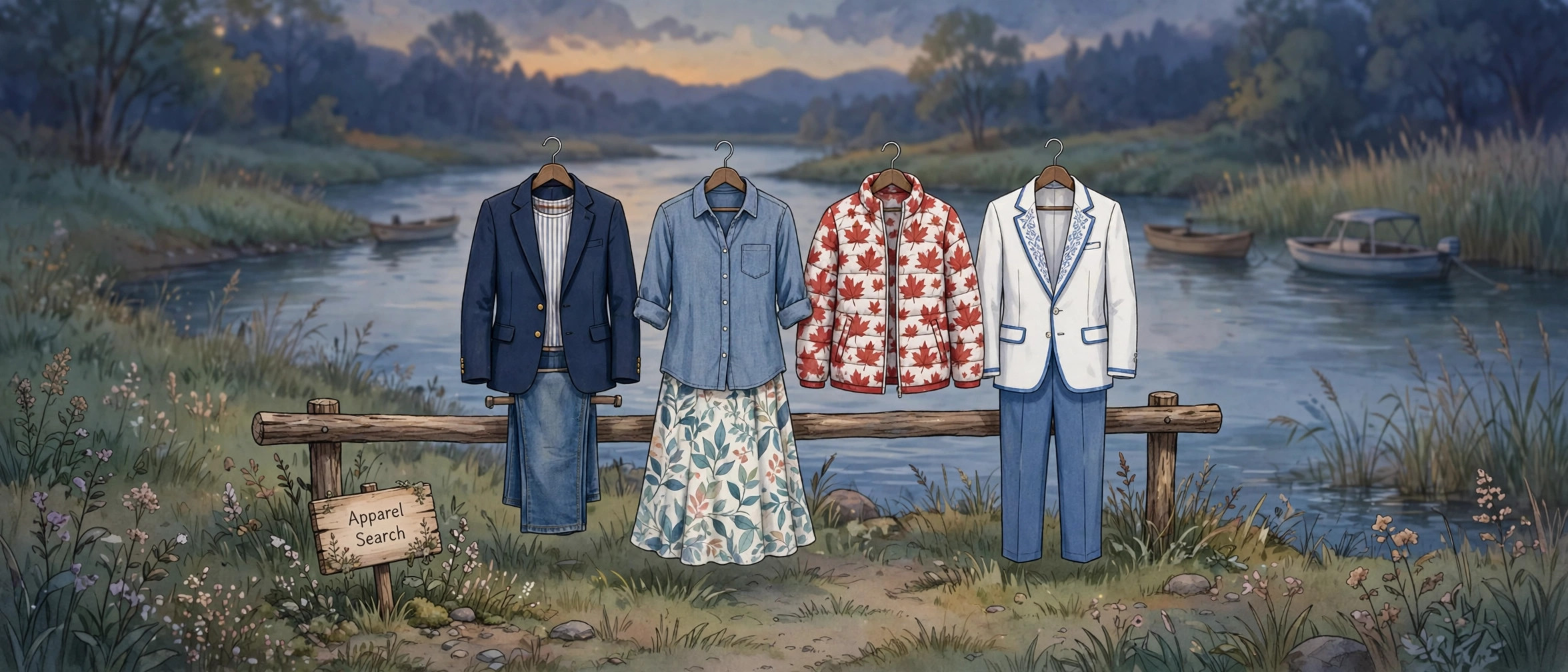
Haiti fielded one of the smallest delegations at the Games, and dressed like a country that understood exactly what a small team can do in a parade of 206: be unforgettable in a single image. The outfits were designed by Stella Jean, the Haitian-Italian designer, in collaboration with Haitian painter Philippe Dodard, whose painting was printed across the women's skirts and the men's trousers — a painter's canvas turned directly into cloth. The women wore a chambray shirt, woven and made in Haiti, under a sleeveless belted blazer; the men's jacket was inspired by the guayabera shirt.
Jean framed the work as combining Haitian fabrics and motifs with Western silhouettes, and called it a tool of counter colonization. The construction backs the framing: the cloth woven in Haiti, the art by a Haitian painter, the silhouettes in dialogue with European tailoring rather than in imitation of it. Set beside Mongolia, Haiti shows the second route by which a small delegation wins a ceremony — not embroidery density but a single, legible artistic gesture, repeated across every member of a tiny team until it reads as a national statement. In a parade where the largest teams are a blur of identical tailoring, seven or a dozen perfectly considered outfits can carry further than five hundred.
The Rest of the Parade
Canada, Britain, Italy, the Philippines and the United States
Canada's ceremony dressing came from Lululemon, in its second Games as the team's outfitter after its debut at Beijing 2022, with bespoke prints built on the maple leaf — the national symbol handled as a print system rather than a flag, in the all-red and winter-white language the company had established for the team. Great Britain's opening and closing ceremony looks were created by Ben Sherman, reported as the brand's third consecutive Games in that role, while adidas supplied Britain's competition kit — the British arrangement, like the French, splitting ceremony tailoring from competition supply. Italy was dressed by Emporio Armani, continuing a relationship that began at London 2012 and has made Armani's tailoring the standing image of the Italian team. The Philippines' ceremony outfits were by Francis Libiran, one more home designer dressing a home team in a national idiom.
The United States arrived in Ralph Lauren, the company's ninth consecutive Games outfitting Team USA. The opening look was a single-breasted wool blazer with red-and-white tipping, worn with a striped shirt, jeans and suede buck shoes — preppy tailoring deliberately relaxed by denim. The closing look changed the register entirely: a moto-style racer jacket with white denim and a Polo shirt from the brand's Create Your Own program. Between the two ceremonies sat the Villagewear collection, and a small landmark of its own: the Paris collection launched the brand's first 100 percent recycled cotton Polo shirt. Skims, meanwhile, was Team USA's underwear and loungewear partner for a third Games — a reminder that a modern Olympic wardrobe is a layered commercial system as well as a parade uniform. The full Ralph Lauren tenure, from Beijing 2008 to Los Angeles 2028, has its own guide in this section.
Paris 2024's lasting contribution to Olympic fashion may be structural. It showed a host can put luxury inside the Games themselves, split ceremony from competition between two domestic houses, and still be upstaged — happily, and to the Games' benefit — by a 42-person workshop in Ulaanbaatar and a painter's print from Haiti. The parade is a competition no medal table records, and Paris proved it is the most open one at the Olympics: anyone with a garment, a symbol and a silhouette can win it.
Common Questions
Questions & Answers
Who designed France's Paris 2024 opening ceremony outfits?
Berluti designed France's opening ceremony outfits, working with former French Vogue editor Carine Roitfeld as a consultant. The house made 1,500 outfits for the Olympic and Paralympic teams: a midnight-blue wool tuxedo with a shawl collar carrying a blue and red French flag patina motif, a white cotton-silk shirt, and Berluti Shadow trainers reimagined in the colours of the French flag. The women's version was sleeveless, and the size range ran to 14 sizes, 3XS to 6XL.
Why were Mongolia's Paris 2024 outfits so celebrated?
Mongolia's outfits, by the Ulaanbaatar couture label Michel and Amazonka, went viral weeks before the ceremony. The deel-inspired ensembles carried intricately embroidered vests, pleated skirts, draped capes and sash belts, with motifs including the Soyombo symbol, the Gua Maral deer, Naadam festival references and an Olympic torch. It was reported that about 20 hours of work went into each outfit, and the label produced 120 sets in three months with 42 people.
What was different about the Paris 2024 opening ceremony?
For the first time in Olympic history the ceremony was held outside a stadium: on July 26, 2024, the Parade of Nations travelled by boat along the Seine, with 206 delegations taking part. Paris 2024 also had LVMH as a premium partner, the first luxury group in that role, with Chaumet designing the medals, the first jeweller ever to do so, and Louis Vuitton making the medal trays and the torch and medal trunks.
Olympic Fashion
More ceremony fashion from this section: the hub, the London Games that began the designer era, the Ralph Lauren tenure, and the Los Angeles Games ahead.
Search Apparel Search