Olympic Fashion · London 2012
London 2012: Stella McCartney Dresses a Nation
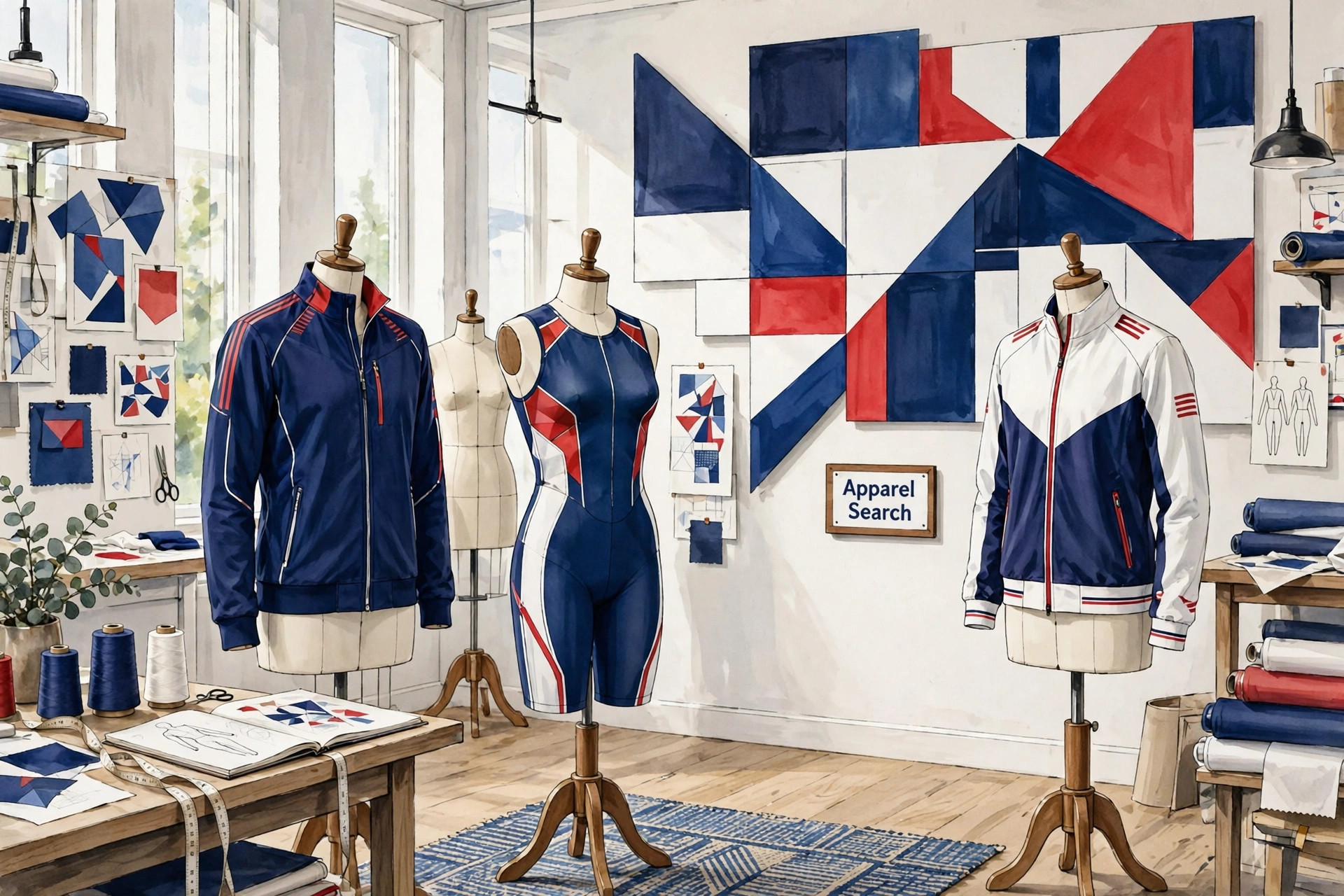
London 2012 is the Games where Olympic fashion changed its job description. For the first time in the history of the Games, a leading fashion designer — Stella McCartney, appointed by adidas — designed one country's apparel across all competitions, for both the Olympic and the Paralympic teams. The result was a kit built from a deconstructed Union Jack, supplied at a scale of more than 900 athletes and about 175,000 items of clothing, and debated in public before a single race had been run. London also began another long story: it was the first Games at which Emporio Armani dressed Italy, the start of a tenure that would still be running in Paris more than a decade later. This guide covers the appointment, the flag, the scale, and what London set in motion.
At a Glance
- The Games
- London 2012 — a home Games for Team GB, and a turning point for designer-led Olympic apparel
- Creative Director
- Stella McCartney, appointed Team GB Creative Director by adidas in September 2010
- The first
- The first time a leading fashion designer designed a country's apparel across all competitions, Olympic and Paralympic
- The design
- A deconstructed Union Jack — predominantly blue and white, with red accents
- The scale
- More than 900 British athletes supplied by adidas, with about 175,000 items of clothing
- Also beginning
- Emporio Armani's run dressing the Italian team, which started at London 2012
The Appointment
September 2010: A Designer, Not Just a Supplier
Sportswear companies had supplied Olympic teams for generations, and the arrangement was understood as a technical contract: fabrics, fits, and quantities. The appointment adidas made in September 2010 broke that pattern in a way that is easy to understate now, because it has since become normal. Stella McCartney was named Team GB Creative Director — not a consultant on a capsule, not a name attached to a ceremony outfit, but the creative director of a nation's entire apparel program.
The scope is what made it a first. The design responsibility ran across all competitions, not a single sport, and it covered both the Olympic team and the Paralympic team. A sprinter, a swimmer, a wheelchair racer, and a weightlifter would all compete inside one design system, conceived by one of the most recognisable names in British fashion. No leading fashion designer had previously been given — or had accepted — a brief of that breadth at a Games.
The appointment also carried a particular weight because London was a home Games. A host nation's kit is never only sportswear. It is worn in front of the home crowd, photographed against the home city's landmarks, and judged by a public that feels a kind of ownership over it. Putting a celebrated British designer in charge was itself a statement: the host intended its team's clothing to be part of the cultural presentation of the Games, alongside the architecture and the ceremonies, rather than a procurement line item settled quietly two years earlier.
That is the sense in which London 2012 belongs in fashion history as well as sporting history. It demonstrated that a designer could be trusted with the full technical wardrobe of a major team — and that the public, the press, and the athletes would treat the result as design, to be praised, argued about, and remembered, rather than as equipment to be issued and forgotten.
The Design
Deconstructing the Union Jack
Every ceremony and competition wardrobe begins with the same problem: how does a garment say its country in a glance? McCartney's answer began with the most obvious source available to a British designer. In her own words: "The first place to start on a project like this is to look at the Union flag." What she did with it, though, was not reproduction but deconstruction — taking the flag apart and rebuilding it as a modern graphic system.
"The first place to start on a project like this is to look at the Union flag."
The reading that emerged was predominantly blue and white, with red used as an accent rather than an equal partner. Diagonals and crosses were cropped, rotated, and abstracted across garments, so that a kit read as a contemporary sportswear design first and revealed its flag source on a second look. It was a confident, fashion-literate treatment — the approach of a designer accustomed to taking a familiar motif and making it new by editing it hard.
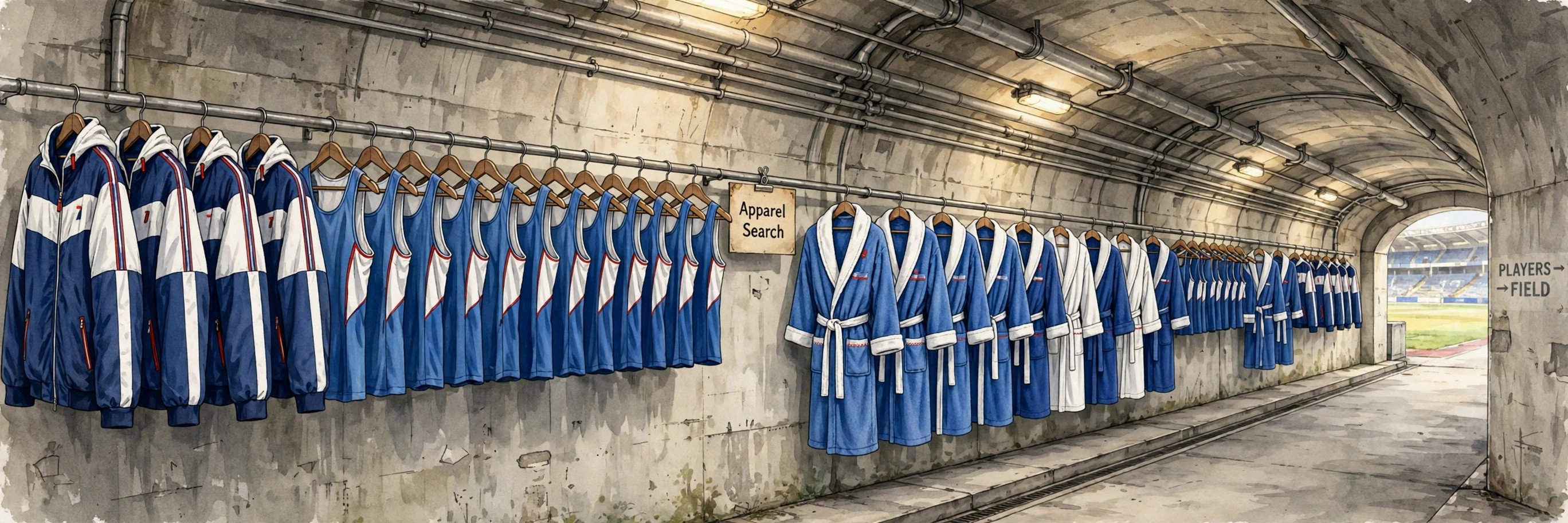
The blue-heavy reading of the flag drew public debate at the unveiling. That reaction, reported widely at the time, is worth understanding rather than dismissing. A national flag is one of the few designs a whole public believes it owns, and altering its colour balance is never a neutral act: where the designer saw a fresh, unified palette, some of the audience saw a familiar emblem with its emphasis changed. The debate was, in its way, evidence that the appointment had worked as intended — the kit was being discussed as a designed object with a point of view, in the language of design, by people who would never normally discuss sportswear at all.
There is a craft lesson in the episode that later Games kept relearning. Olympic rules tightly limit the commercial marks that can appear on athlete clothing, so ceremony and competition design has to work through colour, cut, and symbol instead of logos. A flag, deconstructed, is one of the strongest tools available — but it is also the tool the audience feels most personally. London 2012 showed both halves of that truth in a single unveiling.
The Scale
900 Athletes, 175,000 Items, One Tower
Designer-led did not mean small. The numbers behind the London kit describe an industrial operation: adidas supplied more than 900 British athletes with about 175,000 items of clothing. That figure covers the reality of an Olympic wardrobe — competition kit, training wear, ceremony and village clothing, in the full range of sizes demanded by a team that runs from gymnasts to heavyweight lifters, with spares, replacements, and the parallel needs of the Paralympic program inside the same system.
The kit was unveiled at the Tower of London on March 22, 2012 — a venue choice that underlined the national framing of the whole project. A fortress that houses the Crown Jewels is not a neutral backdrop for a sportswear launch; it placed the new kit inside the country's ceremonial geography months before the opening ceremony, and it gave the deconstructed-flag design its first public examination in the most traditional setting imaginable.
The public was part of the plan, not an afterthought. Replica kits for six sports — including football, tennis, athletics, and swimming — were sold to the public from April 2012. That retail mirror matters to the fashion story: the same design system an athlete wore in competition could be bought, worn, and kept by a supporter, which turned a team kit into one of the most widely distributed pieces of British design of that summer. The uniform had become a capsule collection with a national audience, a pattern later Games would repeat and enlarge.
Scale also explains why the creative-director model was a genuine risk. A design idea that works on a runway sample has to survive being manufactured in hundreds of thousands of units, fitted to hundreds of different bodies, and delivered on a deadline that cannot move. That the London system held together at that volume is a large part of why the model — a named designer directing a major supplier's team wardrobe — was available for other countries and other Games to copy afterwards.
There is a further dimension to the scale that the raw figures only hint at. A single design system had to remain recognisably itself across garments engineered for entirely different purposes: a marathon kit built for heat and distance, a swimming kit built for water, a ceremony outfit built for standing still and being looked at, and Paralympic competition wear built around the bodies and equipment of para-athletes. Holding one visual identity across that range — so that a viewer changing channels still knew instantly which nation they were watching — is a branding exercise as much as a clothing one, and it is the part of the London brief that most clearly anticipated the future. Modern Olympic wardrobes are now routinely conceived the same way: one identity, many technical dialects, designed from the start as a family rather than assembled as a pile of individual team kits.
The Other Tenure Begins
Italy: Emporio Armani's Run Starts Here
London 2012 was a beginning for a second designer story, quieter at the time but just as durable. It was at these Games that Emporio Armani began dressing the Italian team — the start of a run that would continue Games after Games, with Italy still Armani-dressed in Paris in 2024.
The contrast between the two stories is instructive. McCartney's London appointment was a single-Games commission that made its designer a headline; Armani's was the opening chapter of a tenure, in which a fashion house and a national team settled into a long relationship and refined a recognisable national look over more than a decade. Olympic fashion remembers both models: the celebrated one-off, and the house that becomes, in effect, part of the team's identity. London 2012, unusually, launched an example of each at the same Games — which is one more reason it repays attention as the moment the modern designer era found its footing.
Team USA in London
Ralph Lauren's Third Games — and a Controversy
The United States team in London was dressed by Ralph Lauren, in what was the brand's third Games as the team's official outfitter, after 2008 and 2010. The London wardrobe, however, became known in the United States for something other than its design: the discovery that the uniforms had been made in China set off a political firestorm at home.
The reaction had lasting consequences. A bill introduced in the Senate — the Team USA Made In America Act of 2012 — would have required the team's uniforms to be sewn or assembled in the United States. The bill did not become law, but Ralph Lauren followed its intent and rebuilt a supply chain in the United States for the Games that followed, a reset that shaped the celebrated American-made wardrobe of the Sochi Winter Games in 2014.
That episode belongs properly to the full story of the brand's tenure, told in our guide to Ralph Lauren and Team USA's Olympic uniforms. It is noted here because London was where it happened: the same Games that proved a designer could direct a nation's kit also proved that where a nation's kit is made had become a question of public consequence. Design, symbolism, and manufacture were now all part of what an Olympic wardrobe means.
The Legacy
What London Changed
McCartney's London work was not a one-Games experiment. She returned as Team GB creative director for the Rio 2016 Games, where the kit was rethought for a tropical climate — about ten percent lighter than the London kit — and a new coat of arms was developed for the team with the College of Arms. A designer returning for a second Games, and developing heraldry for a national team in collaboration with the institution that governs it, would have been an unlikely sentence before 2012. After London, it was a career path.
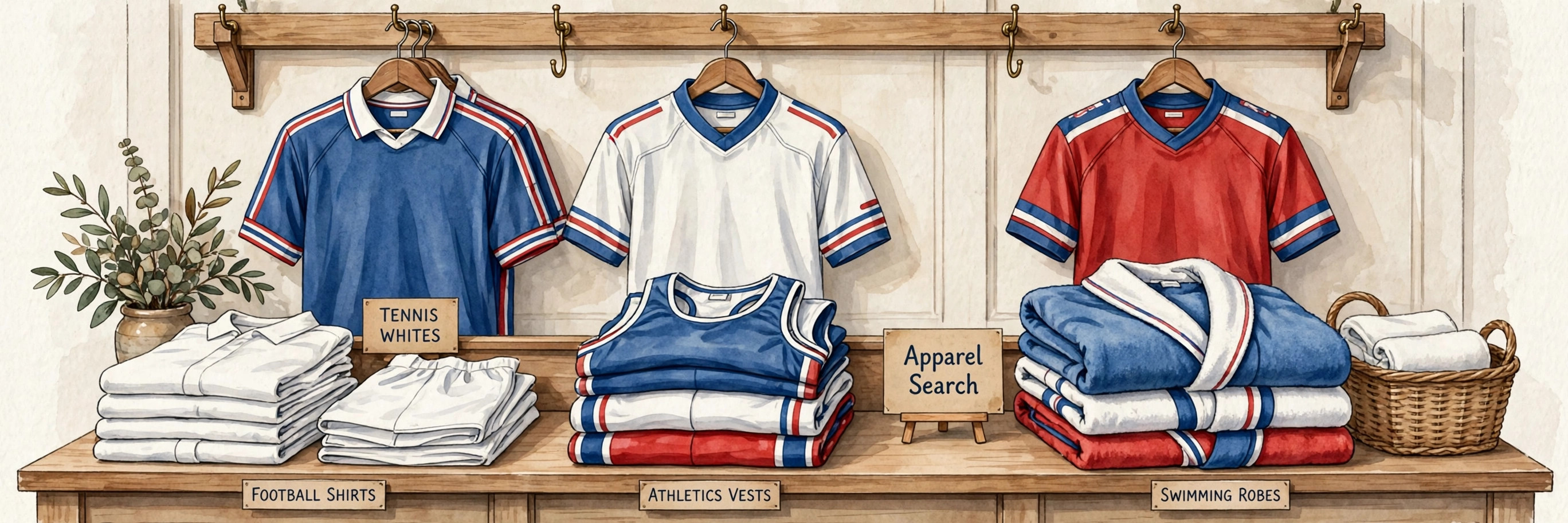
London's wider legacy is the template it left behind. A named fashion designer, appointed years ahead, directing a complete national wardrobe across every sport and both the Olympic and Paralympic teams; a national symbol treated as raw material for modern design rather than copied onto a chest; an unveiling staged as a cultural event; and a retail collection that let the public wear the same system. Paris 2024 would take the logic further, with a luxury group as a premium partner of the Games themselves — but the door Paris walked through was opened in London.
For the athletes, the change was simpler and more personal. A kit designed as a coherent wardrobe — rather than assembled sport by sport — gives a whole delegation a single visual identity, recognisable in a stadium tunnel, on a podium, and in a photograph decades later. London 2012's blue deconstruction of the Union Jack remains instantly identifiable for exactly that reason. It looked like one team, designed by one mind, for one summer — and the argument it started about how a flag should be worn has never entirely stopped, which may be the surest sign that the design mattered.
Common Questions
Questions & Answers
Who designed Team GB's London 2012 kit?
Stella McCartney, appointed Team GB Creative Director by adidas in September 2010. It was the first time in the history of the Games that a leading fashion designer designed a country's apparel across all competitions for both the Olympic and Paralympic teams.
Why did the London 2012 kit cause debate about the flag?
McCartney deconstructed the Union Jack, producing a design that was predominantly blue and white with red accents. That blue-heavy reading of the flag drew public debate at the unveiling, as reported reaction at the time.
How much kit did adidas supply for London 2012?
adidas supplied more than 900 British athletes with about 175,000 items of clothing. The kit was unveiled at the Tower of London on March 22, 2012, and replica kits for six sports were sold to the public from April 2012.
Olympic Fashion
More guides in this series — the section hub, the Paris 2024 Games, the Rio 2016 Games, and the long history of ceremony dress.
Search Apparel Search