Olympic Fashion · Rio 2016
Rio 2016: Six Teams, Six Answers
Rio 2016 gave Olympic fashion its widest field. Christian Louboutin dressed Cuba — for the closing ceremony, a distinction this guide is careful to keep. Stella McCartney returned for a second Games with Team GB, developing a new coat of arms and a kit about ten percent lighter for the tropical climate. Dsquared2 designed Canada's ceremony looks with Hudson's Bay, H&M dressed Sweden and built its flag bearer's dress partly from recycled garments, Lacoste dressed France, and Ralph Lauren reached its fifth Games with the United States. This guide takes the Rio parade team by team.
At a Glance
- The Games
- Rio 2016 — the first South American Games, and a wardrobe brief written by a tropical climate
- Cuba
- Christian Louboutin, with Sporty Henri, designed Cuba's closing ceremony outfits; the opening ceremony looks were by Puma
- Great Britain
- Stella McCartney's second Games with adidas — a new coat of arms, and a kit about 10 percent lighter than 2012
- Canada
- Dsquared2's Dan and Dean Caten designed the ceremony looks, produced with Hudson's Bay
- Sweden
- H&M dressed the team under a four-year agreement signed in 2013, covering ceremony, training and village wear
- France and the USA
- Lacoste dressed France for ceremonies, podium and village; Ralph Lauren's fifth Games dressed the United States
The Headline Act
Cuba: Louboutin at the Closing Ceremony
First, the fact that is most often got wrong about Rio 2016: Christian Louboutin designed Cuba's closing ceremony outfits. The opening ceremony looks were by Puma. Louboutin, collaborating with the French concept store Sporty Henri (SportHenri.com), dressed the Cuban team for the farewell parade — and brought a couture shoemaker's eye to a brief most designers would have treated as tailoring alone.
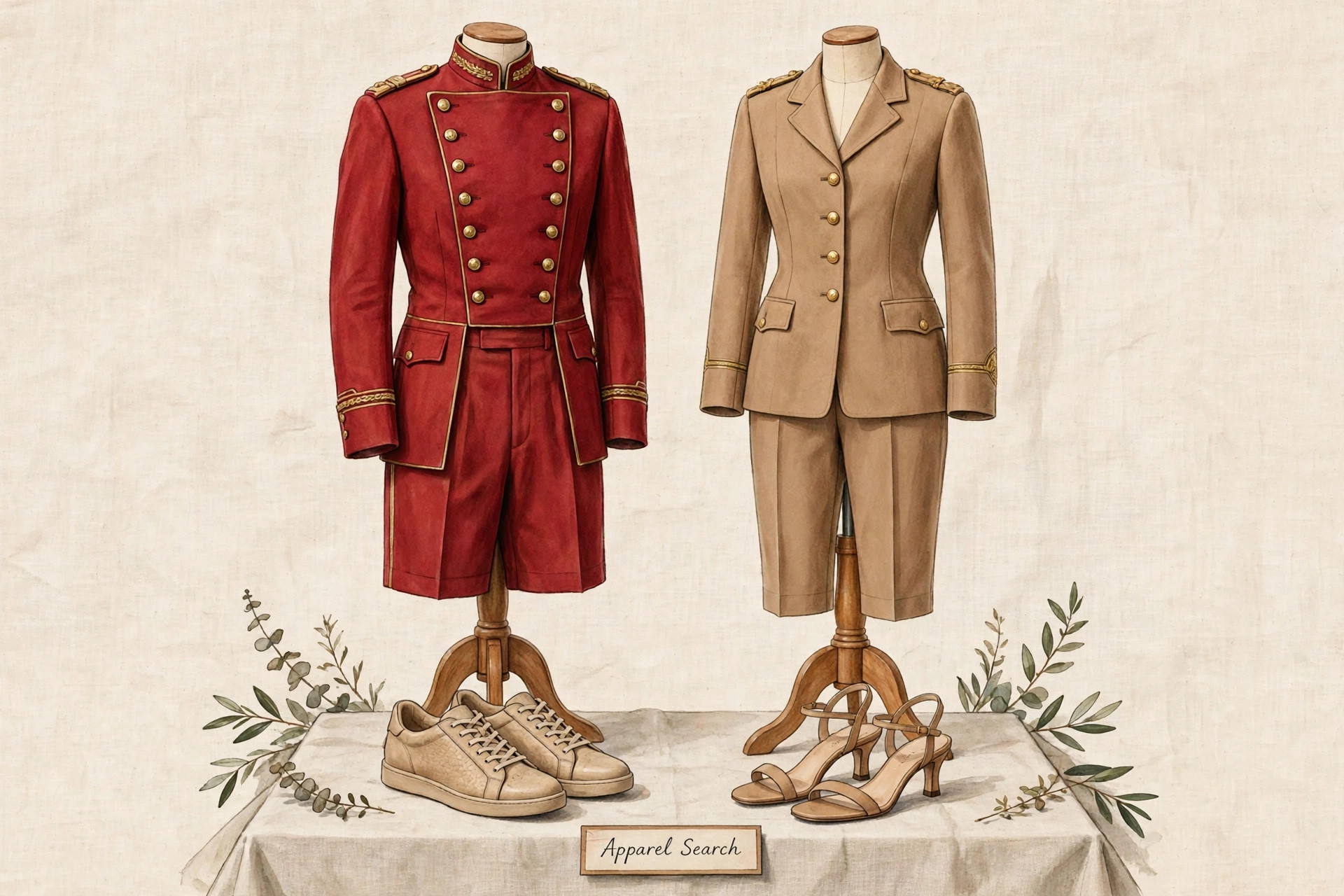
The outfits were tailored and military in style. For the men: scarlet jackets worn with longer shorts. For the women: camel tones, with capri pants. The footwear completed the design rather than merely accompanying it — calfskin sneakers for the men, and low-heeled sandals and kitten heels for the women. This was a designer whose house is built on shoes treating the shoe as part of the silhouette, and it showed in the completeness of the look from collar to sole.
The fitting story tells you what bespoke means at Olympic scale. The shoes were made to measure up to size EU 51.5, for the wrestler Mijaín López. A ceremony wardrobe must work on every body in a delegation — gymnasts and heavyweight wrestlers in the same design system — and Cuba's closing look solved the hardest end of that range the couture way: by making the shoe to the foot. In a series full of industrial-scale kit operations, Rio's Cuban wardrobe is the reminder that made-to-measure still has a place in the parade, at least at its closing end.
There is also a sequencing lesson in the Cuba arrangement. Opening and closing ceremonies are different occasions with different emotional registers — arrival and farewell — and Rio's Cuba is the clearest case in this series of a team treating them as two separate design commissions, from two different hands. Puma opened; Louboutin closed. When you picture the famous scarlet jackets, picture them at the farewell, which is where they were worn.
The closing ceremony is, in fashion terms, the freer of the two occasions. The opening parade is formal and processional: delegations enter in order, in full view, at the start of two weeks of competition, and their clothing tends toward the official. The closing is a celebration after the results are settled, with athletes mingling rather than marching in strict formation, and its dress codes have always allowed more individuality and more theatre. A tailored military jacket in scarlet, worn with longer shorts and a calfskin sneaker, is exactly the kind of garment that freer register invites — formal in its cut, relaxed in its combination, and unmistakably designed rather than issued. That Louboutin's Cuba wardrobe is remembered as one of Rio's defining fashion images, despite appearing only at the farewell, shows how much presence a closing look can carry when a real designer is given the occasion.
The Returning Designer
Great Britain: McCartney's Second Games
Stella McCartney returned as Team GB creative director for Rio 2016, her second Games with adidas after the landmark London appointment. A returning designer changes the brief: the first Games establish an identity, the second must develop it — for a different country, a different climate, and a team four years older in its expectations.
The Rio kit's signature move was heraldic. A new GB coat of arms was developed with the College of Arms — the institution that governs heraldry in England — and used across the kit. Where London had deconstructed an existing national symbol, Rio created a new one, properly, with the authority that exists to create such things. It is a remarkable detail in the history of sportswear: a fashion designer and a centuries-old heraldic body collaborating on the emblem a national team would wear into an Olympic stadium.
The engineering brief was the climate. The Rio kit was about 10 percent lighter than the 2012 kit, rethought for tropical heat. That figure captures a principle that runs through the whole craft of ceremony and competition design: the same design system cannot simply be reissued in a new place. Weight, breathability, and heat management are design decisions, and a kit that honoured London's summer would have failed Rio's. McCartney's second Games is therefore a study in adaptation — same designer, same team, same supplier, and a wardrobe rebuilt around weather and a new emblem.
North and North
Canada: Dsquared2 with Hudson's Bay
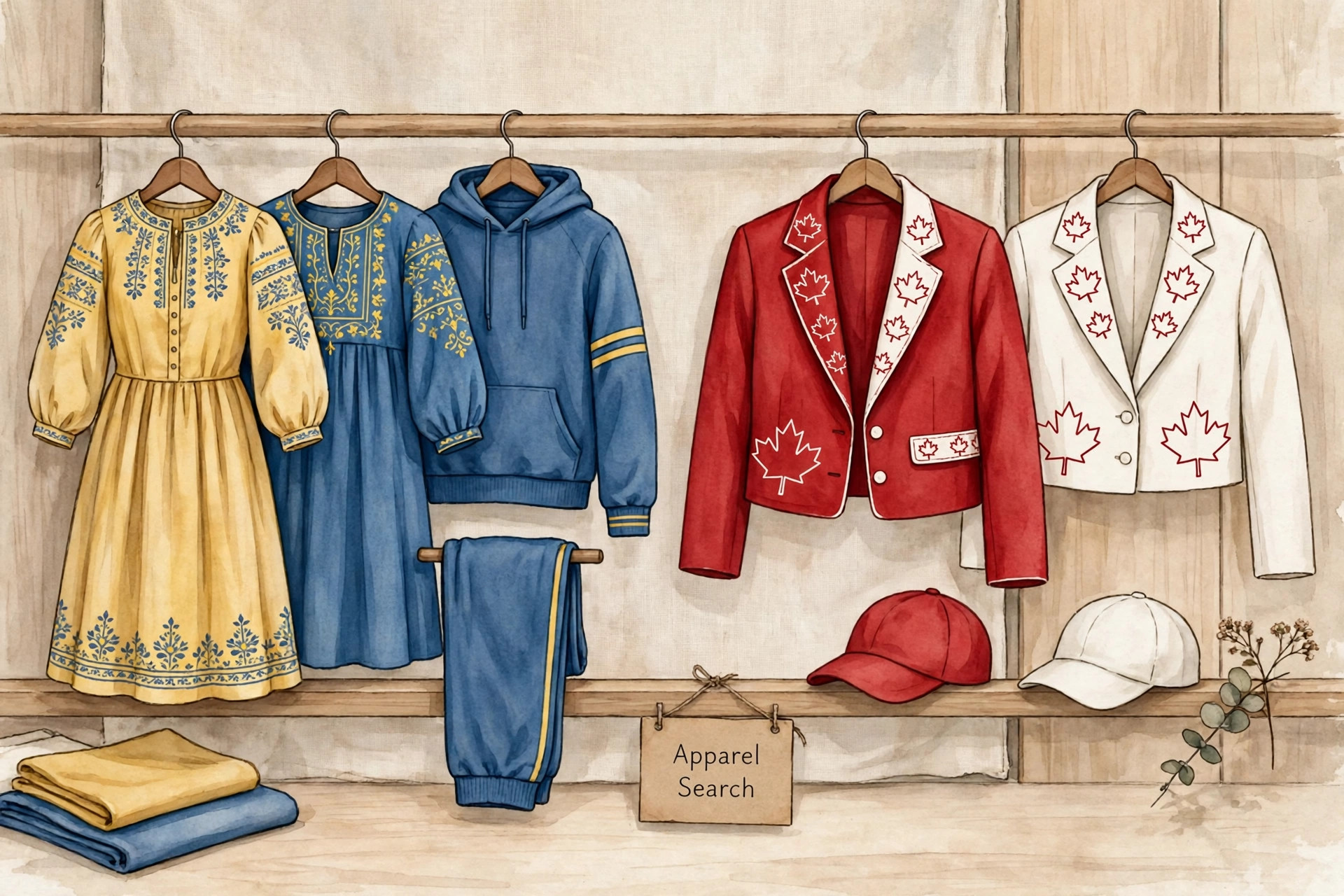
Canada's Rio ceremony looks were designed by Dsquared2's Dan and Dean Caten, and produced with Hudson's Bay — a pairing of Canadian-born fashion designers with the company that has dressed Canada at the Games, on and off, since 1936. The looks were contemporary and pared back: cropped blazers, minimalist caps, and trainers.
The combination matters. Hudson's Bay brought the institutional memory — the company whose Point Blanket Coat first outfitted Canada at the 1936 Winter Games, and whose red mittens would become a lasting Team Canada staple. Dsquared2 brought a current fashion label's silhouette. Rio's Canada is a good example of how national teams increasingly assemble a wardrobe: heritage retailer as producer and anchor, designer label as the creative hand, and a ceremony look that aims to be recognisably of its country while reading as modern fashion rather than costume. The cropped blazer, in particular, took a formal garment and cut it to the proportions of contemporary street style, which suited a young team entering a summer Games in a beach city.
The High-Street Giant
Sweden: H&M and the Recycled Dress
Sweden's Rio wardrobe came from H&M, under a four-year agreement signed in 2013 that covered ceremony, training, and village wear — the full wardrobe, from a high-street retailer rather than a luxury house or a sportswear specialist. The arrangement itself was the statement: a Swedish global retailer dressing the Swedish team, at every level of the kit.
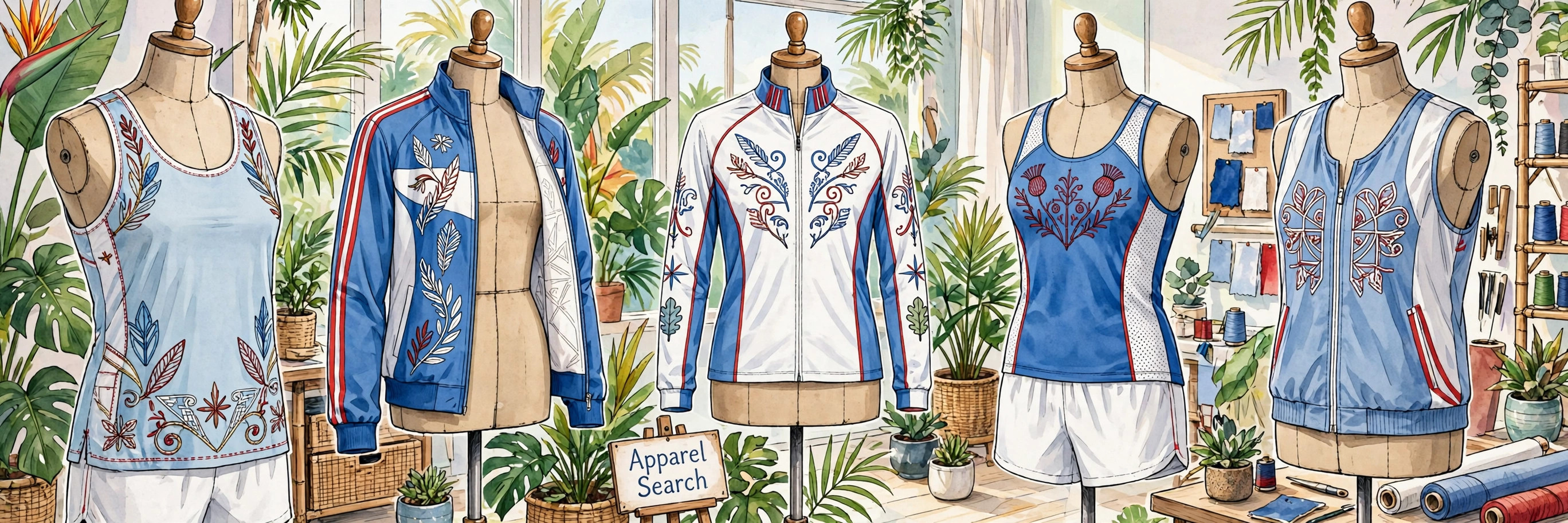
Its most telling garment was the flag bearer's dress, which incorporated fabric made from recycled garments collected through H&M's Garment Collecting Initiative. A dress worn at the head of a national delegation, made partly from the public's handed-in clothing, turned a take-back scheme into a piece of ceremony design — circularity not as a report or a label, but as the literal material of the most photographed Swedish garment of the Games.
H&M also sold a companion retail line, "For Every Victory," so the public could buy into the same design story the team wore. That retail mirror is a recurring character in this series — replica kits in London, a post-Games collection in Tokyo — and Sweden's version is notable for tying the shop floor to the sustainability story as well as the look: the same company collecting old garments, recycling them into a flag bearer's dress, and selling the companion line in its stores.
Two More Tenures
France in Lacoste, the USA in Ralph Lauren
France marched in Rio dressed by Lacoste, which outfitted the team for ceremonies, podium, and village — the full presentation wardrobe of a nation whose own fashion identity is among the strongest in the world, entrusted to one of its most recognisable home brands. The podium inclusion is worth noting: the clothes worn to receive a medal are among the most photographed garments of any Games, and Rio's France kept them inside the same design hand as the ceremony dress.
The United States, meanwhile, reached a milestone of continuity. Rio was Ralph Lauren's fifth Games as the team's outfitter, and the opening ceremony look was a crisp distillation of the brand's American register: a navy blazer, white selvedge denim jeans, and boat shoes. By 2016 the tenure that had begun in Beijing in 2008, and survived the manufacturing controversy of London 2012, had settled into a recognisable national uniform language — blazer, denim, and leisure footwear, refined Games by Games rather than reinvented.
Set the six Rio stories side by side and the Games become a map of the era's options. A couture shoemaker at a closing ceremony. A returning creative director developing heraldry. Designer twins producing with a heritage department store company. A high-street giant recycling the public's clothes into a flag bearer's dress. A home luxury-sport brand dressing France, and an American institution at its fifth Games. No two teams solved the same brief the same way — which is precisely what makes Rio 2016 such a useful Games to study.
The Lesson
What Rio Showed
Rio's first lesson is precision about ceremonies. Opening and closing are separate commissions, separate moods, and sometimes separate designers — Cuba opened in Puma and closed in Louboutin, and any account that merges the two misplaces one of the most distinctive wardrobes of the Games. The closing ceremony, often treated as an afterthought, got Rio's most couture treatment: tailored military jackets, camel and scarlet, kitten heels, and shoes made to measure to EU 51.5.
Its second lesson is climate as a design material. A kit ten percent lighter for the tropics, a flag bearer's dress built from recycled garments, boat shoes with selvedge denim for a summer parade — Rio's wardrobes were shaped by heat and place more openly than most, and they read better for it. The craft of ceremony design is partly the craft of dressing athletes who must wait and march for hours in the weather the host city actually has.
And its third lesson is range. Between London's single-designer national system and Paris's luxury-group partnership, Rio shows the field at its widest: luxury, high street, sportswear, heritage retail, and returning and first-time designers all dressing nations at one Games, each with a defensible logic. The parade in Rio was, in that sense, the most complete fashion show of the three Games in this part of the series — not because any single wardrobe outshone London's or Tokyo's best, but because so many different answers to the same question marched past, one delegation after another, in a single night.
Rio also quietly marked how normal the designer era had become in just four years. In 2012, a leading fashion designer directing a national wardrobe was a first, announced as news. By 2016, the question for a major team was no longer whether a designer would be involved, but which kind: a returning creative director refining a system, a luxury name hired for a single ceremony, a designer label paired with a heritage producer, or a retail giant treating the team as the pinnacle of its own brand story. Each of Rio's six headline wardrobes represents one of those models working as intended, and the failures of imagination at later Games are usually failures to choose a model at all. Rio chose, six times over — and the parade was richer, stranger, and more memorable for every one of those choices.
Common Questions
Questions & Answers
Who designed Cuba's Rio 2016 outfits?
Christian Louboutin, collaborating with the French concept store Sporty Henri, designed Cuba's closing ceremony outfits. The opening ceremony looks were by Puma. The closing outfits were tailored military-style jackets, scarlet for men and camel tones for women, with shoes made to measure up to size EU 51.5.
What was new about the Team GB kit at Rio 2016?
It was Stella McCartney's second Games as Team GB creative director with adidas. A new GB coat of arms was developed with the College of Arms and used across the kit, and the kit was about 10 percent lighter than the 2012 kit for the tropical climate.
What did the Swedish retailer do for its team at Rio 2016?
The Swedish retailer dressed the team under a four-year agreement signed in 2013 covering ceremony, training and village wear. The flag bearer's dress incorporated fabric made from recycled garments collected through the Garment Collecting Initiative, and the company sold a companion retail line called For Every Victory.
Olympic Fashion
More guides in this series — the section hub, the London 2012 Games, the Paris 2024 Games, and the craft of designing a ceremony uniform.
Search Apparel Search