Royal & State Fashion · Section Hub
Royal and State Fashion
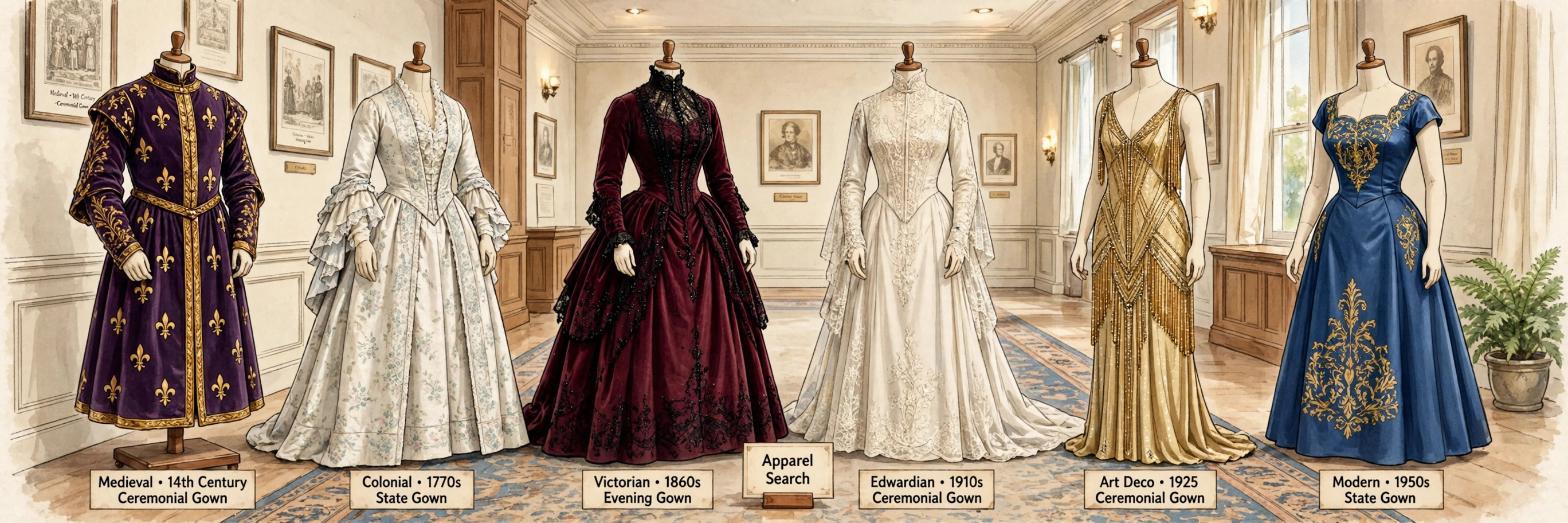
Some clothes are worn to be admired. The clothes in this section were worn to do a job: to crown a sovereign, to compliment a host nation without a word of speech, to keep a lace trade alive, to mourn in public for forty years, to put a young designer's name into the history books. This hub defines the craft those wardrobes share — state dressing — and indexes the twelve guides that document it: ten profiles of the monarchs, consorts and First Ladies who practised it, from Rose Bertin's Versailles to the re-used coronation robes of 2023, and two topic guides on the craft itself.
At a Glance
- The section
- Twelve guides: ten figure profiles and two topic guides, plus this hub
- The span
- 1774 to 2023 — Rose Bertin's first seasons at Versailles to the coronation of Charles III
- The monarchies
- Britain, the Netherlands and Spain, with historical France and Japan in the ceremonial comparison
- The First Ladies
- Jacqueline Kennedy and Michelle Obama — state dressers of a republic, covered on the same terms
- The method
- Documented record first: designers, garments and occasions traced to museums, auction houses, platforms and academics — see the honesty box below
- The designers
- Hartnell, Cassini, Bertin, Catherine Walker, Varela, Vermeulen and Taminiau, Waight Keller, Wu and Helen Rose
Search Apparel Search
Definition and Scope
What State Dressing Is
State dressing is the use of clothing as an instrument of public office. A monarch, a consort or a First Lady holds a position whose powers are largely ceremonial and whose communications are constrained — a constitutional sovereign cannot argue policy in public, and a First Lady holds no office at all — yet both are photographed more than almost anyone alive. What they wear therefore carries weight that ordinary fashion never has to bear. This section reads their wardrobes under three heads. Ceremony: the prescribed dress of crowning, mourning, weddings and state ritual, where correctness is constitutional and the garments are archived like treaties. Diplomacy: the deliberate compliment paid in cloth — a host nation's emblem embroidered on a gown, its colours worn on arrival, its designers chosen for its banquet. National-industry promotion: the patronage that keeps trades alive, from a queen choosing English lace to support a declining industry to a First Lady whose young designer is transformed overnight into an international name.
That is what separates this section from celebrity fashion, and the distinction governs every guide in it. A film star's dress is a personal and commercial choice; a state dresser's dress is a public act, made inside an institution, recorded by official photographers and court circulars, and preserved — unusually often — in museum collections where it can be checked. The wearers here were also, several of them, genuinely influential on what everyone else wore; but the section's claim is narrower and stronger: that their clothes did documented work for the states and offices they served, and that the work can be evidenced rather than merely admired.
The coverage follows the evidence. The monarchies treated in depth are Britain, the Netherlands and Spain, with historical France under Marie Antoinette and Japan appearing in the ceremonial comparison; alongside the crowned heads stand two American First Ladies, Jacqueline Kennedy and Michelle Obama, because the republican version of the craft — an official designer appointed in 1960, inaugural gowns entering the national museum — is state dressing by any honest definition. One boundary is stated plainly: Queen Elizabeth the Queen Mother, whose patronage brought Norman Hartnell into the royal fold and whose crinoline-and-pastel formula he built, is covered inside the coronation guide and the Hartnell thread of this hub, not as a standalone page — her record is one designer and one formula, and it is told whole where it belongs.
Start Here
The Two Topic Guides
Diplomatic Dressing and Signaling
The section's thesis, in one guide. How host-country emblems, colours and designers are commissioned and worn as compliments — the Royal Collection Trust's own "Diplomatic Dressing" material, the maple-leaf brooch's seventy years of Canadian service, the green of Ireland 2011, falcon embroidery for Saudi Arabia and Commonwealth flora on a wedding veil — and, just as carefully, where documented practice ends and commentator inference begins. Brooch "messages" are never Palace-confirmed, and this guide is built on that distinction.
Coronation and State Ceremonial Dress
The comparative guide to crowning clothes. Its anchor is Hartnell's 1953 dress — eight designs, the eighth chosen, the Commonwealth emblem scheme directed by the Queen herself, down to the leek imposed over the designer's daffodil and the four-leaf shamrock hidden for luck. Against it: the re-used vestments of Charles III in 2023, the Dutch investiture, Spain's crownless proclamation and Japan's sokui no rei — four answers to the question of what a state wears at its most formal moment.
The Figures
Figure Index: The Ten Profiles
| Figure | Role and dates | The hook |
|---|---|---|
| Queen Elizabeth II | Queen of the United Kingdom, reigned 1952–2022 | Norman Hartnell's emblem-embroidered coronation dress of 1953, and the bright-colour visibility doctrine run for seventy years by dresser Angela Kelly. |
| Princess Diana | Princess of Wales, 1961–1997 | Catherine Walker's working wardrobe, the 1985 Travolta dress, and the hardest impact record in the section — her own 1997 charity auction and the million-dollar auction prices since. |
| Catherine, Princess of Wales | Princess of Wales, married 2011 | Sarah Burton's McQueen wedding gown and the contemporaneously documented sell-outs — the Issa engagement dress, the Reiss Shola that crashed a website in 2011. |
| Meghan, Duchess of Sussex | Duchess of Sussex, married 2018 | Clare Waight Keller's Givenchy wedding dress and the veil embroidered with the flowers of all 53 Commonwealth countries; platform-traced impact, 2017–2019. |
| Michelle Obama | First Lady of the United States, 2009–2017 | Jason Wu's inaugural gowns of 2009 and 2013, high-low dressing as policy, and the roster's one academic measurement — David Yermack's event study. |
| Jacqueline Kennedy | First Lady of the United States, 1961–1963 | Oleg Cassini, the first official designer to a First Lady, 300-plus outfits; the Paris triumph of 1961 and the resolved story of the pink suit. |
| Queen Victoria | Queen of the United Kingdom, reigned 1837–1901 | The 1840 white wedding dress in Spitalfields satin and Honiton lace, chosen for the English lace trade — then forty years of mourning that built Whitby's jet industry. |
| Marie Antoinette | Queen of France, 1774–1793 | Rose Bertin, the "ministre des modes"; Léonard's poufs as political media; and the chemise à la reine, fashion's most consequential scandal, in 1783. |
| Queen Máxima | Queen of the Netherlands, consort from 2013 | Natan's Edouard Vermeulen as workhorse house, Jan Taminiau's cobalt investiture gown of 2013, and twenty-five years of statement hats by Fabienne Delvigne. |
| Queen Letizia | Queen of Spain, consort from 2014 | The former news anchor's formula: Felipe Varela for state formality over a Spanish high-street base — and a wedding dress by Manuel Pertegaz, not Varela. |
Grace Kelly belongs in any reader's wider tour of this territory, and Apparel Search already tells her story: the site's existing icon profile covers the actress who became Princess of Monaco. She is deliberately not a guide in this section — her state-wardrobe chapter is reached through the Helen Rose entry in the designers index below, and her profile is linked there — because this section complements the site's icon profiles rather than rewriting them.
The Makers
Designers of State: An Index
State dressing is a designer story as much as a wearer story. These are the houses and couturiers the guides keep returning to — each with the guide where their work is documented.
| Designer | Known here for | Documented in |
|---|---|---|
| Norman Hartnell | The 1953 coronation dress and the ceremonial system around it; brought into the royal fold by the Queen Mother | Queen Elizabeth II's Wardrobe |
| Oleg Cassini | First official designer to a First Lady (December 1960); 300-plus outfits and the 1961 inaugural coat | Jacqueline Kennedy |
| Rose Bertin | Marchande de modes to Marie Antoinette from 1774; Le Grand Mogol; the two-week copy embargo | Marie Antoinette |
| Catherine Walker | Diana's 1990s working wardrobe of tailored coat-dresses, and the gold-falcon gown for Saudi Arabia | Princess Diana |
| Felipe Varela | Letizia's formal and state designer, including the 2014 proclamation outfit | Queen Letizia |
| Edouard Vermeulen (Natan) and Jan Taminiau | Máxima's workhorse house, and the cobalt investiture gown of 2013 | Queen Máxima |
| Clare Waight Keller | The Givenchy wedding dress of 2018 and its 53-Commonwealth-flora veil | Meghan, Duchess of Sussex |
| Jason Wu | Both of Michelle Obama's inaugural gowns, 2009 and 2013, now at the Smithsonian | Michelle Obama |
| Helen Rose | Grace Kelly's 1956 wedding gown at MGM — the bridge between this section and the site's icon profile | Grace Kelly, Fashion Icon |
The Spine
Timeline: 1774 to 2023
| Date | Moment |
|---|---|
| 1774 | Rose Bertin begins dressing Marie Antoinette; the marchande de modes becomes the "ministre des modes." |
| 1840 | Victoria's wedding: white Spitalfields satin and Honiton lace, chosen to support the English lace trade; engravings make white the bridal default. |
| 1861–1901 | Victoria's forty years of mourning after Albert's death; Whitby's jet industry peaks at over 200 workshops and some 1,500 workers (Whitby Museum). |
| 1953 | The coronation dress: Hartnell's eighth design, its Commonwealth emblem scheme directed by Elizabeth II herself; first televised coronation, 27 million UK viewers. |
| 1961 | Cassini's Jackie: the official-designer system, and the Paris state visit dressed in French couture. |
| 1985 | The Travolta dress: Diana's ink-blue Edelstein velvet gown at the White House dinner, 9 November 1985. |
| 1997 | HALO: Diana walks a cleared minefield in Angola in ballistic vest and visor — anti-fashion as statecraft, months before the Ottawa Treaty. |
| 2009 / 2013 | The Wu gowns: Michelle Obama chooses the little-known Jason Wu for both inaugurations; the 2009 gown enters the Smithsonian. |
| 2011 | The Kate effect, documented end: the Issa engagement dress and the website-crashing Reiss Shola mark the sell-out era's start. |
| 2018 | The Givenchy wedding: Waight Keller's dress and the 53-Commonwealth-flora veil — diplomatic dressing at a wedding. |
| 2023 | Re-used vestments: Charles III is crowned in the Imperial Mantle of 1821 and George VI's robes; Camilla's Oldfield gown revives the emblem idea. |
How We Source
The Honesty Box: How This Section Treats Effect Figures
Royal fashion writing runs on big numbers, and many of them dissolve when traced. This section applies one rule to all of them: every effect figure is quoted with the body that measured it and the date, and the strength of the evidence is stated on the page where the figure appears.
The hard end of the scale is auction prices and museum records: Diana's 79-dress charity sale at Christie's in 1997 ($3.25 million, contemporaneously reported), the Travolta dress at £240,000 (Kerry Taylor Auctions, 2013), the Black Sheep sweater at $1,143,000 (Sotheby's, 2023) and Whitby Museum's workshop and workforce counts for the jet boom. The documented middle is platform and retailer reporting, quoted as self-reported: Net-a-Porter's Givenchy figures after the 2018 wedding, Lyst's search-lift percentages, Reiss's own account of the Shola sell-out in Retail Week. These are real records of what platforms said happened; they are not audited accounts, and the guides say so.
The soft end is labelled, never laundered. The famous "£1 billion a year" Kate effect is presented in this section as what it is: an unaudited press estimate that traces to Newsweek's 2012 estimate of more than $1 billion, with no published methodology behind it. Brand Finance's £150 million a year for Meghan is labelled a projection, made before the wedding it predicted. David Yermack's $2.7 billion for Michelle Obama is the roster's most rigorous figure and its most misquoted: it is cumulative abnormal stock-market value across 29 listed companies in an academic event study (NYU Stern, Harvard Business Review, November 2010) — shareholder value, not sales, with roughly $2.3 billion of it arising from a single European tour — and it is labelled as such wherever it appears. And where no measurement exists at all — for Máxima and for Letizia, no retail figures were found — the guides say that plainly instead of borrowing a neighbour's numbers. Brooch and signal "messages," finally, are presented throughout as reported interpretation by commentators, never as established fact: the documented practice of choosing emblems and colours for hosts is real, and it does not need invented ciphers to be interesting.
Common Questions
Questions & Answers
What is state dressing?
State dressing is the use of clothes as an instrument of office by monarchs, consorts and first ladies. It covers ceremony, diplomacy and national industry promotion, from emblem embroidery chosen for a host country to a designer appointment made to champion home talent. It is distinct from celebrity fashion because the wearer holds or shares public office and the clothes are part of how that office communicates.
Why do royal wardrobes matter to the fashion industry?
Because state dressers are among the most photographed people in the world and their choices are documented in unusual detail. A single documented wearing can be traced through auction prices, retailer reported sell outs and platform search data, and a long patronage can sustain a house or a craft, from Norman Hartnell at the British court to Felipe Varela in Spain and Natan in the Netherlands.
How does this section source its effect figures?
Every effect figure in this section is quoted with the body that measured it and the date. Auction prices and platform data are reported as recorded. The one billion pound Kate effect is presented as an unaudited press estimate that traces to a 2012 Newsweek estimate in dollars, and David Yermack's 2.7 billion dollar figure for Michelle Obama is labeled as stock market value from an academic event study, not retail sales.
Royal Style on Apparel Search
The site's own royal-style reading and the neighbouring sections this hub sits alongside: its princess and fashion-queen guides, the existing Jackie Kennedy icon profile, wedding traditions across cultures, the tiara definition, the Met Gala and the designer index.