Royal & State Fashion · State Dressing Profiles
Queen Elizabeth II: The Wardrobe That Worked as Statecraft
A constitutional monarch cannot make speeches about policy, argue with governments in public, or explain herself in interviews. Queen Elizabeth II, who reigned for seventy years, did much of that communicating in cloth instead. Her coronation dress mapped an entire Commonwealth in embroidery. Her day clothes were engineered — logged, rotated, weighted at the hem, dyed to be visible across a crowd fifteen people deep. Her tour wardrobes paid tailored compliments to host nations, and her jewellery carried provenance the way a speech carries footnotes. This guide documents how the wardrobe worked: the designers who built it, the dresser who ran it, and the occasions — above all Ireland in 2011 — where dressing was the diplomacy.
At a Glance
- The reign
- 1952–2022 — seventy years, the longest of any British monarch; the wardrobe had to work in every decade of it
- Principal designers
- Norman Hartnell, Hardy Amies and Ian Thomas; Stewart Parvin among her later couturiers
- The dresser
- Angela Kelly, who joined the household in 1994 and rose from Senior Dresser to Personal Assistant, Adviser and Curator of the wardrobe
- The doctrine
- Visibility: block-bright colour so that anyone in a crowd could say "I saw the Queen"
- The constants
- A Launer top-handle handbag, Anello & Davide handmade shoes with a 2¼-inch heel, a brooch chosen for the occasion
- The record
- Fashioning a Reign (2016), the Royal Collection Trust's exhibition of around 150 of her outfits across three palaces
The Founding Document
1953: A Dress That Mapped a Commonwealth
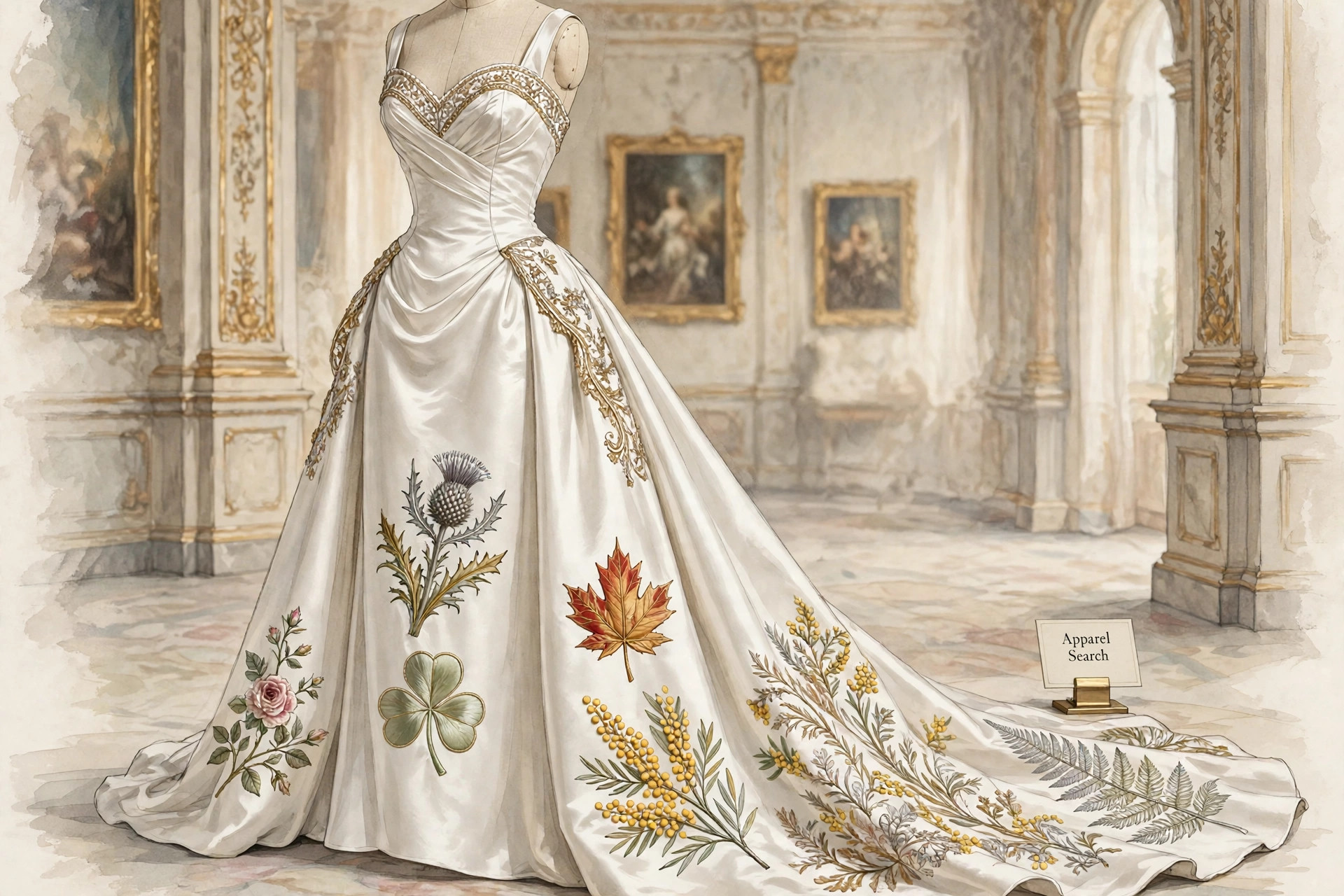
The wardrobe's founding document is a single dress. For her coronation on 2 June 1953, the Queen commissioned Norman Hartnell — dressmaker to her mother before her, and designer of her wedding dress — and the design chosen was his eighth. On its face it was a white satin gown in the full-skirted silhouette of the decade, the world our 1950s fashion history guide describes. Its meaning was in the embroidery.
Hartnell's scheme began with the floral emblems of the United Kingdom: the Tudor rose of England, the thistle of Scotland, the shamrock of Ireland and the leek of Wales. The Queen herself then intervened — and the Royal Collection Trust's account is clear that the intervention was hers. She insisted the dress speak for the whole Commonwealth, so the design was extended, worked in coloured silks at her request, to carry the emblems of the Dominions as well: Canada's maple leaf, Australia's wattle, New Zealand's silver fern, South Africa's protea, a lotus for India and another for Ceylon, and wheat, cotton and jute for Pakistan. The embroidery was executed with the Royal School of Needlework.
Consider what that dress was doing. A coronation is a constitutional ceremony, not a fashion show; every element of it is scrutinised for what it declares. In 1953 the Commonwealth was the central fact of Britain's post-war identity, and its newest head chose to wear it — literally, on her body, in gold and coloured thread — in front of the cameras that carried the ceremony around the world. Hartnell added one private stitch of his own: a tiny four-leaf shamrock, worked in secretly as a good-luck charm. The public message was statecraft; the hidden one was a dressmaker's affection. Both were in the embroidery, and the distinction between the two kinds of meaning — declared and discovered — runs through everything she wore afterwards.
The Doctrine
Colour as Policy: Being Seen
The most famous sentence about the Queen's clothes is one she apparently never said. "I have to be seen to be believed" is attributed to her everywhere — but when her biographer Gyles Brandreth put it to her, she answered: "I don't believe I ever said it. It sounds more like Queen Victoria to me." The doctrine behind the sentence, however, is thoroughly documented by the people who dressed her.
"She needs to stand out for people to be able to say, 'I saw the Queen.'"
That is Sophie, Countess of Wessex — now Duchess of Edinburgh — explaining the system in the documentary The Queen at 90: "Don't forget that when she turns up somewhere, the crowds are two, three, four, 10, 15 deep, and someone wants to be able to say they saw a bit of the Queen's hat as she went past." Angela Kelly, who ran the wardrobe for the last three decades of the reign, wrote the same doctrine from the inside in her authorised book The Other Side of the Coin: "Colour is key… Vibrant colors work well in the daytime: they allow her to stand out from the crowd and be visible to the well-wishers who have come to see her." And the Queen's own verified version of the thought, recorded by her biographer Robert Hardman, is blunter and better: "I can never wear beige because nobody will know who I am."
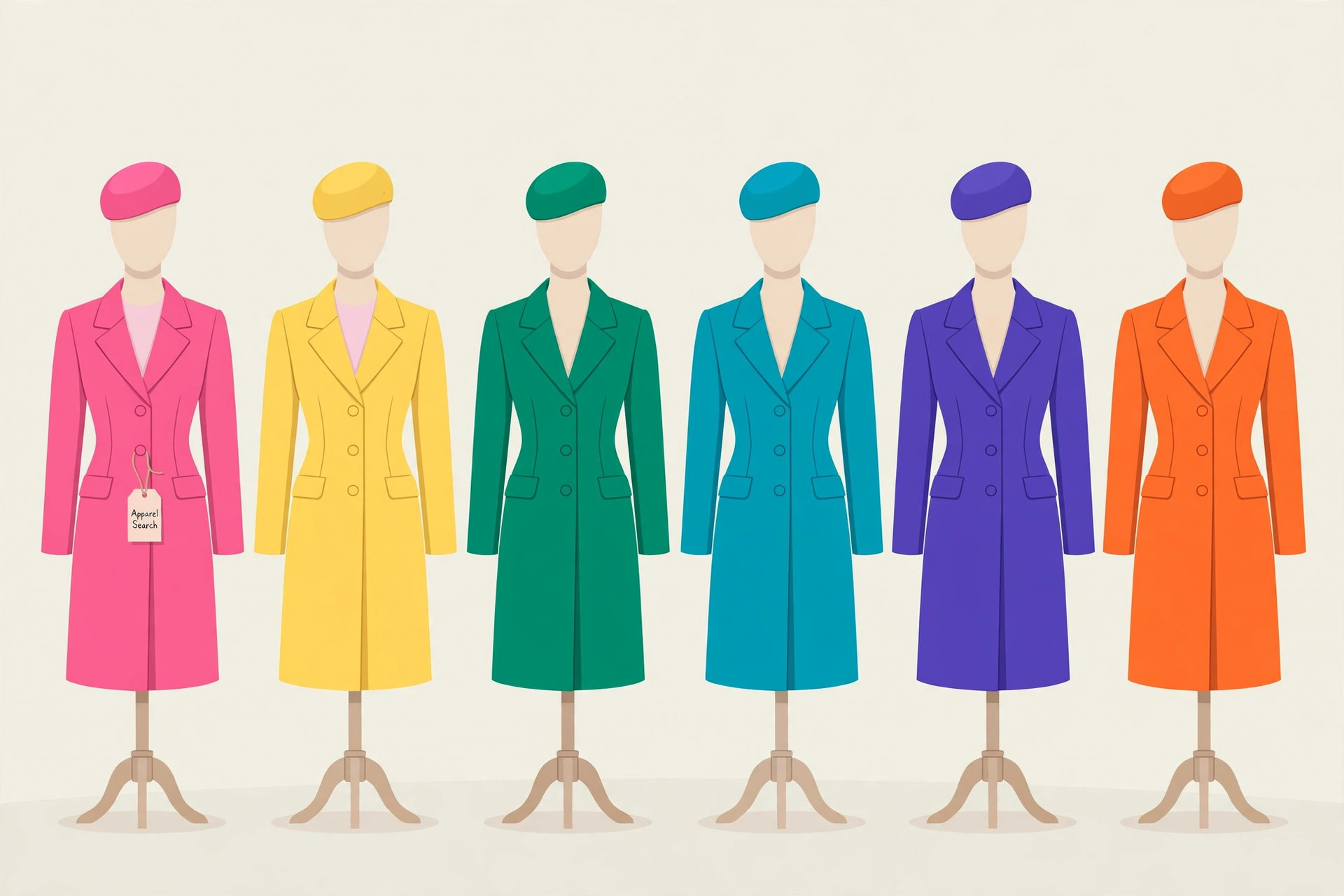
The result was the most recognisable silhouette in public life: a tailored coat in a single saturated colour — fuchsia, tangerine, lime, turquoise, violet — a matching hat engineered to frame rather than hide her face, black shoes, black bag, a brooch at the left shoulder. Caroline de Guitaut, the Royal Collection Trust's curator, made the millinery point to the New York Times in 2016: the Queen "has always been aware that she needs to stand out from the crowd, and it is for this reason that millinery has always played an important role in her wardrobe." A head of state whose job was to be looked at dressed so that looking was rewarded — at two hundred metres, in rain, on a small screen. It was not vanity. It was the uniform of an office whose power was presence.
The Operation
Angela Kelly and the Wardrobe Machine
A wardrobe used this deliberately does not run on taste alone; it runs on systems. Angela Kelly joined the Royal Household in 1994 and rose from Senior Dresser to become the Queen's Personal Assistant, Adviser and Curator (Jewellery, Insignias and Wardrobe) — the first dresser to hold the monarch's confidence publicly, with the Queen's own approval to write about the work in Dressing The Queen: The Jubilee Wardrobe and The Other Side of the Coin (2019). Her accounts describe an operation closer to a small atelier with a registrar's discipline.
Every finished dress was given a name and entered into the Queen's official wardrobe log — a detailed record of every outfit, hat and accessory worn — so that nothing repeated too soon: once a dress had been worn, it would not come out again for several months, and even colours were rested, a red worn at one engagement taking that colour off the rota for a period afterwards. Fabrics were chosen as engineering: "The fabric has to be right for the design, but it also has to perform. If an outfit is going to be worn for several hours sitting down, the material must not crease or crush easily." Skirts and coats were defended against the weather by her couturier Stewart Parvin, who sewed circular lead curtain weights into hemlines — "I just pop a couple of weights into the hemline of her dresses and coats and it makes them hang beautifully" — down to a pea-sized weight or a length of chain in a chiffon skirt. And the famous shoes were broken in by the dresser herself. "As has been reported a lot in the press, a flunky wears in Her Majesty's shoes to ensure that they are comfortable and that she is always good to go," Kelly wrote. "And yes, I am that flunky." They shared the same shoe size.
For tours, the system scaled up: ensembles were designed for the climate they would meet, and — in the Royal Collection Trust's summary of the practice — "fabric colours and embroideries are incorporated to pay subtle compliments to the host nation." The next section is about what those compliments looked like when they landed.
Diplomatic Dressing
Dressing for Hosts: The Tour Wardrobe
Karachi and Accra, 1961. The most retold tour dress of the reign began as a compliment to Pakistan: a white gown made for the state banquet in Karachi with a dramatic emerald-green pleat falling down its back — Pakistan's colours, worn in Pakistan. The same gown then travelled on to Ghana, where photographs of the Queen dancing with President Kwame Nkrumah made it one of the defining images of her Commonwealth diplomacy. One dress, two messages: respect for the host it was made for, and ease with the host it was re-worn for.
Australia, 1954. On the first tour of the reign — the first visit to Australia by a reigning monarch — Hartnell dressed the Queen in a gown embroidered with golden wattle, Australia's national flower: the coronation dress's emblem language, translated for a single host and worn in their own country.
Thailand, 1972. For the state banquet in Bangkok, her gown was made in the colours of the Order of the Royal House of Chakri, Thailand's royal order — the compliment moved from flora to heraldry, pitched at exactly the level a court would notice.
Ireland, 2011. The masterclass. The visit was the first by a reigning British monarch to Ireland since George V in 1911, and the first ever to the independent Republic — a century of difficult history carried by one itinerary. She arrived in green, dressed by Stewart Parvin. At the state banquet in Dublin Castle she wore a white Angela Kelly gown covered in embroidered shamrocks with a crystal harp — Ireland's national emblem — and the Girls of Great Britain and Ireland tiara, its very name a piece of the shared history the visit was addressing. Then she opened her speech in Irish. The clothes had already said the respectful part before she spoke. (Ireland's own gift to world dress is a humbler garment entirely — our guide to the Aran sweater tells that story.)
None of this was announced. That was the method: the compliment was in the cloth, available to anyone who looked, deniable by anyone who needed it to be. It is the clearest working definition of state dressing the modern world has produced — and it was repeatable precisely because it was a system, run by named designers and a professional dresser, not a series of improvisations.
The Brooch Drawer
Brooches: Documented Meaning, Reported Messages
If the coats were the headline, the brooch was the footnote — and the Queen's collection was an archive in itself. The pieces she reached for had provenance that can be documented, not guessed. Her most-worn brooch was the Cullinan V: an 18.8-carat heart-shaped diamond, made by Garrard in 1911 from the greatest rough diamond ever found. The most valuable was its sibling, the brooch known as "Granny's Chips" — the Cullinan III and IV stones, 94.4 and 63.6 carats — which she wore only a handful of times in seventy years. The True Lover's Knot, a diamond bow made by Garrard in 1932 for Queen Mary, came out for weddings: Princess Margaret's in 1960 and Prince William's in 2011. The Prince Albert brooch, a sapphire and diamond cluster, was a gift from Albert to Victoria on the eve of their wedding in 1840, inherited down the line of queens. And the collection kept growing by diplomacy: in 2017 Canada presented the Sapphire Jubilee Snowflake Brooch, designed as a companion to the diamond maple-leaf brooch Queen Mary had worn in 1939 and passed to her — the brooch most associated with Canadian tours.
Against that documented record, handle the famous "brooch codes" with care — this guide does. When the Queen opened Parliament in 2017 in a blue hat trimmed with five yellow-centred flowers, the press read it, widely and gleefully, as the European Union flag worn in protest at Brexit. Angela Kelly addresses it directly in her book: the hat was pure coincidence — the fabric was in stock, the background had been checked, and it never occurred to her or her milliner. When a three-brooch sequence during the 2018 Trump visit was assembled online into a coded insult, the reading was a social-media thread reported as speculation; it was never confirmed by anyone in a position to know, and one of the photographs that powered it showed a different brooch altogether. The documented truth is interesting enough: a woman who chose jewellery the way speechwriters choose words — for provenance, occasion and host — without needing the jewellery to be a cipher. (If the drawer inspires you, our brooch styling guide covers wearing one well.)
The Makers
Couturiers, Bagmakers and Shoemakers
Norman Hartnell founded the wardrobe's style. Brought into the royal fold by the Queen Mother (her dressmaker from 1940), he made the two most famous garments of the young Queen's life — her 1947 wedding dress and the 1953 coronation dress — and received his Royal Warrant as her dressmaker in 1957. Hardy Amies began designing for her with the 1950 tour of Canada and held his warrant from 1955; he gave the warrant up in 1990, though his house dressed her until 2002 — Amies brought a tailor's restraint that balanced Hartnell's grandeur. Ian Thomas, who had joined Hartnell as an assistant in 1952 and worked on the coronation robes themselves, founded his own house in 1969, took his warrant in 1973, and dressed her for more than twenty years until his death in 1992. Between them, three houses set the template every later designer — Stewart Parvin among them — inherited: immaculate tailoring, engineered fabrics, and decoration that always meant something.
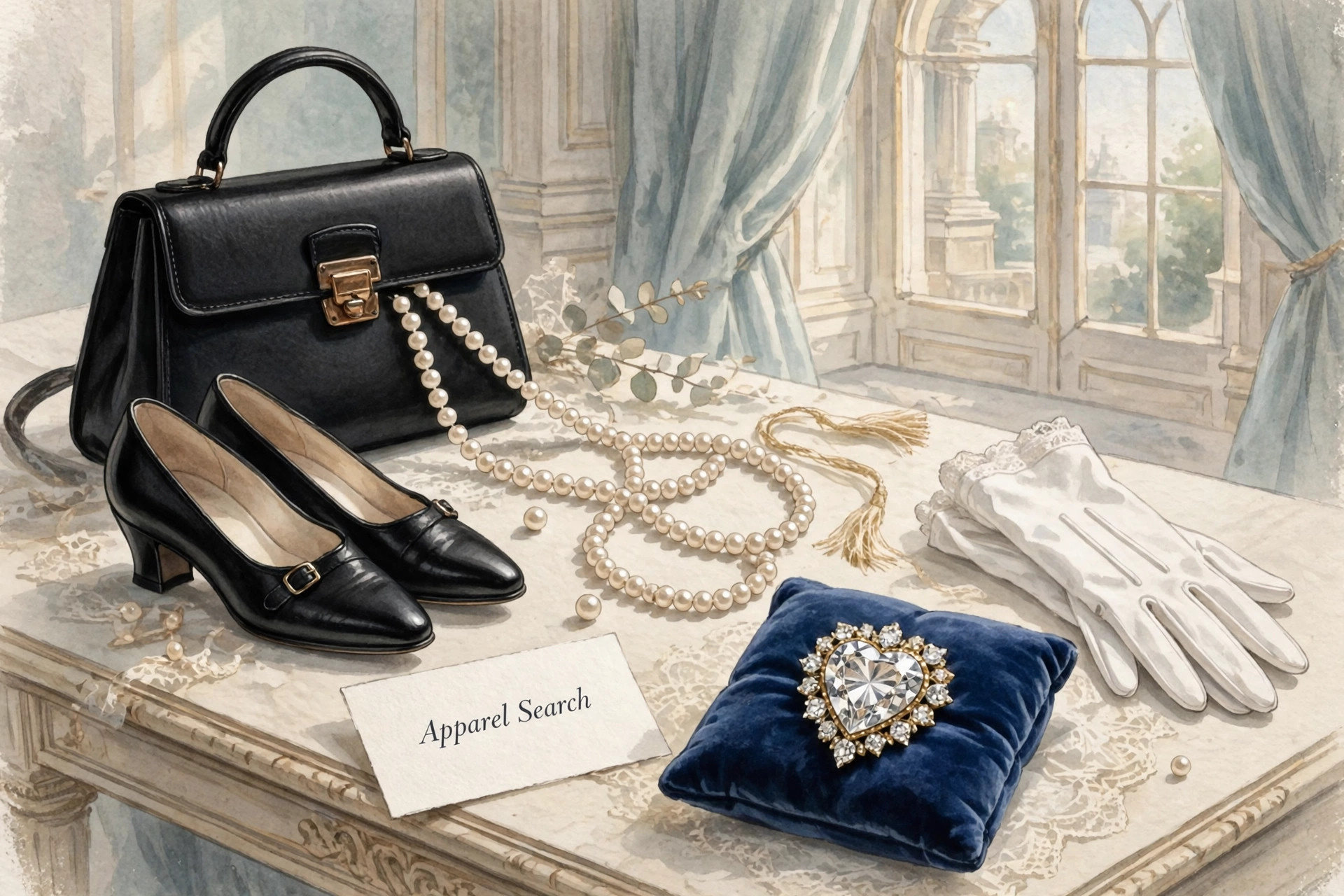
The constants came from two more warrant-holders. Launer London, holder of the Royal Warrant since 1968, supplied the top-handle handbags she carried for the rest of her life — the black leather Royale and black patent Traviata among her documented favourites; the bag was carried in the crook of the arm, held everything from spectacles to the famous lipstick, and doubled, courtiers noted, as a polite full stop to conversations. Anello & Davide made her shoes by hand from the 1970s: a classic court shoe on a 2¼-inch heel, at around £1,000 a pair, only one or two pairs a year, re-heeled and maintained rather than replaced. "The Queen doesn't waste money," her shoemaker observed. For all the statecraft, the wardrobe's economics were a housewife's: buy the best, keep it for decades, log it, rotate it, mend it.
The Record
Fashioning a Reign: The Wardrobe as Archive
In 2016, for her ninetieth birthday, the Royal Collection Trust did something no reign had done on this scale: it exhibited the wardrobe as history. Fashioning a Reign: 90 Years of Style from The Queen's Wardrobe showed around 150 outfits across the three palaces she actually lived and worked in — the Palace of Holyroodhouse in Edinburgh, Buckingham Palace in London, and Windsor Castle — from christening robes to the coronation dress to the bright coats of the final decades.
The exhibition's argument was the argument of this guide: that these clothes are primary documents. A coronation dress records a constitutional settlement. A tour gown records a diplomatic relationship. A logged, rotated, re-heeled wardrobe records a theory of monarchy itself — visibility as duty, thrift as virtue, and continuity as the whole point. When the reign ended in 2022, the wardrobe was the most complete material record any modern head of state has left of how power dresses when it is not allowed to speak. That is why it opens this section: every royal and state wardrobe since — and several before it — is measured against the standard this one set.
Common Questions
Questions & Answers
Who designed Queen Elizabeth II's clothes?
Her principal couturiers were Norman Hartnell (dressmaker to her from before her coronation; Royal Warrant 1957), Hardy Amies (Royal Warrant 1955) and Ian Thomas (Royal Warrant 1973), with Stewart Parvin among her later designers. From 1994 her wardrobe was run by her dresser Angela Kelly, who rose to become her Personal Assistant, Adviser and Curator of the wardrobe and wrote the authorised account of it, The Other Side of the Coin (2019).
Why did the Queen wear such bright colours?
Visibility was policy. As Sophie, Countess of Wessex explained in the documentary The Queen at 90, the Queen needed to stand out so that people in crowds "two, three, four, 10, 15 deep" could say "I saw the Queen." Her dresser Angela Kelly wrote that vibrant colours "allow her to stand out from the crowd and be visible to the well-wishers who have come to see her." The famous line "I have to be seen to be believed" is widely attributed to her, but she told her biographer Gyles Brandreth she did not believe she ever said it.
Did the Queen's brooches send secret messages?
Her documented practice was real: she chose jewellery with provenance and occasion in mind, from the maple-leaf brooch associated with Canada to the shamrock-covered gown and harp brooch worn in Ireland in 2011. The famous "brooch codes" — such as the claim that three brooches worn during the 2018 Trump visit formed a coded protest — are commentator speculation that was never confirmed, and Angela Kelly states in her book that the blue hat read as an EU flag at the 2017 State Opening was pure coincidence.
Royal Style on Apparel Search
The site's own royal-style reading — its princess and fashion-queen guides — plus the red-carpet and designer indexes this profile sits alongside.
Search Apparel Search