Traditional Dress by Country · Ireland
Irish Traditional Dress and the Aran Sweater
Ireland’s traditional dress is a story in two weathers. The old Gaelic world dressed in the saffron léine and the great woollen brat cloak; the modern world knows Ireland by the cream Aran sweater, its cables and diamonds knitted thick against Atlantic wind, and by tweed, linen and lace made for export and pride alike. This guide follows both stories: what Gaelic Ireland wore, how the Aran sweater was really made and sold, what its stitches are said to mean, and how Irish cloth is worn and kept today.
The Garment
From Léine and Brat to Aran
Historic Irish dress begins with two garments named in the earliest literature. The léine was a long tunic of linen, worn by men and women, often dyed a rich saffron yellow with native dye plants — saffron cloth was valuable, legislated about, and mocked by English commentators precisely because it marked Gaelic identity so clearly. Over it went the brat, a great rectangular cloak of thick wool, sometimes fringed or bordered, wrapped around the body and fastened at the chest with a brooch. Bare legs, long hair and, for men in later centuries, close-fitting woollen trews completed a look that Tudor writers described with fascinated hostility.
Under English rule and through the centuries of poverty that followed, Gaelic dress gave way to the general clothing of the poor: woollen frieze coats, flannel, shawls for women — the great black shawl of the west lasted into living memory — and homespun cloth made for use, not display. Ireland kept no parish-costume system of the Scandinavian kind. What it kept, and then sold to the world, was craft: knitting, tweed weaving, linen and lace, each rooted in a place. The Aran sweater is the most famous of them — a 20th-century classic built on older fishermen’s knitting — and it now stands, with tweed cap and jacket, as the recognised heritage dress of Ireland.
That honesty matters. Irish traditional dress is not a frozen costume; it is a working wardrobe that became an emblem. This guide treats both halves with respect: the léine and brat as history, the Aran sweater, tweed, linen and lace as living craft.
Anatomy
The Parts of the Outfit
The classic modern Irish heritage outfit, and the historic garments behind it:
- Léine — the historic tunic
- A long, full linen tunic with wide sleeves, often saffron-dyed, belted at the waist. The defining garment of Gaelic Ireland for a thousand years.
- Brat — the great cloak
- A heavy woollen mantle worn over the léine, fastened with a brooch; its thick, shaggy wool shed Atlantic rain and served as blanket as well as cloak.
- Aran sweater — the island jumper
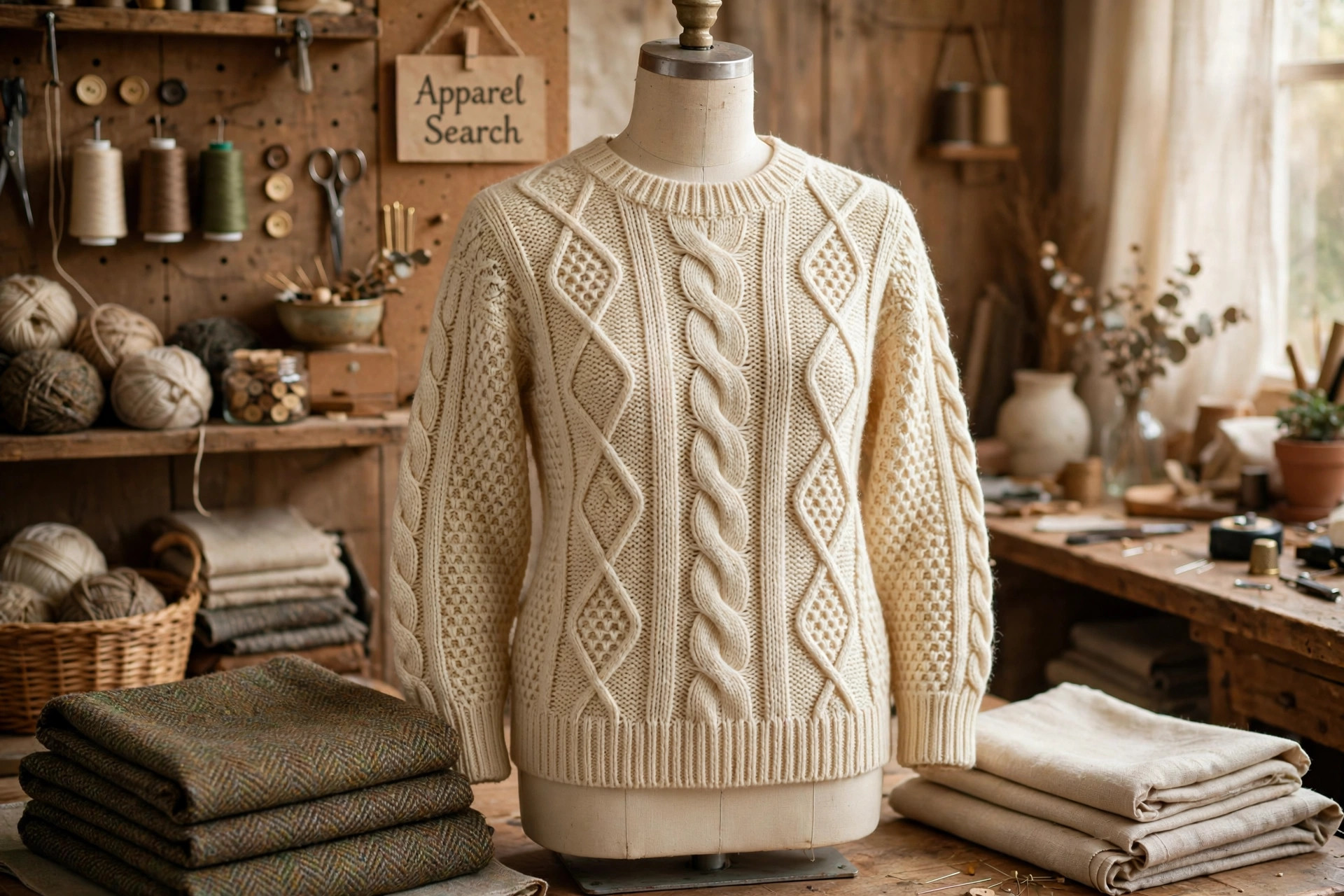
- A heavy crew-neck sweater in cream undyed wool (báinín), knitted with raised cable, diamond, honeycomb and zigzag panels, traditionally with saddle shoulders and a snug, weatherproof fit.
- Tweed jacket and cap
- Donegal and other Irish tweeds in jackets, waistcoats and flat caps — flecked, hard-wearing wool that pairs with the Aran sweater in the modern heritage wardrobe.
- Linen shirt
- The “grandad” collarless linen or flannel shirt, descendant of Ireland’s great linen industry, still sold as classic Irish dress.
- Shawl and lace
- The women’s woollen shawl of the 19th-century west, and Ireland’s fine laces — crochet, Carrickmacross, Limerick — worn as collars, christening wear and bridal detail.
The Stitches
Aran Stitches and Their Stories
An Aran sweater is read across its panels. The centre usually carries the boldest pattern, flanked by narrower stitches in a rhythm the knitter composes from a shared vocabulary:
| Stitch | Form | The story told for it |
|---|---|---|
| Cable | Twisting ropes of raised stitches | Fishermen’s ropes — safety and good luck at sea |
| Diamond | Lattice diamonds, often with moss-stitch centres | Wealth and success; the small fields of the islands |
| Honeycomb | Close hexagonal texture | The bee — hard work and its sweet reward |
| Zigzag | Sharp wandering lines | The twisting cliff paths of the islands |
| Tree of Life | Branching stems | Family, health and long life |
| Moss stitch | Speckled filling stitch | Seaweed and abundance along the shore |
Enjoy the stories, and hold them lightly. Researchers have shown that patterned gansey knitting circulated around these coasts for generations, that Aran knitters brilliantly combined and elaborated available stitches for the export market, and that the neat stitch-by-stitch “meanings” were largely written afterwards, when the sweater became famous. The craft needs no myth to be impressive: a hand-knitted Aran contains hundreds of metres of wool and weeks of skilled work.
Cloth and Pattern
Tweed, Linen and Lace
Tweed. County Donegal gives Irish tweed its name and its look: a plain or twill weave flecked with coloured slubs — tiny bursts of blue, red, orange and white yarn — said to echo gorse, heather and stone. Handweavers still work in Donegal town and Ardara alongside the famous mills, and a length of genuine handwoven tweed carries its weaver’s irregular life in a way mill cloth smooths away. Either makes the definitive Irish jacket and cap.
Linen. The north of Ireland built one of the world’s great linen industries on flax, damask weaving and finishing; Irish linen handkerchiefs, shirts and table linen became bywords for quality. The léine itself was linen — the modern linen shirt closes a very old circle.
Lace. Famine-era Ireland turned lace-making into survival income, and Irish schools of lace won world fame: three-dimensional Irish crochet, the appliqué Carrickmacross lace of County Monaghan, needle-run Limerick lace and Youghal needle lace. Our lace traditions guide in the World Textiles series sets Irish lace among the great laces of the world. Together, tweed, linen and lace are Ireland’s textile signature: practical cloths raised to art by skill.
Living Dress
Irish Dress Today
Today the Aran sweater is everyday heritage wear — sold in Galway and Dublin shops, worn through Irish winters and exported everywhere as the instantly readable sign of Ireland. Hand-knitted sweaters from island and mainland knitters command the prices their labour deserves; machine-knitted versions carry the look worldwide. Tweed thrives likewise, from traditional tailoring to fashion collaborations that cut Donegal cloth into modern coats.
Formal Irish dress adds its own notes: pipers and some regiments wear solid-colour kilts, dancers compete in elaborately embroidered dresses whose Celtic knotwork panels are a modern craft of their own, and lace still crowns christening robes handed down for generations. Behind the emblems stands a real industry of mills, knitters and makers, profiled on our Ireland clothing industry page. The through-line from brat to báinín is unbroken: Ireland dresses for its weather, in wool, and makes the necessity beautiful.
Wearing
Wearing Basics
A true Aran fits close, ends at the hip and feels reassuringly heavy — the weight is the weatherproofing. Wear it over a shirt with tweed or plain trousers and let the pattern carry the outfit; the cream báinín colour is the classic, with soft greys and greens as modern island variations. Tweed jackets want plain knitwear beneath and shoes that respect Irish rain. None of this is costume: the heritage wardrobe works because every piece still does its original job against wind and wet.
Keeping
Care and Storage
Wool Aran sweaters are washed rarely and gently — cool water, mild wool wash, no wringing — then dried flat to their measurements, since a heavy wet sweater hung up will stretch beyond rescue. Airing after wear does most of the work between washes. Store folded, never on a hanger, with cedar against moths, and rest tweed jackets on broad hangers, brushing after wear and resting them between outings. Linen improves with washing and ironing while slightly damp; antique lace is washed only by specialists, stored flat in acid-free tissue, and never folded on the same crease twice. Kept so, an Aran or a tweed jacket measures its life in decades.
Acquiring
Buying and Collecting
Buy the Aran by its wool and its making: genuine báinín or quality merino, dense even stitching, patterns that continue cleanly across seams, and — at the top of the market — a hand-knitter’s name and island or county origin. Expect hand-knitted work to cost what weeks of knitting must; very cheap “Aran” sweaters in acrylic tell their own story. For tweed, look for woven-in-Ireland cloth, check the fleck and hand of Donegal weave, and prefer jackets tailored from it over printed imitations. Vintage Irish linen and lace reward collectors who learn the lace schools’ stitches — a fine Carrickmacross collar is a museum piece that can still be worn, carefully, on the great days.
In Detail
How an Aran Is Knitted
A hand-knitted Aran begins as a fleece’s worth of yarn and a knitter’s pattern memory. The sweater is worked in panels — back, front and two sleeves — each panel composed like a page: a bold central motif, flanked by cables and fillings, the whole balanced so the pattern flows unbroken across the shoulders. Increases hide inside the pattern’s rhythm; seams are joined so the cables meet cleanly; the neck is shaped to sit flat under a coat. A skilled knitter holds dozens of stitch combinations in her head and corrects a miscount by eye, rows back, without a chart. That fluency, learned at island and mainland firesides and now taught in knitting circles worldwide, is the sweater’s real tradition — older than any printed meaning, and visible in every genuine hand-knitted piece.
Common Questions
Common Questions
What did people traditionally wear in Ireland?
Gaelic Ireland wore the léine, a long linen tunic often dyed saffron yellow, with a great woollen cloak called a brat fastened by a brooch, and later woollen trews, jackets and shawls as fashions changed. The dress visitors know today — Aran sweaters, tweed and linen — grew from Ireland’s working and export crafts of the 19th and 20th centuries.
Where does the Aran sweater come from?
From the Aran Islands off County Galway, where knitters — building on gansey knitting traditions shared around the Irish and British coasts — developed richly patterned cream sweaters in undyed báinín wool in the early 20th century. Entrepreneurs and the Congested Districts Board helped turn island knitting into an export craft, and by the 1950s–60s the Aran sweater was world famous.
Do Aran stitches have meanings?
The familiar readings — cables for fishermen’s ropes and luck, diamonds for wealth, honeycomb for hard work and its reward, zigzags for the island paths — were popularised in the mid-20th century as the sweater became famous. They are best enjoyed as a poetic sales tradition layered onto real knitting craft, not as an ancient code: stitch patterns travelled between knitting regions and books.
What is Irish tweed?
Irish tweed is a woollen cloth, most famously woven in County Donegal, flecked with coloured slubs in the weave — Donegal tweed’s speckled look comes from small bursts of contrasting yarn. Handwoven and mill-woven tweeds make jackets, caps and coats prized for warmth, durability and quiet colour drawn from the landscape.
Is the kilt traditional in Ireland?
Kilts in solid saffron or green were adopted in Ireland in the early 20th century as a nationalist symbol, worn by some pipers, dancers and regiments. They are part of modern Irish ceremonial dress, but they are not the historic everyday dress of Gaelic Ireland, whose classic garments were the léine and brat.
Keep Exploring
More to Explore
In This Series
Traditional Dress by Country
The series hub — every country guide, from the hanbok of Korea to the kilt of Scotland, as each is published.
Visit the hub ↑Ireland Clothing Industry
Ireland’s apparel and textile industry directory — the modern industry behind the traditional craft.
Explore ↑Go Deeper
Search Apparel Search