World Textiles & Traditional Crafts · Europe
Lace Traditions of Europe
Lace is cloth built from almost nothing: a needle and one thread, or a pillow full of bobbins, patience measured in years, and air left deliberately inside the pattern. This guide follows the towns that made it famous — Burano in the Venetian lagoon, Alençon in Normandy, Chantilly north of Paris and Honiton in Devon — through the dowry chests and court wardrobes it filled, the machine age that nearly ended it, and the small number of places where hands still make it today.
The Cloth
Pattern, Ground and Air
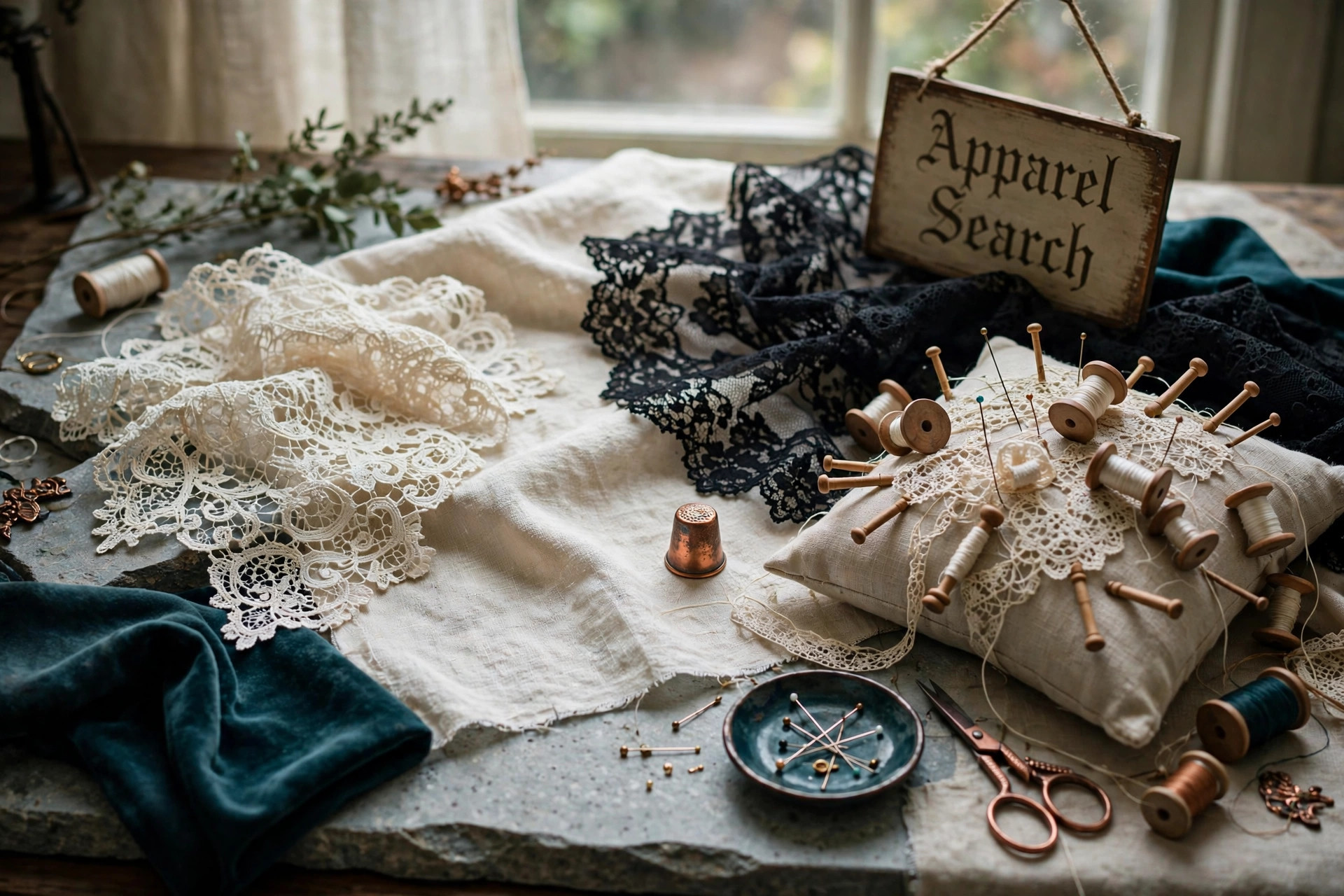
Lace is an openwork fabric in which yarn is looped, twisted or knotted into a patterned web, leaving deliberate spaces between the motifs. In one paragraph, that is the whole definition — and for the short reference version of lace types, fibre behaviour, sewing and care, Apparel Search’s lace fabric guide is the companion to this page. What a definition cannot hold is the geography: for roughly three centuries, lace was Europe’s most concentrated form of portable wealth, and particular towns became so identified with particular techniques that their names turned into the names of the laces themselves.
Two parts decide any lace’s character. The motif is the visible design — flowers, leaves, scrolls — flat or outlined with a heavier cord. The ground holds the motifs together: a fine hexagonal net, a barely visible mesh, or, in guipure, no net at all, only connecting bars.
Two Families
Needle and Bobbin
Every handmade European lace belongs to one of two families, separated by a single question: how many threads are working at once?
Needle lace — one thread, built in the air
A design is drawn and pricked on parchment; the maker builds the lace stitch by stitch with a needle and a single thread, mostly in buttonhole stitch, following the drawing, then cuts the finished work free. Venetian punto in aria — “stitches in the air” — is the famous early form, and Alençon and Burano are its heirs. Needle lace can model form almost like sculpture, with raised, padded outlines, but it is the slowest textile work in Europe.
Alençon · Burano · VeniceBobbin lace — many threads, woven on a pillow
Dozens or hundreds of threads, each wound on its own bobbin, are twisted and crossed over a pattern pinned to a firm pillow. Motif and ground grow together in one continuous web, which is why bobbin lace can be made in long, even lengths and in collaborative widths. Chantilly and Honiton are bobbin laces, as are the great Flemish laces. The work is faster than needle lace — which is a statement about needle lace, not about bobbin lace being quick.
Chantilly · Honiton · FlandersThe Towns
Four Lace Towns, Four Answers
Hand lace was never made “in Europe” in the abstract. It was made in named places, by named communities of mostly women and girls, working to local patterns with local thread.
Burano — needle lace in the Venetian lagoon
Burano, a small island a few miles from Venice, made needle lace in the Venetian tradition: designs built with a needle on a pattern, with no woven ground left in the finished piece. Britannica notes that precise early records for Burano are lacking, that its fine eighteenth-century form died out in the early nineteenth century, and that it was revived in 1872, with noble patronage, to relieve islanders after a disastrous winter for the fishing industry — an elderly inhabitant who still remembered the technique taught the local women. The island’s lace school flourished for nearly a hundred years, imitating seventeenth-century Venetian needle laces and developing a typical Burano form, before cheaper imported laces forced its closure in the late twentieth century. Its building survives as the Museo del Merletto, the Lace Museum, and some lace was still being made on the island into the twenty-first century.
Alençon — the point that UNESCO timed
Alençon, in Normandy in north-west France, gives its name to point d’Alençon, a needle lace whose motifs sit on a finely stitched net and whose outlines carry the raised, corded definition modern bridal Alençon still imitates. UNESCO’s description of the technique is the most sobering sentence in the lace world: the work takes about seven hours per square centimetre, and full mastery takes seven to ten years of training, transmitted orally and by practical apprenticeship. In 2010 UNESCO inscribed the craftsmanship of Alençon needle lace-making on the Representative List of the Intangible Cultural Heritage of Humanity — an inscription for the making, not for any single piece. UNESCO also sets out the process in stages: drawing and pricking the design on parchment, outlining, netting, pattern stitching, shading with filling stitches, decoration and embroidered relief, then freeing the lace from the parchment with a razor blade, trimming it, and polishing the filling stitches with a lobster claw.
Chantilly — black silk on a fine net
Chantilly, north of Paris, is a bobbin lace: floral motifs in half stitch on a fine hexagonal net, outlined with a flat, untwisted thread. Its fame rests on silk — first pale “blonde” silk, then, from the 1840s, matte black silk shawls. Handmade Chantilly was worked in narrow strips, invisibly joined; most lace sold under the name today is machine-made in that style, much of it on Leavers looms — a continuation of the look, honestly labelled, rather than of the hand technique.
Honiton — Devon’s royal bobbin lace
Honiton, in Devon in south-west England, made bobbin lace in which sprigs and motifs could be worked separately and applied or joined into larger pieces — a practical structure for flounces, veils and collars. Its defining moment came on 10 February 1840, when Queen Victoria married Prince Albert wearing a white satin dress with, in her own journal’s words, “a deep flounce of Honiton lace.” The Royal Family’s account confirms the dress, the Honiton flounce and the matching lace veil, and notes that Honiton lace went on to feature in a number of royal wedding dresses. The choice was a deliberate show of support for an English industry at a moment when Brussels lace was the fashionable import, and it is widely credited with giving Devon lace-making an important boost.
Beyond the famous four, the map keeps going — Flanders, the English Midlands, and dozens of smaller centres whose laces were often sold under a bigger town’s name: geography as branding, centuries before the term existed.
The Work
Lace as Livelihood: Dowries, Schools and Piece Rates
Through a museum case, lace looks like delicacy. The women who made it saw arithmetic. Hand lace was overwhelmingly women’s and girls’ work, done at home, in convents and in lace schools, fitted around a household’s other labour, and paid by the piece through merchants who supplied thread and patterns. The skill was real; the bargaining power usually was not.
Lace schools, like Burano’s of 1872, taught a marketable skill, organised the work and set standards a buyer could trust. Dowry lace worked from the household outward: a family’s stored labour, displayed at weddings, kept for christenings, moving between clothing, jewellery and savings over its lifetime. When a tradition “died out,” the arithmetic usually stopped working, daughter by daughter, until one elderly keeper of the technique remained.
Reading a price honestly
Price a handmade piece against UNESCO’s Alençon figure — hours per square centimetre, years of training — and genuine hand lace is not expensive; it is underpriced for the labour inside it. Conversely, a low price is information: it tells you a piece is machine-made, recently made for the tourist trade, or both. None of those things makes a piece worthless, but they should be described as what they are, and paid for as what they are.
The Machine Age
Leavers Looms and the Great Displacement
The nineteenth century did to lace what it did to every hand textile: it mechanised the net first, then the pattern. English engineers developed the mechanical looms at the beginning of the century — John Heathcoat’s work, improved by John Leavers, whose name the looms still carry, in the spelling “Leavers.” According to the Dentelle de Calais-Caudry federation, those machines were smuggled from Nottingham to the north coast of France in 1816, and in 1837 the Jacquard system let Leavers looms decorate plain tulle with motifs, producing lace close to the handmade version. Calais and then Caudry became the two principal centres of this exceptional machine lace.
Yet Leavers lace is itself a demanding industrial art. The federation guarantees that lace carrying its label is made on Leavers looms, and notes that France now holds about 80 per cent of the world’s Leavers looms, all in Calais and Caudry. The label began as Dentelle de Calais in 1958 and became Dentelle de Calais-Caudry in 2015 — a registered trademark reserved for Leavers lace by affiliated producers in those two towns. What the machines ended was the mass hand-lace economy of home workers; what survived was the hand craft at its highest level, kept alive as heritage, couture supply and teaching.
| Kind of lace | How it is made | What to expect |
|---|---|---|
| Hand needle lace | Needle and single thread over a pricked pattern | Slowest work; sculptural motifs; Alençon, Burano |
| Hand bobbin lace | Many bobbined threads twisted and crossed on a pillow | Continuous webs and joined sprigs; Chantilly, Honiton |
| Leavers machine lace | Intertwined threads on Leavers looms, Jacquard-patterned | Fine, supple, close to hand bobbin lace; Calais-Caudry |
| Other machine lace | Warp-knit and embroidered-net methods | Even, economical, everywhere; honest when labelled as such |
Today
Collecting, Designers and the Surviving Centres
For collectors, the discipline is description: family first — needle or bobbin, hand or machine — then ground, then fibre, and only then claims about age and town. A piece’s joins, edges and repairs tell its working life more truthfully than any certificate. Buy lace you can examine, from sellers who name technique before romance, and keep fine pieces flat in acid-free tissue — care detail lives in our lace fabric guide.
Designers never stopped using lace; they changed where it comes from. Couture and bridal houses buy Leavers lace from Calais and Caudry for its two centuries of pattern knowledge, while handmade lace now appears where its cost can be honoured: one-off bridal pieces, conservation work, museum teaching and revival workshops. The healthiest signs are institutional — a UNESCO inscription protecting the teaching at Alençon, a museum in Burano’s old school, a protected label at Calais-Caudry. Lace survived by becoming specific: about place, method and maker. That specificity is what this section records, alongside the other traditions in our World Textiles & Traditional Crafts hub.
Common Questions
Common Questions
What is the difference between needle lace and bobbin lace?
Needle lace is built stitch by stitch with a single needle and thread, usually buttonhole stitches worked over a drawn pattern, as at Alençon and Burano. Bobbin lace is made from many threads wound on bobbins, twisted and crossed over a pattern pinned to a pillow, as at Chantilly and Honiton. Needle lace tends to be slower and more sculptural; bobbin lace can grow in wider, more continuous webs.
Why is Alençon lace so expensive?
UNESCO, which inscribed the craftsmanship of Alençon needle lace-making on its Representative List of the Intangible Cultural Heritage of Humanity in 2010, puts the work at about seven hours per square centimetre, with seven to ten years of training needed to master the technique. A craft measured in hours per square centimetre cannot compete on price with any machine, and is not meant to.
Did Queen Victoria really wear Honiton lace at her wedding?
Yes. For her wedding to Prince Albert on 10 February 1840 she wore a white satin dress with a deep flounce of Honiton lace, a bobbin lace made in Honiton in Devon, and a matching lace veil. The Royal Family’s own account confirms the Honiton flounce, and her choice is widely credited with giving the Devon lace industry an important boost at a time when Brussels lace was more fashionable.
Is machine-made lace inferior?
Not automatically. Leavers looms, developed in England in the early nineteenth century, weave lace by intertwining threads in a way that comes remarkably close to hand bobbin lace, and the Dentelle de Calais-Caudry label is reserved for Leavers lace made by affiliated makers in Calais and Caudry in France. What machine lace cannot reproduce is the hand, slight irregularity and documented human labour of a handmade piece, which is what collectors of hand lace are paying for.
How can I tell hand lace from machine lace when buying?
Look closely with a magnifier. Hand needle lace shows buttonhole stitches of slightly varying tension and motifs joined by hand-worked bars; hand bobbin lace shows threads that twist and cross continuously through motif and ground. Machine lace is more mechanically regular, its net ground perfectly even. Provenance matters as much as appearance: a named place, a named maker or school, and an honest description of technique are worth more than the word antique on a label.
Keep Exploring
More to Explore
Sibling Textile Guides
World Textiles & Traditional Crafts
The section hub — every cloth tradition in this series, from mudcloth to Moroccan weaving.
Visit the hub ↑Harris Tweed & Donegal Tweed
Europe’s other protected cloth story: island handweaving, a certification mark and the law behind it.
Read ↑Navajo Weaving
Another tradition where place, wool and women’s labour define the cloth — told through its regions, not invented symbols.
Read ↑Fabric & Definition Partners
Lace Fabric Guide
Lace as a fabric to buy, sew and care for — types, performance and sewing practice.
Read ↑Fabric Guides Hub
All of Apparel Search’s fabric guides, from silk and wool to tulle and poplin.
Explore ↑Traditional Dress Partners
Search Apparel Search