World Textiles & Traditional Crafts · The Four Corners
Navajo Weaving
Navajo weaving — diyogí in the Diné language — is the textile art of the Navajo people of the Four Corners country, where Utah, Colorado, Arizona and New Mexico meet. Its blankets were prized trade goods across the Plains long before its rugs reached the world’s floors and walls, and its history holds both extraordinary artistry and real suffering. This guide treats the tradition with the respect it asks for: looms, wool and history in depth, regional styles described as what they are — geographies of palette and pattern — and no invented meanings attached to other people’s designs.
The Tradition
Blankets First: What Navajo Weavers Made, and for Whom
Begin by correcting the usual picture. Navajo weavers did not originally make rugs. They made wearing blankets — dense, weather-shedding shoulder blankets and dresses, saddle blankets and sashes — for their own communities and for wide trade. Only toward the end of the 1800s, as railways brought tourists and traders reshaped demand, did production turn decisively toward rugs for non-Native homes. The Kauffman Museum’s chronology gives the frame collectors still use: Classic Period before about 1865, Transition about 1865–1890, Rug Period about 1890–1950, when the regional styles formed, and a contemporary period since 1950.
Weaving among the Diné has traditionally been women’s work, taught within families at looms in and around the home. Technique and design judgement live in families, not pattern books, and the finest historical pieces are the work of expert makers whose names early traders and collectors usually never recorded. Modern practice is repairing that anonymity; this guide follows it, discussing every style as a place and a period, not a code.
A note on meanings
This guide deliberately assigns no symbolic meanings to motifs. Popular books are full of confident dictionaries applied to weavings whose makers were never asked. Some designs carry teachings — weavers say so themselves — but the authority on a weaving’s meaning is its weaver. What can be described honestly is structure, palette, place and period.
The Loom
The Upright Loom and the Continuous Warp
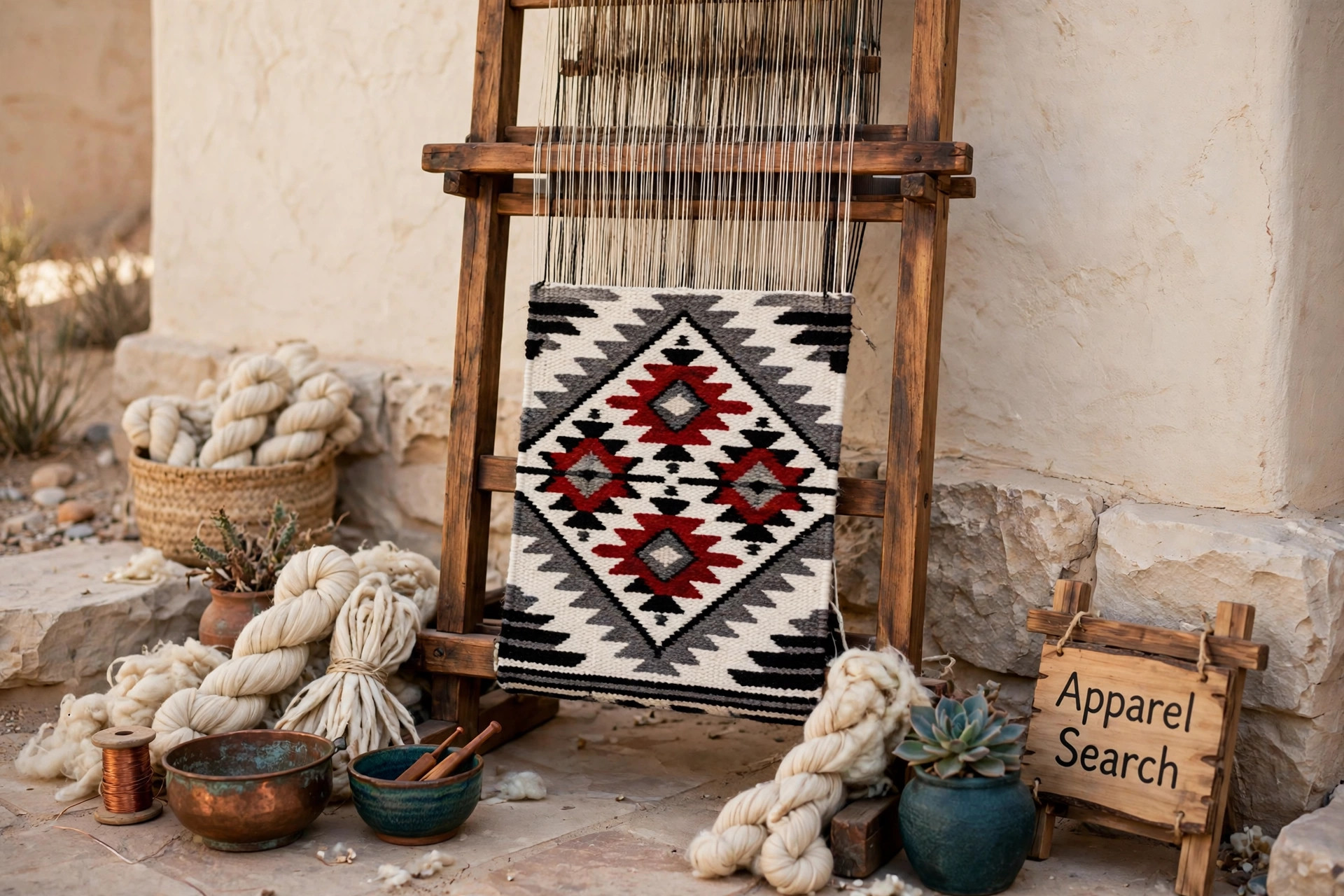
The Navajo loom is an upright frame — posts and crossbars, often outdoors — with the warp stretched vertically and the weaver seated before it, working upward. The weaving is flat tapestry weave, weft beaten down hard until it completely covers the warp, which is why finished pieces are so dense, flat and hard-wearing.
Two technical facts distinguish this weaving from its lookalikes, and both are worth learning because they are also authenticity checks. First, the warp is one continuous length of yarn, wound back and forth around the loom bars, so it does not extend beyond the weaving as fringe: a genuine piece ends in clean, self-finished edges, its warp ends woven back in, with tassels appearing only at the corners where the warping cord finishes. Second, Navajo weavers do not use the slit-weave technique common in kilims, in which adjacent colour areas separate into little slits; colour changes are managed within the tapestry structure instead. Add hand-spun yarn — spun on a hand spindle, often several times over to build strength — and you have the full technical signature: continuous warp, covered weft, no slits, no fringe.
The work is slow in the way all tapestry is slow: the design exists nowhere except in the weaver’s judgement, row by row. A large rug represents months at the loom, preceded by shearing, cleaning, carding, spinning and dyeing.
The Wool
Churro Wool: The Sheep Inside the Story
Navajo weaving is unthinkable without its sheep. The Diné built their flocks from Churro sheep of Spanish origin — Spanish records and later accounts place sheep and wool weaving in Navajo life from the seventeenth century onward — and over generations of desert herding those sheep became the Navajo-Churro: a hardy, double-coated breed whose long-staple, low-grease fleece is close to ideal for hand spinning, and which grows in a wide range of natural colours, letting a weaver build greys, browns, blacks and creams straight from the flock without a dye pot. The breed’s full fleece facts — weights, staple lengths, fibre diameters and yields — live on Apparel Search’s Navajo-Churro sheep page, and the fibre’s general behaviour is covered in our wool fabric guide; this page keeps to the wool’s role in the weaving story.
That role was nearly destroyed twice — first at Bosque Redondo, below, and again in the 1930s, when a federal livestock-reduction programme decimated the Churro flocks and the livelihoods depending on them, as Utah State University’s Museum of Anthropology describes. Recovery began in the 1970s, when animal scientist Lyle McNeal launched the Navajo Sheep Project to breed the Churro back from the brink; weaver and lifeway organisations, including Diné be’iiná (“Sheep Is Life”), carried the revival into weaving itself. Contemporary weavers raising and spinning Churro are restoring a material relationship that policy interrupted.
History
From Classic Blankets Through Bosque Redondo
How the Diné learned to weave is still discussed: Southwestern weaving technology is closely associated with Pueblo peoples, and Navajo weaving is generally understood to have developed in dialogue with Pueblo practice, with wool entering as sheep spread through the Spanish colonial world. The result is not in doubt: by the eighteenth century, Spanish colonial observers were describing the Navajo as exceptional weavers whose blankets traded far beyond their homeland.
The Classic Period’s glory is the Chief Blanket — a striped wearing blanket so prized in trade with neighbouring peoples that its name records its status. Collectors divide it into phases by design development:
| Phase | Approximate dates | Design |
|---|---|---|
| First Phase | c. 1800–1850 | Broad bands of white and dark brown or indigo stripes, the top, bottom and centre stripes often wider — design by proportion alone |
| Second Phase | c. 1840–1870 | Small red rectangles appear, set into the darker stripes at centre and ends |
| Third Phase | c. 1860–1880 | Stepped or serrated diamonds join the stripes, at the centre and quarter points of the blanket |
| Fourth Phase | c. 1870–early 1900s | The diamonds grow larger and more elaborate, rivalling and finally overtaking the stripes |
Red teaches how trade shaped the palette: strong red dye was hard to produce locally, so weavers obtained red yarn by unravelling imported red cloth — bayeta — and re-spinning its threads. The same ingenuity later took up vivid commercial Germantown yarns for the Transition Period’s “eye-dazzler” blankets.
Then came the catastrophe every honest account must centre. In 1864, after a scorched-earth campaign, thousands of Diné were forced on the Long Walk to internment at Bosque Redondo — Hwéeldi — near Fort Sumner. The Smithsonian’s National Museum of the American Indian records that by November 1864 about 8,570 people were imprisoned there, and that 2,000 internees — one in four — died and remain buried in unmarked graves. It also records what matters most here: weaving knowledge and the Churro sheep were, in Diné tribal member Ezekiel Argeanas’s words quoted there, an important part of how ancestors survived. On 1 June 1868, Navajo leaders signed the treaty that returned their people home. Weaving’s survival through Hwéeldi is part of what the art is.
After the return came the trading-post era. Traders such as John Lorenzo Hubbell at Ganado and J. B. Moore at Crystal encouraged rug production, supplied yarns and dyes, displayed favoured patterns and published catalogues — an influence both creative and narrowing, which produced the Rug Period’s geographic styles. The contemporary period has since put named individual weavers at the centre, where they had in truth always been.
Regions
Regional Styles Are a Map, Not a Code
From the Rug Period onward, weavings are commonly described by regional styles named for the communities and trading posts around which particular palettes and layouts became established. Read the names as addresses:
Two Grey Hills — natural colour, fine weave
The style of the Two Grey Hills area of New Mexico is the connoisseur’s benchmark: intricate geometric layouts in natural, undyed wool colours only — whites, greys, browns, black — often in unusually fine, tight weaving. Its discipline is its identity.
Ganado — the deep red field
Around Ganado, Arizona, where Hubbell’s post encouraged Classic-period layouts, the style is dominated by a strong red ground with black, white and grey patterning and wide borders.
Crystal — from bands to borders
Crystal, New Mexico, is associated first with J. B. Moore’s catalogue era and banded designs, and later with a softer vegetal-dye palette and border-led layouts — one regional name holding two periods.
Teec Nos Pos — colour at full stretch
Teec Nos Pos, near the Four Corners, names the most expansive style: large weavings, wide elaborate borders, dense multicoloured patterning filling the field.
Chinle, Wide Ruins and the vegetal revival
Chinle, Arizona, is linked with the mid-century revival of plant dyes and softer, banded layouts without heavy borders; nearby Wide Ruins is named in the same vegetal-dye conversation, with fine, closely banded designs. Alongside the geometric regionals sit pictorial weavings — trains, flags, daily life — and the bordered “storm pattern” type sold under that trader-era name. In every case the honest description is the same: this palette, this layout, this place, this period.
Today
Collecting Honestly and the Living Tradition
Navajo weaving today is a living art practised by named artists, many from weaving families generations deep — Classic revivals, regional styles, pictorials and contemporary work answering to no regional label. Weavers are also more mobile and independent of any single trading post than their Rug Period predecessors, and many combine or depart from regional conventions; style names now describe pattern families as much as birthplaces. Buy the weaver and the work, not the label.
Collecting honestly starts with attribution. Ask who wove the piece; favour sellers — weavers and families, cooperatives, established trading posts, reputable galleries — who can answer. Expect months-long hand work to be priced like it, and treat cheap “Navajo-style” rugs as what they usually are: imported imitations. A genuine Navajo weaving is woven by a Navajo weaver; honest marketing says so plainly. Keep weavings out of harsh light, roll rather than crease, protect from moths, and use historic-textile specialists for cleaning valuable pieces.
The tradition’s centre of gravity is where it has always been: in Diné homes, at upright looms, with wool increasingly from restored Churro flocks. The rest of us are guests in that story. See also our Mayan weaving guide and the World Textiles & Traditional Crafts hub.
Common Questions
Common Questions
What makes Navajo weaving technically distinctive?
Two things above all. The weaving is a flat tapestry weave worked on an upright loom, and its warp is one continuous length of yarn that does not extend beyond the weaving as fringe, so a finished blanket or rug ends in clean, self-finished edges with tassels only at the corners. The slit-weave technique common in kilims is not used. Together with hand-spun wool and a weaver’s control of every row, that structure gives Navajo textiles their density, flatness and durability.
What are the Chief Blanket phases?
Collectors divide the classic striped wearing blankets called Chief Blankets into phases by how their design develops. First Phase blankets (about 1800 to 1850) are bands of white and dark stripes alone. Second Phase blankets (about 1840 to 1870) add small red rectangles within the stripes. Third Phase blankets (about 1860 to 1880) add stepped or serrated diamonds at the centre and ends of the wide stripes, and in Fourth Phase work the diamonds grow until they rival or overtake the stripes. The phases overlap in date because individual weavers adopted changes at different times.
What do the patterns on a Navajo rug mean?
Treat simple symbol dictionaries with suspicion. The named regional styles, such as Two Grey Hills, Ganado, Crystal and Teec Nos Pos, are geographic: they describe the palettes and pattern layouts associated with weaving communities and their trading posts, not a code of fixed symbol meanings. Individual weavers make individual choices, some designs are family or personal, and weavers themselves are the proper authority on what a particular weaving of theirs carries. This guide therefore describes patterns by place, period and structure rather than assigning meanings to motifs.
Why does Churro wool matter to Navajo weaving?
The Navajo-Churro is the sheep breed the Diné developed from Spanish Churro stock, with a long-staple, low-grease, double-coated fleece that hand-spinners and weavers prize: it spins strong, takes dye well and also provides a wide range of natural fleece colours. Federal livestock reduction in the 1930s devastated the flocks, and the Navajo Sheep Project, begun in the 1970s, led the breed’s recovery. Our Navajo-Churro sheep page gives the breed’s fleece facts in full.
How can I buy a Navajo weaving responsibly?
Buy from the weaver, a weaver’s family or cooperative, or a reputable trading post or gallery that names the weaver, and expect to pay for months of hand work. Ask who wove the piece, where, and from what wool. Be wary of imported imitations marketed in a Navajo style: a genuine Navajo weaving is made by a Navajo weaver, and honest sellers say plainly which pieces are and are not. A weaving with a maker’s name attached is worth more, in every sense, than an anonymous one.
Keep Exploring
More to Explore
Sibling Textile Guides
World Textiles & Traditional Crafts
The section hub — every cloth tradition in this series, from mudcloth to Moroccan weaving.
Visit the hub ↑Mayan Weaving of Guatemala
The Americas’ other great loom tradition: backstrap looms, brocade and jaspe ikat.
Read ↑Lace Traditions of Europe
Another tradition of women’s handwork, town-named styles and honest collecting.
Read ↑The Wool Story
Navajo-Churro Sheep
The breed behind the weaving: fleece weights, staple lengths and fibre facts from sheep research.
Read ↑Wool Fabric Guide
Wool as a fibre — what it is, how it performs, and how to buy and care for it.
Read ↑Fabric Guides Hub
All of Apparel Search’s fabric guides in one place.
Explore ↑Traditional Dress Partners
Search Apparel Search