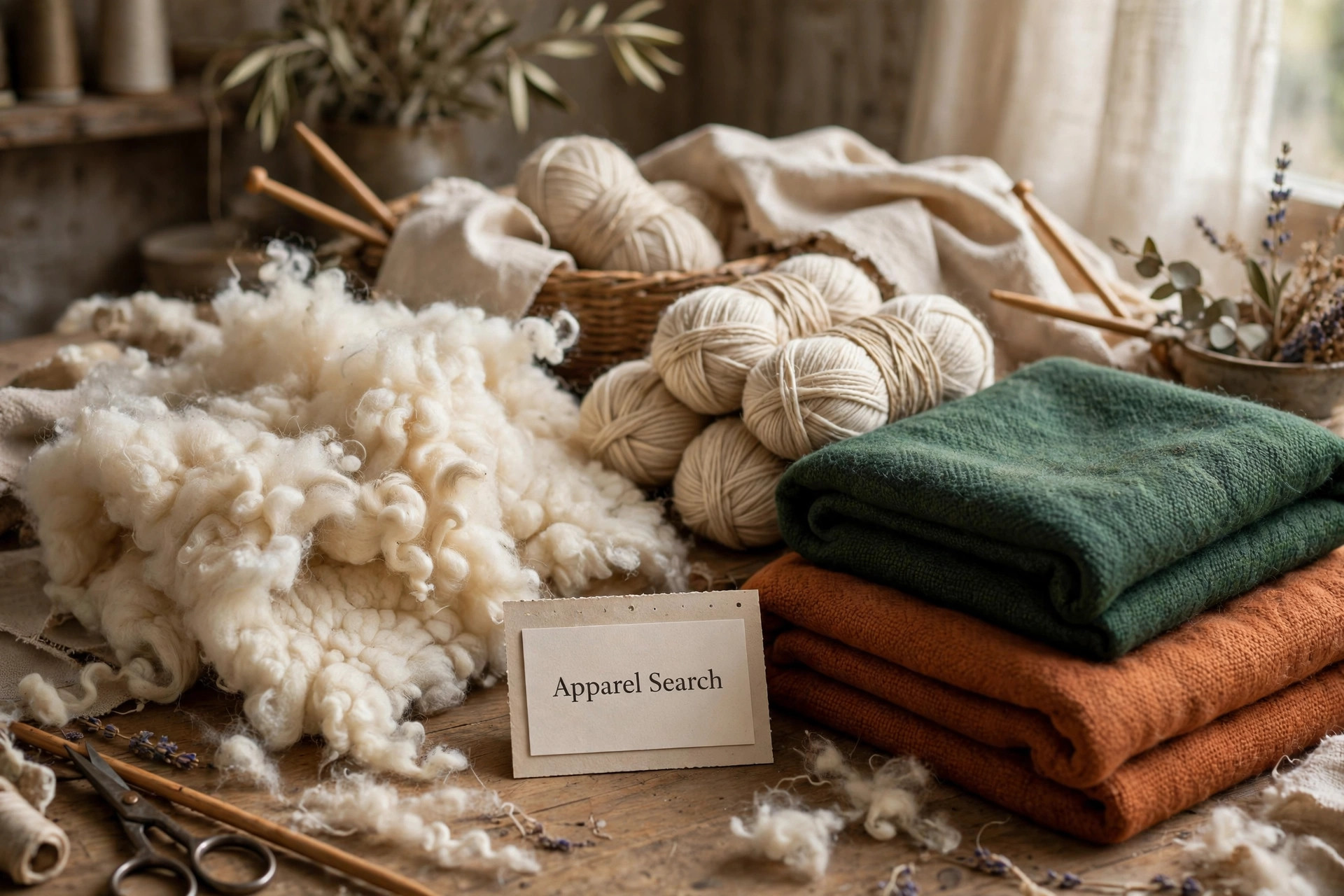
Wool is the original performance fiber - warm without weight, comfortable across a wide range of temperatures, and resilient enough that a good wool garment can serve for decades. Yet "wool" on a label covers an enormous range: the fiber of a fine merino base layer and the fiber of a rugged carpet are both wool, and they behave almost nothing alike. This guide explains where wool comes from, how it is graded by fineness, the difference between worsted and woolen cloth, what wool does well and where it needs care, and how to choose and look after it.
01 / The fiber
What Wool Is
Wool is a protein fiber - keratin, the same material as hair - grown by sheep and several other animals. In trade and labeling, wool from goats (cashmere and mohair), rabbits (angora), alpacas and camels belongs to the same family of specialty hair fibers, but the great majority of the world's wool comes from sheep, and sheep's wool is what this guide chiefly covers. Each fiber grows with a natural wave called crimp and a surface of tiny overlapping scales. The crimp traps still air, which is where wool's warmth comes from; the scales explain both wool's ability to felt and its soft springiness underfoot and in a sweater.
The journey from sheep to cloth runs: shearing, then scouring to wash out lanolin (the natural grease) and dirt, then carding to open and align the fibers. From there the road forks. Woolen yarns are spun from carded fiber with the fibers still jumbled, giving soft, lofty, slightly fuzzy yarn. Worsted yarns are additionally combed, which removes the short fibers and lays the long ones parallel, giving smooth, strong, sleek yarn. That fork - woolen versus worsted - decides whether the finished cloth is a fluffy tweed or a polished suit fabric.
Wool quality is graded above all by fineness, measured in microns - millionths of a meter - as the average diameter of the fibers. Finer fibers bend easily, so they feel soft; coarser fibers are stiffer, hardier and can prickle. Merino, the benchmark fine apparel wool, is graded from strong (broad) wool at about 23 to 24.5 microns, through medium at 19.6 to 22.9 and fine at 18.6 to 19.5, to superfine at 15 to 18.5 and ultrafine at 11.5 to 15 microns. Coarser wools above that range go to outerwear, upholstery and carpets, where durability matters more than next-to-skin softness.
02 / Performance
How Wool Feels and Performs
Wool insulates because crimped fibers hold pockets of still air, and it insulates intelligently: the fiber absorbs moisture vapor from the skin and releases a small amount of heat as it does so, which is why wool feels warm the moment you put it on and why it stays comfortable as temperatures swing. Wool can take up a substantial amount of moisture before it feels damp, and it breathes that moisture back out as conditions dry. It is naturally elastic and resilient - fibers bend and spring back - so wool garments resist wrinkles and recover their shape. Wool is also naturally flame resistant: it chars rather than melting and tends not to sustain a flame, one reason it is used in blankets and upholstery. And because the fiber's surface discourages the bacteria that cause odor, wool clothing can be worn repeatedly between washes.
Strengths
- Warm for its weight; comfortable across seasons
- Absorbs moisture vapor without feeling wet
- Elastic and resilient - resists wrinkles, keeps shape
- Naturally flame resistant and odor resistant
- Renewable and biodegradable fiber
Trade-offs
- Can felt and shrink with heat, water and agitation
- Coarse grades prickle against bare skin
- Vulnerable to clothes moths in storage
- Weaker and heavier when wet; slow to dry
- Fine grades cost more than most fibers
03 / Varieties
Common Types of Wool
- Merino wool - the fine wool of the Merino sheep, graded by micron as described above. Superfine and ultrafine merino make next-to-skin base layers, fine knitwear and luxury suiting; medium merino makes everyday sweaters and socks. See the merino wool definition for the grade table.
- Lambswool - wool from a young sheep's first shearing. The fibers are short, fine and naturally tapered, so lambswool knitwear feels especially soft and smooth.
- Shetland wool - from the hardy Shetland sheep of Scotland's Shetland Islands; a medium, slightly rustic wool used for characterful knitwear and tweeds.
- Highland and crossbred wools - medium and strong wools from meat-and-wool breeds; the backbone of tweeds, blankets, outerwear cloth and carpets.
- Cashmere - the fine undercoat of the cashmere goat, softer and lighter than sheep's wool and considerably more delicate; covered in full in our cashmere fabric guide.
- Mohair, alpaca and angora - specialty hair fibers: mohair from the Angora goat adds luster and resilience to suiting and knitwear; alpaca is soft, warm and silky; angora from the Angora rabbit is exceptionally soft and fluffy, usually blended for strength.
- Virgin (new) wool and recycled wool - "virgin wool" means wool spun for the first time, never previously woven or worn. Recycled wool is reclaimed from pre- or post-consumer cloth, shredded back to fiber and respun - a long-established practice that saves fiber but shortens it, so recycled wool is often blended with new fiber.
04 / Construction
Wool Fabrics and Weaves
Worsted cloth, woven from combed long-staple yarn, is smooth, dense and clean-finished: suiting gabardine and tropical wool, fine flannel's smoother cousins, and the sharp creases of tailored trousers. Worsted fabrics drape precisely and show weave patterns crisply, which is why tailoring is built on them. Woolen cloth, woven from carded yarn, is softer, bulkier and warmer for its weight: tweed with its flecked, rustic surface, cozy flannel, melton for coats, and the brushed cloth of blankets. The same sheep can stand behind both - the preparation of the yarn, not the fiber alone, sets the character.
One tweed stands apart in law as well as character: Harris tweed, which by Act of Parliament must be handwoven by islanders at their homes in Scotland’s Outer Hebrides from pure virgin wool dyed and spun there. Its story, and its Irish cousin Donegal’s, is told in Harris Tweed & Donegal Tweed, part of our World Textiles series.
Knitted wool ranges from fine merino jersey in base layers to chunky Aran and Fair Isle sweaters, ribbed socks and watch caps. And wool can skip yarn altogether: felt is made by matting the fibers directly - hot water, soap and pressure lock the scales together - producing the dense, edge-stable cloth of hats, craft felt and industrial uses. When a label just says "wool," ask which construction you are holding: a worsted suit, a woolen coat and a merino base layer are three different tools for three different jobs.
05 / Buying
How to Choose Wool
Start with fineness. For anything worn against the skin - base layers, scarves, fine sweaters - look for merino described as superfine or with a stated micron count in the high teens or below; the lower the micron, the softer the feel. For outerwear, blankets and rugs, medium and strong wools are not a compromise but the right choice: they wear harder, resist pilling better and cost less. On tailored clothing you may meet "Super" numbers (Super 100s, Super 120s and so on): higher numbers indicate finer worsted yarns and a smoother, lighter cloth, with the trade-off that very fine suiting needs gentler treatment than a workhorse flannel.
Then read the blend. Wool is often blended on purpose: a little nylon makes socks and gloves far more abrasion-resistant; elastane helps knits keep their shape; and wool-polyester blends lower the price and add wrinkle resistance while keeping much of wool's warmth and hand. Percentages tell you how much of wool's character survives. Finally, check the care label before you buy - if a garment must be dry cleaned and your life needs machine washing, choose a machine-washable (felting-resistant treated) wool instead, and let the routine fit the wardrobe rather than the other way round.
06 / Care
Caring for Wool
Wool needs less washing than most fibers - airing a garment overnight refreshes it, and spot-cleaning handles many marks. When washing is needed, use cool water, a gentle cycle or hand wash, and mild detergent; keep heat and agitation low to avoid felting, reshape the garment and dry it flat, since wet wool is heavy and stretches on a hanger. See the fabric care guide for the full routines by fabric.
Storage is wool's other care frontier. Clothes moth larvae feed on wool - especially wool put away with body oils or food stains on it - so always store wool clean and fully dry, sealed in a closed box or garment bag. Cedar and lavender are useful deterrents, but clean and sealed beats scented and open. Fold knitwear rather than hanging it, and your wool will come out of storage ready to wear.
Wool at a Glance
Common Questions
Does wool shrink in the wash?
It can. Wool fibers are covered in tiny scales, and heat, water and agitation together make those scales lock into each other - the felting that shrinks and stiffens a wool garment. Wash wool cool and gentle, or choose machine-washable wool that has been treated to resist felting, and dry it flat rather than hanging it wet.
Is merino wool itchy?
Fine merino usually is not. Prickle comes from coarse fibers that are too stiff to bend against the skin. Superfine and ultrafine merino fibers are so thin that they flex instead of pricking, which is why fine merino is used for base layers worn directly on the skin. Coarser wools are better kept to outer layers.
What is the difference between wool and cashmere?
Cashmere is one member of the wool family - the fine undercoat down of the cashmere goat, at roughly 14 to 19 microns. Sheep's wool covers a much wider range, from ultrafine merino that rivals cashmere to coarse carpet wools. Cashmere is softer and lighter for its warmth; sheep's wool is generally more resilient, more elastic and less expensive.
How do you protect wool from moths?
Moth larvae feed on wool, especially wool stored with body oils and food stains on it. Always store wool clean, fully dry, and sealed in a closed container or garment bag; cedar and lavender help deter moths but clean, sealed storage is the real protection. Check stored pieces a few times a year.
More to Explore
Explore more: Fabric Directory | Fabric Industry Guide