World Textiles & Traditional Crafts · Scotland & Ireland
Harris Tweed & Donegal Tweed
Two island tweeds, two kinds of protection. Harris Tweed, from Scotland's Outer Hebrides, is the only cloth whose definition is written into an Act of Parliament — handwoven by islanders at their homes, from wool dyed and spun on the islands, and stamped with the Orb. Donegal tweed, from Ireland's north-west, guards a different treasure: the fleck of bright colour spun into its yarn. This guide follows both cloths step by step from fleece to finished length, through crofter sheds and Donegal mills, to the catwalks that keep rediscovering them.
The Cloth
Tweed Before the Law
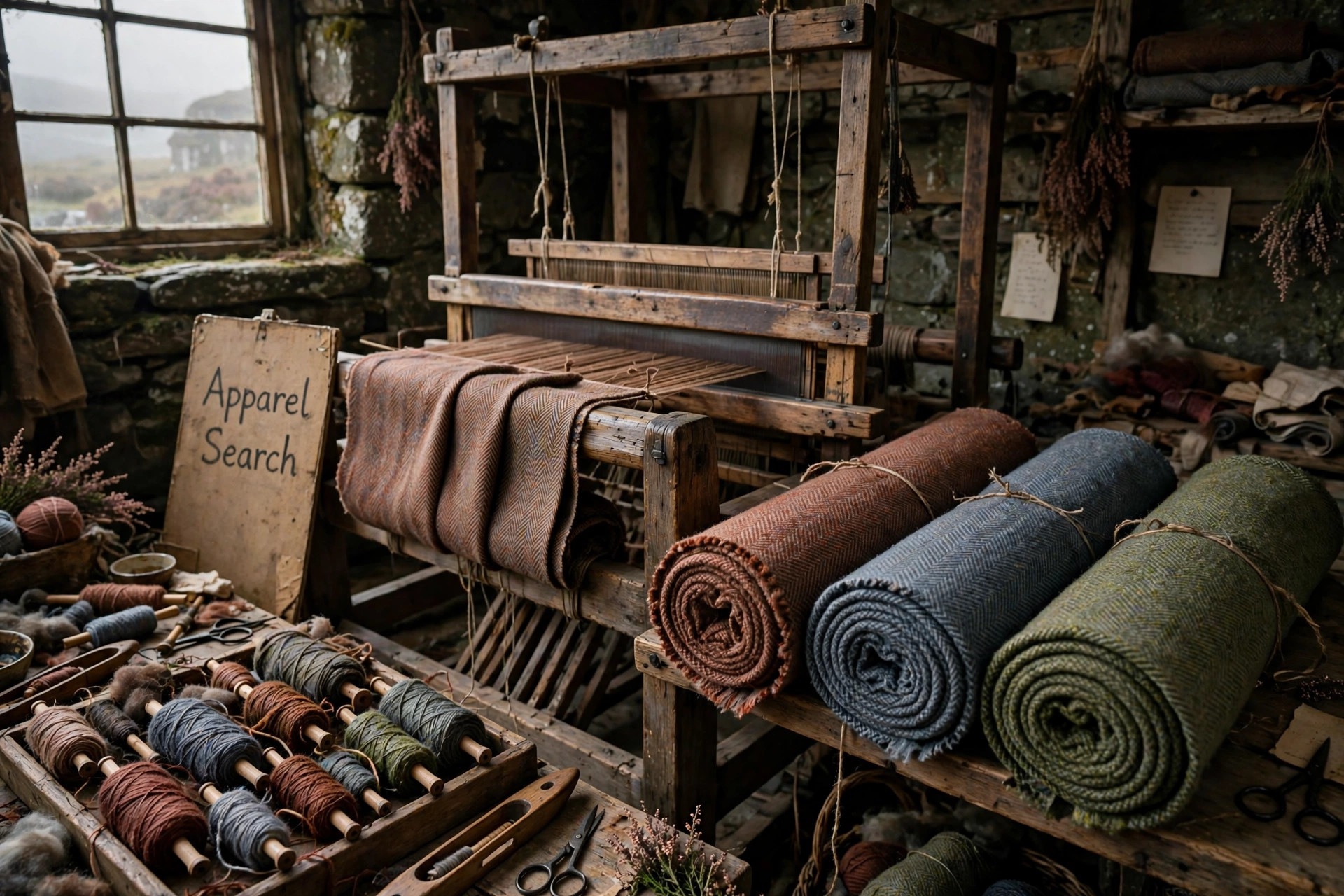
Tweed itself is the broader family: as the Apparel Search tweed definition summarises, it is a rough-surfaced woollen cloth, typically of mixed flecked colours, woven in plain weave, twill or herringbone, its colour made by mixing dyed wool before spinning. Islanders in the Outer Hebrides — Lewis, Harris, the Uists, Benbecula and Barra — wove such cloth for generations, washing the wool in soft peaty water and colouring it with dyes from local plants and lichens. In the nineteenth century aristocratic buyers commissioned it for shooting and fishing dress, and "Harris tweed" became a name worth money — which is precisely when it became a name worth stealing.
Imitations followed the money. Mainland mills produced machine-woven "Harris" tweeds, and island merchants realised that without a protected definition the name would dissolve into a style. Their answer came in two stages, a trademark and then a statute, and it is that legal spine — not any single pattern — that makes Harris Tweed a world textile in its own right rather than a regional variant. Donegal's story runs parallel but lands differently: County Donegal's weavers also sold flecked homespun through merchants, and its best-known firm, Magee, began in 1866 buying hand-woven tweed from part-time weaver-fishermen and farmers at local markets. But Donegal never received an Act of its own, and the contrast between the two cloths' protections is one of the great lessons in how a textile name survives.
A note on dress: the jackets, kilts and country clothing these tweeds become belong to the garment guides. Our Scotland Traditional Dress guide covers Highland dress and the tweed Argyll jacket worn with it; this page stays with the cloth — its law, its making and its makers.
The Process
How Harris Tweed Is Made, Step by Step
Harris Tweed production is a relay between mill and home: the mill does everything except the weaving, and the weaving — the step the law cares about most — happens alone, at a treadle loom, in a shed beside the weaver's house.
Shear and scour the wool
The cloth begins as pure virgin wool, principally from Cheviot and Scottish Blackface sheep. Most of the wool now comes from the UK mainland, blended with island-sheared fleeces; it is scoured clean and delivered to the island mills in bales.
Dye in the wool
Colour goes in at the fibre stage: loose wool is dyed in a wide range of base colours before any yarn exists. This dyeing-in-the-wool is the root of the cloth's heathered depth — no yarn-dyed or piece-dyed cloth can match it.
Blend to recipe and card
Dyed and white wools are weighed in predetermined proportions and blended thoroughly to exact recipes, so a single yarn will carry several tones. The blend is carded between toothed rollers into a soft, fragile embryonic yarn.
Spin and warp
The carded wool is spun to give it strength for weaving, wound onto bobbins, and the warp — well over a thousand individual threads — is gathered in a precise order and wound onto beams. Warp beams and weft yarn go out from the mill to the weavers.
Handweave at home
Each self-employed weaver "ties in" at their own loom, knotting and threading every warp end through the heddles in order, then weaves by treadle power — today mostly on double-width rapier looms for mill orders, and on single-width Hattersley looms for independent producers selling their own patterns — mending breaks as they occur.
Finish, inspect, stamp
The woven length returns to the mill in its greasy state, where darners correct flaws before it is scoured, milled, dried, steamed, pressed and cropped. Then an independent Harris Tweed Authority inspector examines it; only cloth that passes is stamped with the Orb.
The economics inside that relay are the crofter economy in modern form. The mills, concentrated on Lewis, centralise the capital-heavy stages while weaving stays distributed among hundreds of self-employed islanders working from home, each paid by the piece. The Act protects that structure as deliberately as the cloth: the point was never only a standard, but a livelihood — written so the weaving cannot quietly migrate to a mainland factory without breaking the law that gives the cloth its name.
The Orb and the Act
The Orb came first. In 1909 the Harris Tweed Association was formed to protect the name, and it registered the Orb and Maltese Cross, with the words "Harris Tweed," as a certification trademark — the mark was registered in 1910 and stamping of cloth began in 1911. The Board of Trade insisted the mark belong to all the Outer Hebrides islands, not Harris alone, since the tweed was made the same way across them. The definition attached to the mark tightened over the decades — a 1934 revision admitted island mill-spun yarn alongside handspun, and stamped production rose steeply, peaking in the 1960s.
The statute followed in 1993. The Harris Tweed Act created the Harris Tweed Authority as the Association's statutory successor, charged — in the Authority's own words — "to promote and maintain the authenticity, standard and reputation" of the cloth, overseeing production and inspection from start to finish. And it fixed the definition in law, as the Authority states it: Harris Tweed must be "handwoven by the islanders at their homes in the Outer Hebrides, finished in the Outer Hebrides, and made from pure virgin wool dyed and spun in the Outer Hebrides." The Authority is equally plain about the mark itself: the Orb is a registered certification mark, not a logo, and only cloth branded with it, after inspection, is genuinely deserving of the name. No other cloth carries quite this armour — a definition in primary legislation, a statutory guardian, and an inspector's stamp on the cloth itself.
The Irish Counterpart
Donegal Tweed: The Fleck
Cross the North Channel and the tweed changes its accent. Donegal tweed, from County Donegal in Ireland's north-west, is recognised at a glance by its fleck: tiny slubs of contrasting colour — called neps — blended into the yarn at spinning, so the finished cloth carries sparks of red, blue, yellow or orange through a quieter salt-and-pepper, plain-weave or herringbone ground. Tradition reads the palette as the county itself — gorse, heather, turf, sea and stone — and each mill guards its own blending recipes, so no two Donegal cloths read quite alike. Where Harris built its identity on a legal definition of process, Donegal built its on a visual signature.
The industry's shape differs accordingly. Donegal weaving was cottage work for centuries — part-time weavers who also fished and farmed — and firms such as Magee, founded in Donegal Town in 1866 and still a family business, organised that homespun into a trade: buying cloth at markets like Ardara, then, from 1918, bringing weavers into a factory to control design and quality, and introducing power looms in 1977. Today Donegal tweed spans both worlds: mills weaving at scale in the county, and handweavers still working in centres such as Ardara and Kilcar. Irish designers Sybil Connolly and Irene Gilbert carried the cloth into international fashion in the mid-twentieth century, and Magee's green tweed for Aer Lingus uniforms in 1962 made it a national emblem in cloth form. The open flank is the name itself: without a statute, "Donegal-style" tweed can legally be woven anywhere, and Donegal makers have campaigned for protected geographical status to close that gap — the very problem the Hebrides solved in 1910.
Then and Now
The Designer Afterlife
Few workhorse cloths have lived so many second lives. Tweed began the twentieth century as country dress — shooting jackets, Norfolk jackets, plus-fours for hunters, cyclists and early motorists — and Paris took it up between the wars: Chanel built her famous suits on tweed, and the cloth never really left couture. Vivienne Westwood made Harris Tweed a signature of her subversion of British tradition, Alexander McQueen returned to it repeatedly, and houses including Dior, Hermès and Ralph Lauren have all woven collections around it. The most famous crossover order remains Nike's: the sportswear giant put genuine Harris Tweed into trainer uppers, a commission the island industry fulfilled collectively and ahead of schedule — proof, if any were needed, that a handwoven cloth from crofters' sheds could meet a global brand's deadline without surrendering a single condition of its Act.
Donegal's afterlife runs through Irish and international tailoring alike, and through interiors, where both tweeds now upholster furniture as readily as they clothe people. For the fibre-level story behind both cloths, see the wool fabric guide: what this page adds is the human structure — a statutory island industry in Scotland, a mill-and-cottage industry in Ireland, each keeping a flecked woollen cloth alive into its second century of fame.
Acquiring
Buying Tweed Well
For Harris Tweed the test is absolute: look for the Orb. Genuine cloth is stamped with the Orb mark, and a finished garment should carry the Authority's label bearing it. A jacket described as "Harris style" or "Harris type" without the label is not Harris Tweed, however honest its wool. Note what the Orb certifies: the cloth — its fibre, island dyeing and spinning, home weaving and finishing — not the tailoring of the garment made from it, so judge cut and construction separately.
For Donegal tweed, buy the maker, not the adjective. Cloth from the county's established mills and handweavers — Magee 1866 in Donegal Town, McNutt of Donegal at Downings, the studios around Ardara and Kilcar — carries a provenance a "Donegal-style" import cannot. In the hand, both tweeds should feel dense, springy and slightly rough, with colour that deepens the closer you look, because it was mixed in the fibre. A good seller will state the weight and the weaver or mill. Kept brushed, aired and moth-guarded, either tweed repays its price by still being worn, gladly, thirty years on.
Common Questions
Common Questions
What is the legal definition of Harris Tweed?
Under the Harris Tweed Act 1993, Harris Tweed must be 'handwoven by the islanders at their homes in the Outer Hebrides, finished in the Outer Hebrides, and made from pure virgin wool dyed and spun in the Outer Hebrides.' The Outer Hebrides named in the Act are Harris, Lewis, North Uist, Benbecula, South Uist and Barra. Cloth meeting the definition is inspected and certified with the Orb mark by the Harris Tweed Authority, the statutory body the Act created.
What is the Orb mark?
The Orb — a globe surmounted by a cross, with the words Harris Tweed — is the certification trademark of genuine Harris Tweed. It was registered in 1910 by the Harris Tweed Association (formed in 1909), and stamping of the cloth began in 1911. Today an independent inspector of the Harris Tweed Authority examines finished cloth and, if it passes, the Orb is applied. The Authority describes the Orb as a registered certification mark, not a logo: only cloth that bears it is genuine Harris Tweed.
What is the difference between Harris Tweed and Donegal tweed?
Place, fleck and law. Harris Tweed is Scottish, from the Outer Hebrides, and its name and method are fixed by the Harris Tweed Act 1993: it must still be handwoven by islanders at their homes. Donegal tweed is Irish, from County Donegal, recognised by the small flecks of contrasting colour — neps — blended into its yarn; today it is woven both by hand and on mill looms within the county, and 'Donegal-style' tweed woven elsewhere is not the same claim, which is why Donegal makers have sought protected status for the name.
Why is Harris Tweed's colour so rich and flecked?
Because the colour goes in before the yarn exists. The wool is dyed in a range of base colours while still loose fibre, and the dyed and white wools are then weighed out to exact recipes and blended by hand, so every yarn carries several tones at once. Carded and spun, that blended yarn weaves into cloth with the heathered, flecked depth Harris Tweed is known for — an effect cloth dyed after weaving cannot reproduce.
How do you know a Harris Tweed garment is genuine, and how should it be cared for?
Look for the Orb: genuine cloth is stamped with the Orb mark and finished garments carry the Harris Tweed Authority label bearing the Orb. Without it, the garment may be fine tweed but it is not Harris Tweed in law. Care is the care of good wool — brush after wear, air before storing, rest between wearings, dry-clean sparingly with a cleaner used to tweed, and store with moth protection. Properly kept, a Harris Tweed jacket lasts for decades.
Keep Exploring
More to Explore
Sibling Textile Guides
World Textiles & Traditional Crafts
The section hub — every world textile guide, from Central Asian felt to European lace.
Visit the hub ↑Lace Traditions of Europe
Britain and Ireland's other protected handcraft world: needle and bobbin lace, from Burano to Honiton.
Read ↑Navajo Weaving
Another wool tradition that became a named, collected art: the upright-loom blankets and rugs of the Southwest.
Read ↑Definitions, Fabric & Dress Partners
Tweed Definition
The short reference: tweed's twill structure, its classic patterns from herringbone to houndstooth, and the tweel-to-Tweed name story.
Read ↑Wool Fabric Guide
Wool as a fibre and fabric family — grades, performance, buying and care in depth.
Read ↑Scotland — Highland Dress
The garment side of Scottish cloth: the kilt, tartan and the tweed Argyll jacket worn with them.
Read ↑Search Apparel Search