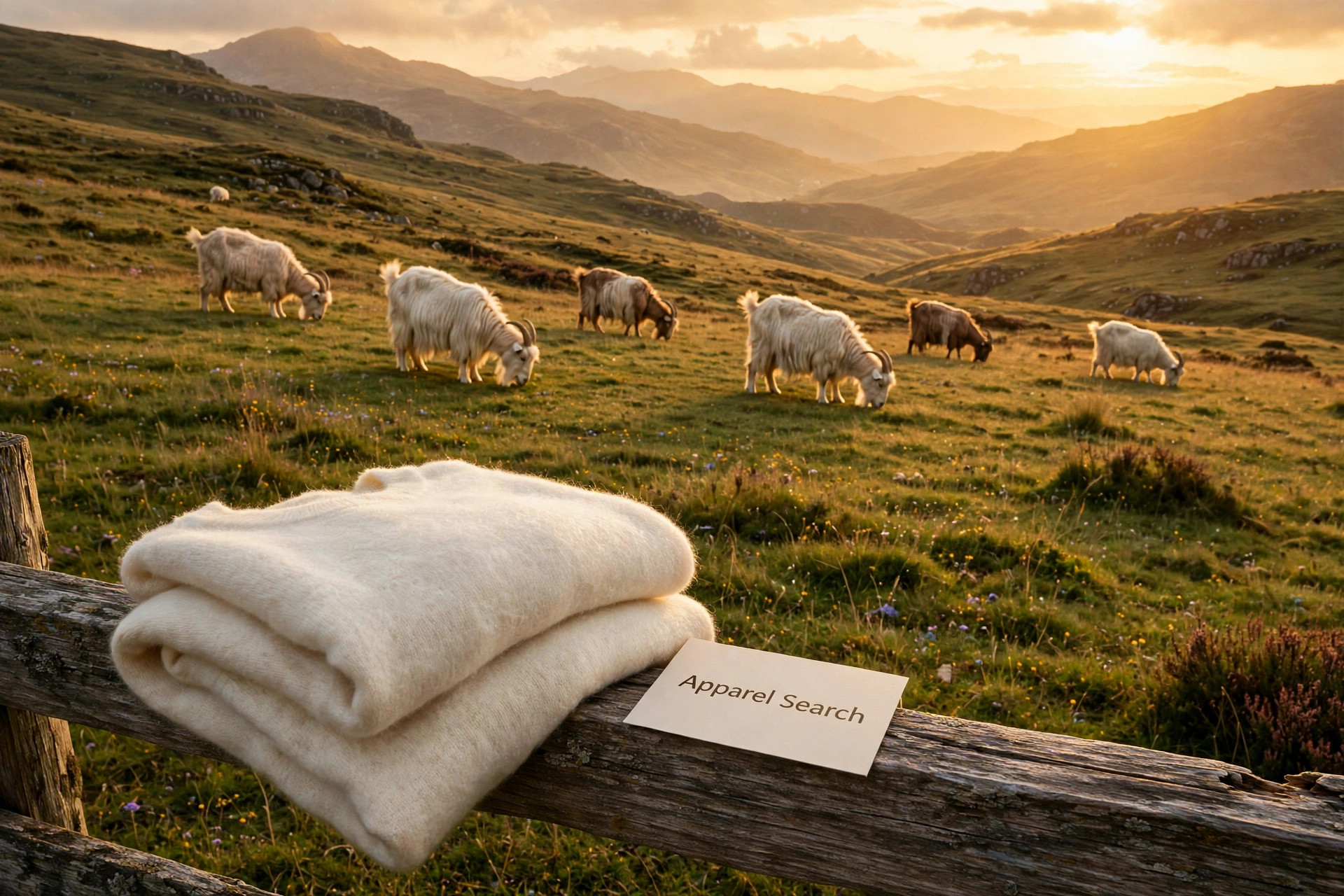
Cashmere is the fiber against which all other softness is measured - and also one of the easiest to buy badly. Two sweaters can both be labeled cashmere and differ completely in feel after a season of wear, because cashmere quality hides in two numbers most labels never print: how fine the fibers are, and how long. This guide explains where cashmere comes from, how it is harvested and graded, what ply and gauge mean on a label, why prices range so widely, and how to choose and care for cashmere so it keeps its promise for years.
01 / The fiber
What Cashmere Is
Cashmere is the soft down undercoat of the cashmere goat (Capra hircus laniger and related regional breeds) - not the coarse outer hair, but the fine, dense fleece the animal grows beneath it to survive the bitter winters of the high plateaus of Central Asia. The classic producing regions are Mongolia, Inner Mongolia in China, and the mountain areas of Iran and Afghanistan, where cold, harsh climates push the goats to grow the finest down. The fine cashmere shawls long woven in Kashmir gave the fiber its English name, and the word pashmina is still used for fine cashmere of that tradition.
The harvest explains the price. Each spring, as the goats naturally molt, herders comb the down out by hand - a slow process that yields only a small amount of usable fiber per animal. The raw harvest is then sorted by color and quality, washed, and dehaired: machinery separates the fine down from the coarse guard hairs mixed through it, and only the down goes on to spinning. Sorted, cleaned and dehaired, the fiber is carded and spun into yarn, then knitted or woven. Every stage discards material, which is why finished cashmere starts scarce and gets scarcer the finer the grade.
Grading rests on two measurements. Diameter: cashmere fibers run about 14 to 19 microns across - for scale, a human hair is several times thicker - and under United States labeling rules fiber sold as cashmere must average no more than 19 microns. The finest premium lots sit at 14 to 16 microns and feel noticeably silkier. Length: longer fibers, around 36 millimeters and above, spin into stronger yarn that pills far less; short fibers feel soft in the shop but work loose, pill and thin out in wear. Color matters too - white down dyes to any shade without bleaching, so it is the most versatile and valuable. When sellers use letter grades, they are describing these same measurements; fineness tells you how soft it will feel, length tells you how long it will stay that way.
02 / Performance
How Cashmere Feels and Performs
Cashmere's fame rests on a rare combination: it is exceptionally soft against the skin, because its fine fibers bend rather than prickle, and it is warm far beyond its weight, because the fine, crimpy fibers trap still air in a light, lofty structure. A cashmere sweater can weigh very little and still out-warm a much heavier garment in coarser wool. It breathes reasonably well, drapes softly, and takes dye in deep, even shades. Handled well, good cashmere is not fragile in the way people fear - it improves with careful washing, growing softer over the years, and a long-fiber garment can serve for decades. What cashmere is not is hard-wearing in the workhorse sense: it has less elasticity and abrasion resistance than sheep's wool, so it asks for rotation, rest between wears, and protection from rubbing and moths.
Strengths
- Among the softest fibers that exist - no prickle
- Outstanding warmth for very little weight
- Soft drape; takes deep, even dye color
- Grows softer with gentle washing and age
- Long-fiber grades wear for many years
Trade-offs
- Expensive - the fiber harvest is tiny
- Pills, especially when spun from short fibers
- Less elastic and abrasion resistant than wool
- Needs gentle washing and flat drying
- A target for clothes moths in storage
03 / Varieties
Grades, Ply and Blends
- By fineness and length - the true grades: fine (14-16 microns) and long (36 mm and up) fiber makes the best garments; coarser, shorter fiber makes the budget end of the market. Two garments can both be honestly labeled 100% cashmere and sit at opposite ends of this scale.
- By ply - ply counts the yarns twisted together in the knitting yarn. One-ply is light and fine for scarves and featherweight sweaters; two-ply and above add warmth, body and durability for winter knitwear. More ply means more fiber, and usually a higher price for the same garment size.
- By gauge - gauge counts knitting needles per inch: higher gauge, finer and smoother knit. Fine-gauge cashmere makes smooth layering pieces; chunky low-gauge knits make relaxed, textured sweaters.
- Cashmere blends - cashmere is blended with silk for sheen and strength in fine knits and shawls (see our silk fabric guide), and with sheep's wool to add resilience and lower cost. A blend is not a lesser product by definition - but the percentage should be printed, and a low percentage will not feel like cashmere.
- Woven cashmere - scarves, shawls, throws and fine coat cloth woven rather than knitted; smooth, dense and often finished with a soft brushed surface.
04 / Uses
What Cashmere Is Made Into
Cashmere is above all a knitwear fiber: sweaters, cardigans, scarves, hats, gloves and socks, where its softness sits directly against the skin and its warmth needs no bulk. Knitting suits it - the fiber is relatively short and precious, and knitted construction gives it the loft that makes it warm. Woven cashmere appears in scarves and shawls, blankets and throws, and luxury coat and jacket cloth, sometimes brushed for a deep, soft surface. It is also used for baby clothing and blankets, where softness is the whole point and garments are outgrown before they wear out. What you will rarely find is cashmere in hard-use clothing - workwear, sportswear and children's play clothes belong to tougher fibers, and good cashmere is priced and built for a gentler life.
05 / Buying
How to Choose Cashmere
Begin with skepticism about price. Genuine long-fiber cashmere cannot be made cheaply - the fiber itself is costly before anyone spins or knits it - so a surprisingly cheap "100% cashmere" sweater is almost always short-fiber fiber that will pill and thin quickly, or a blend wearing a cashmere-forward label. Read the fiber-content label for the actual percentage, and treat vague wording ("cashmere feel", "cashmere touch") as what it is: not cashmere.
Then judge the knit. A good cashmere garment is knitted tightly and evenly: hold it to the light and look for a dense, uniform surface rather than a loose, open one - loose knits stretch, snag and pill faster, however soft they feel on the rail. Stretch a small area gently and let go; quality knits recover their shape. Prefer longer-fiber claims where a seller states them, choose ply to match the season - one-ply for layering, multi-ply for winter warmth - and buy from sellers who state fiber content, ply and origin plainly. Finally, plan the garment's life: cashmere rewards owners who rotate it, rest it a day between wears, and store it folded and clean. Bought well and kept well, it is one of the few luxury fibers that genuinely earns its price back in years of wear.
06 / Care
Caring for Cashmere
Cashmere does not need washing after every wear - air it, rest it, and wash only when it needs it. Hand wash in cool water with a gentle detergent, or use a mesh bag and a wool cycle; never wring or twist it. Reshape the garment on a towel and dry it flat, away from direct heat and sun. Remove the pills that appear in early wears with a cashmere comb, working gently in one direction - pilling settles down as loose fibers clear. See the fabric care guide for washing and storage routines across fabrics.
Store cashmere folded, never hung - hangers stretch the shoulders of knits - and store it clean, because clothes moth larvae feed on cashmere as happily as on wool, especially where body oils remain. A sealed box or bag for the off-season, checked now and then, is the whole secret. Treat cashmere this way and it will not merely last; it will get softer.
Cashmere at a Glance
Common Questions
Why is cashmere so expensive?
Supply. A cashmere goat grows only a small amount of fine undercoat each year, and that down must be combed out by hand in spring, sorted, and dehaired to separate it from the coarse guard hair. Fine, long fibers are the scarcest part of a scarce harvest, so the best cashmere commands the highest prices.
Does cashmere pill?
Some pilling is normal, especially in the first wears and under the arms or where a bag strap rubs. Garments made from longer fibers pill much less, because long fibers stay anchored in the yarn. Rest the garment between wears and remove pills gently with a cashmere comb - never pull them off.
What is the difference between cashmere and merino wool?
Both are animal hair fibers, but cashmere comes from the undercoat of the cashmere goat at about 14 to 19 microns, while merino comes from sheep across a wider range of fineness. Cashmere feels softer and warmer for its weight; fine merino is more elastic, more resilient and usually less expensive, and it tolerates harder wear.
How do you wash cashmere?
Hand wash in cool water with a gentle detergent, or use a wool wash cycle in a mesh bag; never wring it. Reshape the garment and dry it flat on a towel away from heat and sun. Fold it for storage - hanging stretches wet and dry cashmere knits alike.
More to Explore
Explore more: Fabric Directory | Fabric Industry Guide