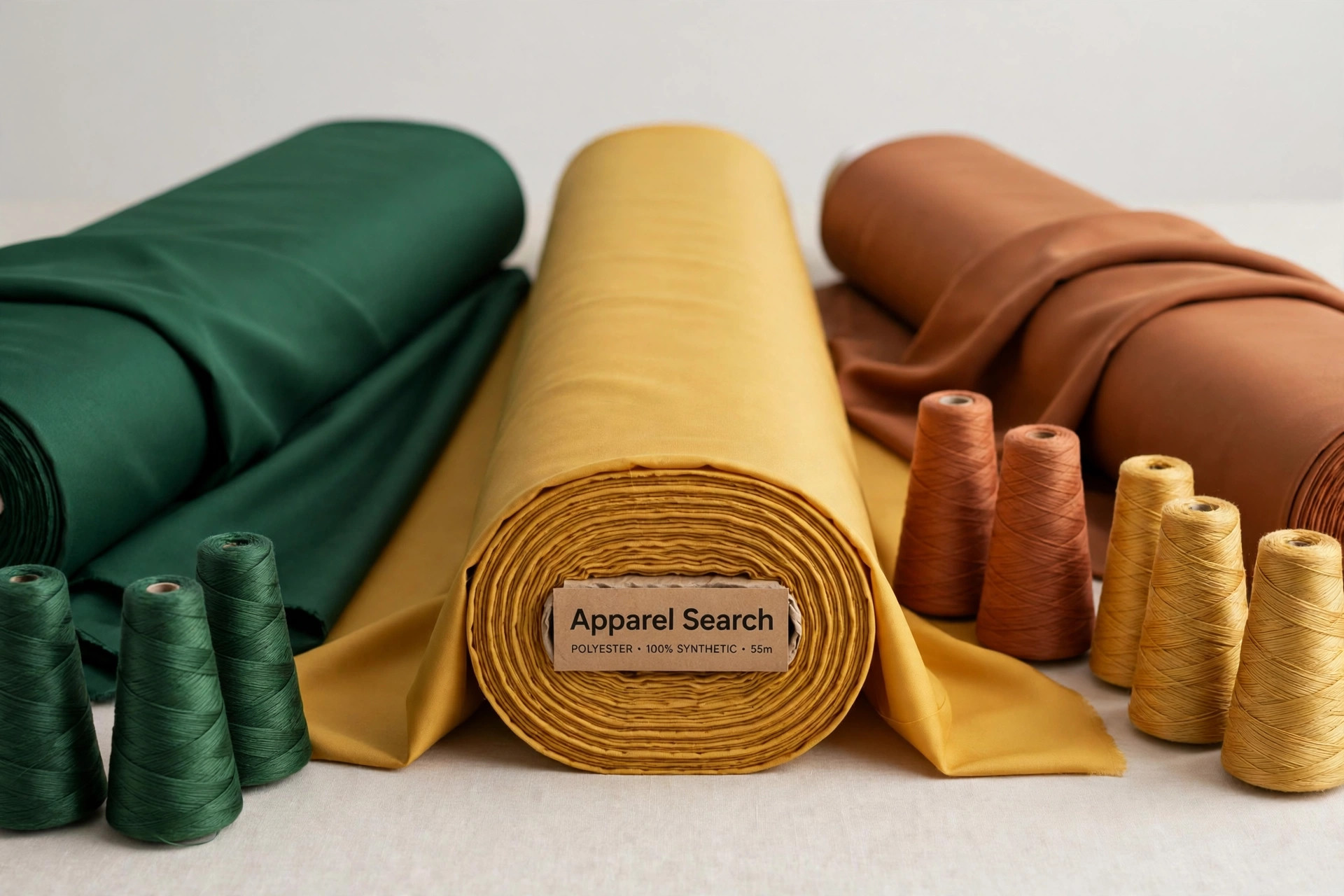
Polyester is the most-used fiber in the world's clothing - the backbone of sportswear, the shine in a satin dress, the easy-care half of countless blends. It is also the fiber people most often misunderstand: praised as indestructible, blamed as plastic-feeling, when the truth is that polyester is a family of engineered yarns whose feel depends on how they are spun, textured and finished. This guide explains what polyester is, how it is made from polymer to cloth, the difference between virgin and recycled polyester, where it outperforms every natural fiber and where it falls short, and how to choose and care for it.
01 / The fiber
What Polyester Is
Polyester is a manufactured synthetic fiber. The polyester used for textiles is PET - polyethylene terephthalate - a polymer formed by reacting terephthalic acid with ethylene glycol, both ultimately derived from petroleum in conventional production. The chemistry gives polyester its defining traits: the polymer chains pack tightly and contain no sites that attract water, so the fiber is hydrophobic, strong and stable. Polyester fiber reached the market in the early 1950s - DuPont's Dacron, launched in 1953, was the famous early name - and production has grown ever since, until polyester passed cotton to become the world's most-produced apparel fiber.
Making the fiber is a study in controlled extrusion. First the ingredients are polymerized into molten PET, which is cooled and cut into small chips. The chips are dried, remelted and forced through a spinneret - a plate pierced with tiny holes - in the step called melt spinning. The emerging streams solidify into continuous filaments, which are then drawn: stretched to several times their length so the polymer chains align and the yarn gains strength. From there the yarn takes the form the fabric needs. Left continuous, it is filament yarn - smooth and strong, the yarn of linings, satins and shell fabrics. Cut into short lengths, it becomes staple fiber, spun like a natural fiber into softer, matte yarns for shirts, fleece and blends. Filaments can also be textured - crimped and looped by air or heat - to add bulk, softness and a more natural hand.
Virgin polyester is spun from newly made PET. Recycled polyester starts from existing PET - most commonly collected plastic bottles, cleaned, melted and re-spun, and increasingly from recovered textiles as well. The spinning steps after that are the same, and finished recycled polyester fabric is functionally equivalent to virgin; what changes is the feedstock, trading new petroleum input for a collected waste stream that itself required energy to gather and process.
02 / Performance
How Polyester Feels and Performs
Polyester's numbers explain its career. Its moisture regain is only about 0.4 percent - it absorbs almost no water - so polyester garments dry fast and do not get heavy and cold with sweat the way cotton can. It is strong and abrasion resistant, holds its size and shape, resists wrinkles, takes pleats and creases permanently when heat-set, and holds dye with excellent colorfastness, including bright and deep shades that are hard to achieve on natural fibers. It is also light for its strength, which is why it dominates travel clothing, uniforms, athletic wear and outdoor shells. Handle heat with respect, though: polyester melts at roughly 255-260°C, and a careless hot iron will glaze or melt it long before that point.
Strengths
- Strong, abrasion resistant and long-wearing
- Dries fast; does not absorb water or stretch out wet
- Wrinkle resistant and holds its shape and pleats
- Excellent colorfastness; takes vivid dye shades
- Light for its strength; easy to wash and care for
Trade-offs
- Can feel clammy in tight weaves; traps heat and vapor
- Attracts static and clings
- Holds onto oils and odors more than natural fibers
- Melts under a hot iron; not flame resistant
- Sheds microfibers in washing; not biodegradable
03 / Varieties
Common Types of Polyester
- Filament polyester - continuous smooth yarns for satin, chiffon-style cloth, taffeta, linings and shell fabrics; sleek, strong and slightly lustrous.
- Staple polyester - filaments cut short and spun like cotton or wool; the matte, softer polyester of shirts, trousers and blends, and the fiber inside quilted insulation.
- Microfiber polyester - filaments split or spun extremely fine, giving dense, soft, suede-like cloth for sportswear, cleaning cloths and soft furnishings. Fineness, not a different chemistry, is what makes it feel luxurious.
- Textured polyester - filaments crimped for bulk and stretch-like give; common in knit tops, dresses and athletic jerseys.
- Recycled polyester (rPET) - spun from recovered PET, chiefly bottles; widely used in fleece, swimwear, activewear and outerwear, and usually labeled with its recycled percentage.
- Polyester fleece - knitted polyester brushed into a deep, warm pile; see our fleece fabric guide for how it is built and used.
- Polyester blends - poly-cotton for easy-care shirts and uniforms, poly-wool for durable suiting, and poly-elastane wherever stretch is required. The blend ratio sets the balance between natural feel and synthetic performance.
04 / Construction
Polyester Fabrics and Their Uses
Because the yarn is engineered, polyester can imitate almost any construction. Woven polyester gives crisp poplin-style shirting (compare the cotton original in our poplin fabric guide), smooth satin and crepe for dresses and blouses, taffeta for linings and evening wear, and rugged plain weaves for workwear, tents and luggage. Knitted polyester gives jersey for t-shirts and athletic tops, open mesh for sports linings and ventilation panels, tricot for lingerie and linings, and brushed fleece for warmth. Double knits hold a tailored shape for trousers and blazers.
Its biggest apparel roles follow from its properties. In sportswear, shaped filament channels move sweat along the fiber surface so it evaporates outside the garment - polyester does not absorb sweat, it transports it. In swimwear and outdoor clothing, it resists chlorine, sunlight and waterlogging better than most fibers. In everyday clothing, it is the durability and easy-care partner in blends, the wrinkle-free shirt, the pleated skirt that keeps its pleats, and the printed dress whose colors never fade in the wash.
05 / Buying
How to Choose Polyester
Judge polyester by construction and finish, not by fiber name alone. A well-made microfiber or textured-filament garment can feel soft and breathable; a cheap, tightly woven filament fabric can feel like a plastic bag. Handle the cloth: look for a dry, soft hand rather than a slick one, check that knit garments are dense enough not to shine or sag, and hold wovens to the light to see how open the weave is - openness is what will make it comfortable in heat. For sportswear, prefer knits described as moisture-wicking or made with shaped or textured filaments, and mesh panels where heat builds.
Read the label for the blend and the source. A polyester-cotton shirt at 65/35 behaves like an easy-care shirt with some cotton comfort; at 50/50 it dries faster and feels more synthetic. If recycled content matters to you, look for a stated percentage and a recognized recycled-content certification on the label, since "made with recycled polyester" can describe anything from a token fraction to the whole garment. And whatever the fiber, remember that polyester's durability cuts both ways: a well-chosen polyester garment will last for years, so choose one you will actually keep wearing.
06 / Care
Caring for Polyester
Polyester is the easiest fiber in the laundry: machine wash in warm water, tumble dry on low or line dry - it dries quickly either way - and remove promptly to avoid setting wrinkles. Use a low iron only if needed, since high heat can glaze or melt the fibers. Wash sportswear promptly after use and inside out; because polyester attracts oils, a detergent formulated for synthetic sportswear removes odor better than a standard wash. See the fabric care guide for details by fabric type.
One honest note on washing: like all synthetic textiles, polyester sheds tiny fiber fragments in the wash. Washing less often, in fuller loads, and at lower temperatures reduces shedding, and a microfiber-catching wash bag or filter reduces it further. None of this changes polyester's care routine - it is still the lowest-maintenance fiber you own - but it is part of owning it responsibly.
Polyester at a Glance
Common Questions
Does polyester shrink?
Very little. Polyester is dimensionally stable and resists shrinking and stretching, which is one of its main advantages. Extreme heat is the exception: a very hot wash or dryer can relax or distort polyester, and a hot iron can glaze or melt it, so keep iron temperatures low.
Is polyester breathable?
The fiber itself does not absorb moisture - its moisture regain is only about 0.4 percent - so breathability depends on construction. Loose weaves and open athletic knits let air and vapor through and move sweat along the fiber surfaces to dry outside; a tight, coated polyester weave can feel clammy because vapor has nowhere to go.
What is the difference between virgin and recycled polyester?
Virgin polyester is made from new petroleum-based feedstock. Recycled polyester is made by melting down existing PET - most often collected plastic bottles - and spinning it into new fiber. Worn and washed side by side, the two are hard to tell apart; the difference is in the raw material source, not in how the finished fabric performs.
Why does polyester clothing hold odor?
Polyester is hydrophobic and oleophilic - it repels water but attracts oils. Skin oils settle into the fiber surface and feed odor-causing bacteria, and ordinary washing removes them less completely than from cotton. Washing promptly, turning garments inside out, and using a detergent made for sportswear helps.
More to Explore
Explore more: Fabric Directory | Fabric Industry Guide