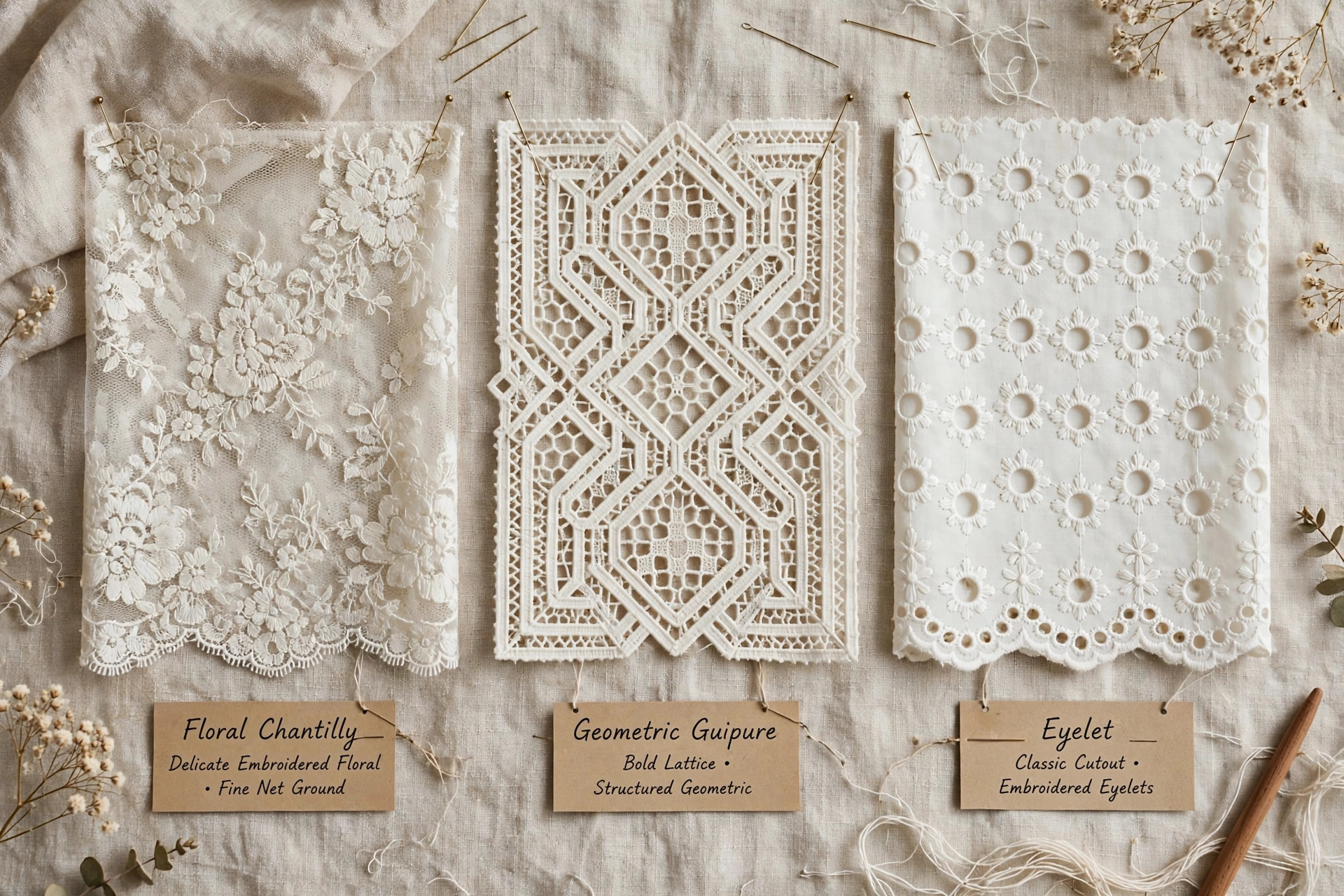
Lace ranges from delicate bridal veiling to sturdy cotton eyelet. Because patterns, edges, and grounds vary so much, buying lace means looking closely at the details that make or break a project.
Types of Lace
- Chantilly lace - fine, lightweight with delicate floral motifs on a sheer ground; the classic bridal lace.
- Alençon lace - needle-made motifs with corded outlines, often appliquéd onto net.
- Guipure lace - heavy motifs joined by bars with no net ground; bold and sculptural.
- Bobbin lace - handmade by twisting bobbins; includes torchon and Bucks Point styles.
- Eyelet - embroidered holes punched in cotton; crisp and washable, a summer staple.
- Stretch lace - lace with elastane for lingerie and fitted garments.
Choosing Lace
Consider motif scale against the garment: large motifs suit overlays and statement pieces, small motifs suit trims. A scalloped edge can become a finished hemline - buy lace with the edge running along the fabric length for borders. Check whether the ground is stable enough for your pattern, and buy extra for matching motifs across seams.
Best Uses
Bridal gowns and veils, evening overlays, lingerie, blouse yokes and sleeves, table linens, and decorative trims.
Sewing Tips
- Match motifs at seams and center fronts for a couture look - cut single layer.
- Use the scalloped edge as a ready-made hem or neckline finish wherever possible.
- French seams or narrow bound seams keep sheer grounds tidy.
- Back bodices with silk organza or net when the lace needs body.
- Hand-baste before machine stitching; lace shifts easily under the foot.
Care
Hand wash fine lace in cool water or use a mesh bag on delicate. Dry clean heirloom and silk laces. Never wring lace; roll in a towel to remove water and dry flat. Store wrapped in acid-free tissue, never on wire hangers.
Also see the Lace in the Fashion Glossary and the lace definition.
Explore more: Fabric Directory | Fabric Industry Guide