World Textiles & Traditional Crafts · Guatemala
Mayan Weaving of Guatemala
In the highlands of Guatemala, weaving is not a decoration applied to life; it is one of the ways life is organised. A loom made of sticks and a strap, tensioned by the weaver’s own body, produces cloth whose patterns name a town, whose brocade is built thread by thread into the fabric itself, and whose skirt yardage carries its design dyed into the yarn first. This guide is about that weaving system — the looms, the techniques, the cloths and the weavers’ cooperatives — and it leaves the best-known garment made from this cloth, the huipil, to the guide that owns it.
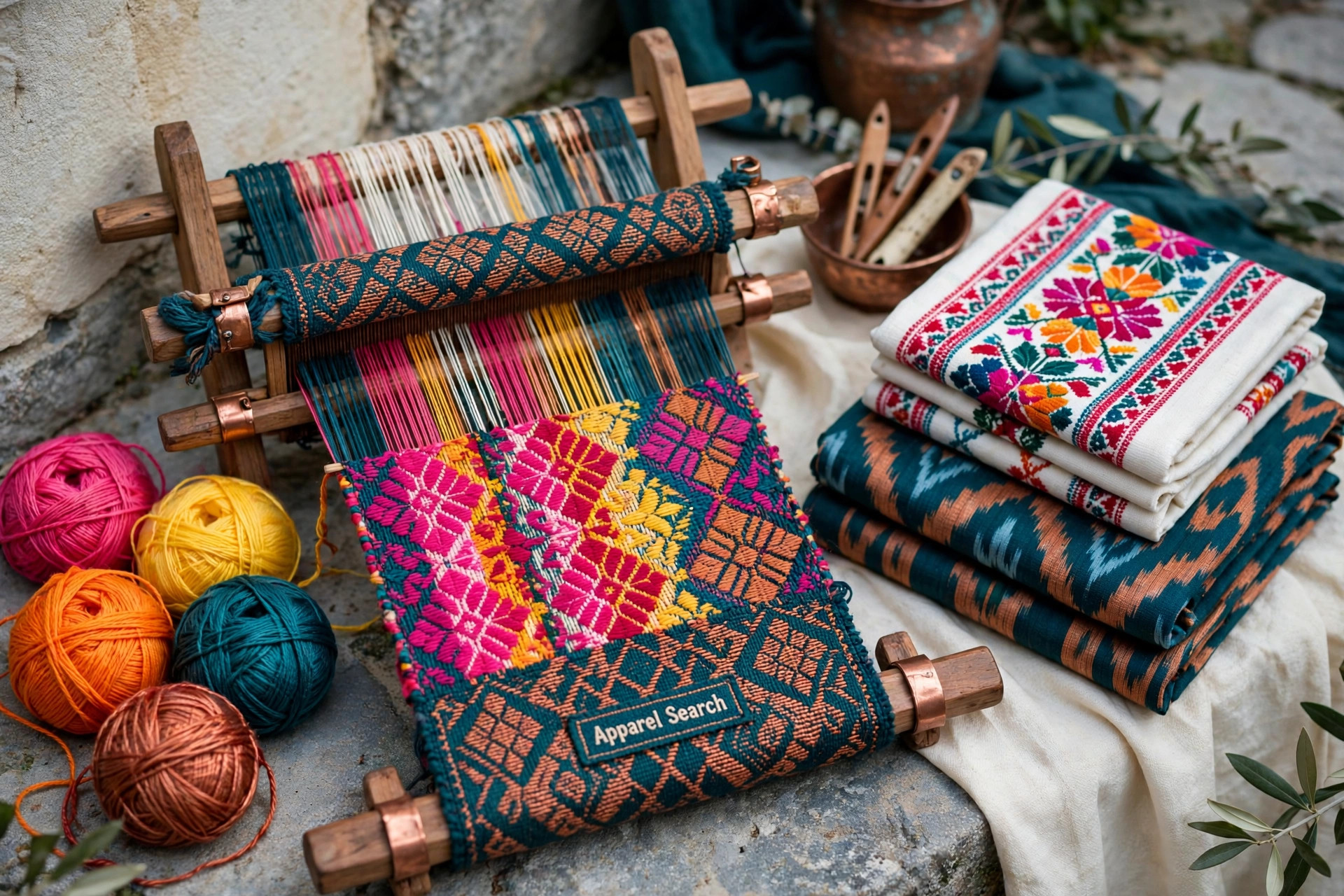
The System
One Weaving Culture, Many Cloths
Start with the division of labour this page will keep returning to. The garment at the centre of Maya women’s dress in Guatemala and southern Mexico is the huipil, and Apparel Search’s huipil guide covers that garment in full — its construction from woven panels, how it is worn with corte and faja, and how to choose and care for one. What that guide treats from the garment side, this page treats from the loom side: the complete weaving system that produces not only huipil cloth but skirt cloth, sashes, head cloths, carrying cloths and yardage for a whole community’s daily and ceremonial life.
The system has three load-bearing parts. First, a loom technology — above all the backstrap loom — that is portable, ancient and entirely body-powered. Second, a set of patterning techniques, principally brocade and jaspe ikat, that put design inside the cloth rather than on its surface. Third, a social organisation of weaving, historically centred on women weaving at home for their households and communities, and today also on cooperatives that sell weavers’ work to the world. Change any one of the three and the cloth changes; together they explain why Guatemalan weaving has survived centuries of pressure that ended many comparable traditions.
The antiquity is not a marketing claim. The Ixchel Museum in Guatemala City — named for Ixchel, the Maya figure associated with weaving — presents the tradition from pre-Hispanic times to the present and treats the backstrap loom as the key instrument of Mesoamerican weaving across a span it frames from 200 BC onward. Classic-period images show women at looms a modern highland weaver would recognise at a glance.
The Loom
The Backstrap Loom: The Weaver Is Part of the Machine
A backstrap loom — telar de cintura in Spanish — is barely an object at all. One end of the warp threads is tied to a post, a tree or a house beam. The other end is attached to a strap that passes around the weaver’s lower back or hips as she sits on the ground or a low stool. Between those two anchors, a set of smooth bars and sticks organises the threads: a shed stick and heddle rod separate alternating warps so the weft can pass, and a batten beats each row home. That is the entire machine. It rolls up into a bundle a child can carry, sets up in a courtyard, a doorway or a patch of shade, and packs away when the day’s other work calls.
The genius of the arrangement is the tension. There is no frame to supply it, so the weaver’s body does: leaning back pulls the warp taut for weaving, leaning forward slackens it to change the shed or advance the cloth. Tension is therefore not a setting but a continuous, felt judgement, adjusted by posture dozens of times a minute. Skilled weavers describe knowing the cloth through their backs as much as through their hands, and the physical intimacy of the loom is one reason its cloth has a character machine cloth does not imitate well — every row passed under tension a person chose.
The loom’s limits shape the cloth’s architecture. A backstrap warp is only as wide as the weaver can manage — typically a panel width — so wide cloths are woven in panels and joined, and the joins themselves become part of the design vocabulary. Length is limited too, which suits a weaving culture built around defined cloths — a panel, a skirt length, a sash — rather than endless yardage. Where yardage is the point, Guatemala’s second loom takes over.
The treadle loom: the system’s other half
The foot or treadle loom, a large wooden frame loom worked with pedals, arrived with the Spanish and took root alongside the backstrap loom rather than replacing it. It weaves wider, longer cloth faster, and in many communities it is historically associated with men weavers and with particular products — notably the jaspe corte cloth the Ixchel Museum describes as mostly woven by male weavers on treadle looms. A weaving town may therefore run two loom cultures at once: backstrap brocade at home, treadle-loom yardage in the workshop, each respected for what it does best.
Techniques
Brocade, Jaspe and the Patterned Cloth
Brocade — pattern woven in, not stitched on
The signature technique of highland weaving is supplementary-weft brocade. As the ground cloth is woven, the weaver introduces extra coloured threads by hand, row by row, building figures — birds, animals, plants, stars, geometric bands — that sit in and on the fabric’s structure. It looks like embroidery and is constantly mistaken for it, but nothing is stitched onto finished cloth: figure and ground are created in the same act. Brocade is slow because every motif is a series of individual decisions, counted in threads, and a densely brocaded cloth can occupy a weaver for weeks or months.
The huipil cloth techniqueJaspe — the pattern dyed into the yarn
Jaspe is Guatemala’s ikat: bundles of yarn are bound tightly at planned points and dyed, sometimes through several colours, before any weaving begins, so the pattern is stored in the threads themselves. As the cloth is woven the stored sections align into motifs with the soft, feathered edges that are ikat’s signature. Jaspe is used above all for corte skirt cloth and other yardage, where its repeating designs suit long lengths. The full resist-dyeing process — warp, weft and double ikat, and how to tell real ikat from printed imitation — is covered in our ikat definition.
Corte cloth · yardageCotton is the historic fibre, hand-spun in the past and today usually bought as thread. Colour has its own history — natural, aniline and synthetic dyes in successive eras — and many contemporary cooperatives have revived natural dye practice, indigo among them, as an aesthetic and economic choice that commands a fairer price for extra days of work.
The Cloths
What the Looms Produce
Read as cloth rather than costume, the highland output is a complete textile kit. The huipil’s brocaded panels are its most famous product, and they belong to the huipil guide; here, note only the weaver’s side — panels woven to the loom’s width, brocade placed where the garment will show it, neck openings planned in the weaving.
Corte cloth — jaspe by the yard
The wrap skirt called the corte is, as cloth, the jaspe showcase: lengths of ikat-patterned fabric, often deep indigo with fine coloured striping, woven to be durable and unmistakable at market distance. As yardage, it belongs largely to the treadle loom and to specialist jaspe dyers, who plan binding and dyeing across the whole length before weaving starts. Good corte cloth shows ikat’s feathered edge honestly, on both faces.
Faja — the sash as engineering
The faja, the woven sash that secures the corte, is a narrow cloth with a structural job: it must be strong, smooth and long, with pattern concentrated where it will show.
Head cloths and ribbons
Woven head cloths and long hair ribbons extend the system to its smallest scale: fine, dense, often brocaded weaving, among the most town-specific of all the cloths.
Everyday and ceremonial cloths
Around the named garments sits the rest of the woven world: carrying cloths, shawls and wraps, napkins and table cloths for household and market, and the heavier ceremonial cloths woven for religious brotherhoods and feast days, where the densest brocade and the most conservative patterns are kept. The distinction that matters to a weaver is not tourist versus traditional; it is cloth for use, cloth for ceremony, and cloth for sale — and a healthy weaving community still produces all three, on its own terms.
Place
Cloth That Names a Town
The most remarkable feature of the system is that its patterns are addresses. Across the highlands, communities developed distinct combinations of colour palette, motif vocabulary and layout, so that woven cloth identified its maker’s town and language community — a fact the huipil guide explores from the wearer’s side, and which the Ixchel Museum builds its whole display around, with examples drawn from well over a hundred towns, the majority in the highlands. To walk through its galleries comparing community with community is to learn the system’s central lesson: variation here is not decoration on a shared product, it is the product. A weaver weaves her town.
That specificity is under real pressure: machine-printed cloth copies highland patterns cheaply, and community designs circulate globally with no benefit returning — concerns weavers’ organisations have raised in debates about protecting Indigenous textile designs. Against the pressure stand documenting museums, transmitting teachers and the market choices below. Industry context: our Guatemala clothing industry page.
Today
Cooperatives, Collaborations and Buying Well
The modern chapter is organisational. Weavers’ cooperatives — women-led associations around Lake Atitlán, in Quetzaltenango and across the highlands — pool what a home weaver cannot easily supply alone: quality control, natural-dye workshops, export paperwork and buyers who pay prices set with loom time counted in. Designer collaborations work best on the same terms — weaving bought as weaving, community and technique credited, brocade paid for at brocade speed. The failures are equally recognisable: community patterns lifted onto printed cloth, with no weaver named or paid.
Buying well, as a visitor or a retailer, follows from everything above. Buy from weavers, cooperatives or sellers who name the community and the technique. Expect backstrap brocade to cost what weeks of skilled work cost, and be wary of the reverse bargain. Choose handwoven cloth for the things it is genuinely best at — garments, wraps, table and carrying cloths with a lifetime in them — and care for it gently, as our huipil guide sets out. Every fairly bought cloth is a small vote for the system’s next generation of teachers, which is the only form in which this tradition has ever actually been preserved. It belongs, finally, in the wider map of the world’s cloth cultures gathered in our World Textiles & Traditional Crafts hub.
Common Questions
Common Questions
What is a backstrap loom?
A backstrap loom is a portable loom in which one end of the warp is tied to a post or tree and the other is held by a strap around the weaver’s lower back. The weaver’s own body supplies the tension: leaning back tightens the warp, leaning forward eases it. The kit is a handful of sticks and bars that rolls up and travels anywhere, yet in skilled hands it produces some of the most complex brocaded cloth in the world.
Is the pattern on a huipil embroidered?
Usually not. The figures on a traditional huipil are brocade: supplementary weft threads worked into the cloth by hand as it is woven, so the pattern is part of the fabric’s structure. Embroidery is stitched onto cloth that already exists; brocade is created in the same act as the cloth itself, which is one reason a finely brocaded piece takes so long to make.
What is jaspe?
Jaspe is the Guatemalan name for ikat: yarn is bound tightly in sections and dyed before weaving, so the pattern is stored in the threads and appears, with soft feathered edges, as the cloth is woven. Jaspe is used especially for corte skirt cloth and other yardage, often woven on treadle looms. Our ikat definition explains the resist-dyeing process in full.
Why do weaving patterns differ from town to town?
Because the cloth was a community’s signature. Across the Guatemalan highlands, towns developed their own combinations of colour, motif and layout, so the woven cloth a woman made and wore identified her home community and language group. The Ixchel Museum in Guatemala City, which holds textiles from well over a hundred towns, organises its collection by community for exactly this reason.
How can I buy Maya weaving fairly?
Buy time, not just cloth. A finely brocaded piece represents weeks or months at the loom, and its price should say so. Buy from weavers themselves, from weavers’ cooperatives or from sellers who name the community and technique, be glad rather than suspicious when handwoven cloth costs more than machine-printed imitations, and treat a very low price as information that someone in the chain was not paid for their work.
Keep Exploring
More to Explore
Sibling Textile Guides
World Textiles & Traditional Crafts
The section hub — every cloth tradition in this series, from mudcloth to Moroccan weaving.
Visit the hub ↑Navajo Weaving
The Americas’ other great loom tradition: upright looms, wool and regional styles of the Four Corners.
Read ↑Lace Traditions of Europe
Another women’s hand-textile economy, built town by town — and nearly ended by its machine age.
Read ↑Garment & Country Partners
Huipil Guide
The garment this weaving system is famous for — how the huipil is constructed, worn, chosen and cared for.
Read ↑Guatemala Clothing Industry
Guatemala’s apparel industry and country profile, beyond the handloom sector.
Explore ↑Definitions & Technique Partners
Search Apparel Search