Traditional Dress by Country · Norway
The Bunad of Norway
On the morning of 17 May, Norway’s streets fill with one of the most alive folk costumes in Europe. The bunad is not a fancy-dress outfit and it is not a uniform: it is a carefully researched regional dress, heavy with wool, linen and silver, that says exactly which valley or district a family comes from. This guide explains how the bunad movement created it, what each part of the outfit is, how regions differ, what the embroidery and silver mean, and how a bunad is worn, cared for and handed down today.
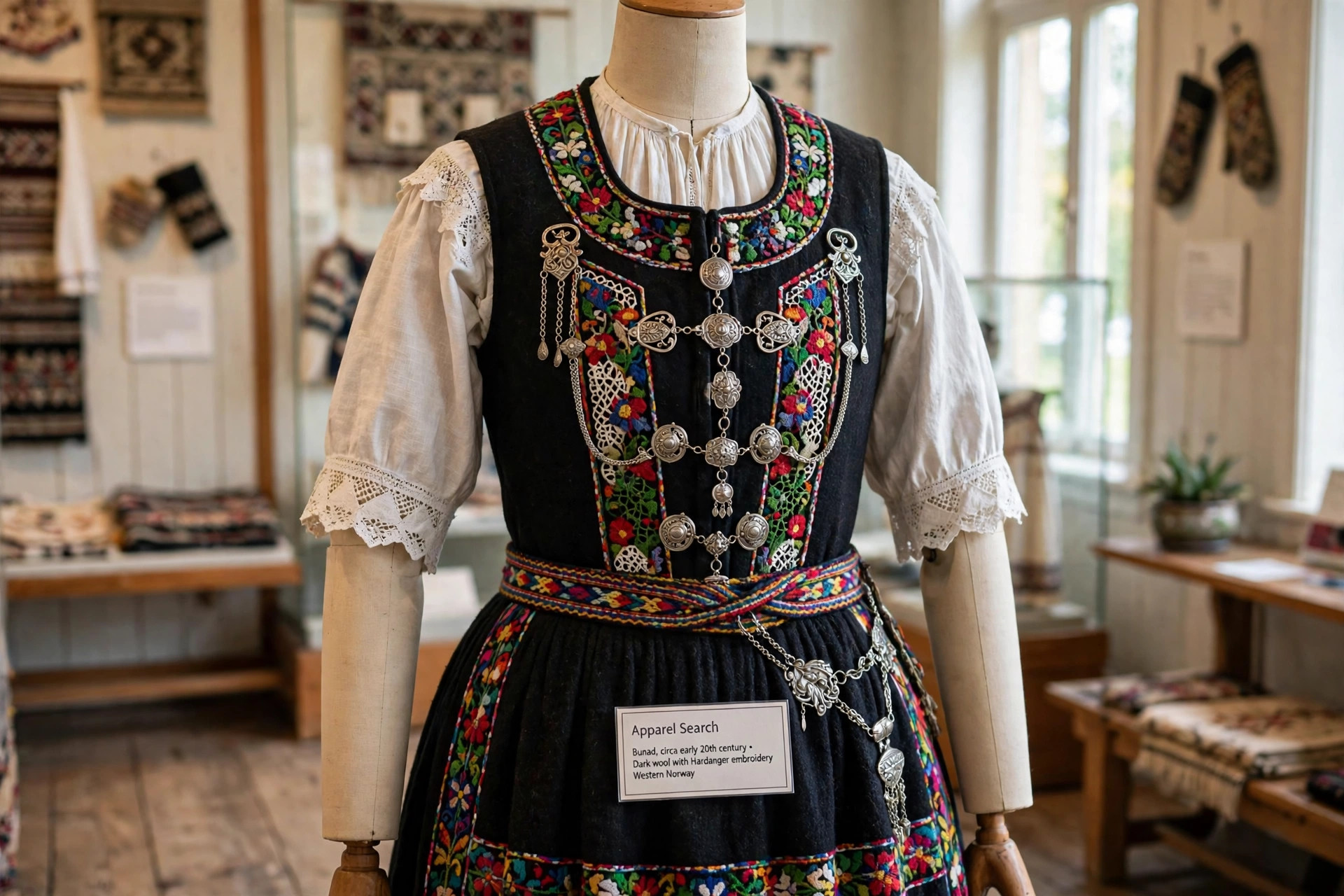
The Garment
What a Bunad Is
The word bunad comes from the Old Norse búnaðr, meaning clothing or household equipment, and in modern Norwegian it names the country’s formal folk costume: a complete, codified outfit whose every detail — cloth, colour, embroidery, jewellery — follows the documented dress of one particular district. Norway has hundreds of local variants. A woman from Hardanger, a man from Setesdal and a child from Trøndelag all wear bunads, yet no knowledgeable Norwegian would mistake one for another. That local precision is the whole point: the bunad is an address you can wear.
Unlike many European folk costumes, the bunad is largely a work of conscious revival. As Norway moved toward independence — the constitution was signed at Eidsvoll on 17 May 1814, and the union with Sweden ended in 1905 — writers and cultural leaders such as Hulda Garborg promoted the folk costume as a national symbol rooted in the districts rather than in foreign fashion. Through the late 19th and 20th centuries, local researchers reconstructed costumes from surviving garments, church inventories, paintings and photographs. Some bunads, notably those of Setesdal and parts of Telemark and Hardanger, continue an unbroken local wearing tradition; many others are careful reconstructions, approved and documented so that makers across the country produce the same district pattern.
The result is a garment with unusual authority. A bunad is not improvised and it is not personalised at whim: the embroidery pattern, the weave of the skirt, the shape of the silver are fixed by the district design. Within that frame there is still life and variation — the age of the cloth, the hand of the embroiderer, family silver of different generations — but correctness matters to wearers in a way that surprises visitors. For the short dictionary version, see Apparel Search’s definition of bunad.
Anatomy
The Parts of the Outfit
A woman’s bunad is an ensemble built in layers, and its silver is as much a part of the dress as its cloth. From the skin out:
- Skjorte — the blouse or shirt
- A white linen or cotton blouse, its collar and cuffs often carrying drawn-thread work or embroidery that shows at the neck and wrists. For men, a white linen shirt serves the same role under the waistcoat.
- Liv — the bodice
- The fitted bodice, in wool or damask, frequently embroidered or woven with the district pattern. It shapes the outfit and carries much of its colour.
- Stakk — the skirt
- A long wool skirt, pleated or gathered, often striped, checked or woven with a patterned border. Wool is the classic bunad cloth: warm, hard-wearing and dyed in the district’s colours.
- Forkle — the apron
- A front apron in linen, cotton or wool, plain, woven or embroidered according to the district. In Hardanger the apron carries the region’s famous whitework.
- Sølje and silver jewellery
- The round filigree brooch (sølje) at the throat, with smaller brooches, cufflinks, shoe buckles and, for men, silver buttons and a knife. Silver is specified by district and made by specialist smiths.
- Headwear, belt and shoes
- District headwear ranges from embroidered caps and scarves to bridal crowns of silver gilt on the greatest occasions. Woven belts, purses on chains and black shoes with silver buckles complete the outfit.
Men’s bunads centre on knee breeches or long trousers, a waistcoat in patterned wool or damask, a jacket, silver buttons and buckles, and in some districts a hat and the short silver-mounted knife. Children wear scaled versions of the same district dress, which is why the 17 May children’s parades read as a map of Norway in miniature.
Regions
Regional Bunads
Because the bunad is local by design, a tour of its regions is a tour of Norway itself. A few of the best-known families of designs:
| District | Character |
|---|---|
| Hardanger | Red bodice, black skirt, white apron with Hardanger whitework embroidery; among the most recognised bunads in Norway |
| Setesdal | An unbroken tradition: white embroidered blouse details, short jacket for men, rich silver; one of the oldest continuously worn designs |
| Telemark | Rose-painting colours translated into wool embroidery — scrolling roses on bodice, skirt border and belt |
| Nordland | Deep blue with floral embroidery, created in the revival period and now a beloved northern emblem |
| Trøndelag | Green or red bodices with woven patterns, reflecting the farming districts around Trondheim |
| Rogaland and the west | Striped and checked wools, silver brooches and district aprons along the fjord coast |
New bunads are still occasionally documented, and old ones revised, through local costume committees — evidence that the system is alive rather than frozen. What never changes is the principle: one district, one dress, worn correctly.
Cloth and Pattern
Embroidery, Wool and Silver
Wool is the bunad’s foundation cloth, woven for skirts, bodices and men’s jackets in stripes, checks and damask patterns recorded for each district. Linen and cotton supply the blouses and aprons, and silk appears in scarves, ribbons and the richest bodices. Dyes follow the documented palette: madder reds, deep blues and blacks, greens and the natural whites of undyed linen.
Embroidery gives many bunads their voice. Hardanger embroidery — the whitework of the Hardanger fjord district — combines satin-stitch blocks, cut threads and drawn-thread fillings to make lacy geometric patterns on aprons and blouses, all in white on white. Telemark and other districts embroider in wool thread with roses and scrolling stems borrowed from the rose-painting tradition. Elsewhere the pattern lives in the weave itself, in woven belts, borders and aprons whose geometry is older than any printed pattern book.
The silver deserves its own paragraph. Bunad silver (bunadsølv) is made by filigree work — twisted silver wires soldered into lace-like rounds — and the great throat sølje often carries dangling spoons that chime softly as the wearer moves. Older tradition credited that sound and flash with turning aside harm, and whatever the wearer believes today, the effect is unmistakable: a bunad in motion glitters and rings faintly, and its silver is cleaned, repaired and inherited as carefully as the cloth.
Living Dress
When the Bunad Is Worn Today
Constitution Day, 17 May, is the bunad’s great day. Children march in school parades under flags in every town, and adults join them in the dress of their districts; in Oslo the parade passes the Royal Palace, and across the country the day belongs to children, ice cream and costume rather than to military display. For many families, a child’s first bunad — or the confirmation bunad given at fourteen or fifteen — is a landmark gift, altered over the years as the wearer grows.
Beyond 17 May, bunads appear at weddings, where bride, groom and guests may all wear them; at christenings and confirmations; at Christmas services and family photographs; and wherever Norwegians gather abroad. Folk dancers wear working versions, and the dress is a common sight at cultural festivals through the summer. Behind the wearing stands a real craft economy of weavers, embroiderers, tailors and silversmiths, alongside the modern industry profiled on our Norway clothing industry page.
Wearing
Wearing Basics
A bunad is worn complete or not at all: trainers, sunglasses perched on the head and modern handbags break the effect wearers work hard to keep. Dress in order — blouse, skirt, bodice, apron, then silver, finishing with the great sølje at the throat. Check that the apron hangs straight, the belt sits at the true waist and the skirt clears the shoes. Men check the waistcoat buttons, silver and knife in their district order. Because the outfit is heavy and warm, summer wearers plan for shade and water, and because the silver tarnishes, it goes on after any hairspray or perfume. Above all, the bunad is worn with the posture it deserves: it is formal dress, and Norwegians treat a person in bunad the way other countries treat a person in evening dress.
Keeping
Care and Storage
A bunad is built to be altered, repaired and inherited, and its care follows that logic. Wool skirts and bodices are aired after wearing, brushed rather than washed, and spot-cleaned or taken to a cleaner who knows folk costume; embroidery is never scrubbed. Blouses and aprons in linen and cotton wash more easily and are ironed crisp for the next occasion. Silver is polished gently before wearing, stored separate from the cloth so tarnish does not mark it, and repaired only by a bunad silversmith. The whole outfit hangs or lies in a breathable garment bag — never sealed plastic — with the skirt supported so its pleats keep. Families record alterations in the garment itself: let-out seams and moved hooks inside a bunad are its family history, written in thread.
Acquiring
Buying and Collecting
A new bunad is commissioned, not bought off the rack: the maker measures the wearer, the cloth is woven and embroidered to the district pattern, and the silver is ordered from a smith — a process of months that explains the price. Ready-made and secondhand bunads exist, and a used bunad in your district pattern, professionally altered, is an honourable and common route in. When buying, verify the district design against its documentation, check the embroidery and silver for completeness, and try the outfit on with its shoes: bunad fit is formal, not forgiving. Machine-embroidered tourist versions exist at far lower prices; they have their place as souvenirs, but they are not bunads in the Norwegian sense, and the difference is visible at a glance. The true article, cared for as above, will dress three generations.
Common Questions
Common Questions
What is a bunad?
A bunad is Norway’s traditional regional costume, worn by women and men for celebrations such as Constitution Day, weddings, christenings and confirmations. Each bunad follows a documented local pattern — its cut, embroidery, colours and silver jewellery identify a specific district. Most bunads were reconstructed in the late 19th and 20th centuries from older folk dress, paintings and surviving garments.
When do Norwegians wear the bunad?
Above all on 17 May, Constitution Day, when children’s parades and street celebrations make the bunad the normal dress of the day in much of the country. It is also worn at weddings, christenings, confirmations, Christmas and other family occasions, and by Norwegians abroad as a sign of home.
What is a sølje?
A sølje is the round silver brooch worn at the throat of the bunad blouse. Filigree søljer carry small dangling silver spoons or discs that move and catch the light, and tradition held that their sound and shine protected the wearer. Søljer are made by specialist silversmiths, often to regional patterns, and are among the most treasured parts of the outfit.
How much does a bunad cost?
A new, handmade bunad with its silver is a major purchase, commonly costing as much as a small car, because the embroidery, weaving and silversmith work take many hours. That cost is why bunads are so often gifts at confirmation, why they are altered rather than replaced, and why a mother’s or grandmother’s bunad is handed down with pride.
Can anyone wear a bunad?
Yes, with respect for what it means. Norwegians generally wear the bunad of a place they or their family come from, and wearing another district’s bunad is best done with a genuine connection or invitation. Visitors who admire the bunad are welcomed — the respectful path is to learn whose dress it is, wear it complete and correctly, and treat the silver with care.
Keep Exploring
More to Explore
In This Series
Traditional Dress by Country
The series hub — every country guide, from the hanbok of Korea to the kilt of Scotland, as each is published.
Visit the hub ↑Norway Clothing Industry
Norway’s apparel and textile industry directory — the modern industry behind the traditional craft.
Explore ↑Go Deeper
Search Apparel Search