Traditional Dress by Country · Sweden
The Folkdräkt of Sweden
Sweden’s folkdräkt is a wardrobe of parishes. For centuries each district dressed in its own colours, stripes and silver, and hundreds of those local costumes survive today — worn at Midsummer poles and church holidays, and joined in the 20th century by a single national costume in yellow and blue, the Sverigedräkten. This guide explains the parts of the outfit, the famous dress of Dalarna, how the national costume came to be, and how folk costumes are worn, cared for and chosen today.
The Garment
What a Folkdräkt Is
Folkdräkt means simply “folk dress,” and in Sweden the folk in question is local. Until industrial clothing swept the countryside in the later 19th century, each parish dressed recognisably as itself: the cut of a bodice, the stripe of a skirt, the pattern of a cap told neighbours which village a woman came from before she spoke. Sweden’s costume map is therefore fine-grained — hundreds of documented district costumes, with the province of Dalarna alone holding dozens, one for nearly every parish around Lake Siljan.
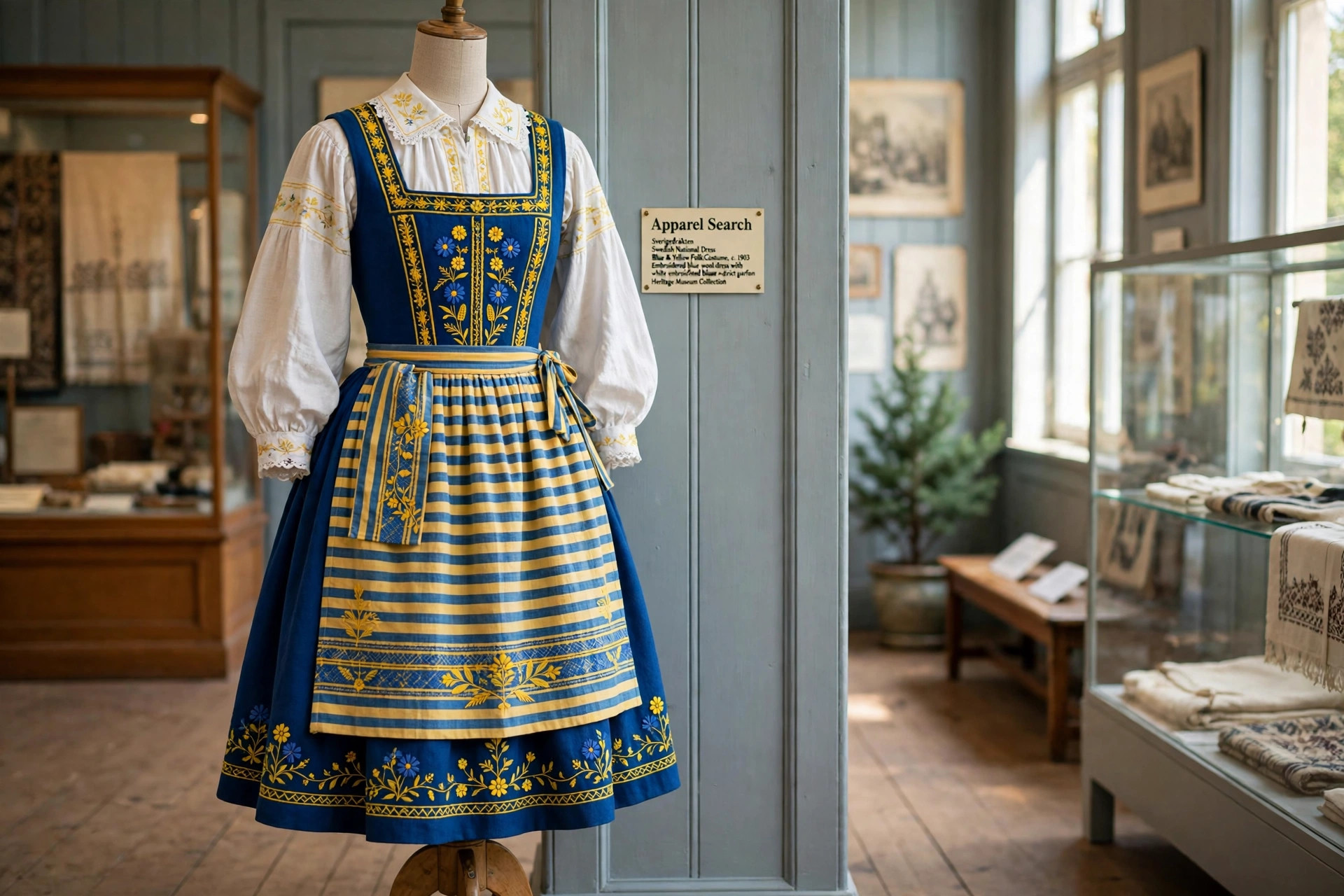
As everyday wear faded, the costumes moved into the keeping of museums, hembygd heritage societies and families. The Nordic Museum in Stockholm and regional museums documented patterns garment by garment, and the 20th-century folk-dance and heritage movements sewed them again. Sweden also gained something Norway deliberately avoided: a single national costume. The Sverigedräkten, designed in 1903, gives every Swede a folk dress in the flag’s blue and yellow, and it now stands alongside the district costumes rather than replacing them — a wearer chooses parish loyalty or national dress, and both choices are correct.
That double system gives Swedish folk dress its character. The district costumes speak of home ground; the national costume speaks of Sweden itself. Both are worn with the same seriousness: complete, correct and clean, for the days of the year when Sweden celebrates who it is.
Anatomy
The Parts of the Outfit
A woman’s folkdräkt is assembled from named pieces whose combination — never the single garment — makes the district design:
- Särk — the blouse
- A white linen or cotton blouse, its collar and cuffs plain, embroidered or trimmed with lace according to the district.
- Livstycke — the bodice
- The fitted, often front-laced bodice in wool, damask or patterned weave, carrying the district’s strongest colour.
- Kjol — the skirt
- A long wool skirt, very often striped — the stripe pattern is frequently the district’s signature — or in a solid colour with a woven border.
- Förkläde — the apron
- The apron, striped, checked, woven or embroidered, worn over the skirt front and tied at the waist; in the national costume it is the famous yellow.
- Huvudbonad — headwear
- Caps, scarves and, for married women in some districts, distinctive shaped headdresses; Midsummer adds the flower wreath (midsommarkrans) over all of them.
- Silver and accessories
- Brooches at the throat, chains, belt buckles, a small bag or pocket (kjolsäck) worn at the hip, knitted stockings and black shoes.
Men’s costumes pair knee breeches or trousers with a waistcoat — often the most colourful piece, in striped or floral weave — a jacket, a white shirt with silver buttons, neckerchief, stockings and buckled shoes; Dalarna parishes add their own hats and long coats for church wear.
Regions
Districts and the National Costume
Dalarna is the heartland. Around Lake Siljan, Leksand’s dress — blue bodice and striped apron for women, yellow waistcoat traditions for men — Rättvik’s, Mora’s and Gagnef’s each hold their own documented patterns, kept alive by strong local societies and by the region’s long memory: Dalarna wore its dress on Sundays well into the age of photography, so its record is unusually complete.
Beyond Dalarna, Skåne in the south contributes richly embroidered and silver-heavy costumes, Hälsingland and Jämtland their northern weaves, and every province keeps its exemplars in its regional museum. Against this parish patchwork stands the Sverigedräkten:
| Element | The Sverigedräkten |
|---|---|
| Colours | Blue dress with yellow apron — the colours of the Swedish flag |
| Origin | Designed 1903 by Märta Jörgensen of Falun; little worn for decades, then revived from the 1970s |
| Details | Floral embroidery and a flower motif drawn from Swedish summer meadows; silver brooch at the throat |
| Who wears it | Anyone — it belongs to no single district; members of the Royal Family wear it on National Day, which carried it to national fame |
The two systems respect each other: at a Midsummer celebration you will see parish stripes and national blue-and-yellow side by side, each wearer dressed correctly by a different rule.
Cloth and Pattern
Wool, Stripes and Embroidery
Wool is the folkdräkt’s main cloth, woven at home and later by local mills in the stripes that identify districts: skirt and apron stripes were woven to pattern, so the loom itself kept the parish record. Linen — Sweden grew and wove flax widely — supplies blouses and aprons, and cotton joined it in the 19th century. Bodices use damask, brocade and, in prosperous districts, silk for scarves and caps.
Decoration divides by region. Skåne is famous for fine whitework and coloured embroidery and for heavy silver; Dalarna for woven pattern, knitted details and painted floral motifs echoed in stitch; many districts embroider the blouse collar and the hip pocket with flowers whose style is local enough to be a signature. Knitting matters too: patterned stockings, mittens and the two-end (tvåändsstickning) knitting of Dalarna, worked with two yarns for warmth and pattern at once. Colour runs to clear northern tones — madder red, indigo and woad blues, greens, black and the undyed white of linen — the palette of natural dyes on wool and flax.
Living Dress
When Folk Costumes Are Worn Today
Midsummer is the folkdräkt’s great day: around the maypole, in village greens and summer gardens, parish costumes and flower wreaths are the dress of the celebration, and folk-dance teams perform in full district dress through the summer festival season. National Day, 6 June, brings out the Sverigedräkten in particular — the Royal Family’s habit of wearing it made the national costume a familiar television image and a popular choice for citizens receiving Swedish citizenship at civic ceremonies.
Weddings, christenings, confirmations and church holidays account for most other wearings, and heritage societies (hembygdsföreningar) keep both the garments and the knowledge of how to wear them. Costume courses teach new wearers to sew, weave and embroider their own district dress — a year’s project that ends in a garment for life. The wider Swedish textile and fashion world, from heritage mills to modern design, is profiled on our Sweden clothing industry page.
Wearing
Wearing Basics
Correctness in Sweden means completeness and district consistency: bodice, skirt, apron, headwear and silver all from the same documented costume, worn clean and pressed. Dress in order — blouse, skirt, bodice, apron, headwear, then silver — and check stripes and apron hang straight. The Midsummer wreath is the one joyful addition allowed across districts, woven fresh from summer flowers on the day. Men check waistcoat, neckerchief and buckles in their parish order. A folk costume worn with modern trainers or mixed with another district’s apron reads to Swedish eyes the way a half-finished sentence reads: the knowledge to wear it whole is part of the heritage, and local societies gladly teach it.
Keeping
Care and Storage
Folk costumes survive because they are worn rarely and stored well. Wool skirts and bodices are aired after wearing, brushed, and cleaned only by specialists; striped wools are never home-washed, since old dyes and weaves can bleed or shrink unevenly. Linen blouses wash and iron to a crisp white and are the outfit’s refreshed layer each season. Silver is polished gently and stored apart from the cloth. Costumes rest in breathable bags or drawers, skirts supported to keep their hang, aprons and caps folded with acid-free tissue, away from light — Swedish attics and museum stores alike follow the same rules. Alterations are recorded and kept reversible where possible: a costume outlives its first wearer by design.
Acquiring
Buying and Collecting
A new district costume is usually made, not bought: heritage societies and specialist makers supply patterns and woven cloth to the documented design, and many Swedes sew their own over a winter of evening courses. The Sverigedräkten is sold ready-made by folk-dress suppliers, which is part of its purpose. Antique costumes appear through auctions and heritage sales; when buying, check that all pieces belong to one district — mixed sets are common and worth less, in every sense, than a complete documented costume — and inspect silver marks, apron weave and bodice lining. A complete costume in good order, stored as above, is a working heirloom: it will dress its next wearer as correctly as its first.
Common Questions
Common Questions
What is a folkdräkt?
Folkdräkt is Swedish for folk costume: the traditional dress of a parish or district, worn for festivals, church holidays, Midsummer and family celebrations. Each district costume has its own documented colours, stripes, embroidery and silver. Sweden also has a national costume, the Sverigedräkten, in blue with yellow details, which anyone may wear.
What is the Sverigedräkten?
The Sverigedräkten is Sweden’s national costume, designed in 1903 by Märta Jörgensen and revived in the 1970s–80s with royal support. For women it pairs a blue dress with a yellow apron and floral details in the national colours; it was created so that Swedes without a district costume of their own would still have a folk dress to wear.
Where is Dalarna dress from, and why is it famous?
Dalarna, the lake district northwest of Stockholm, kept its parish costumes in everyday and Sunday use longer than most of Sweden, so its dress — Leksand, Rättvik, Mora and their neighbours, each different — became the best-known image of Swedish folk costume. Painters such as Anders Zorn recorded it while it was still living dress.
When do Swedes wear folk costume today?
Above all at Midsummer, Sweden’s great summer festival, and on National Day, 6 June, as well as at weddings, christenings, confirmations, folk-dance performances and heritage festivals. Many costumes come out of the wardrobe only a few days a year, which is part of why they survive in such good condition.
Can anyone wear the Sverigedräkten?
Yes. The national costume was designed for all Swedes, including those whose home district has no documented costume, and it is worn respectfully by newcomers as well. District costumes carry a stronger local meaning — wearing one usually signals a family or parish connection — but admiration and correct, complete wearing are welcomed.
Keep Exploring
More to Explore
In This Series
Traditional Dress by Country
The series hub — every country guide, from the hanbok of Korea to the kilt of Scotland, as each is published.
Visit the hub ↑Sweden Clothing Industry
Sweden’s apparel and textile industry directory — the modern industry behind the traditional craft.
Explore ↑Go Deeper
Search Apparel Search