Traditional Dress by Country · Finland
The Kansallispuku of Finland
Finland’s kansallispuku — the national costume — is a dress of parishes and provinces, documented stitch by stitch: striped skirts and fitted vests in the west, the rich embroidery of Karelia in the east. In the far north, the Sámi people wear a dress of their own, the gákti, which is theirs alone and is treated in this guide with the respect it requires. This guide explains the kansallispuku’s parts and regions, Karelian craft, the gákti’s separate place, and how Finnish dress is worn and kept today.
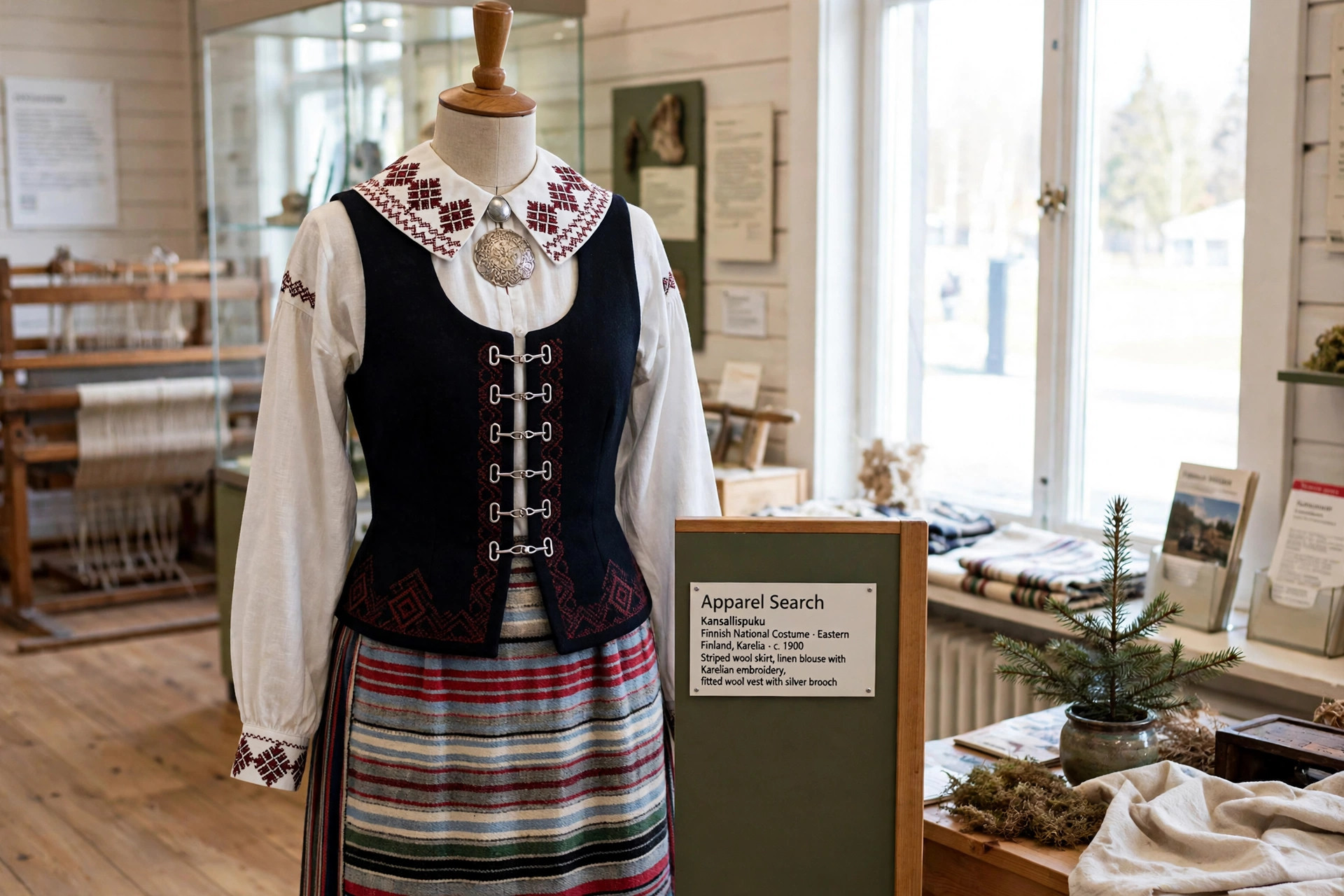
The Garment
What a Kansallispuku Is
When Finland built its national culture in the 19th century — the century of the Kalevala, the national epic — dress took its place in the project. A famous landmark came in 1885, when women in regional costumes presented them during a royal visit and the idea of the Finnish national costume caught the country’s imagination. Through the following decades, researchers documented the dress of Finland’s parishes from surviving garments, and costume models were published locality by locality: the kansallispuku system Finland still uses, in which every costume has a documented home, pattern and set of parts.
The map divides by culture. Western Finland, long tied to Sweden, dresses in striped skirts, fitted vests and aprons close in spirit to Scandinavian folk dress. Eastern Finland and Karelia embroider: blouses, aprons and headwear carry geometric stitchery in red and black, and Orthodox Karelia historically wore the sarafan-like feresi and richly decorated head-dresses of its own tradition. A Finnish costume therefore announces not just Finland but a compass point and a parish within it.
One boundary must be drawn clearly, and this guide draws it with care. The far north is Sápmi, homeland of the Sámi people, whose dress — the gákti — is not a regional variant of the kansallispuku but the national dress of another people, described in its own section below on its own terms.
Anatomy
The Parts of the Outfit
- Paita — the blouse
- A white linen or cotton blouse, plain in the west and embroidered at collar, chest and cuffs in Karelian and eastern costumes.
- Liivi — the vest
- The fitted vest or bodice in wool or damask, front-fastening, carrying the costume’s strong colour over the blouse.
- Hame — the skirt
- A long wool skirt, characteristically striped in western costumes — the stripe is the locality’s signature — or solid with woven borders in the east.
- Esiliina — the apron
- A front apron, woven, striped or embroidered to the local model, tied at the waist over the skirt.
- Headwear and jewellery
- Lace caps, scarves and, in Karelia, embroidered headbands and headdresses; silver or bronze brooches (solki) at the throat, and bead necklaces in eastern dress.
- Men’s costume
- Knee breeches or trousers, waistcoat, jacket and, in Karelia, embroidered shirts — documented parish by parish like the women’s dress.
Regions
Finland’s Costume Regions
| Region | Character |
|---|---|
| Southwest and Häme (west) | Striped skirts, fitted vests, lace caps — the classic western kansallispuku of the old Swedish-facing parishes |
| Ostrobothnia | Bold stripes and strong colour on the west coast, with distinctive waistcoats and wedding dress traditions |
| Savo | Lakes-region costumes balancing western cut with eastern embroidery touches |
| Karelia (east) | Red-and-black embroidery on linen, decorated headwear, beadwork; Orthodox districts keep the feresi tradition |
| Peräpohjola (far north, Finnish) | Northern Finnish parish costumes of the Tornio valley and Lapland’s Finnish communities — distinct from Sámi dress |
The Finnish National Costume Centre in Jyväskylä keeps the documentation — patterns, cloth and correct assemblies — that makers and wearers consult, a national wardrobe office for a wardrobe of parishes.
Cloth and Pattern
Stripes, Embroidery and Karelian Stitch
Wool woven in stripes is the west’s signature: skirt and apron stripes were woven to the locality pattern, so the loom held the parish record, in madder reds, indigo blues, greens and black on natural grounds. Linen supplies blouses and aprons, and lace — Finland’s bobbin-lace town of Rauma is famous — trims caps and collars.
The east works in thread. Karelian embroidery covers linen with counted geometric patterns, stylised birds, trees of life and human figures in red, black and touches of blue and yellow — motifs with deep roots around Lake Ladoga, worked on blouse fronts, aprons, towels and headwear. Woven pattern answers it: Karelian and eastern textiles carry tablet-woven bands and patterned borders whose geometry matches the stitchery. Together, stripe and stitch give Finland two textile languages in one small country — which is precisely what its costume map records.
The North
The Sámi Gákti — Another People’s Dress
The gákti is the traditional dress of the Sámi people, Indigenous to Sápmi — northern Finland, Norway, Sweden and the Kola Peninsula. It is a tunic-like garment of wool or other cloth, belted, its bands, colours and silver brooches varying by family and home area within Sápmi, worn with distinctive shoes (nutukas, with upturned toes), scarves, and in winter with reindeer-fur garments. A knowledgeable Sámi viewer reads a gákti the way Finns read a kansallispuku — as an address and a family history.
It belongs in this guide only to be distinguished and respected. The gákti is not a Finnish regional costume, not a souvenir and not dress-up: Sámi people have been clear that their dress is for them, and that imitation gákti sold to tourists misrepresent a living Indigenous culture. The respectful visitor admires it at Sámi cultural events, buys genuine Sámi handicraft (duodji) from Sámi makers when it is offered for sale, and leaves the wearing of the gákti to the people whose dress it is.
Living Dress
Finnish Dress Today
Independence Day, 6 December, is the kansallispuku’s formal summit — worn at celebrations and visible at the season’s receptions — with Midsummer its summer counterpart at lakeside festivals and dances. Weddings, confirmations, graduations and choir and folk-dance festivals fill the calendar between, and costume birthdays are celebrated nationally each August, when wearers picnic in full dress to honour the costume tradition itself.
Making remains active: the costume centre documents, weavers weave skirt cloth to order, and sewing courses graduate new wearers with parish-correct costumes. The wider Finnish textile and design industry around the craft is profiled on our Finland clothing industry page.
Wearing and Keeping
Wearing Basics, Care and Storage
A kansallispuku is worn complete and locality-true: blouse, vest, skirt, apron, headwear and brooch all from the one documented model, clean and pressed, with correct shoes. Consultants at costume centres check assemblies for the great days — Finns take the correctness as a courtesy to the parish the dress names. Care follows the northern rulebook: wools aired and brushed, cleaned by specialists; linen blouses washed and ironed crisp; embroidery washed only by knowledgeable hands; brooches polished gently and stored apart. Costumes rest in breathable covers, skirts supported, away from light and damp — Finnish homes store them as they store flags, folded with respect and ready for the day.
Acquiring
Buying and Collecting
New costumes are bought as documented sets or sewn from the centre’s patterns with cloth woven to the model — a considerable but once-in-a-lifetime purchase, usually altered across decades rather than replaced. Secondhand costumes circulate within families and costume societies; when buying, verify the locality model and completeness of parts, since a costume’s value — cultural and monetary — lies in its correctness as a set. Karelian embroidery, old and new, collects its own following. And one buying rule stands apart: genuine Sámi duodji carries the Sámi Duodji mark and is bought from Sámi makers; the gákti itself is not a purchasable souvenir, and this guide asks its readers to honour that.
In Detail
Making a Costume, Parish by Parish
A Finnish costume begins on paper: the documented model for the parish, held by the costume centre and regional museums, specifies skirt stripe, vest cloth, apron weave, blouse cut and brooch, down to the order in which stripes repeat. Weavers weave the skirt cloth to that specification — a stripe out of place makes another parish’s skirt — and the sewer works to the model’s patterns, fitting the vest close and setting the apron’s weave to hang true. Many wearers sew their own across a winter of guided evenings, helped by costume consultants who check each stage against the documentation; the finished garment is then inspected, in effect, by everyone who knows the parish dress, and it will be checked again, kindly and exactly, at every Independence Day of its long life. That shared discipline is why a room of Finns in national costume reads as a map: each wearer a parish, each parish correct, the whole country present in cloth.
That discipline has a gentle side, too: a costume made for a confirmation teenager is let out, re-fitted and re-trimmed across a lifetime, its alterations recording the wearer’s own history inside the parish pattern. Finns speak of growing with a costume rather than out of it, and a well-kept kansallispuku at a family celebration may be on its third wearer and its sixth decade — still correct, still parish-true, still entirely itself.
Common Questions
Common Questions
What is a kansallispuku?
Kansallispuku means national costume in Finnish: the documented traditional dress of a Finnish locality or region, worn for celebrations, Independence Day, Midsummer, weddings and folk performance. Each costume — its striped skirt, vest, blouse embroidery, apron and jewellery — follows a researched local model, many of them standardised in the late 19th and 20th centuries from surviving garments.
What is Karelian dress?
Karelia, in Finland’s east (and across the Russian border), dresses in some of the country’s richest costume: embroidered blouses and headwear, woven patterns and, historically, the sarafan-style dress of Orthodox Karelia alongside Finnish western forms. Karelian embroidery — red and black geometric and stylised motifs on linen — is a signature Finnish craft.
What is the gákti, and who wears it?
The gákti is the traditional dress of the Sámi, the Indigenous people of Sápmi across northern Finland, Norway, Sweden and Russia’s Kola Peninsula. Its colours, bands, silver and cut identify family and home district within Sápmi. It is the Sámi people’s own dress — not a Finnish national costume — and it is worn by Sámi people; others should admire it, learn about it, and not wear imitations of it.
When do Finns wear national costume?
On Independence Day, 6 December, at Midsummer, at weddings, christenings and confirmations, at folk-dance and choir festivals, and on official and school celebrations through the year. Many Finns receive or sew a costume for confirmation or graduation and wear it for decades.
How is a Finnish costume chosen?
By connection: Finns wear the costume of their own or their family’s home locality, documented by the national costume centre and regional museums. Ready-made costumes, sewing patterns and woven cloth are sold to those documented models, and costume consultants help wearers assemble the correct pieces — down to the right brooch and apron for the parish.
Keep Exploring
More to Explore
In This Series
Traditional Dress by Country
The series hub — every country guide, from the hanbok of Korea to the kilt of Scotland, as each is published.
Visit the hub ↑Finland Clothing Industry
Finland’s apparel and textile industry directory — the modern industry behind the traditional craft.
Explore ↑Go Deeper
Search Apparel Search