Bunad
Clothing Definitions — definitions of garments and clothing terms from Apparel Search
Search Apparel Search
At a Glance
Definition: A bunad is a Norwegian traditional costume, based on the folk dress of a specific district, with regional embroidery, colors and handmade silver jewelry that identify where the wearer comes from.
Pronunciation: BOO-nahd
Category: Clothing Definitions
Word Origin
Bunad comes from the Old Norse búnaðr, meaning equipment, outfit or household gear — the same root as words for preparing and providing. The name fits the garment's nature: a bunad is not a single dress but a complete, assembled outfit of clothing, embroidery and silver.
A bunad is a Norwegian traditional costume — formal dress, not fancy dress. Every district has its own recognized design, so the embroidery patterns, colors, cut and handmade silver or gold jewelry of a bunad tell an informed eye exactly which valley or coastal community the wearer comes from. Wearing the bunad of your home region is a point of pride, and on Norway's Constitution Day the streets fill with hundreds of local variations worn at once.
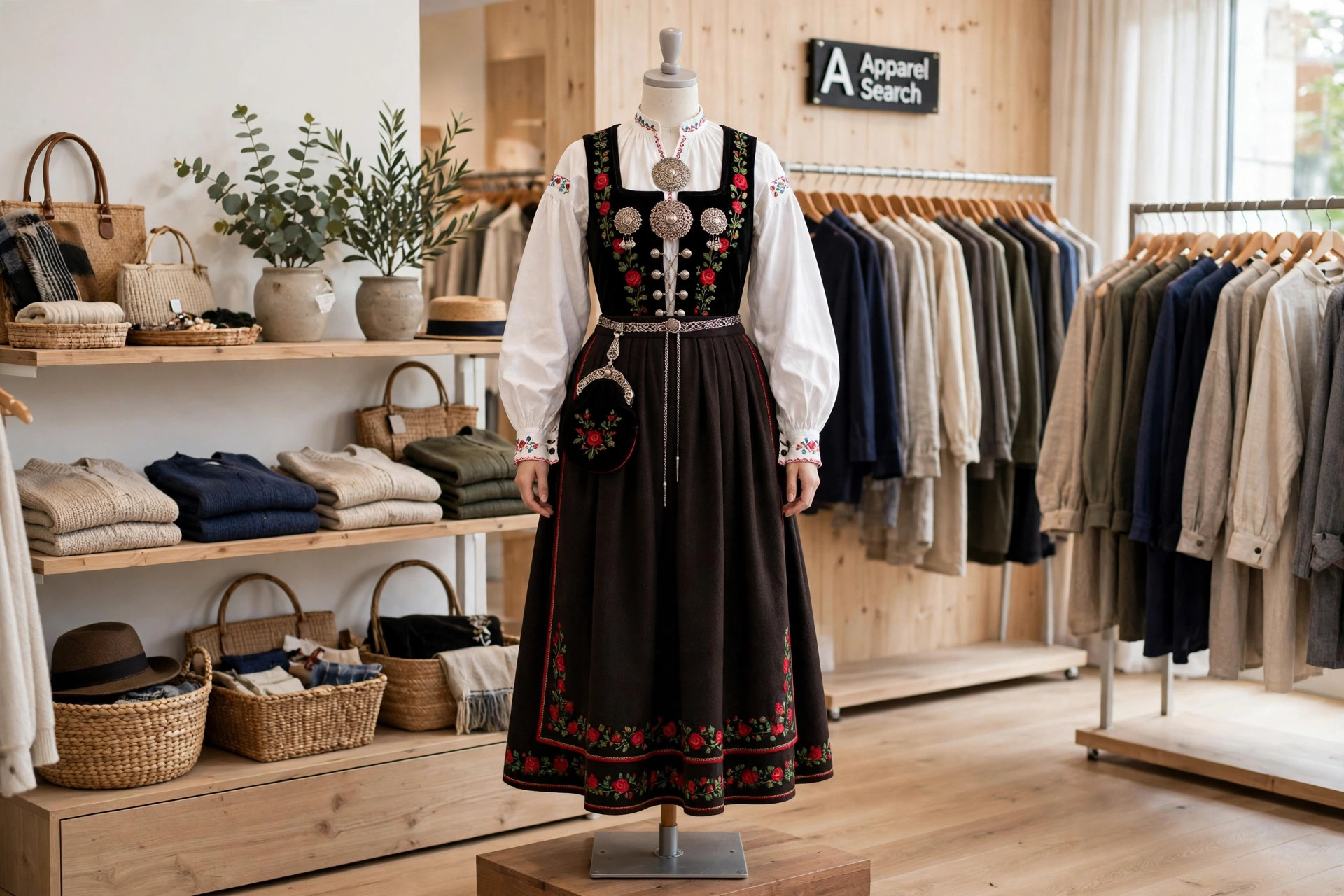
What a Bunad Consists Of
A woman's bunad is built in layers: a white linen or cotton blouse with embroidered collar and cuffs, a fitted bodice or vest over it, a long wool skirt — often with a woven or embroidered band at the hem — and an apron, plain, woven or embroidered according to the district. A shawl or scarf, a small cap or headband, and dark shoes complete the outfit. The embroidery is the district's signature: floral patterns worked in wool or silk thread, in colors fixed by local tradition, cover the bodice, skirt hem, apron and sometimes a purse or bag carried with the outfit.
A man's bunad centers on a waistcoat — frequently the most heavily embroidered piece — worn over a white shirt, with a short jacket, knee breeches or long trousers depending on the district, knitted stockings and buckled shoes. Both versions are made to measure in wool and natural fibers, and a complete outfit is a major investment, expected to last a lifetime: many Norwegians receive a bunad at confirmation in their teens and wear the same one, let out or taken in as needed, for decades.

The Silver: Sølje
No bunad is complete without its silver. The centerpiece for women is the sølje, a filigree brooch worn at the throat to fasten the blouse, worked in intricate patterns and hung with small dangling silver spoons or discs that move and catch the light. Larger brooches, ring brooches, silver buttons down the bodice, cufflinks, belt fittings and shoe buckles complete the set, and men's bunads carry their own silver buttons and buckles.
The silver is often the most valuable part of the outfit and the most personal: pieces are inherited, given at confirmation and weddings, and made by specialist silversmiths who still work in regional styles. Like the embroidery, the silver follows district tradition, so it reinforces the bunad's message — this is where I am from.
How the Bunad Was Made — and Remade
Bunads have two kinds of origin. Some descend in a direct line from local dress worn into the nineteenth century — districts such as Setesdal, parts of Telemark, Hallingdal, Gudbrandsdalen, the Bergen coast and Røros kept living folk-dress traditions longest. Others are reconstructions, assembled in the twentieth century from surviving garments, photographs, paintings and written records when local dress had already disappeared. Interest in the bunad grew with the folk-dance movement of the early 1900s, led by pioneers such as Hulda Garborg and Klara Semb, and in 1947 a national advisory body — the Landsnemnda for Bunadspørsmål — was established to advise on bunad questions; its work continues today through the Norwegian Institute for Bunad and Folk Costume.
That history explains the famous debate about correctness — the so-called 'bunad police' on one side, who hold that designs should follow documented tradition strictly, and those on the other who accept new bunads and gentle evolution. Both sides agree on the core principle: a true bunad is tied to a place and documented from its dress, which is what separates it from a generic festive costume assembled without a district behind it. New variations are still created, but they earn the name by doing the research.
When Norwegians Wear It
The bunad's great day is 17 May, Constitution Day, when children's parades and street celebrations are a sea of regional costume — the surest sign that the bunad is living dress, not a museum piece. It is also worn for weddings, confirmations, christenings, Christmas and official occasions; at formal events in Norway a bunad is fully equivalent to a suit or an evening dress, and no one wearing one is underdressed. Around 200 distinct bunads are counted, and Norwegians abroad wear theirs as a declaration of home.
Among the world's national costumes, the bunad is closest in spirit to Scotland's kilt outfit: regionally coded, formally worn, expensive, inherited, and fiercely debated by traditionalists. Our national costume definition covers the wider family, and the clothing industry of Norway page places the bunad in its home industry.
Not to Be Confused With
In Norwegian folk-dress research, a bunad is distinguished from a folk costume (folkedrakt): the folk costume is the everyday and festive dress people actually wore in earlier centuries, with all its local variation, while the bunad is the formal, documented outfit — based on that tradition — that is made and worn for celebrations today. The words overlap in everyday speech, but the distinction matters to the committees who document each district's design. See also our general national costume definition.
Common Questions
What is a bunad?
A bunad is the Norwegian traditional costume: a formal outfit based on the folk dress of a particular district, with regional embroidery, colors and silver jewelry. Each district has its own recognized design — around 200 types are counted — so a bunad shows where its wearer comes from.
When is a bunad worn?
Bunads are worn above all for Norway's Constitution Day on 17 May, when streets fill with people in regional costume, and for weddings, confirmations, christenings and other celebrations. A bunad counts as formal dress in Norway, appropriate anywhere a suit or evening dress would be worn.
What silver is worn with a bunad?
Silver jewelry called sølje — filigree brooches with dangling silver spoons or discs — is an essential part of the women's bunad, with silver buttons, cufflinks and belt fittings on men's versions. The silver is often the most valuable part of the outfit and is handed down through families.