Royal & State Fashion · State Dressing Profiles
Jacqueline Kennedy: State Dressing in the White House Years
This guide treats one narrow, remarkable thing: the wardrobe Jacqueline Kennedy built for the job of First Lady between January 1961 and November 1963, and the system behind it — an official designer appointed before the inauguration, more than 300 outfits planned as a single state wardrobe, and state visits dressed as carefully as speeches. Her wider story as a fashion icon — the years before and after the White House — is told in full on Apparel Search's Jacqueline Kennedy fashion icon profile, and this page deliberately does not retell it. What follows is the working wardrobe of 1961–63: Cassini's appointment, the inauguration, Paris, and the pink suit whose maker scholarship has finally settled.
At a Glance
- The years
- 20 January 1961 – 22 November 1963 — the White House years only; the full style story is on her fashion icon profile, linked above and below
- The designer
- Oleg Cassini, appointed her official designer in December 1960 — the first such formal appointment for a First Lady
- The output
- More than 300 outfits created across the White House years, planned as one wardrobe system
- The signature
- Clean A-line day dresses, sleeveless evening sheaths, the pillbox hat, pearls and white gloves
- The test case
- Paris, May–June 1961 — French couture worn in France, French spoken to the press
- The artifact
- The pink bouclé suit of 22 November 1963, held unwashed by the US National Archives, not displayable until 2103
The Appointment
December 1960: A First Lady Gets an Official Designer
State dressing usually happens by accumulation: a wardrobe grows around a public figure, designer by designer, occasion by occasion. The Kennedy White House did it by appointment. In December 1960, weeks before the inauguration, Oleg Cassini was named Jacqueline Kennedy's official designer — the first time a First Lady had made such a formal arrangement with a single designer. It is the founding fact of this page, because it turned dressing from a private taste into an office: one designer, briefed on the whole calendar, building a wardrobe the way a speechwriter builds a tour.
The scale matched the intention. Cassini created more than 300 outfits across the White House years. That number matters less as a count of dresses than as evidence of method — a wardrobe planned in depth, so that a state dinner, a televised address, a christening and a foreign tour each drew on a stock designed for exactly that register. The early 1960s silhouette she wore — the clean lines and shorter hemlines our 1960s fashion history guide traces — was, in her case, not simply the fashion of the moment. It was a uniform chosen for a new medium: television, which rewarded uncluttered shapes, strong plain colour and a face left completely clear.
Cassini's own background suited the brief. He was a working designer of the American industry, not a Paris couturier, and that was politically the point: a First Lady who had been criticised during the campaign for her French wardrobe needed an American name at the head of it. The appointment solved a presentational problem and a practical one at the same time. It gave the press a single story to report — the First Lady and her official designer — and it gave the White House a single point of control over how its most photographed member would appear. Every later First Lady wardrobe operation, however informal, works in the shadow of that December 1960 decision.
Inauguration Day
20 January 1961: The Fawn Coat and the Pillbox
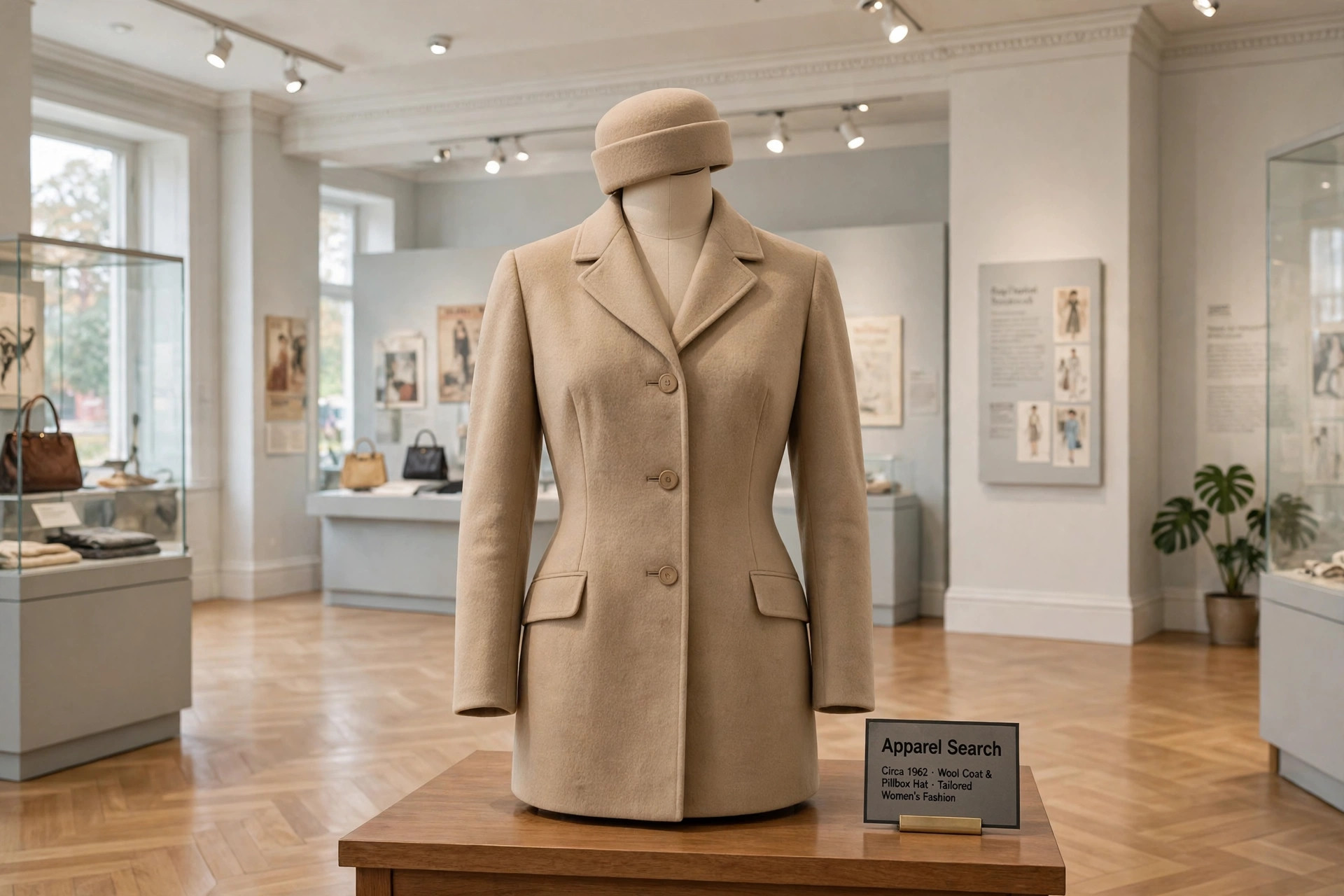
The system's first public test was the inauguration on 20 January 1961, one of the coldest in memory, and the outfit chosen for it is still the reference image of the whole wardrobe: a fawn wool coat by Cassini, worn with a pillbox hat from Bergdorf's custom salon. Nothing about it was grand in the traditional inaugural sense — no fur, no jewels on display, no sweeping silhouette. Its power was in its restraint: a plain, beautifully cut coat in a quiet colour, and above it a small, brimless hat that left a young face entirely visible to the cameras.
The pillbox did something no one had budgeted for. The hat is credited with a worldwide millinery revival — a small, simple, wearable shape that women who would never buy couture could buy, or have copied, the following week. That is the first recorded instance of the pattern that defines this wardrobe's impact: a garment chosen for a state occasion, in a form so reproducible that the state occasion effectively launched a retail trend. The coat made the same point more quietly. Fawn, not black or navy or inaugural white: a colour chosen to read warmly on black-and-white television and in newsprint, against snow.
Read together, coat and hat show the system's priorities in miniature. The clothes were American-made, camera-tested, weather-appropriate and instantly copyable. A First Lady's wardrobe had been treated before as a matter of personal elegance; from 20 January 1961 it was visibly a communications instrument, designed with the same care as the ceremony it appeared in.
The System
The Jackie Look: A Wardrobe, Not a Series of Outfits
What Cassini built, and what the world copied, was a repeatable formula rather than a run of individual triumphs. Day dress: a clean A-line, often sleeveless or with a short sleeve, in a plain strong colour, worn with low heels, white gloves and a single or triple strand of pearls. Evening: a sleeveless sheath, equally uncluttered, letting jewellery and the occasion carry the decoration. Hair smooth, sunglasses oversized, jewellery minimal and repeated. The components were few, and they were worn in rotation with a discipline that made the whole wardrobe read as one continuous statement.
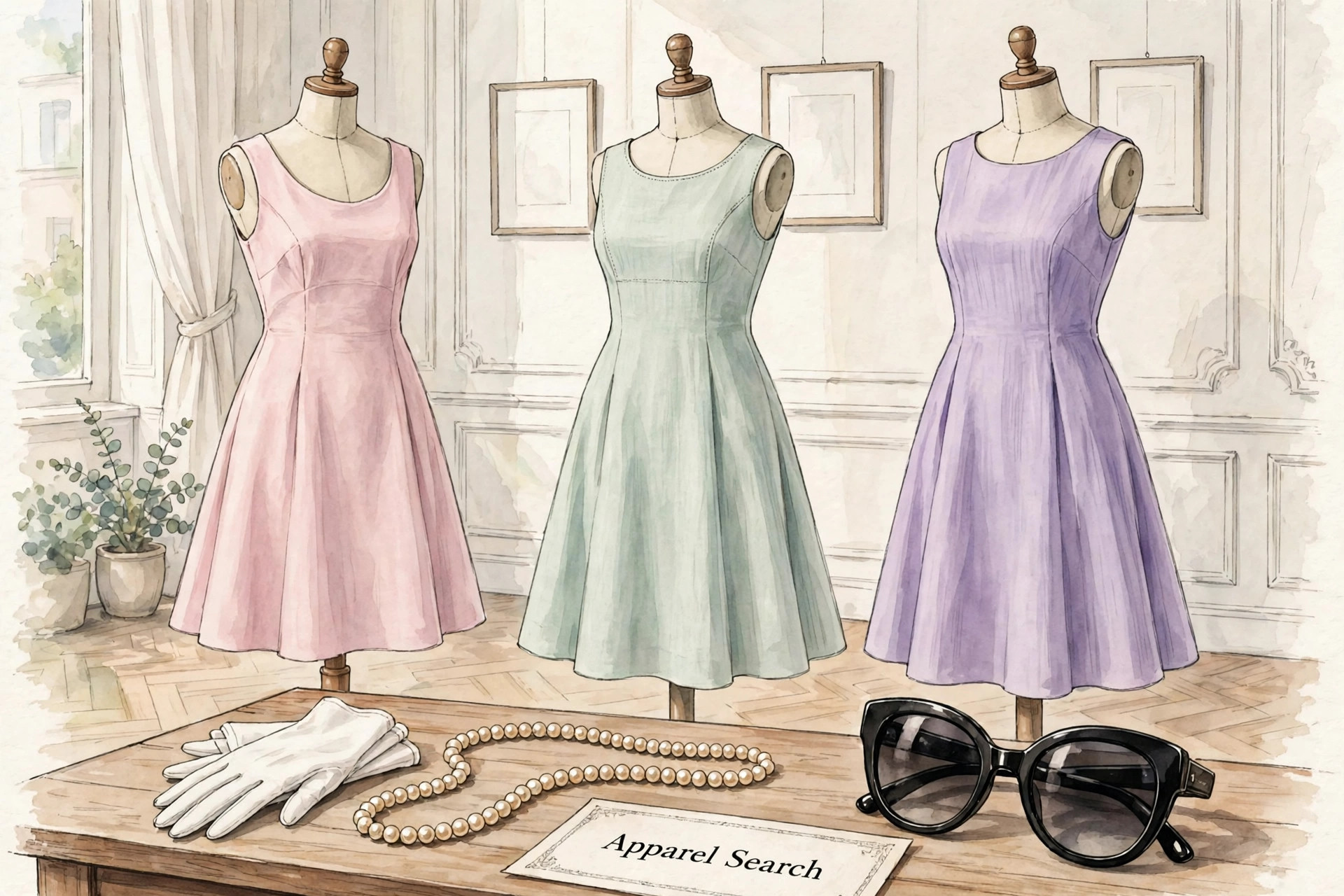
The discipline is the story. A formula this consistent does three kinds of work at once. It photographs predictably, which a press office values above novelty. It travels: the same components, re-coloured and re-fabriced, could dress a morning in Washington or an afternoon on a state visit without a change of language. And it brands: within months the combination of A-line dress, pillbox, pearls and sunglasses was recognisable at any distance, in any country, as her. Contemporaries named it plainly — the "Jackie look" — and American manufacturers copied it at every price point within weeks of each appearance, which is why the look survives in photographs of ordinary women of 1961–63 who never saw Washington.
It is worth being precise about what kind of achievement this was. The individual garments were not avant-garde; Paris was showing stranger and more inventive clothes in the same years. The achievement was editorial: a wardrobe edited down to a grammar simple enough to be understood instantly and repeated endlessly, worn by a woman who understood — earlier than almost any public figure of her generation — that in the television age consistency is itself a message.
The State Visit
Paris, May–June 1961: Dressing in the Host's Language
The system's supreme test came four months into the presidency, on the state visit to Paris in May–June 1961 — and she dressed for it by breaking her own American rule, deliberately and in the open. For Paris she wore French couture, including Givenchy for the dinner at Versailles. Where the Cassini appointment had solved the domestic problem — a First Lady dressed by an American — Paris posed the diplomatic one, and the answer was the compliment every host nation understands: your clothes, worn well, in your palace.
She completed the compliment in the host's language, literally. She spoke French to the press — fluent, idiomatic French — and became, by every contemporary account, the visit's diplomatic sensation: the crowds and the French media took to her in a way that measurably warmed a visit whose politics were difficult. President Kennedy's own verdict has become the era's summary of the trip; introducing himself at a press event, he described himself, as the line is widely reported, as "the man who accompanied Jacqueline Kennedy to Paris." Treat the quote as period colour rather than record — it is attributed everywhere and sourced to the moment's retelling — but its survival tells its own truth: the First Lady's presentation was understood, at the time and by her own husband, as the visit's chief diplomatic asset.
Paris is why this page exists separately from a general style profile. The Givenchy at Versailles was not shopping; it was protocol executed in cloth — the same discipline Elizabeth II's tour wardrobes applied with embroidered emblems, applied here through designer nationality and language. State dressing rarely gets a cleaner demonstration.
The Pink Suit
Dallas, 22 November 1963: The Suit Scholarship Settled
The most examined garment of the twentieth century is a raspberry-pink wool bouclé suit with navy trim, worn in Dallas on 22 November 1963. For decades its label was debated — Chanel, or a copy? — and the debate mattered, because it touched the central tension of her wardrobe: a First Lady with Paris taste who had pledged to wear American. Justine Picardie's research resolved the question, and the resolution is more interesting than either simple answer.
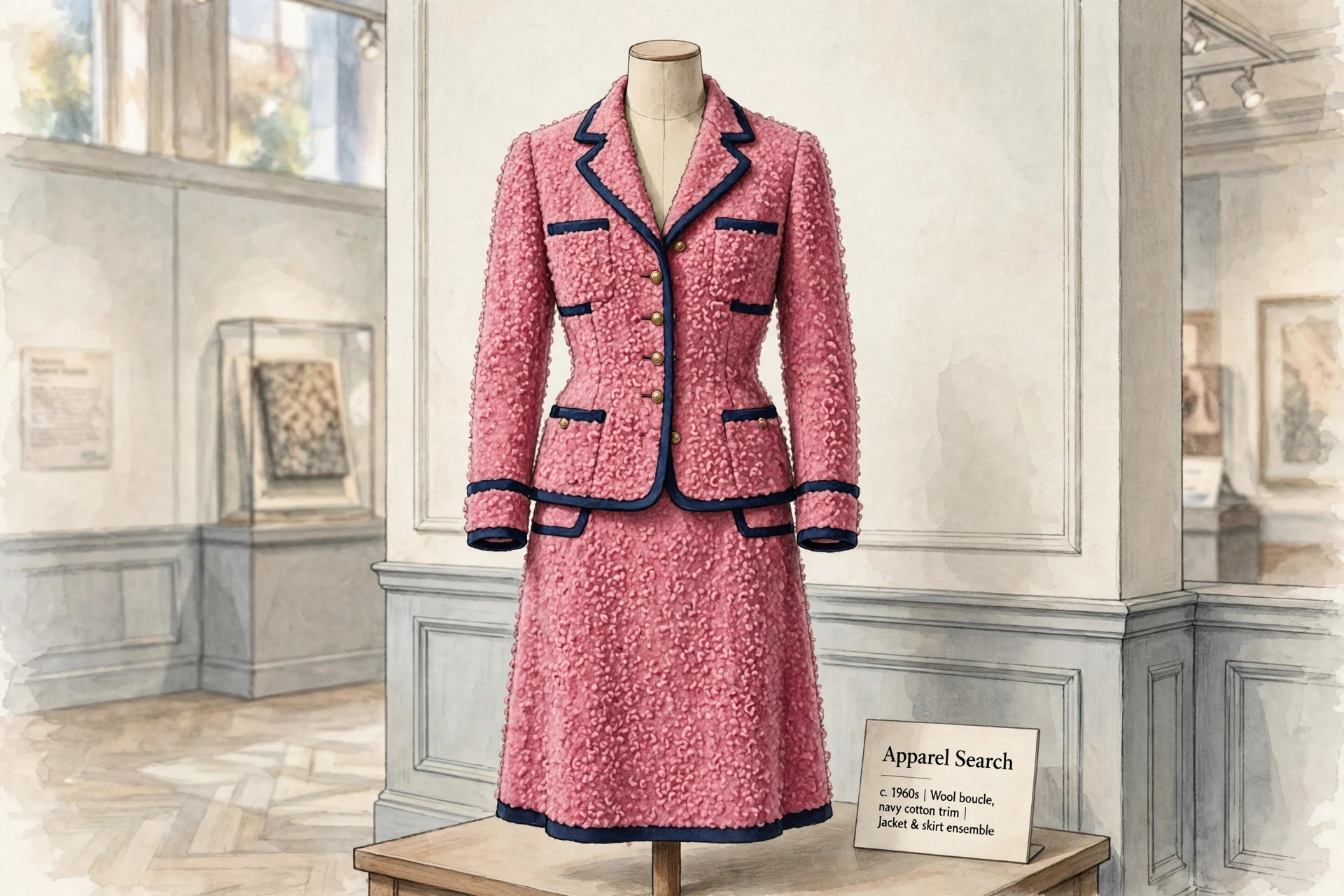
The suit was made by Chez Ninon in New York under Chanel's authorised "line-for-line" system, using Chanel patterns and Chanel materials. It was, in other words, a genuine Chanel design, legitimately produced in America with the house's own patterns and cloth — the authorised mechanism by which Paris couture was reproduced by approved American salons. The political elegance of the arrangement is obvious in hindsight: the First Lady could wear the exact suit Paris designed, and every word of the pledge to dress American remained true. The pink suit was not an exception to the Cassini-era system; it was the system working at its most sophisticated, sourcing design and manufacture on two continents at once.
What she did in the suit belongs to history rather than fashion, but the garment is inseparable from it. After the assassination she refused to change out of the bloodstained suit, kept it on for the flight back to Washington and for Lyndon Johnson's swearing-in aboard Air Force One, saying: "Let them see what they've done." The suit passed to the US National Archives, where it is held unwashed, and under the family deed it is not to be displayed until 2103. The most famous First Lady garment in existence will be seen again, if the deed holds, by a century that knows it only as this page's readers do — by description.
The Impact
An Honest Accounting: What the Wardrobe Changed
Impact claims for this wardrobe are usually made in numbers, and the honest first point of this section is that no trustworthy sales figures exist for 1961–63 — none were measured at the time in any form that survives scrutiny, and none are invented here. What can be documented is structural, and it is substantial enough without embroidery.
The Cassini appointment itself is the impact: a First Lady with an official designer was a new institution, and it has never quite gone away.
First, the institutional change. Before December 1960, a First Lady's clothes were a private matter that happened to be photographed. After it, they were a brief, held by a named designer, planned against a calendar — the model every subsequent presidential wardrobe, and several royal ones, has adapted. Second, the diffusion: the "Jackie look" was copied by American manufacturers at every price point within weeks, a speed of translation from state occasion to high street that the pillbox revival had already demonstrated on inauguration day. Third, the naming honour the industry gives only to true signatures: the Gucci handbag she carried was renamed the "Jackie" — a product line carrying a First Lady's name because her carrying it had made it famous.
That is the measured claim, and it is the right size. A wardrobe that created a designer's office where none existed, set a retail look for a continent, and put its wearer's name on a handbag line does not need a dollar figure to rank among the most consequential state wardrobes of the century. It needs only what this page has tried to give it: the record, with the settled facts separated from the legend.
Common Questions
Questions & Answers
Who designed Jacqueline Kennedy's clothes as First Lady?
Oleg Cassini, appointed her official designer in December 1960, was the first designer to hold a formal appointment of that kind for a First Lady. He created more than 300 outfits across the White House years, building a complete state wardrobe of clean A-line day dresses and sleeveless evening sheaths rather than dressing her occasion by occasion.
Was the pink suit Jacqueline Kennedy wore in Dallas a real Chanel?
Justine Picardie's research resolved the long debate: the raspberry-pink boucle suit with navy trim was made by Chez Ninon in New York under Chanel's authorised line-for-line system, using Chanel patterns and materials. The arrangement let her wear the Chanel design while honoring her pledge to dress in American-made clothes.
What happened to the pink suit after Dallas?
She kept the bloodstained suit on for the flight back to Washington and for Lyndon Johnson's swearing-in, saying "Let them see what they've done." The suit is held unwashed by the US National Archives and, under the family deed, is not to be displayed until 2103.
Royal Style on Apparel Search
Her full fashion-icon profile tells the whole style story; this section adds the state-dressing treatments — her successor in the measured-impact stakes, the craft guide, and the monarch whose system hers paralleled.
Search Apparel Search