Royal & State Fashion · State Dressing Profiles
Michelle Obama: High-Low Dressing and the Measured Effect
A First Lady holds no office and commands no department, but her wardrobe is read as policy whether she intends it or not. Michelle Obama dressed as if she understood that from the first day: an inaugural gown by an unknown young designer instead of an established house, cardigans and chain-store dresses worn as a deliberate high-low policy, and American designers — established and emerging — promoted by the simple act of being worn. Uniquely in this section, her effect was then measured by an academic: an event study of 189 appearances that priced her wardrobe in stock-market returns. This guide tells both stories — the dressing, and the measurement, with the study's own caveats printed in full, because the caveats are what make the number worth quoting.
At a Glance
- The gowns
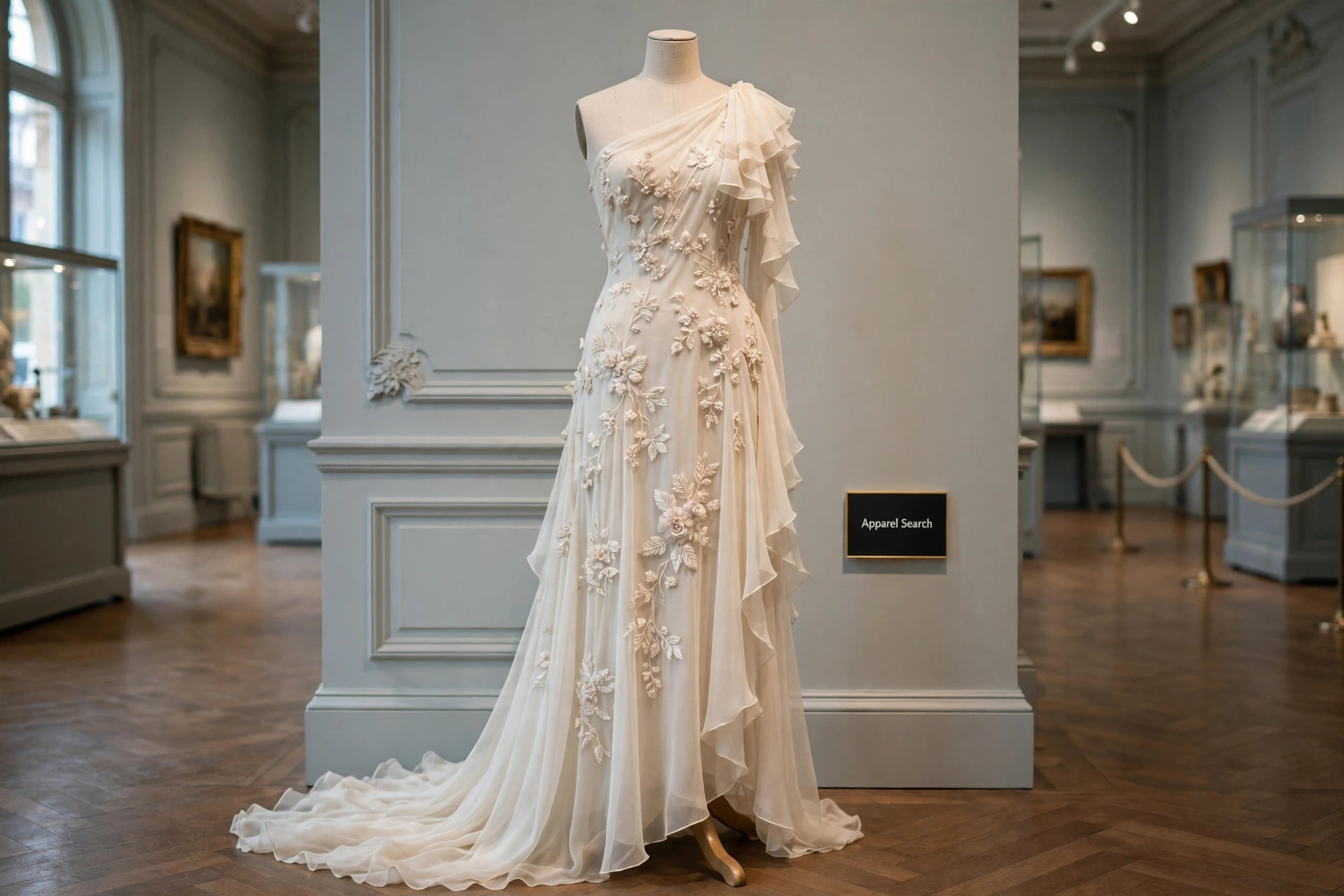
- Jason Wu for both inaugurations: the ivory one-shoulder gown of 2009 and the red gown of 2013
- The designer then
- Little-known, with a staff of four, when the 2009 gown was chosen; the gown is now at the Smithsonian
- The policy
- High-low dressing: J.Crew, Gap and H&M worn deliberately alongside Thakoon, Isabel Toledo, Tracy Reese and Maria Pinto
- The stylists
- Ikram Goldman first, then Meredith Koop
- The study
- David Yermack, New York University: 189 appearances, November 2008 to December 2009, 29 listed companies
- The caveat
- The headline figure is shareholder value in share prices, not retail sales, and largely value moving between firms
The Inaugural Gowns
Twice Jason Wu: 2009 and 2013
For the inaugural balls of January 2009, the new First Lady wore a one-shoulder ivory silk-chiffon gown scattered with organza flowers and crystal detail. Its designer was the story. Jason Wu was then a little-known young designer with a staff of four — not an established house, not a campaign donor's label, not a safe ceremonial choice. In the closing years of the decade our 2000s fashion history guide covers, when a First Lady's inaugural gown was expected to come from a famous name, she used the most-watched dress of her tenure to introduce an unknown one. The gown itself entered the national collection: it is now held by the Smithsonian National Museum of American History, the archive's verdict that the dress, and the choice behind it, were history.
The consequences for the designer were documented as carefully as the dress. The New York Times traced how the 2009 choice transformed Wu's business from a four-person studio into a label with partnerships reaching from Target to Net-a-Porter — the full arc of American fashion, from mass retail to luxury platform, opened by a single evening's wearing. That arc is part of this wardrobe's record, because it shows what First Lady patronage actually is in economic form: not a compliment but a launch. Established houses did not need it. She gave it, twice, to a designer who did, and the industry's younger generation organised its ambitions accordingly — to be ready, as Wu had been ready, on the night the call might come.
Four years later she did the thing that turned a gesture into a doctrine: she chose him again. The red Jason Wu gown of the 2013 inaugural balls confirmed that 2009 had not been a one-night experiment in novelty. Loyalty to an emerging designer across two inaugurations told the American fashion industry that the First Lady's patronage was a relationship, not a lottery — wearers could build on it, and other young designers could reasonably hope to earn it. The New York Times documented the transformation that followed for Wu himself, whose career expanded into partnerships with Target and Net-a-Porter. The gowns bookend the argument of this page: in state dressing, who you choose is the message, and choosing the same young designer twice is a message about values — merit, loyalty and American making — that no speech on the subject could have delivered as efficiently.
The Policy
High-Low Dressing as Policy
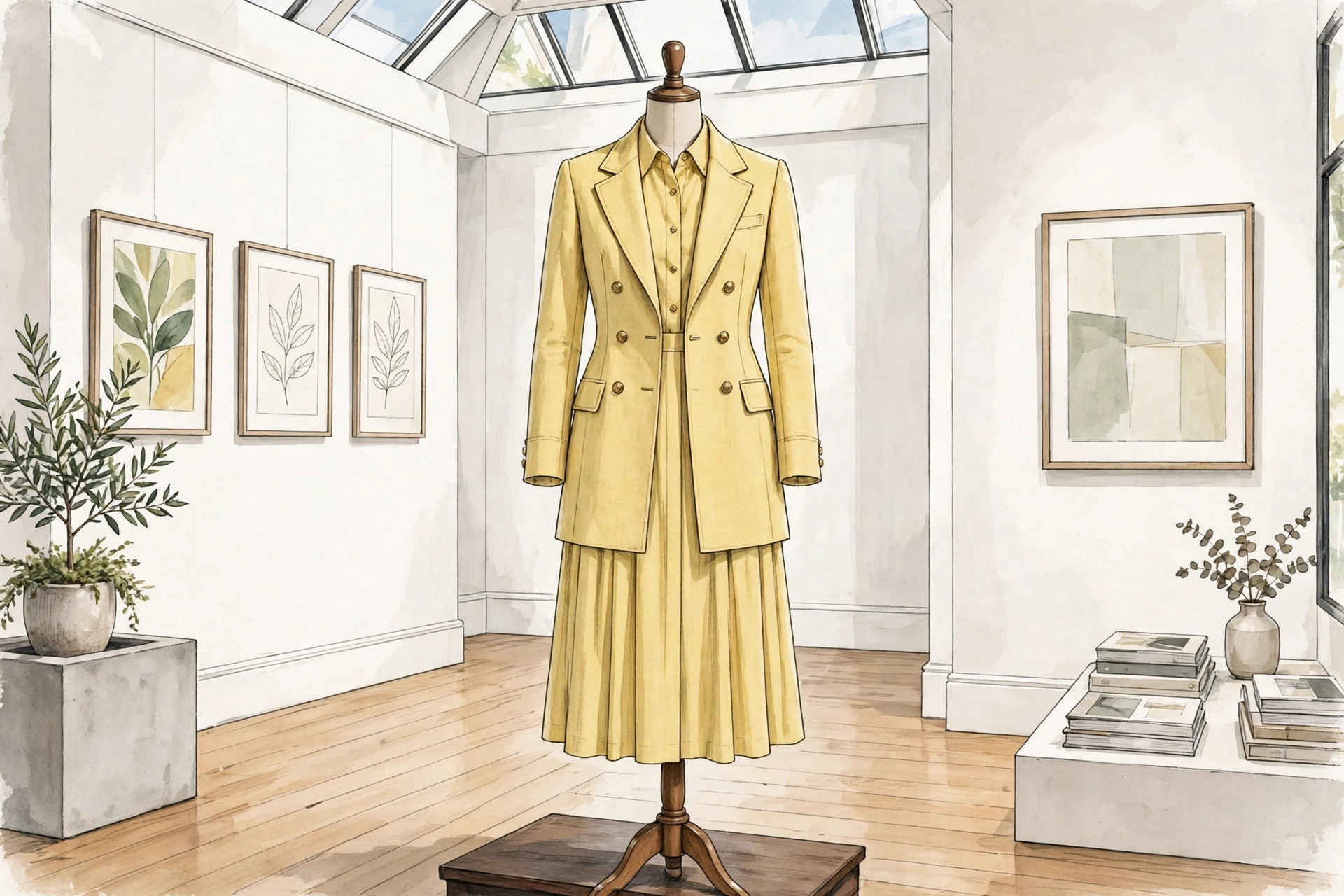
The day clothes made the same argument at street prices. She wore J.Crew cardigans so consistently that the cardigan became her signature garment, and a J.Crew belt worn on inauguration day itself sold out within hours. She wore Gap, and she appeared on television in an H&M dress priced at $34.95 — a First Lady, in a dress that cost less than the studio audience's lunch, presented without apology or announcement as simply what she was wearing that day. Alongside the chain stores stood a deliberate roster of American designers: Thakoon, Tracy Reese and Maria Pinto in regular rotation, and Isabel Toledo, whose lemongrass-yellow outfit she wore on inauguration day in 2009, a choice that put a Cuban-American designer's tailoring at the centre of the ceremony's daytime pictures.
Notice what the mixture required of the wearer. Couture and chain store fail in opposite ways: couture can look remote, and a $34.95 dress can look like a stunt. Worn in alternation, week after week, each corrected the other — the designer pieces gave the everyday clothes ceremony, and the everyday clothes gave the designer pieces a public. The roster was also a map of the American industry she was promoting: immigrant-founded and minority-led labels such as Isabel Toledo's and Thakoon's alongside Chicago's Maria Pinto and the mall brands in every viewer's own high street. It was industrial policy conducted at the level of the outfit, and it only worked because it never announced itself as policy at all.
The mixture was managed professionally: her first stylist was the Chicago boutique owner Ikram Goldman, succeeded by Meredith Koop, and the policy survived the change of stylist because it was a policy, not a person's taste. It also had edges, and the record includes them honestly. When she wore an Alexander McQueen gown to the 2011 state dinner for China, the choice of a British house for that particular occasion drew public controversy — proof, if any were needed, that a First Lady's clothes were being read as diplomatic signals by an audience ready to grade them. A wardrobe that is never criticised is a wardrobe nobody is reading. Hers was read constantly, which is precisely why the high-low mixture mattered: it kept the signal pointed at accessibility and American industry, at prices her audience could verify in any mall.
The Media Saga
Arms, Cardigans and the Commentary Machine
No account of this wardrobe is complete without the strangest part of its record: the sheer volume of commentary devoted to two garments and one body part. From 2009 her sleeveless dresses and bare arms drew sustained media attention — admiration, criticism and think pieces in roughly equal measure. She answered the criticism in the most direct way available to her, by covering up for a period, and then, in the record's own quiet punchline, reverted to sleeveless dresses. The cardigan ran the opposite course: a humble, deliberately unglamorous garment that her wearing turned into a news event, summed up in the period by NPR under the headline "Mrs. Obama Saves the Cardigan."
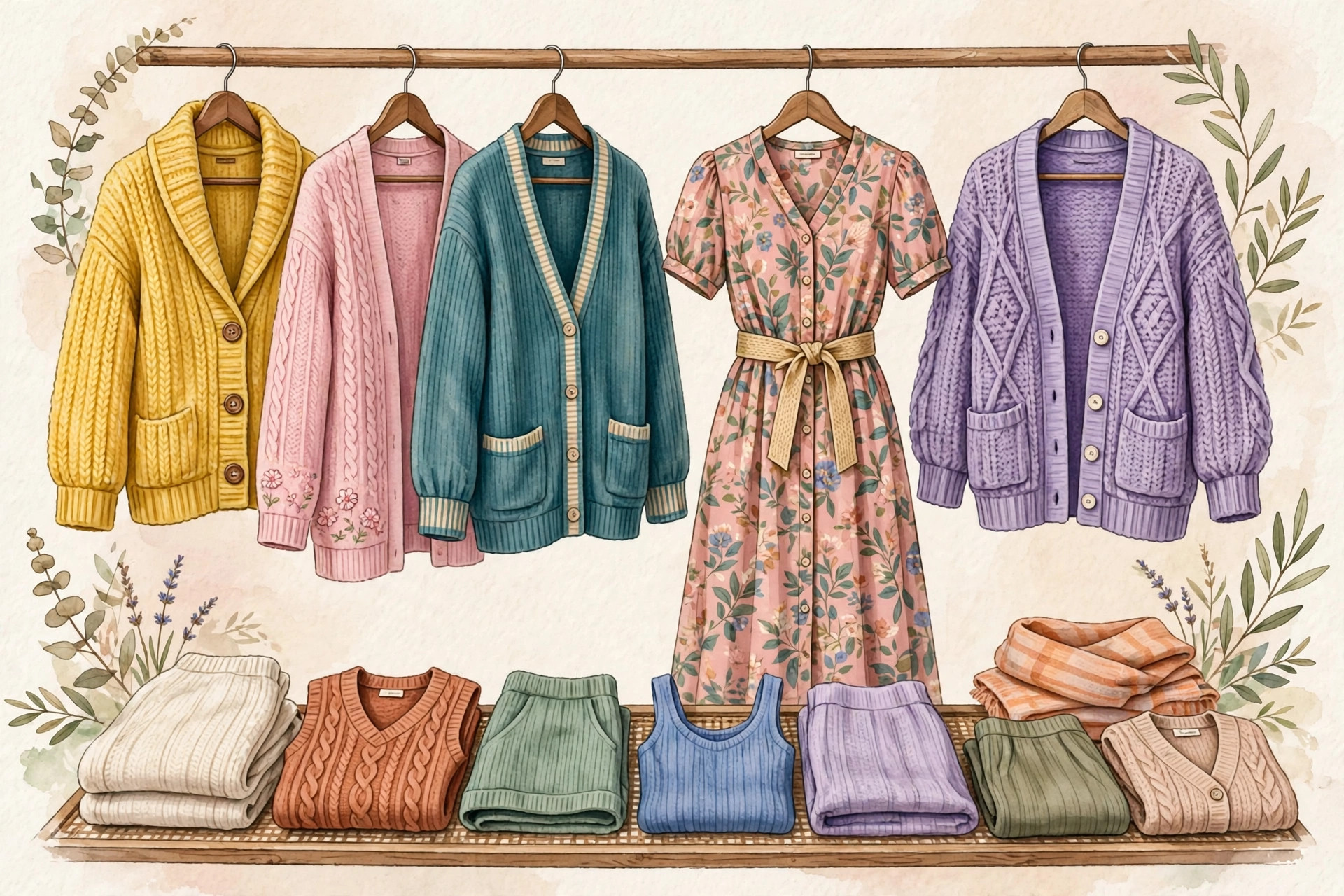
This guide treats that saga as documented media history rather than gossip, because it is evidence about how state dressing works. A First Lady's wardrobe is a broadcast medium with no off switch: every sleeveless dress transmitted, whether the intended message was about fashion, fitness, informality or nothing at all. Her handling of the saga — concede nothing in words, adjust briefly in cloth, then dress as she pleased — is a case study in managing that medium. The cardigans, meanwhile, did quieter work: they were the high-low policy made visible at a glance, the garment that told every viewer who owned a similar one that the First Lady's wardrobe and theirs overlapped.
The Measurement
The Michelle Markup: Yermack's Study, Caveats Included
The centrepiece of this page is a piece of academic work, and it is presented here the way its author presented it. David Yermack of New York University's Stern School studied the market effect of her appearances in a paper titled "The Michelle Markup," summarised in Harvard Business Review in November 2010 under the headline "How This First Lady Moves Markets." His method was an event study: 189 public appearances between November 2008 and December 2009, tracking the share prices of 29 publicly traded companies whose clothes, shoes and accessories she had worn, and measuring the abnormal returns — movements beyond what the market would otherwise predict — around the days she wore them.
His headline finding was cumulative abnormal stock returns of about $2.7 billion (the paper's text says "exceeding $2.6 billion"; Harvard Business Review rounds it to $2.7 billion). Around major appearances, the companies she wore gained on average about 2.3 percent in abnormal value, against roughly 0.5 percent for a typical celebrity endorsement announcement. Now the caveats, which are Yermack's own and are not optional. First, the $2.7 billion is shareholder value — movements in share prices — not retail sales; it does not mean $2.7 billion of clothes were sold. Second, he frames the effect largely as value redistribution between firms rather than net new value: competitors whose clothes she did not wear lost about 0.4 percent over the same windows, so much of the gain was share taken from rivals, not wealth created from nothing. Third, the total is dominated by a single observation: the April 2009 European tour, with its much-photographed "fashion faceoff" alongside Carla Bruni, accounts for about $2.3 billion of the $2.7 billion. Print the number without those three sentences and you have misreported the study. Print it with them, and it remains the most rigorous measurement of a state wardrobe's economic effect ever published — which is why it, and not a headline estimate, anchors this page.
The Corroboration
Retail Evidence: Real, and Anecdotal
The study measured share prices. The shops told a smaller, human-scale version of the same story.
Below the stock-market level, the retail evidence is genuine but anecdotal, and this guide labels it as such. The J.Crew sell-outs, including the inauguration-day belt gone in hours, were reported as they happened. The New York Times, examining the effect on designers, interviewed 16 of them and found nearly all reporting gains in sales or appointments after being worn; the young label Cushnie et Ochs, for example, booked about 25 extra retailer appointments after a single wearing. Appointment books and sell-out anecdotes are not an event study — no control group, no market model, no abnormal-return calculation — but they corroborate the direction of Yermack's finding at the level where designers actually feel it: a First Lady's appearance moved real commercial outcomes for the firms she chose, most powerfully for the small ones least able to buy that attention any other way.
The Lineage
The Predecessor and the Standard
Every First Lady's wardrobe is measured against one predecessor, and hers was explicit. Half a century earlier, Jacqueline Kennedy had shown what a First Lady's dressing could do — an official designer, a Paris triumph, clothes read around the world as American confidence. Michelle Obama inherited that role and rewrote its economics: where the Kennedy wardrobe projected American elegance at couture level, the Obama wardrobe projected American accessibility, couture and chain store in the same week, emerging designers promoted by the most valuable endorsement in the country. The two wardrobes are the twin pillars of First Lady state dressing in this section, and they are best read together, as before-and-after evidence of how the office's unofficial uniform adapted to a mass-media, instant-retail age.
Her place in this section is therefore double. As a wearer, she ran the most deliberately democratic state wardrobe on record: unknown designers at inaugurations, a $34.95 dress on television, cardigans as signature, and the discipline to keep the mixture coherent across eight years and two stylists. As a subject, she is the only figure here whose effect survives academic scrutiny — measured, caveated and still remarkable. State dressing is usually asserted. In her case, unusually, it was also priced.
Common Questions
Questions & Answers
Who designed Michelle Obama inaugural gowns?
Both were designed by Jason Wu. For the 2009 inaugural balls she wore his one-shoulder ivory silk-chiffon gown with organza flowers and crystal detail, when Wu was a little-known designer with a staff of four. She chose him again for 2013, wearing his red gown, and the 2009 gown is now held by the Smithsonian National Museum of American History.
What is the Michelle Markup?
It is the name of David Yermack's study of 189 public appearances from November 2008 to December 2009, tracking 29 publicly traded companies whose clothes she wore. Published in Harvard Business Review in November 2010, it found cumulative abnormal stock returns of about 2.7 billion dollars. That figure is shareholder value in share prices, not retail sales, and Yermack framed it largely as value moving between firms.
Did Michelle Obama really wear high-street clothes as First Lady?
Yes, as a deliberate policy alongside couture. She wore J.Crew cardigans and an inauguration-day belt that sold out in hours, clothes from Gap, and a 34.95 dollar H and M dress on television, mixed with designers such as Thakoon, Isabel Toledo, Tracy Reese and Maria Pinto. Her stylists were Ikram Goldman and then Meredith Koop.
Royal Style on Apparel Search
Her First Lady predecessor, the craft guide to diplomatic dressing, the section's reference wardrobe, and the site's own royal-style reading.
Search Apparel Search