Royal & State Fashion · Topic Guide
Diplomatic Dressing: How Clothes Do the Talking
A monarch on a state visit cannot argue, negotiate in public, or explain herself to the press. What she can do is arrive wearing the host country's colours, a brooch that belongs to the host nation's story, or a gown embroidered with its national flower — and let the cameras carry the compliment. That craft has a name: diplomatic dressing. This guide documents how it works, with the named garments and occasions that prove each technique, and it holds the subject to a standard the fashion press often skips: separating the practice that can be documented — emblems commissioned, colours chosen, designers deliberately worn — from the secret codes that commentators infer and no palace has ever confirmed. The distinction is not a footnote to this guide. It is the reason this guide exists.
At a Glance
- The reference system
- Queen Elizabeth II's wardrobe — the Royal Collection Trust itself publishes the practice under the name "Diplomatic Dressing"
- Emblem embroidery
- National flowers and symbols worked into gowns and veils, from the 1953 Coronation dress to a 2018 Commonwealth wedding veil
- Host dressing
- Wearing the host country's designer, colours or motifs on tour — the tailored compliment
- Colour
- Block-bright colour chosen first for visibility, as her dresser Angela Kelly's published account explains, then read for meaning
- The anti-signal
- Protective kit, mourning black and remembrance poppies — meaning made by refusing fashion altogether
- The guardrail
- Documented practice is provable; secret brooch codes are commentator speculation, never confirmed by any palace
The System
A System with a Name: The Reference Wardrobe
Diplomatic dressing is not a journalist's coinage pasted onto random acts of dressing up. The institution that holds the most important wardrobe of the modern era uses the term itself: the Royal Collection Trust publishes material under the heading "Diplomatic Dressing" describing how Queen Elizabeth II's tour clothes were built — in its summary of the practice, ensembles were designed for the climate they would meet, and fabric colours and embroideries were incorporated to pay subtle compliments to the host nation. Our full profile of Queen Elizabeth II's wardrobe is this section's reference system, and this guide generalises from it.
The system's longest-running thread is a single piece of jewellery. The Canadian Maple Leaf brooch was first worn on the 1951 Canada tour and then re-worn for Canadian occasions for seventy years — a brooch with a provenance, attached to a country, produced whenever that country was the audience. Around it sat the wider grammar: flag-colour dressing for hosts, and emblem dressing pitched at exactly the level a court or a camera would catch. Its most famous single deployment came in 2011, when the Queen arrived in Ireland — the first visit by a reigning British monarch to the independent Republic — dressed in green, and wore at the Dublin Castle state banquet a white gown covered in embroidered shamrocks with a crystal harp, Ireland's national emblem, and the Girls of Great Britain and Ireland tiara. Nothing about that outfit was announced. Everything about it was legible.
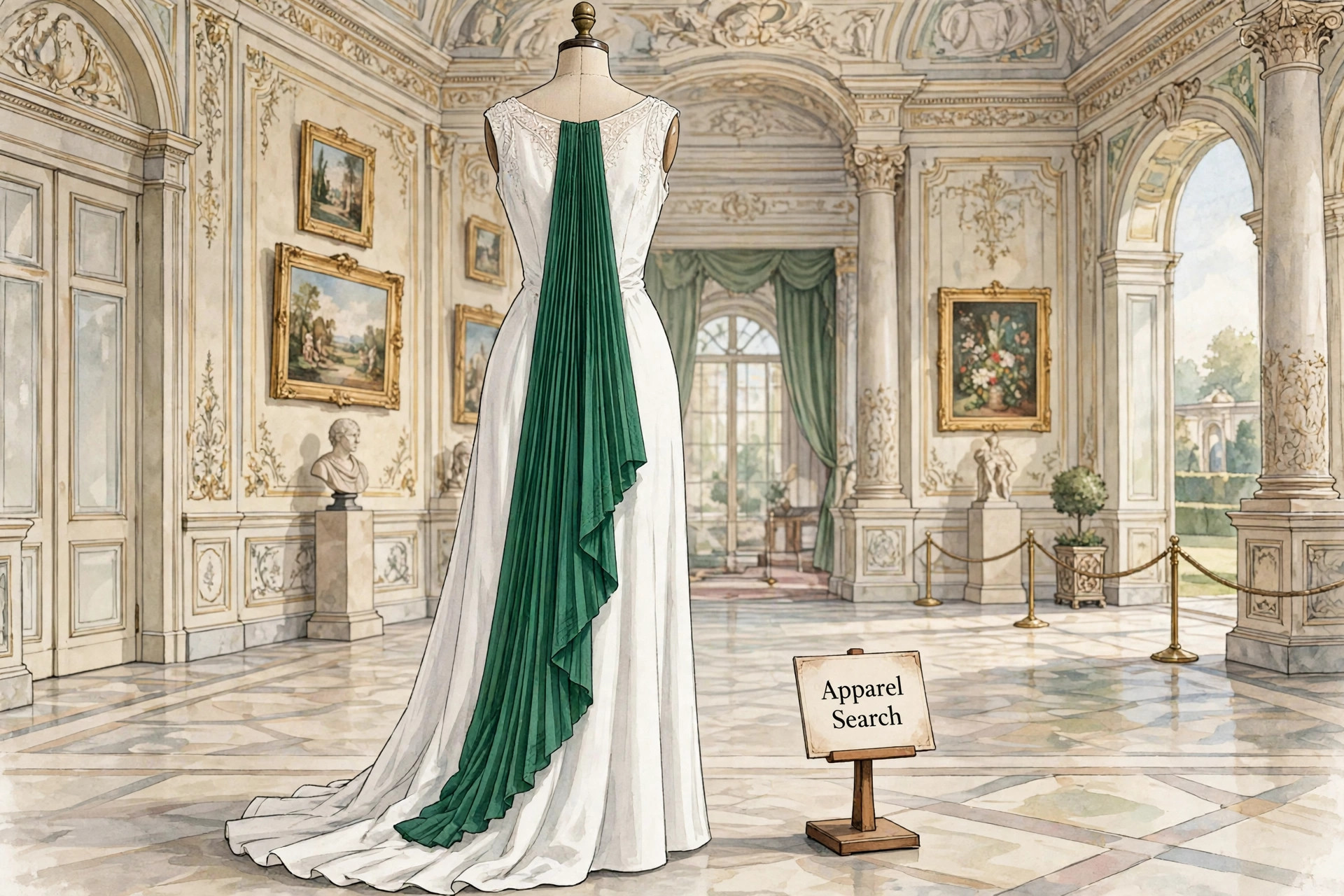
And its most elegant economy was a dress that worked twice. For the 1961 state banquet in Karachi, the Queen wore a white gown with a dramatic emerald-green pleat falling down its back — Pakistan's colours, worn in Pakistan. The same gown travelled on to Ghana, where photographs of her dancing with President Kwame Nkrumah made it one of the defining images of her Commonwealth diplomacy. One garment, two hosts, two different messages — respect for the country it was made for, and ease with the country it was re-worn for. That is the craft at its best: deliberate, documented, and deniable by anyone who needed it to be merely a dress.
Emblem Embroidery
Embroidery as a Language: Flowers That Mean Countries
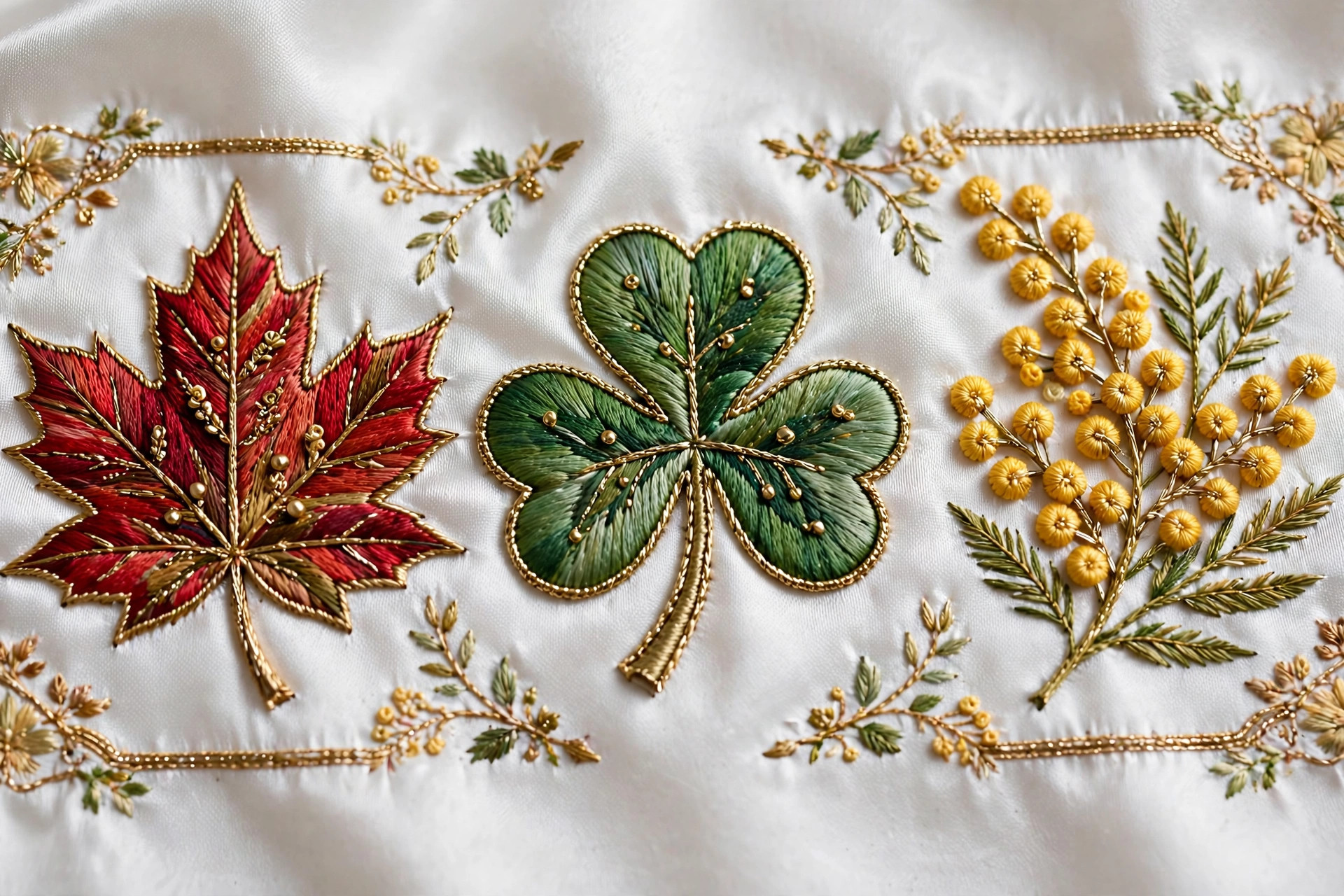
The genre's founding text is a coronation dress. For 2 June 1953, Norman Hartnell embroidered the Queen's white satin gown first with the floral emblems of the United Kingdom — Tudor rose, thistle, shamrock and leek — and then, at the Queen's own insistence, with the emblems of the whole Commonwealth in coloured silks: Canada's maple leaf, Australia's wattle, New Zealand's silver fern, South Africa's protea, a lotus for India and another for Ceylon, and wheat, cotton and jute for Pakistan. A new head of the Commonwealth wore the Commonwealth, in thread, at the ceremony that defined her role. Emblem embroidery has been a genre of state dressing ever since: a garment whose decoration is a list of nations, readable by anyone who knows the flora.
The genre's second classic is narrower and sharper. On the 1986 Saudi Arabia visit, Princess Diana wore a cream silk Catherine Walker dress embroidered with gold falcons — the falcon being Saudi Arabia's national bird. Where the coronation dress addressed a whole federation, the falcon gown addressed one host with one emblem, executed in gold on silk: the compliment reduced to a single, unmistakable symbol. Her tour dressing, guided by her Vogue mentor Anna Harvey, treated host-country symbols as a standing brief rather than an occasional flourish.
The genre reached its widest canvas in 2018, when the wedding veil of Meghan, Duchess of Sussex — for the Givenchy gown by Clare Waight Keller — was embroidered with the flowers of all 53 Commonwealth countries. The device Hartnell had invented for a coronation was quoted, knowingly or not, for a wedding: the bride marrying into the family wore its whole federation in her veil. And the practice continues in working form in the tour wardrobes of Catherine, Princess of Wales, whose colour-blocked tour dressing with host-country nods — Canada in 2011 and 2016 among the documented examples — keeps emblem and colour dressing in the modern rotation. Embroidery, colour, motif: three dialects of one language, and all of them documented at the level of the individual garment.
Host-Designer Dressing
Wearing the Host: Designers and Colours as Compliments
The boldest form of the craft is not to embroider the host's emblem but to wear the host's clothes. Diana's version was the most systematic of her generation: in Japan she wore Yuki, in Wales she wore Welsh colours — her mentor Anna Harvey's own summary of a practice that treated every tour wardrobe as a set of addressed envelopes. The compliment lands differently when it is a designer rather than a motif: it says the visitor did not merely study the host's symbols but trusted the host's makers.
The First Lady tradition produced the craft's most famous single evening. On the Paris state visit of May–June 1961, Jacqueline Kennedy dressed in French couture for Paris — Givenchy for the Versailles dinner — spoke French to the press, and became the visit's diplomatic sensation; her husband's rueful joke about being the man who accompanied Jacqueline Kennedy to Paris is the era's own verdict on whose dressing did the work. Wearing Givenchy in Paris was not vanity. It was the compliment a guest pays when the host's national industry is fashion itself.
The practice is alive in the present generation of state dressers. Queen Rania of Jordan wore, for the Norwegian state visit in 2020, a banquet ensemble by the Lebanese house Azzi & Osta carrying Jordanian kaffiyeh-inspired embroidery — her own national motif, executed by a regional designer, presented to a European court: host dressing inverted, exporting the home emblem rather than borrowing the host's. And Queen Letizia of Spain works the industrial version of the same brief, wearing Spain's fashion industry at every price level as a standing act of national promotion. The forms differ — borrowed designer, borrowed colours, home motif, home industry — but the grammar is one: the wardrobe acknowledges the relationship before the speeches begin.
Colour
Colour: Visibility First, Message Second
Colour is the dialect of diplomatic dressing that everyone thinks they can read, and the one where the documented record is most usefully deflating. For Elizabeth II, colour's first job was not symbolism at all. It was visibility. Her dresser Angela Kelly wrote the doctrine down in her authorised account: vibrant colours "allow her to stand out from the crowd and be visible to the well-wishers who have come to see her." A head of state whose function is presence dressed in block-bright, single-colour tailoring so that a crowd fifteen people deep could say they saw her. The famous rainbow of coats was a signalling system, yes — but the signal was here I am, not a coded commentary on the day's politics.
On top of that visibility layer, colour could then carry a second, deliberate message — and the documented cases are the flag colours. Green in Ireland in 2011. The emerald pleat in Karachi in 1961. Host-nation colours selected for tours as a matter of recorded practice. The two layers are easy to confuse and important to keep apart: saturation was policy for every crowd, while hue was diplomacy for particular hosts. A lime coat at a racecourse is visibility. A green arrival outfit in Dublin is a message. The wardrobe did both, on different days, for different reasons — and only the second kind was aimed at the host.
That ordering — visibility first, message second — is the correct lens for every colour reading offered elsewhere in this section. It explains why the same wardrobe can be both the most deliberately communicative of the modern era and, in most of its day-to-day choices, simply the most findable. The message layer was real precisely because it was rationed.
The Anti-Signal
The Anti-Signal: When Refusing Fashion Is the Message
The craft's most powerful documented moment involved no couture at all. In January 1997, in Huambo, Angola, Diana walked a partially cleared minefield wearing a HALO Trust ballistic vest and visor over a plain shirt and chinos — protective kit, no gloves, no hat — and then repeated the walk so that photographers could get the shot. The visit is documented as building momentum toward the Ottawa Mine Ban Treaty, signed that December after her death. Every element of her usual armoury was refused, and the refusal was the communication: this subject was too serious for dressing up, and the plainest clothes on earth made the landmine, not the princess, the picture. It remains the clearest case in the whole field of anti-fashion used deliberately as statecraft.
Mourning and remembrance dressing works the same seam. Black at state funerals, poppy brooches and remembrance emblems in November, the codified stages of mourning black that earlier reigns turned into an industry — these are signals sent by subtraction, in which the wearer withdraws every decorative choice until only the observance remains. A wardrobe that can say this matters by wearing almost nothing is a wardrobe whose decorated statements carry weight by contrast. The anti-signal is not the absence of diplomatic dressing. It is its bass note.
The Guardrail
Documented Practice, Inferred Messages: This Guide's Method
Everything in this guide so far can be sourced: to the Royal Collection Trust's own account of the practice it names, to a dresser's published book, to a designer's documented commission, to a garment a museum holds. This section exists because a large and popular literature about state dressing cannot be sourced in that way — and a credible guide has to say so, on the record, as a matter of editorial method.
The documented category is generous enough. Emblems were commissioned and can be listed flower by flower. Colours were chosen for hosts and the choosing is on record. A brooch with seventy years of Canadian provenance was produced for Canadian occasions. None of that requires guesswork. The inferred category is different in kind: the claim, for instance, that the Queen's choice of a brooch originally given by President Obama, worn during a Trump state visit, was a deliberate diplomatic slight. That reading belongs to a style commentator — it was advanced by Miranda Holder — and it was never a Palace statement, never confirmed by anyone in a position to know. The same applies to the whole genre of secret brooch codes assembled from photographs after the fact: they are readings, presented by their authors as interpretation, and hardened by repetition into something that looks like fact.
The one time the wardrobe's keeper answered a famous reading directly, the answer was deflationary: Angela Kelly states in her book that the blue hat read across the press as a European Union flag at the 2017 State Opening of Parliament was pure coincidence — a case our Queen Elizabeth II wardrobe guide, linked above, treats in full. That rebuttal is the guardrail in miniature. Where this section can document a message, it prints the message and its source. Where a message has only been inferred, it prints the inference labelled as inference, with its author's name attached. Diplomatic dressing is a real craft with a real paper trail; it does not need invented ciphers to be interesting, and this guide will not lend it any.
The Thesis
Why the Distinction Is the Craft
It would be easy to treat the guardrail as a killjoy's appendix. It is actually the point of the whole subject. Diplomatic dressing worked — in Karachi, in Dublin, in Paris, in Huambo — because it was a disciplined practice run by identifiable people: couturiers who embroidered to order, dressers who logged and rotated, wearers who understood that a compliment in cloth is believed precisely because it costs effort and can be checked. A maple leaf is either on the dress or it is not. A falcon is either embroidered in gold or it is not. The craft's credibility is its verifiability.
That is the standard this section of Apparel Search applies to every wardrobe it profiles, and it is why this guide stands at the section's centre. Read the profiles that surround it with the same two questions — what is documented, and what is merely inferred — and the whole field comes into focus: a century of state dressers, from a coronation dress that mapped a Commonwealth to a journalist-queen wearing her country's high street, using the oldest mass medium there is. Clothes were saying things long before speeches were broadcast. The honest record of what they said is interesting enough.
Common Questions
Questions & Answers
What is diplomatic dressing?
Diplomatic dressing is the deliberate use of clothes and jewellery to send a respectful or political message on state occasions: embroidered national emblems, the colours of a host country flag, a brooch associated with the host nation, or a gown by a host country designer. The Royal Collection Trust uses the term for Queen Elizabeth II's practice, documented from the Canadian Maple Leaf brooch of her 1951 Canada tour to the green she wore in Ireland in 2011.
What is the best documented example of emblem embroidery?
The fullest example is Queen Elizabeth II's 1953 Coronation dress, designed by Norman Hartnell and embroidered at her own direction with the floral emblems of the United Kingdom and the Commonwealth, from the Tudor rose and thistle to Canada's maple leaf and Australia's wattle. Later examples include the gold falcons on Princess Diana's 1986 Saudi Arabia gown and the flowers of all 53 Commonwealth countries on the 2018 wedding veil of Meghan, Duchess of Sussex.
Do royal brooches carry secret coded messages?
There is no confirmed evidence that they do. Documented practice is real: emblems were commissioned, colours were chosen for hosts, and brooches with known provenance were selected for particular countries and occasions. The famous secret codes, such as readings of brooches worn during American state visits, are commentator speculation that no palace has confirmed, and Angela Kelly states in her book that the blue hat read as a European Union flag in 2017 was pure coincidence.
Royal Style on Apparel Search
The section's ceremonial companion guide and its reference wardrobe, plus the site's own princess and fashion-queen guides.
Search Apparel Search