Royal & State Fashion · Topic Guide
Coronation and State Ceremonial Dress
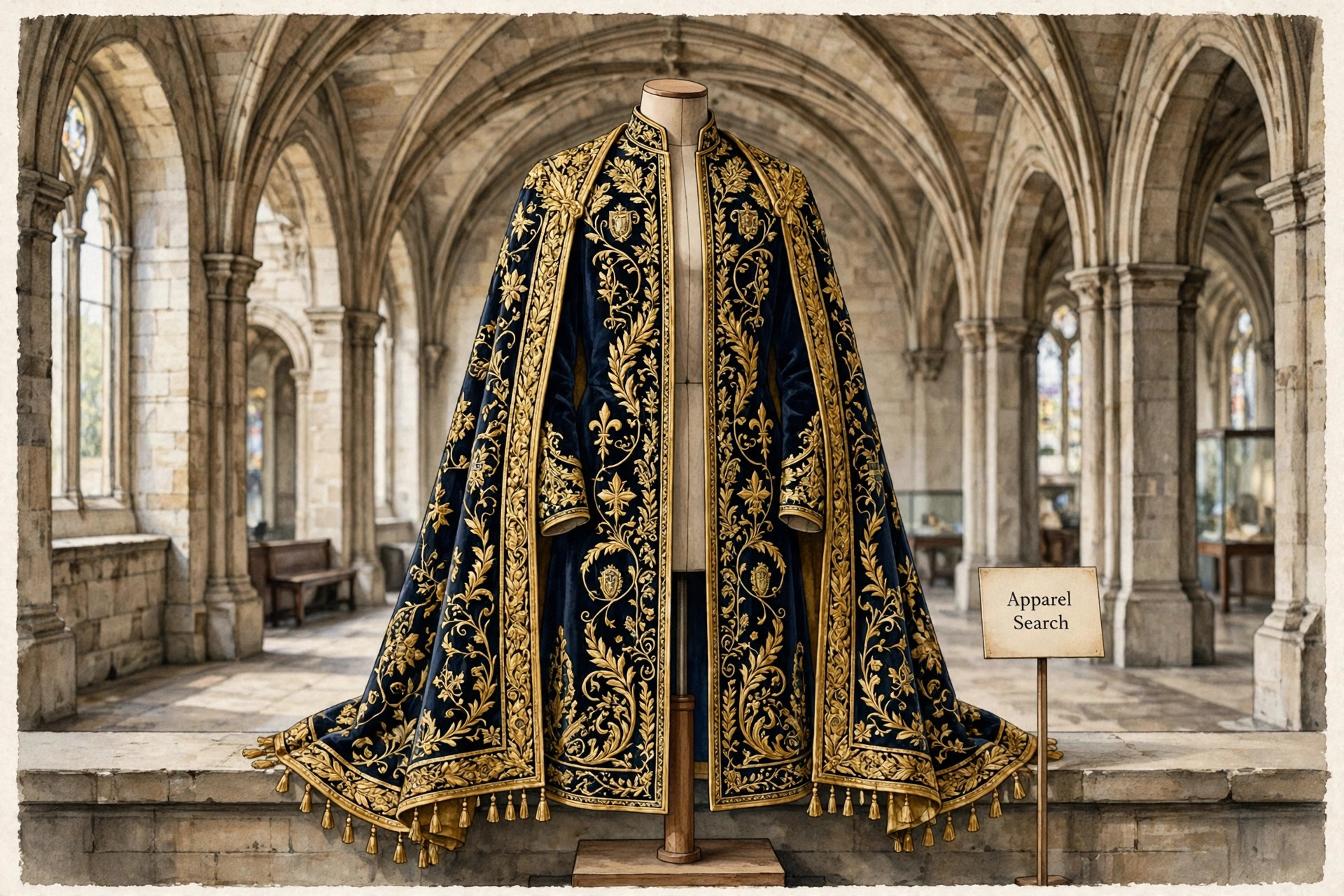
A coronation is the one occasion when clothing is not decoration but constitution: the garments are prescribed, inherited, argued over by heralds, and read by millions as a statement of what the state is. This guide takes the best-documented crowning dress of the modern age — Norman Hartnell's 1953 gown for Queen Elizabeth II, its embroidery directed by the Queen herself — as its anchor, and then sets it against the contrasting systems that make ceremonial dress a comparative subject: a British king in 2023 who chose two-hundred-year-old robes over new ones, a Dutch investiture with no crown at all, a Spanish proclamation with no ceremony of crowning, and a Japanese enthronement whose court dress predates every European robe in this guide.
At a Glance
- The anchor
- Elizabeth II, Westminster Abbey, 2 June 1953 — Norman Hartnell's eighth design, chosen from eight submitted after the October 1952 commission
- The scheme
- Floral emblems of the United Kingdom and the Commonwealth realms, directed by the Queen and worked in coloured silks
- The silk
- Grown at Lady Hart Dyke's Lullingstone farm and woven by Warner & Sons
- The contrast
- Charles III, 2023 — historic vestments re-used, the Imperial Mantle of 1821 among them
- The alternatives
- A Dutch investiture, a Spanish proclamation and a Japanese enthronement — three systems with no coronation
- The dress today
- Held by the Royal Collection, reference RCIN 250044
The Anchor Garment
1953: The Dress the Queen Directed
The commission came early and the process was formal. In October 1952 Elizabeth II commissioned Norman Hartnell — already her dressmaker, and her mother's before her — to design the dress she would be crowned in. Hartnell submitted eight designs. The Queen chose the eighth, and then did the thing that turns a beautiful dress into a state document: she took charge of its decoration herself. The Royal Collection Trust's account of the dress is explicit that the emblem scheme was hers, directed by the wearer rather than proposed by the couturier.
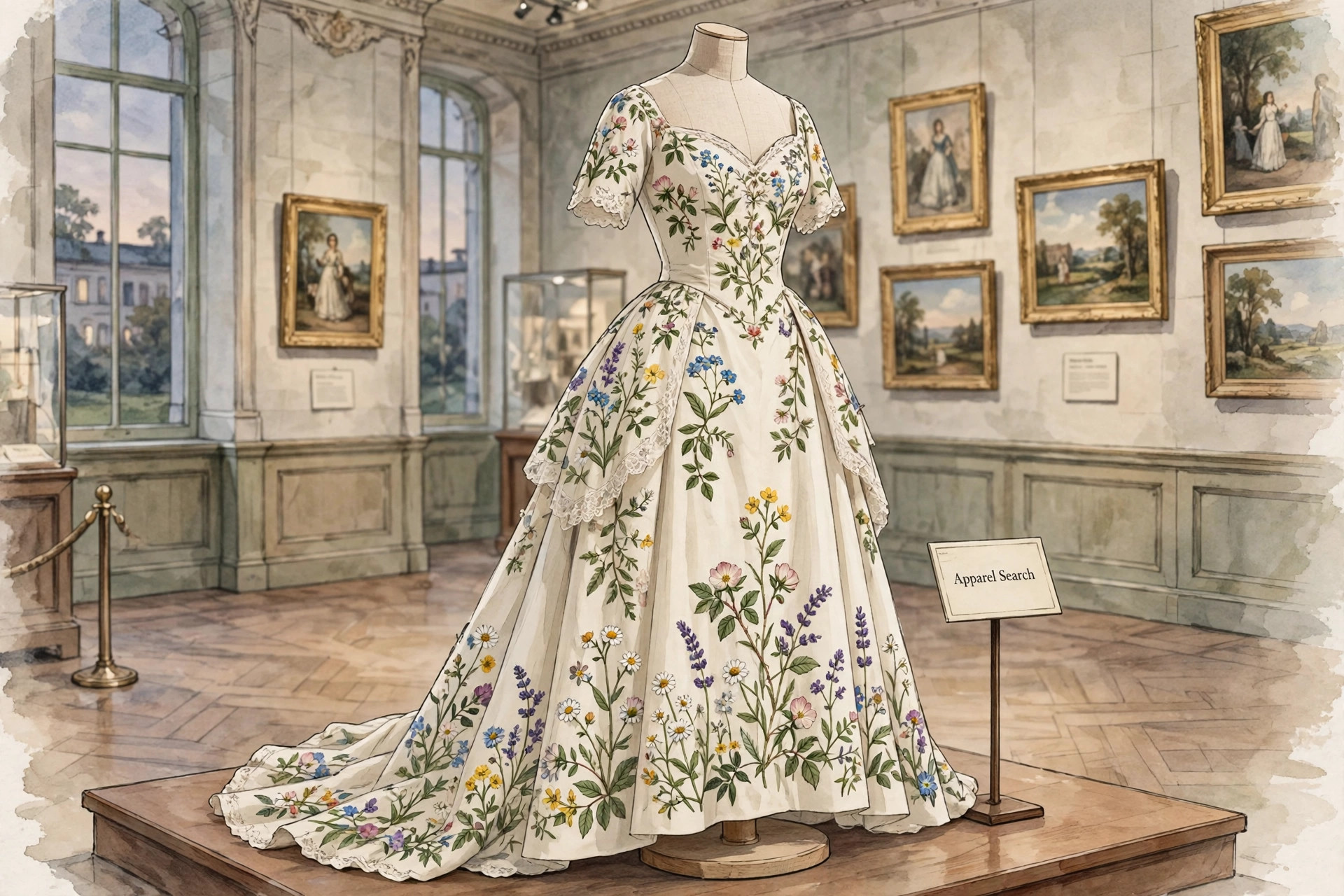
The embroidery mapped a political order onto a skirt. For the United Kingdom it carried the Tudor rose of England, the thistle of Scotland, the shamrock of Ireland and the leek of Wales — and the leek itself was a small constitutional drama. Hartnell's original design had used the daffodil for Wales; the Garter King of Arms, the heraldic authority for the ceremony, vetoed it, and the leek — the older and correct emblem — was imposed in its place. A coronation dress is one of the few garments in the world whose ornament can be overruled by a herald, and that is precisely the point: every motif on it was a claim, and claims get checked. Beyond the home nations, at the Queen's direction, came the emblems of the Commonwealth realms: Canada's maple leaf, Australia's wattle, New Zealand's silver fern, South Africa's protea, a lotus for India and another for Ceylon, and wheat, cotton and jute for Pakistan. She further directed that the emblems be worked in coloured silks rather than in gold and silver alone, so that each nation's flower read as itself and not as generic splendour.
The materials were a statement of national industry of the kind this section traces throughout. The silk came from Lady Hart Dyke's silk farm at Lullingstone in Kent — English-grown silk — and was woven by Warner & Sons. And inside the official scheme Hartnell hid one unofficial stitch: a tiny four-leaf shamrock, a clover worked secretly as a good-luck charm, placed where the Queen's left hand would rest. The public embroidery declared a Commonwealth; the private one wished its wearer luck. Both survive, because the dress survives: it is held by the Royal Collection as RCIN 250044, the reference point against which every later crowning garment in this guide is measured.
This page treats the dress comparatively — as the anchor of a system. The full garment-by-garment account, set inside the wardrobe it founded, is our deep treatment of Queen Elizabeth II's wardrobe, where the coronation dress opens the story of the seventy-year dressing operation that followed it. Read this guide for the ceremonial frame; read that one for the dress in its working life.
One Designer, One Ceremony
Hartnell's Ceremonial System — and the Queen Mother Who Brought Him In
A coronation is not dressed one gown at a time. In 1953 Hartnell dressed the ceremony as a single system: the Queen herself, the Queen Mother, Princess Margaret and the Maids of Honour all wore his work, so that the Abbey's central group read as one coordinated composition — a court presented to the cameras as a designed whole. That mattered more in 1953 than at any coronation before it, because this was the first coronation to be televised: the Royal Collection Trust records an audience of 27 million viewers in the United Kingdom alone, watching a ceremony whose visual language had been planned by one house.
The house owed its place at the centre of that ceremony to the woman standing beside the throne in it. It was the Queen Mother who brought Norman Hartnell into the royal fold, making him her dressmaker from 1940, and with him she built the formula she wore for the rest of her long life: glittering crinoline-skirted evening gowns, soft pastel daywear, and hats and heels calibrated to her height. When the young Elizabeth needed a dressmaker for her wedding in 1947 and her coronation six years later, the appointment of her mother's couturier was the natural continuity — and the Queen Mother's own coronation-day dress in 1953, Hartnell's work like her daughter's, closed the circle she had opened thirteen years earlier. She has no standalone guide in this section, by design: her fashion story is this thread — one designer, brought in by her patronage, and one unmistakable formula — and it belongs inside the Hartnell story rather than stretched across a page of its own.
There is an older thread in the same family wardrobe worth marking here, because ceremonial jewellery carries it. Among the brooches that pass down the line of queens is the Prince Albert brooch, a sapphire and diamond cluster given by Albert to Victoria on the eve of their wedding in 1840 — a betrothal gift that became working state jewellery for four reigns. Our guide to Queen Victoria's mourning dress tells the fuller story of that marriage's two wardrobes, the white wedding dress of 1840 and the forty years of black that followed it; the brooch is the small, portable point where the 1840 story touches the ceremonial dress of 1953 and after.
The Contrast
2023: The King Who Wore the Archive
Seventy years after Hartnell's new-made splendour, the coronation of Charles III on 6 May 2023 ran on the opposite philosophy: re-use. Where his mother's ceremony had commissioned its centrepiece new, the King wore history itself. His vestments were historic pieces rather than new commissions — the Colobium Sindonis, the Supertunica, and the Imperial Mantle made for George IV in 1821, a robe worn at every coronation since its making, so that the garment on the King's shoulders in 2023 was already two centuries into its working life. He also wore robes that had belonged to his grandfather, George VI — his mother's father's Robes of State and Estate — making the ceremony's wardrobe a literal inheritance, handed down rather than designed up.
Read against 1953, the choice was itself the message. A new emblem dress in 1953 had declared a young queen and a renewed Commonwealth. Re-used vestments in 2023 declared continuity, thrift and an institution presenting its own age as its credential — the clothes argued that nothing needed inventing because everything had been kept. Neither philosophy is the more splendid; they are opposite answers to the same question of what crowning clothes are for.
And then, in the same Abbey on the same morning, the Hartnell idea quietly returned. Queen Camilla's coronation gown was new — by Bruce Oldfield — and it was embroidered with British wildflowers, with the emblems of the four nations worked on the cuffs. Seventy years on, a queen consort's coronation dress once again carried the flora of the nations as its ornament: Hartnell's emblem scheme, translated from the Commonwealth map of 1953 to the wildflower register of 2023, and worn beside a king dressed entirely in other men's robes. The two philosophies shared one ceremony.
No Crown, Full Ceremony
The Netherlands and Spain: Investiture and Proclamation
Two of Europe's monarchies demonstrate that the ceremonial-dress problem exists in full even where no coronation does. The Netherlands does not crown its monarchs: the sovereign is invested, in a ceremony of inauguration rather than anointing and crowning. The dress, however, loses nothing of its state weight. For the investiture of Willem-Alexander on 30 April 2013, Queen Máxima wore a cobalt-blue lace gown and cape by the Dutch designer Jan Taminiau, worn with the Mellerio sapphire tiara — a full state gown by a national designer for the defining ceremony of the reign, chosen and read exactly as a coronation dress would be. Her wardrobe's wider working system, built on the house of Natan and a quarter-century of hats by Fabienne Delvigne, is the subject of our guide to Queen Máxima's style; the investiture gown is where that system meets pure ceremony.
Spain stands at the minimalist pole. There is no crown and no coronation at all: a Spanish king is proclaimed before the Cortes, and the dress code of the occasion contracts accordingly. When Felipe VI was proclaimed in June 2014, Queen Letizia wore an outfit by Felipe Varela — her signature designer for formal and state dressing — whose restraint was the statement: no gown, no tiara, no regalia, a sober tailored ensemble for a parliamentary act. Set beside the Imperial Mantle of 1821, Varela's proclamation outfit marks the far end of the ceremonial spectrum, where the monarchy dresses down to meet a constitution that gives it no crowning moment. Our guide to Queen Letizia's style follows Varela's place in her wider formula of Spanish high street and couture; here the proclamation outfit stands as the control case — proof that state ceremonial dress is defined by the constitution it serves, not by the quantity of gold thread.
The Non-European System
Japan: The Sokui no Rei, 2019
The enthronement of Emperor Naruhito in 2019 — the sokui no rei — presents the comparative guide's necessary corrective: a ceremonial dress system that owes nothing to European coronation practice at all. Where Westminster prescribes robes accumulated over two centuries of British use, the Japanese court prescribes garments whose forms were fixed by a much older court tradition. The Emperor's sokutai and the Empress's junihitoe — the layered court dress of many robes — are not antiques re-used in the British sense, nor new commissions in the Hartnell sense; they are a living pattern-book, remade to ancient specification for each occasion, in which correctness consists of fidelity to forms that long predate every other garment in this guide.
The comparison clarifies what the European cases share. Hartnell's dress, the re-used vestments of 2023, Taminiau's investiture gown and Varela's proclamation tailoring are all, in their different ways, decisions — a wearer and a designer choosing what the ceremony should say. The Japanese system locates the meaning elsewhere: not in choice but in exact continuation, the garment saying that the office is older than any wearer and that the wearer's duty is to fit the dress rather than the dress the wearer. A guide to ceremonial dress that stopped at Europe would mistake a local habit — the expressive, emblem-carrying gown — for a universal rule. The sokui no rei is the reminder that state dress has more than one grammar.
Regalia and Jewellery
Crowns, Robes and the Tiara Protocol
Ceremonial dress is completed by regalia, and the British set frames the protocol the whole section uses. Two crowns divide the work. St Edward's Crown is the coronation crown itself, the heavy gold crown with which the sovereign is actually crowned at the ceremony's climax — and which, by tradition, is otherwise scarcely worn at all. The Imperial State Crown is the working crown: the one worn for the procession and for occasions such as the State Opening of Parliament, carrying the monarchy's ceremonial presence through the ordinary year. The distinction mirrors the dresses in this guide — one garment for the single crowning moment, another system for the decades of state dressing that follow it.
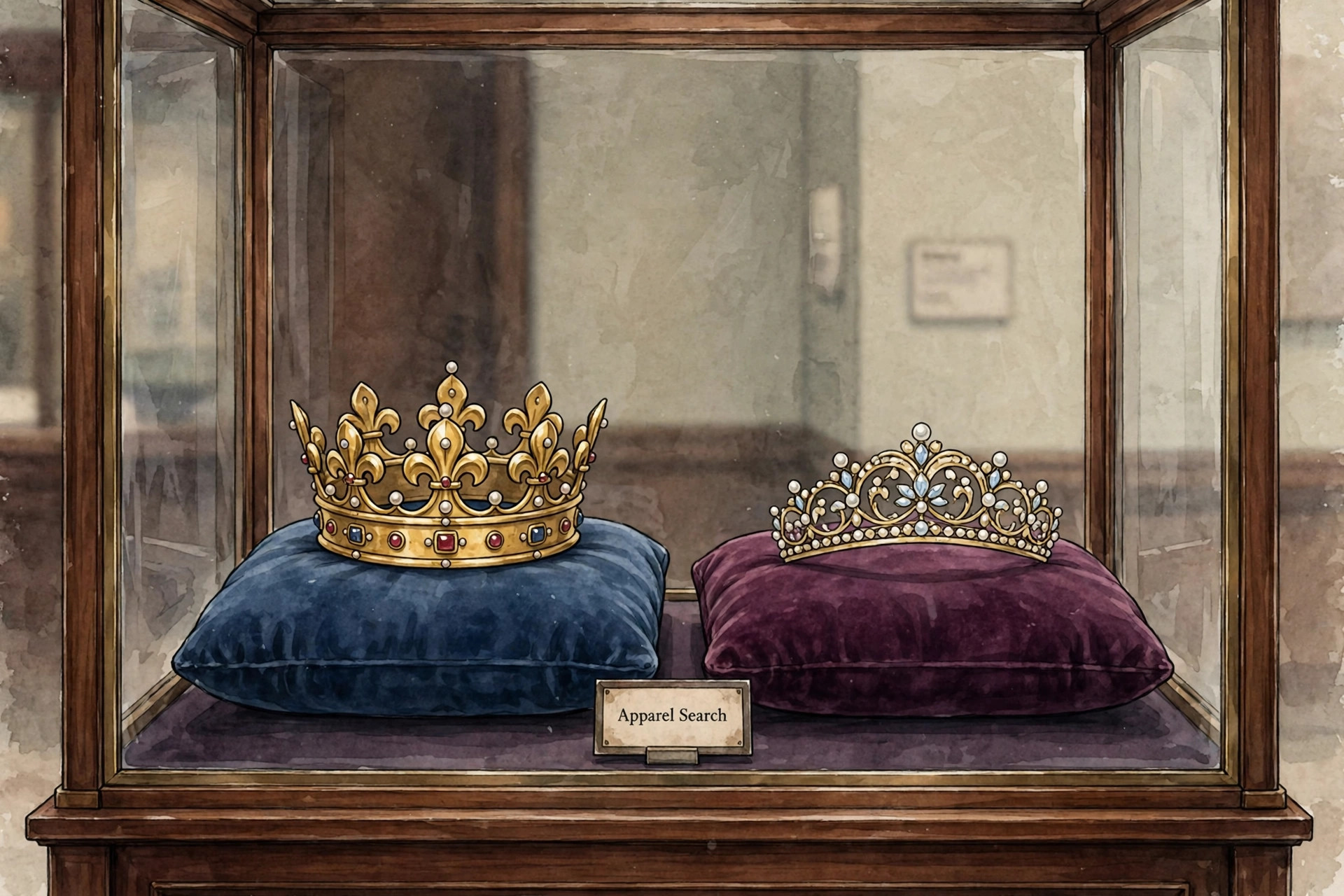
Below the crowns, the tiara is the standard headpiece of state evening dress, and its protocol is a working language of its own: tiaras belong to state banquets, state visits and the grandest white-tie occasions, worn by royal women as part of the formal uniform of those events rather than as personal decoration. A tiara at a state banquet is therefore read the way a robe is read — as office dress. Máxima's Mellerio sapphire tiara at the 2013 investiture, worn with Taminiau's cobalt gown, is this guide's clearest modern example: in a ceremony with no crown, the tiara carried the full ceremonial register on its own. The regalia, the robes and the gowns are one system, and this section reads them together.
In 1953 the dress was new and mapped a future. In 2023 the robes were old and mapped a past. The ceremony was the same; the argument had reversed.
That reversal is why ceremonial dress repays a guide of its own. The garments are few — a handful of dresses, robes and gowns across seven decades and four monarchies — but each was made or chosen under constitutional scrutiny, recorded in unusual detail, and preserved: Hartnell's dress in the Royal Collection, the vestments in continuous use, the investiture and proclamation outfits in the documented record of two reigns. No other category of clothing is so thoroughly archived, or so plainly legible as statecraft.
Common Questions
Questions & Answers
What did Queen Elizabeth II wear for her coronation in 1953?
She wore a white satin gown by Norman Hartnell, the eighth of the designs he submitted after the October 1952 commission. At her own direction the embroidery carried the floral emblems of the United Kingdom and the Commonwealth realms, worked in coloured silks on silk woven by Warner and Sons from Lady Hart Dyke Lullingstone silk. Hartnell secretly added a four leaf shamrock for luck where her left hand would rest. The dress is now in the Royal Collection, reference RCIN 250044.
Why did King Charles III reuse old robes at his coronation in 2023?
Reuse was the philosophy of the day. The King wore historic vestments rather than newly made ones, including the Colobium Sindonis, the Supertunica and the Imperial Mantle made for George IV in 1821 and worn at every coronation since, together with robes that had belonged to George VI. Queen Camilla took the opposite path in a new Bruce Oldfield gown embroidered with British wildflowers and the emblems of the four nations, carrying the Hartnell emblem idea forward seventy years.
Do all monarchies hold a coronation?
No. The Netherlands holds an investiture rather than a coronation, and Queen Maxima wore a cobalt blue Jan Taminiau gown for the 2013 investiture of Willem Alexander. Spain proclaims its king before the Cortes with no crown and no coronation at all, and Queen Letizia wore a Felipe Varela outfit for the 2014 proclamation. Japan enthroned Emperor Naruhito in 2019 in the sokui no rei, with court dress in the junihitoe and sokutai traditions.
Royal Style on Apparel Search
The companion topic guide, the anchor garment's own profile and the mourning-dress story, plus the site's princess and fashion-queen reading and this section's hub.
Search Apparel Search