Royal & State Fashion · State Dressing Profiles
Queen Victoria: The White Dress and the Forty Years in Black
Queen Victoria holds a record no other figure in this section can match: she reshaped what an entire society wore twice, in opposite directions, with two wardrobes. In 1840 she married in white satin and English lace, in a choice made deliberately to support a struggling home industry — and the engravings of that dress made white the default colour of Western weddings. In 1861, widowed at forty-two, she put on black crape and jet and did not take them off for the remaining forty years of her reign, turning mourning into a codified national dress system and a Yorkshire mining town into its jewellery capital. Both stories are documented, and the second comes with something rare in fashion history: hard industrial numbers, kept by the museum that holds the collection.
At a Glance
- The wedding
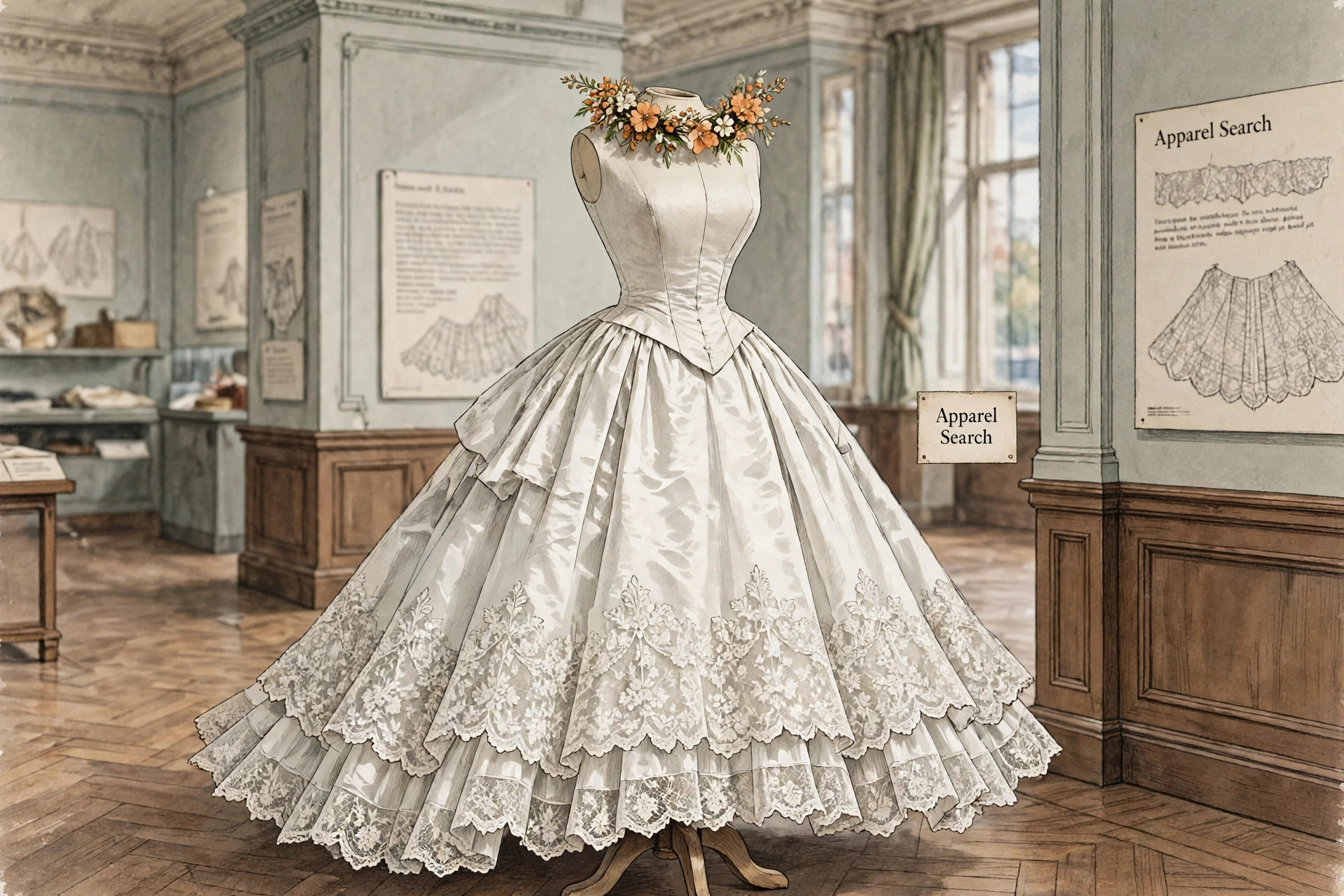
- 10 February 1840 — white satin woven in Spitalfields, trimmed with a deep flounce of Honiton lace
- The choice
- Honiton lace picked deliberately to support the declining English lace industry over foreign competition
- The mourning
- December 1861 – January 1901: black mourning worn for the remaining forty years of the reign
- The uniform
- Widow's cap, matte crape, and jet jewelry — the stages of mourning codified for the whole court
- The industry
- At its 1860–1880 peak, Whitby had over 200 jet workshops employing about 1,500 people (Whitby Museum)
- The collection
- Whitby Museum holds more than 500 Victorian jet artifacts
Story One · The Wedding
1840: A Wedding Dress That Backed an Industry
The first thing to say about the most influential wedding dress ever worn is that its wearer did not invent it. Brides had worn white before Victoria married Prince Albert on 10 February 1840; white was one choice among several, and often simply the choice of a bride whose best dress happened to be pale. What Victoria's wedding did — and it is the standard scholarly formulation, and the honest one — was make white the default. The mechanism was print: engravings of the dress circulated widely, in Britain and America, and a generation of brides dressed toward the picture.
The dress itself was an act of industrial policy in satin. The white satin was woven in Spitalfields, London's silk district. Its trimming was a deep flounce of Honiton lace — and that choice was deliberate in the most practical sense: Honiton, in Devon, was the centre of a declining English lace industry losing ground to Brussels and French competition, and the young queen chose English lace for the most reported garment of the century precisely to support it. On her head she wore not a diamond circlet but a wreath of orange blossom. Even the bridesmaids' white dresses were hers in a literal sense — she had sketched them herself. The world she was dressing in was the one our 1850s fashion history guide opens in: a court still setting the pattern that industry and print then carried everywhere.
Read as state dressing, the wedding outfit is a small masterpiece of alignment. Every element pointed the same way: English silk, English lace, a wreath of flowers instead of dynastic diamonds, bridesmaids dressed to her own sketch. A royal wedding is the one garment commission a whole nation reads at once, and Victoria spent that attention at home — on Spitalfields weavers and Devon lace-makers whose trades were visibly struggling against foreign competition. Whether or not every bride who followed her knew it, the white dress carried an argument about buying British inside the most romantic image of the century. That double function — sentiment on the surface, patronage underneath — is exactly the craft this section documents in later reigns, and Victoria was practising it at twenty, on her wedding day.
She also treated the dress as a beginning rather than a relic. Victoria treasured the Honiton lace and re-wore it for the rest of her life, long after the wedding — the lace of 1840 appearing again at family christenings and occasions across six decades. The garment that launched the white wedding became, in her own wardrobe, a piece of working royal dress, which is part of why its story stayed alive: it was not shut in a box in 1840 but kept in use, and in view, until 1901. The white wedding she normalised is now so complete a custom that it has its own global etiquette — our Wedding Traditions guides trace how ceremonies like hers are kept around the world.
Story Two · The Widowhood
1861: Mourning Begins — and Does Not End
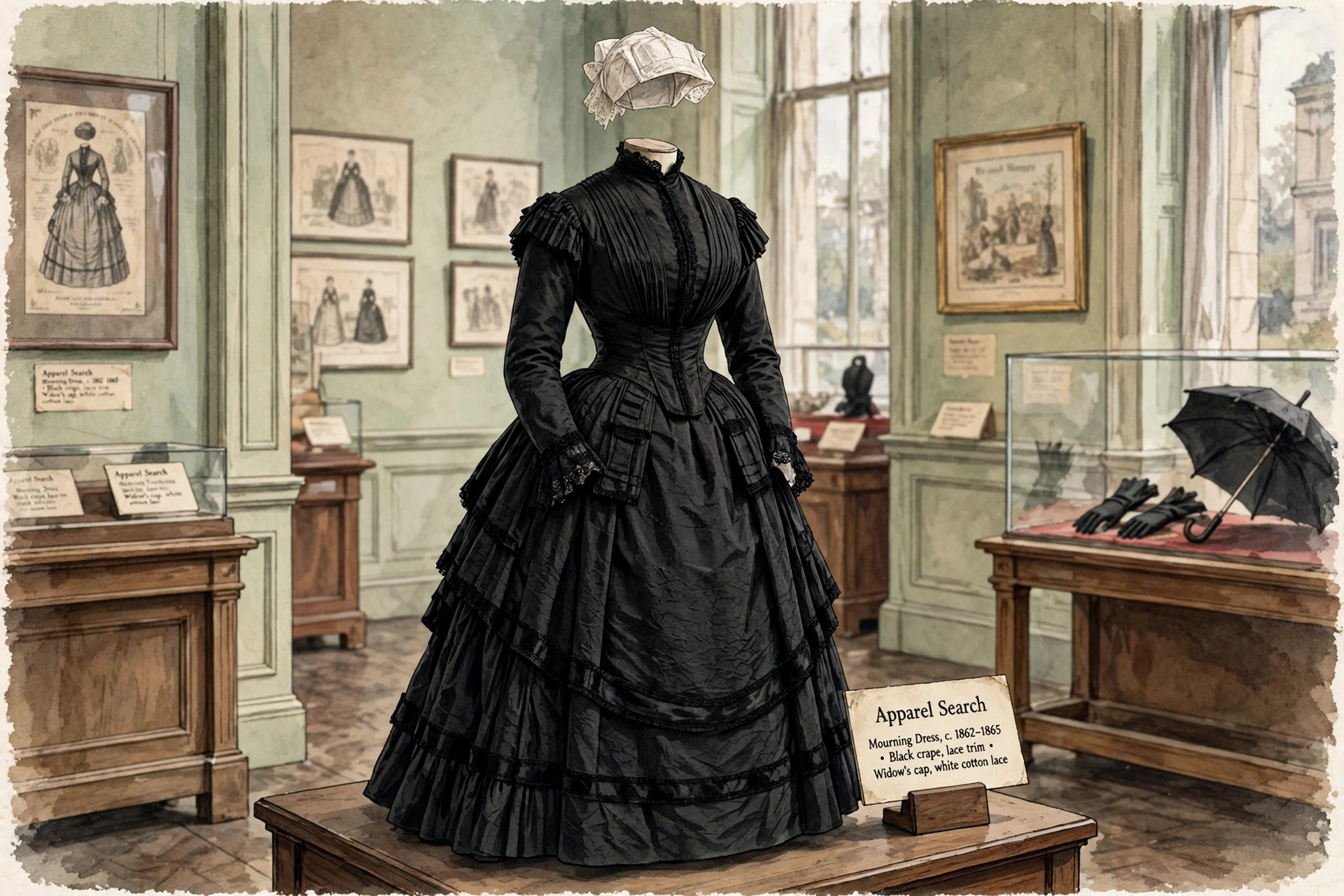
Prince Albert died in December 1861, and Victoria's response became the longest sustained act of state dressing on record. She adopted full mourning — the widow's cap, black dresses in matte crape that drank the light, jet jewelry in place of coloured stones — and she wore it, with the court following her example, for the remaining forty years of her reign, until her own death in January 1901. The silhouette of the elderly queen in black with a white widow's cap, familiar from a thousand photographs, is this decision made visible: a reign's second half dressed as a single, unbroken statement of grief and fidelity.
The world receiving that statement was the one our 1860s fashion history guide describes — and under Victoria's example, mourning stopped being merely a private observance and hardened into a system with rules a whole society could follow, buy for, and be judged by. A widow's dress was no longer a matter of taste; it was a schedule. The queen's forty years in the first stage of that schedule gave the system its authority and, as the next sections show, its extraordinary commercial scale. No modern "royal effect" — no sell-out dress, no crashed website — has ever run for four decades. Hers did.
The System
The Stages of Mourning: Crape, Then Grey, Then Lavender
Victorian mourning etiquette divided grief into codified stages, each with its own fabrics and colours, and the queen's example sat at the head of the code. Deep mourning came first: matte black crape, a fabric engineered to absorb light and reject shine, worn with jet jewelry and the widow's cap. Second mourning relaxed the crape and admitted plainer black silks. Half-mourning completed the progression, opening the wardrobe to grey, mauve and lavender — the muted colours that still read, in a modern wardrobe, as mourning's descendants. To move through the stages too fast was a social error; to dress them correctly took knowledge, money and suppliers.
Mourning was a schedule before it was a sentiment — and a schedule needs shops, mills and makers.
The suppliers organised themselves around the code. Mourning warehouses — Jay's of Regent Street in London the famous name — sold the complete apparatus of bereavement under one roof, so a household struck by a death could be correctly dressed at speed. Behind them stood the crape mills, Courtaulds above all, whose black crape became a substantial industry in its own right: a fabric with one purpose, demanded in quantity, on a timetable set by etiquette and endorsed from the throne. Victoria herself never progressed through the schedule she authorised — she remained, in effect, in deep mourning for forty years — but the society beneath her cycled through its stages in millions of households, and every cycle was a purchase.
The Industry
Whitby Jet: The Town That Mourning Built
Deep mourning required one jewelry material above all: jet, the glossy black fossilised wood that took a high polish, carved beautifully, and — crucially — was black enough for the strictest stage of grief while remaining a jewel. Jet was mined on the Yorkshire coast and worked in Whitby, and Victoria's patronage turned a regional craft into an industry. Whitby Museum, which holds the collection, states the connection plainly: the queen's adoption of mourning dress including jet after Albert's death in 1861, worn for the rest of her life, was a direct driver of the boom.
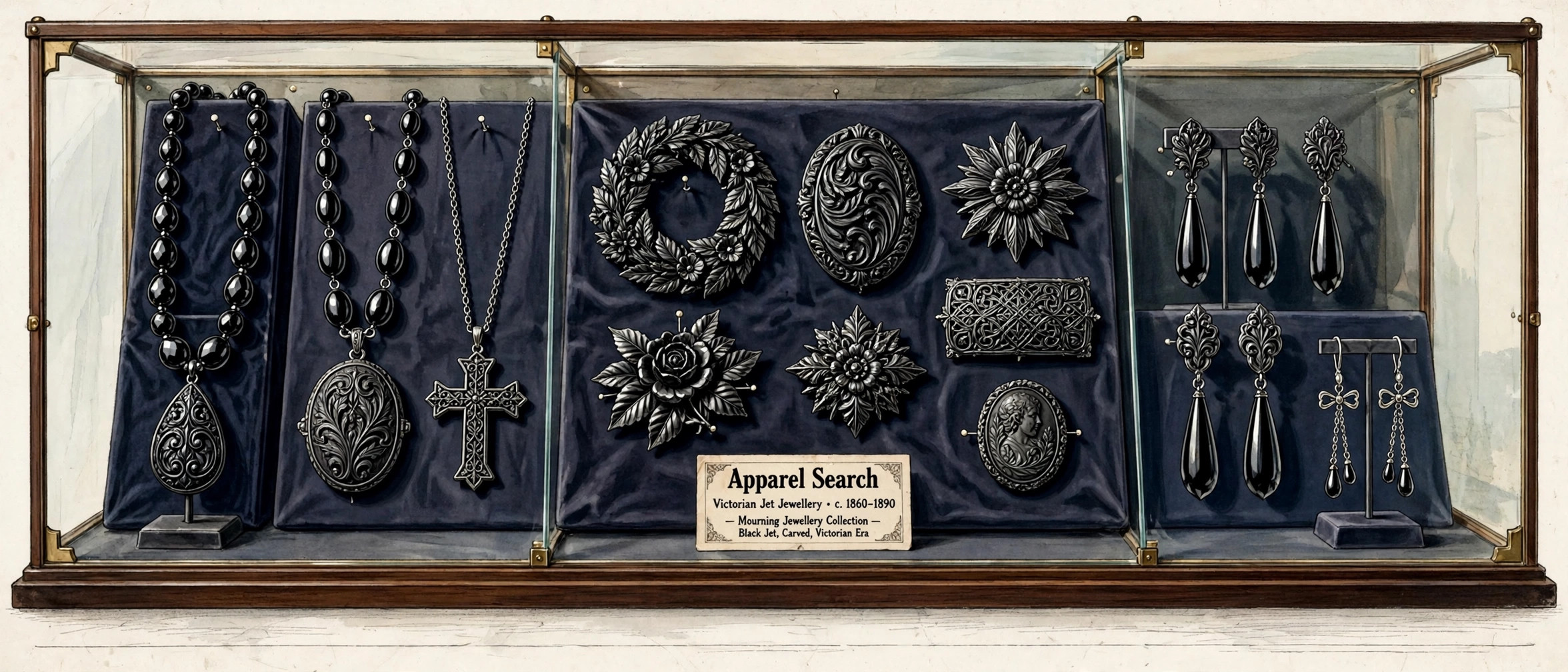
The Museum's figures give the boom its scale. At the industry's height, between 1860 and 1880, Whitby had over 200 jet factories and workshops, employing about 1,500 people, supplied by around 300 mines. The Museum frames Victoria's patronage as one driver alongside two others — the railway, which brought the customers and carried the goods, and the 1851 Great Exhibition, which had shown Whitby jet to the world a decade before the boom — and the conjunction is the honest picture: a queen's example, a transport revolution and a showcase, multiplying each other. Whitby Museum today holds more than 500 Victorian jet artifacts, the material archive of what a royal wardrobe did to a town.
The Reckoning
A Royal Effect You Can Count
This section of Apparel Search treats modern "royal effects" carefully — sell-outs reported by retailers, search spikes measured by platforms, headline figures that dissolve on inspection. Victoria's case is the historical counterpart of those stories, and it is better evidenced than most of them. The white-wedding effect is real but must be presented as what it is: cultural diffusion, carried by engravings and the bridal press, with no number attached and none needed — a custom changed, worldwide and permanently, by one widely pictured dress. The jet effect, by contrast, comes with a named institution's count: workshops, workers, mines, dates. When Whitby Museum says over 200 workshops and about 1,500 workers at the 1860–1880 peak, a guide can print the figure with its source and stand behind it.
There is a final point about the forty years themselves. State dressing is usually measured in moments — a coronation, a tour, a photograph. Victoria's mourning was measured in decades, and duration changed its nature: it stopped being a message sent on an occasion and became the standing visual identity of the monarchy, reproduced in every portrait, statue and photograph of the reign's second half. The widow in black became so completely the public image of the crown that the coloured, jewelled queen of the 1840s and 1850s reads, to modern eyes, almost like a different person. No designer was appointed to achieve that, and no single garment did it. It was done by repetition — the slowest and, in the end, the most powerful technique in this entire section.
That double legacy is why Victoria anchors the early end of this section's timeline. In 1840 she demonstrated the soft mechanism of royal influence — example, image, imitation — that every royal wardrobe since has relied on. From 1861 she demonstrated the hard one: a sustained, decades-long royal practice reorganising an industry around itself, measurably, in a named town. The monarchs and First Ladies who follow her in these guides worked with faster media and shorter cycles. None of them has yet matched forty years.
Common Questions
Questions & Answers
Did Queen Victoria invent the white wedding dress?
No. Brides had worn white before 1840. What Victoria did was make it the default: her white satin dress with its deep flounce of Honiton lace was reproduced in widely printed engravings, and white became the standard bridal colour in Britain and America thereafter. She had chosen the Honiton lace deliberately, to support the declining English lace industry, and she re-wore the lace for the rest of her life.
Why did Queen Victoria wear black for forty years?
She wore mourning for her husband Prince Albert from his death in December 1861 until her own death in January 1901, and the court followed her example. Her mourning dress meant a widow's cap, matte crape and jet jewellery, and wider society organised mourning into codified stages, from deep mourning in crape through second mourning to half-mourning in grey, mauve and lavender.
What is Whitby jet, and why did it boom under Victoria?
Jet is a black fossilised wood, mined on the Yorkshire coast and carved in Whitby into the necklaces, brooches and earrings that mourning dress required. Whitby Museum records that at the industry's height between 1860 and 1880 Whitby had over 200 jet workshops employing about 1,500 people, supplied by around 300 mines, and it names Queen Victoria's adoption of jet in her mourning as a direct driver of the boom.
Royal Style on Apparel Search
The ceremonial guide for the crowns Victoria's century defined, the queen whose court dressing became politics, and the modern monarch who inherited both traditions.
Search Apparel Search