Royal & State Fashion · State Dressing Profiles
Princess Diana: The Wardrobe That Learned to Speak
Diana, Princess of Wales, began her public life dressed by other people's expectations and ended it as the most deliberate dresser the modern monarchy has produced. In between, her clothes traced an education: the shy knitwear of a teenage aristocrat, the big-shouldered glamour the press called Dynasty Di, a tailored working wardrobe built with one trusted designer, and finally a ballistic vest worn into an Angolan minefield — anti-fashion used, quite consciously, as statecraft. She could rarely say what she meant in public. Her wardrobe said it for her, and the record it left — in auction rooms and in a Kensington Palace exhibition — is the hardest evidence any royal dresser has ever produced. This guide documents that record: the designers, the two dresses that made headlines on opposite sides of the Atlantic, the rules she broke, and what her clothes are worth now that museums, not magazines, keep the score.
At a Glance
- The arc
- Shy Di → Dynasty Di → the tailored working wardrobe → post-separation minimalism — the structure Historic Royal Palaces itself used for her exhibition
- Principal designers
- Catherine Walker at the core; Victor Edelstein, David and Elizabeth Emanuel, Bruce Oldfield, Christina Stambolian; Versace in the final years
- The mentor
- Anna Harvey of Vogue, who guided the wardrobe's development across the whole period
- The method
- Host-country dressing on tour, and rule-breaking at home: no gloves, no hats on children's visits, clothes chosen for touch and access
- The anti-fashion moment
- Huambo, Angola, January 1997 — a HALO Trust vest and visor over a plain shirt and chinos, in a partially cleared minefield
- The record
- Her own 1997 charity sale of 79 dresses raised $3.25 million; a single sweater later made $1,143,000 at auction; Diana: Her Fashion Story showed 25 outfits at Kensington Palace, 2017–19
The Arc
Shy Di, Dynasty Di, Working Wardrobe
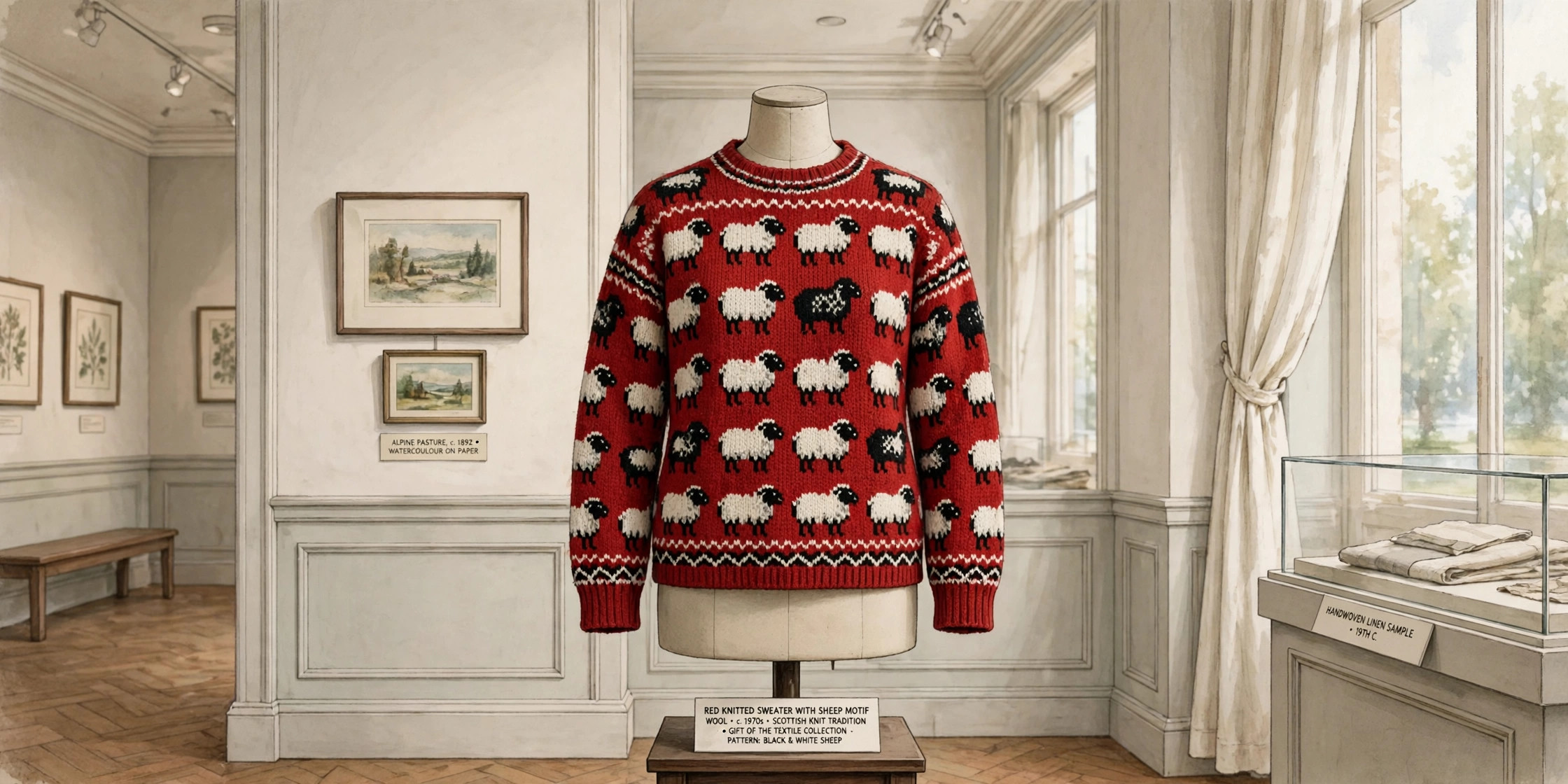
The wardrobe's first chapter was written before she had any say in it. The 1981 wedding gown by David and Elizabeth Emanuel fixed the opening image — a fairy-tale bride — and the early years that followed were the era of "Shy Di": soft knitwear, pie-crust collars and demure day dresses, photographed at polo matches and nursery-school doors. The most durable garment of those years was not couture at all but a red Warm & Wonderful sweater patterned with black and white sheep, worn at a polo match in 1981. One black sheep among the flock: the joke wrote itself, and the sweater became the first Diana garment the public could read as a message.
The second chapter belonged to the decade. Through the 1980s her dressing turned glamorous and big-shouldered — the phase the press nicknamed "Dynasty Di," after the television soap whose silhouette it shared. The nickname is documented in auction coverage of her 1980s pieces by Bruce Oldfield, the designer most associated with that glamour, and the clothes belong squarely to the world our 1980s fashion history guide describes: power shoulders, saturated evening colour, dressing as spectacle. Under the guidance of her fashion mentor Anna Harvey of Vogue, the spectacle was increasingly aimed rather than accidental.
The third chapter is the one that matters for state dressing. In the 1990s the wardrobe settled into a tailored working uniform — coat-dresses and suits, mostly by Catherine Walker — cut for hospital corridors, charity galas and foreign tours rather than for fairy tales. After her separation it simplified further into the post-separation minimalism of the final years, when Versace joined the rotation. When Historic Royal Palaces came to exhibit the wardrobe, it organised the story in exactly this sequence — Shy Di, Dynasty Di, working wardrobe, minimalism — because the clothes themselves had kept the diary.
The Makers
Catherine Walker and a Small Court of Designers
Diana's designer circle was strikingly small for someone photographed this much, and the smallness was the strategy. A short roster meant a consistent silhouette, relationships deep enough for designers to dress occasions rather than outfits, and a wardrobe that read as one voice. At its centre stood Catherine Walker, whose tailored coat-dresses and suits formed the 1990s working wardrobe — the clothes in which Diana did the job: openings, visits, tours, the daily business of a working royal. Walker's tailoring gave the wardrobe its grammar of clean lines and covered shoulders, as suitable for a hospice as for a state reception.
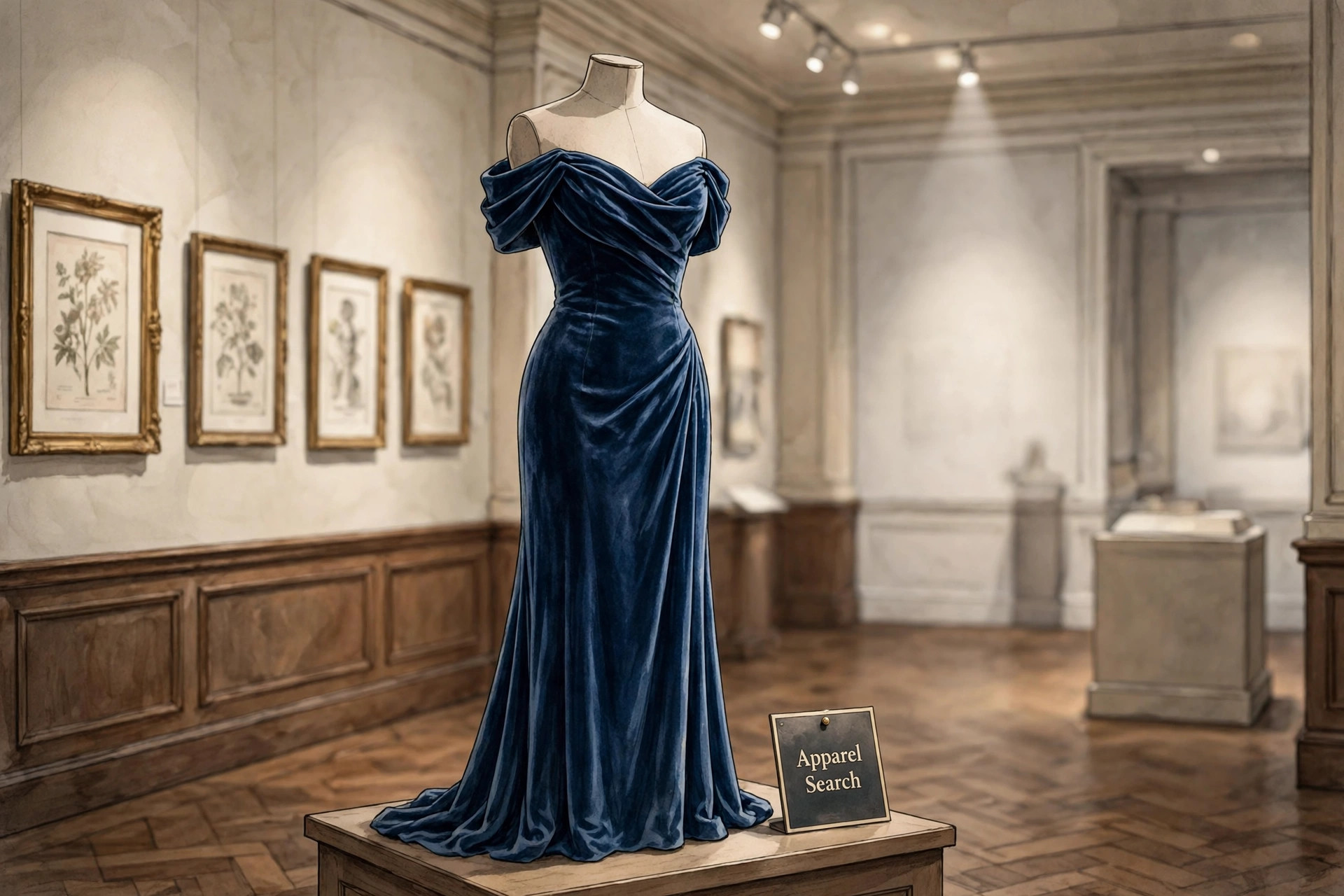
Around that core, each designer owned a register. Victor Edelstein made the era's most famous evening gown, the ink-blue velvet dress of the 1985 White House dinner. Bruce Oldfield supplied the high glamour of the 1980s. David and Elizabeth Emanuel made the 1981 wedding gown that started everything. Christina Stambolian made a little black dress that waited three years in the wardrobe for its single, devastating outing in 1994. And in the final years Versace brought a sleeker, international polish to the post-separation wardrobe. Anna Harvey of Vogue stood behind the whole arrangement as mentor — the professional eye that turned a young woman's taste into a working system.
A short roster, one trusted tailor at its centre, and a mentor from Vogue: the wardrobe read as one voice because it was built like one.
Compare the system with the one in our Queen Elizabeth II profile: the Queen's wardrobe was an institution, logged and rotated by a dresser's office. Diana's was a practice — personal, portable, and increasingly hers alone. That difference is why her clothes could do things the Queen's never attempted, from the diplomatic embroidery of the next section to the deliberate provocations of 1994.
Diplomatic Dressing
Dressing for the Host: The Falcon Gown
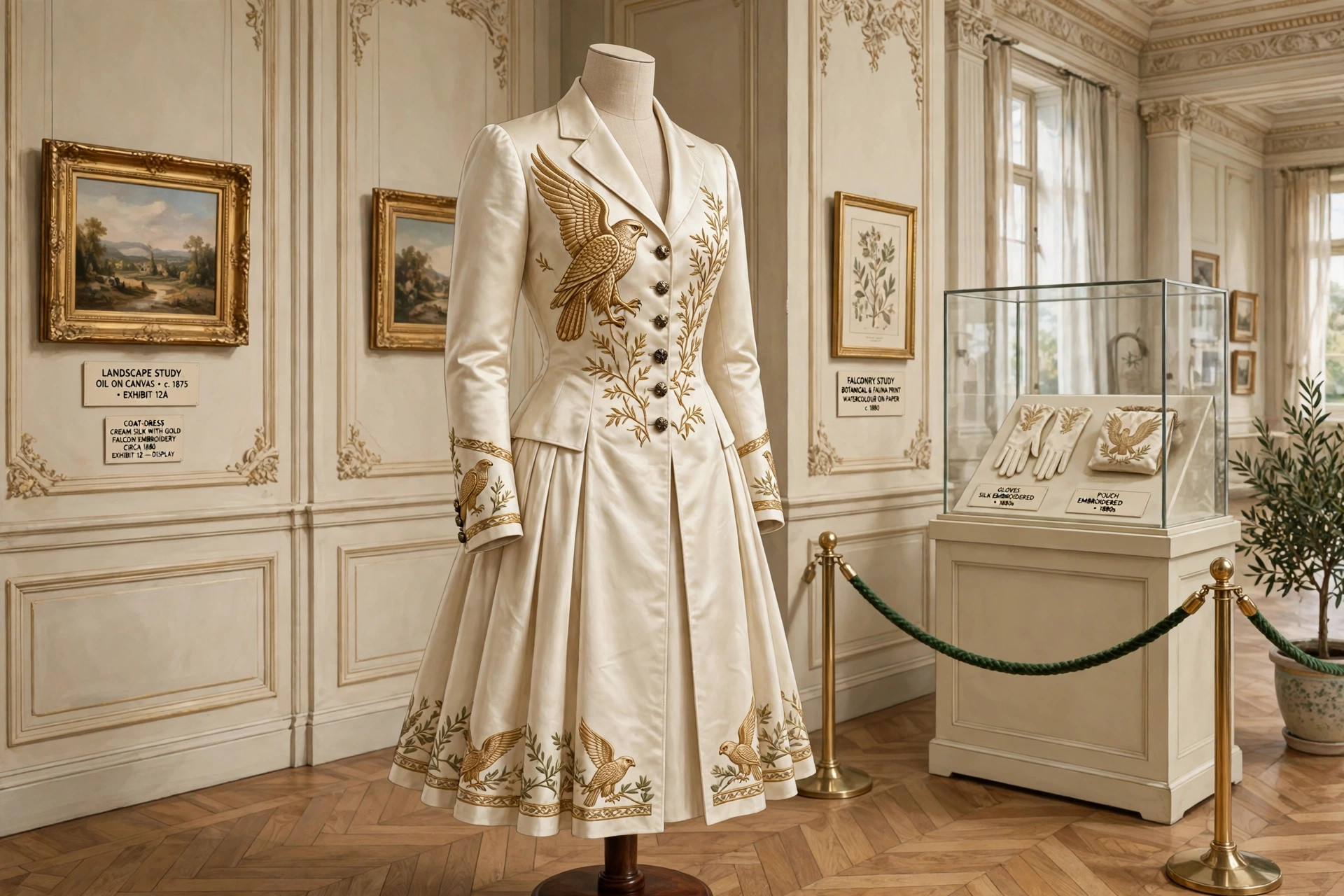
On tour, Diana dressed the way the Queen's wardrobe office dressed — in compliments to the host — but she wore them with a learner's thoroughness that made the practice famous. The textbook example is Catherine Walker's cream silk dress embroidered with gold falcons, worn on the 1986 visit to Saudi Arabia: the falcon is Saudi Arabia's national bird, and the embroidery placed the host's emblem on the guest's body, exactly as the emblem scheme of the 1953 coronation dress had placed a Commonwealth on the Queen's. It is the single clearest case of diplomatic dressing in Diana's record, and it was Walker's tailoring that carried it.
The same instinct ran through the tour wardrobe at every scale: Welsh colours worn in Wales, a Yuki garment worn in Japan, a shalwar kameez worn in Pakistan in 1996. Each choice said the same sentence in the host's own visual language — we have noticed who you are — without a word of speechmaking. This is the section's central craft, state dressing, practised by its most gifted modern student: the compliment is in the cloth, it is specific rather than generic, and it costs the wearer research rather than money. Diana's tours are still the standard teaching example because the homework showed.
Two Dresses
The Travolta Dress and the Revenge Dress
The Travolta dress, 1985. For the White House dinner on 9 November 1985, Victor Edelstein made Diana an ink-blue velvet off-the-shoulder gown. Photographed dancing with John Travolta, it produced the defining image of her American fame, and Historic Royal Palaces later confirmed it as a highlight of her exhibition. The dress then acquired a second life as the most carefully traceable price history in royal fashion — and it must be traced, because three different transactions are routinely conflated into one wrong figure. It was first sold as part of Diana's own charity auction at Christie's in New York in June 1997. It sold again at Kerry Taylor Auctions in London in March 2013, for £240,000. In December 2019 it failed to sell at a first Kerry Taylor offering, and Historic Royal Palaces then acquired it that month for about $290,000 (around £264,000) for the Royal Ceremonial Dress Collection. There is no single "price of the Travolta dress." There are three documented moments, and this guide reports all three.
The revenge dress, 1994. Christina Stambolian's black off-the-shoulder silk dress had sat in the wardrobe for about three years, considered too daring to wear. On 29 June 1994 Diana wore it to a Serpentine Gallery party — the same evening that the Dimbleby television interview, in which Prince Charles admitted adultery, was broadcast. The choice was made at the last moment: the Valentino outfit she had planned to wear had been leaked to the press, and she switched to the Stambolian instead. A princess who could not answer an interview answered it in a photograph. The dress's nickname was bestowed by the press, but the timing, the leak and the broadcast are documented fact — and as a piece of statecraft-by-wardrobe, dressing to seize a news cycle she was forbidden to address, it has no equal in the modern record.
Anti-Fashion as Statecraft
Angola, January 1997: The Vest and Visor
The most consequential outfit of Diana's life contained no fashion at all. In January 1997, at Huambo in Angola, she walked a partially cleared minefield wearing a HALO Trust ballistic vest and visor over a plain shirt and chinos — protective kit, issued for safety, identical to what the deminers around her wore. Then she walked the lane again, so that the photographers could get the shot. The repetition is the point: this was not a candid moment but a staged one, staged by a woman who understood exactly what her image could carry. A princess in couture visiting a minefield would have been a contrast story. A princess in the deminers' own kit was a landmines story.
The visit is documented as building momentum toward the Ottawa Mine Ban Treaty, signed in December 1997, a few months after her death; she repeated the formula in Bosnia in August 1997. Within this section's argument, Angola is the purest case on record of dressing as statecraft: the garment's meaning came from everything it refused to be. No gloves, no hat, no couture, no distance. The wardrobe that had learned to speak finished by saying the most with the least.
The Practices
Breaking the Rules: Hands, Hats and Gloves
Diana's rule-breaking was not carelessness; it was a set of documented practices, each with a practical reason, and together they rewrote the physical grammar of the royal walkabout. She stopped wearing gloves so that she could hold hands — most famously in 1987, when she shook hands with AIDS patients at the Middlesex Hospital, a gesture photographed around the world at a moment when the illness was widely and wrongly feared to spread by touch. A gloved handshake is ceremony; a bare one is contact, and she chose contact deliberately.
She likewise stopped wearing hats on visits to children, so that nothing stood between her and cuddling them — a hat is a small fence, and she removed it. Set beside the tour dressing of the falcon gown, the pattern is consistent: every element of the conventional royal uniform was audited for what it did to the encounter in front of her, and kept, adapted or discarded on that evidence alone. The Queen's wardrobe optimised for visibility at a distance. Diana's optimised for closeness at arm's length. Both were statecraft; they were simply aimed at different ranges.
The Record
Auctions, an Exhibition, and an Honest Accounting
Diana's measurable legacy begins with an act of wardrobe management she proposed herself: in June 1997 she sold 79 of her dresses at Christie's in New York for charity, raising $3.25 million for the Royal Marsden Hospital Cancer Fund and the AIDS Crisis Trust. It was a working wardrobe converted, at a stroke, into medical funding — and it started the auction record that has compounded ever since.
The posthumous figures are the hardest impact numbers in this entire section. The red Warm & Wonderful Black Sheep sweater of 1981 sold at Sotheby's in New York in September 2023 for $1,143,000 — fourteen times its estimate, and at the time a record both for a Diana garment and for any sweater at auction. Three months later a ballerina-length gown by Jacques Azagury, dating to 1985, sold at Julien's Auctions in December 2023 for $1,148,000, more than eleven times its estimate, setting a new record for a Diana dress. Between them, the Travolta dress history traced above — £240,000 in 2013, about $290,000 to Historic Royal Palaces in 2019 — completes a price record that needs no embellishment.
The museum record matches it. Diana: Her Fashion Story, at Kensington Palace under Historic Royal Palaces, ran from 24 February 2017 to 18 February 2019 — extended beyond its original run — showing 25 outfits with the designers' original sketches, curated by Eleri Lynn, and opening in the twentieth anniversary year of her death. (Our fashion museums hub tracks the institutions now keeping wardrobes like this one.) The honest accounting, which this guide owes the reader: Diana's retail influence in her lifetime was real — her looks were copied widely and sold widely — but it survives as anecdote, not measurement; no audited series exists. What can be measured is the auction and museum record above, and it is extraordinary enough to stand without inflation.
Common Questions
Questions & Answers
Who designed Princess Diana's clothes?
Her core designer was Catherine Walker, whose tailored coat-dresses and suits formed the working wardrobe of her 1990s. Victor Edelstein made the ink-blue velvet gown she wore at the White House in 1985, David and Elizabeth Emanuel made her 1981 wedding gown, Bruce Oldfield dressed her glamorous 1980s, Christina Stambolian made the black dress she wore in June 1994, and she wore Versace in her final years. Her fashion mentor was Anna Harvey of Vogue.
What is the Travolta dress, and what has it sold for?
It is the ink-blue velvet off-the-shoulder gown by Victor Edelstein that Diana wore to a White House dinner on 9 November 1985, where she danced with John Travolta. It has no single price. It was part of her own 1997 charity sale at Christie's in New York, it sold at Kerry Taylor Auctions in London in March 2013 for £240,000, and after failing to sell at a first offering in December 2019 it was acquired that month by Historic Royal Palaces for about $290,000 for the Royal Ceremonial Dress Collection.
What was the revenge dress?
It is the black off-the-shoulder silk dress by Christina Stambolian that Diana wore to a Serpentine Gallery party on 29 June 1994, the evening a television interview in which Prince Charles admitted adultery was broadcast. She had owned the dress for about three years and had considered it too daring. She chose it after the Valentino outfit she had planned to wear was leaked to the press.
Royal Style on Apparel Search
The section's hub, its companion profiles and topic guide, plus the site's own princess and fashion-queen reading.
Search Apparel Search