Military Uniforms · Design & History
The History of Uniform Design
Uniforms were not invented for parades. They emerged because commanders who clothed their own troops found uniformity cheaper, because men who dressed alike fought as a unit, and because on a smoke-filled battlefield identical dress could be the difference between rallying and being shot by your own side. This guide follows the system that grew from those practical beginnings: the facing colours that turned one red coat into dozens of regiments, the colonels who owned and dressed those regiments, the states that took clothing supply into their own hands, the factories and measurements that industrialised it, and the moment — driven by the rifle — when the uniform's first job, being seen, was replaced by its modern one, not being seen.
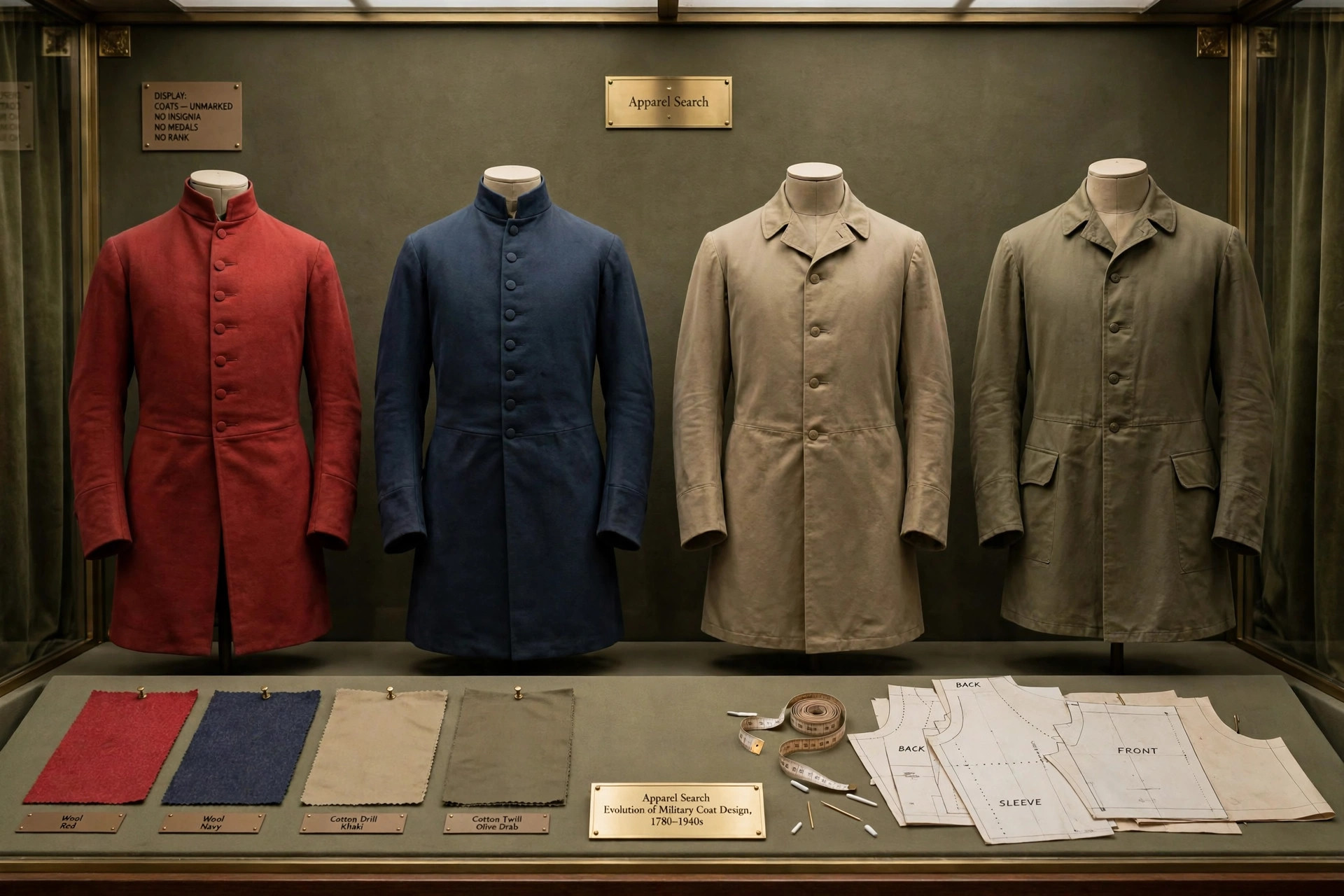
At a Glance
- Livery to uniform
- Household guards dressed alike first; identical dress for a whole force is a late development
- Facings
- One standard coat distinguished regiment by regiment by colour at cuffs, lapels and tails
- The proprietor
- The colonel raised, dressed and equipped his regiment — and controlled its clothing money
- Industry
- Civil War measurement data made standard sizing practical; the sewing machine took off under wartime demand
- Concealment & split
- Khaki for the field, full dress retained for ceremony — one uniform became two lineages
Before the Uniform
Livery, Guards and Dressing Alike
Livery came first: potentates and warlords clothed guards in uniform dress as palace servants wore personal livery — a household model surviving in the Papal Guards and London's Yeomen of the Guard, whose dress resembles Tudor court dress. A uniform in the modern sense — all members of a unit in similar dress — is a late development, not an ancient one. The British starting point usually cited is the Civil War, when the Parliamentary New Model Army adopted a fairly standardised pattern of red clothing; by the end of the 17th century English uniform colour was largely settled on red. The National Army Museum calls the regiment the Army's key permanent unit, each with its own history, traditions and insignia — the “military family” uniform design had to serve.
Why Uniforms Emerged
Identification, Economy and Esprit de Corps
From the late 16th and early 17th centuries, massed musketry made drilled permanent infantry decisive. Units were raised by individuals who sold their services; the commander provided clothing, and economy as well as building esprit de corps led to uniformity within units. Economy and cohesion — not parade vanity — are the founding reasons. Identification pressed the same way: on battlefields enshrouded in black-powder smoke, with flags often bearing a commander's badge rather than a national symbol, misidentification could be fatal, pushing uniformity from battalion to whole-army level. By the mid-18th century coat colours had become national — Britain largely red, France pale grey or white (blue after 1789), Prussia dark blue, Austria white, Russia dark green. James Laver's three principles still frame the subject: hierarchical (differentiating rank and elite, as in the Foot Guards' bearskins from 1831), seduction (making the wearer taller and more imposing), and utility — which wins in war, when rank badges are dropped because they draw fire. Armies also copy the perceived superior power: French style dominated until the Franco-Prussian War, after which kepis gave way to German spiked helmets.
Colour as a Code
Facing Colours and Regimental Variety
A facing is mechanical before decorative: the coat's lining was made in a contrasting regimental colour, showing where cloth turned back — cuffs, lapels, tails — so one standard coat could distinguish dozens of regiments. Most European armies adopted facings in the late 17th and early 18th centuries; in Britain they solved a real problem, identical red coats making units hard to distinguish and rally in battle, each regiment's flag matching its facing shade. By the 19th century linings became universal white or black and facings shrank to collars and cuffs. In Britain the facings were set by royal warrant in 1768, supplemented by lace, burnished buttons bearing the regimental number and helmet plates. “Royal” regiments wore blue facings as a mark of favour; other colours ran from buff to orange (35th), gosling green (5th), willow green (24th), black (50th, 58th), white (43rd, 47th) and red (33rd). Some regiments took nicknames from facings — the Buffs are the standard example — which is why standardisation was later fought so hard.
Who Owned a Regiment?
Colonels as Proprietors
The regimental system has its roots in the 17th century, when aristocrats and professional soldiers commissioned to recruit troops, ranked as colonels, raised, dressed and equipped their regiments. Today's “colonel of the regiment” — usually a retired general who served in it, “head of the family” — is the fossil of that ownership. A colonel could originally put whatever badge he chose on his soldiers' headdress; a Royal Warrant in 1751 forbade this, and badges have since been controlled by high command — an early milestone of state control over design. France shows the same pattern: under the Ancien Régime, colonels who in effect owned their regiments largely fixed facing colours, producing by 1776 shades as exotic as silver-grey, aurore and “red speckled with white.” Under the proprietor system the colonel was responsible for clothing his regiment and controlled the money stopped from soldiers' pay for that purpose — a system open to abuse, and one reason the state progressively took clothing supply into its own hands. Precise allowance or profit figures would need a further archival source, and this guide does not print them.
The State Takes Over
Standardisation in the 19th Century
Napoleonic uniforms were elaborate in theory and faded, improvised and locally replaced in practice; the long peace after 1815 then pushed parade elaboration to a peak. Mass conscript armies drove standardisation for economy and supply: in France, red facings became universal for metropolitan line infantry from 1854, regiments distinguished by numbers alone. Britain's 1881 grouping — Guards and “Royal” regiments dark blue, English and Welsh white, Scots yellow, Irish green — made manufacture simpler but proved unpopular; it was dropped and historic colours reinstated regiment by regiment (Buffs to buff, Northumberland Fusiliers to Gosling green, Norfolks to yellow, Essex to “Pompadour Purple”), reversions still approved after the First World War. Identity won over supply logic. The context was the Crimean War's supply failures, the Indian Mutiny and Prussia's victories — background to Cardwell's reforms and the abolition of purchase of commissions in 1871. The tight coatee gave way across armies to the tunic with skirts covering the thigh, and the United States adopted a universal blue uniform distinguished only by numbers, insignia and branch colours, lasting until blue ceased to be general issue in 1917.
Industry
Standard Sizing and the Sewing Machine
Mass uniform production in the American Civil War generated the body-measurement data that made standard sizing practical — the foundation of ready-to-wear. Before anthropometry every man's dimensions were assumed unique, so fitted factory clothing was thought futile; wartime demand produced data showing measurement sets recur predictably — a 38-inch waist with a 34-inch sleeve predicted shoulder breadth in eight cases out of ten. Ready-made clothing existed before the war, and sizing was refined again later; the Civil War data made commercial sizing practical at scale, guiding manufacturers supplying demobilised soldiers after the war. Daniel Edward Ryan's Human Proportions in Growth (1880) turned the statistics into size charts, and by the early 20th century a man could say he was a “42” and be fitted with little alteration. The sewing machine, a civilian invention with little public appeal, gained widespread acceptance only after proving its value outfitting the Union army; examination of Union and Confederate artefacts shows a large percentage of Union goods machine-stitched and an overwhelming percentage of Confederate goods hand-sewn. Adoption was uneven and contested, accelerating under wartime pressure rather than instantly replacing hand sewing.
The Field-Driven Turn
Khaki, Camouflage and the Split
The smoothbore musket's range was about 100 yards, so coat colour hardly mattered beyond recognition; rifles, breech-loaders, magazine rifles and smokeless powder made troops vulnerable at great distances, and uniforms were redesigned to inhibit recognition. Khaki was pioneered in India in the late 1840s by the Corps of Guides (raised 1846) and adopted as British service dress in stages — India 1885, foreign stations 1896, general service dress 1902. For the Guides, the National Army Museum records cotton dyed by the Indian method of using river mud, its dust-colour providing useful camouflage. The First World War completed the turn — steel helmets, gas masks, and pageantry gone — and post-war dress moved to disruptive patterns, at the cost of increased friendly-fire risk: identification, the uniform's first job, is in permanent tension with camouflage, its modern one.
One uniform became two lineages: field dress for concealment, ceremonial dress for the state.
Battledress (1937 Pattern), researched from the early 1930s to replace the combined field-and-dress Service Dress, was designed for mechanised infantry, inspired by wool ski suits, and issued widely from 1939; its “Austerity” pattern stripped pleats, fly front and brass buttons under wartime economy. It served even for parades, including at Buckingham Palace, until separate parade uniforms returned in the late 1950s, and No. 2 Service Dress took the formal role by the early 1960s while combat dress evolved separately. Ceremonial full dress survived — virtually unchanged from pre-1914 in the Brigade of Guards and the Marine Corps, hybridised in the French Foreign Legion's camouflage with white kepi — and facings survived with it, in Household troops', bandsmen's and officers' ceremonial uniforms. In the modern era, Britain's Multi-Terrain Pattern (from March 2010, developed from Crye's MultiCam as tested in trials) and the Personal Clothing System, designed for mandatory body armour and layered wear, continue the field lineage, while 2022 changes — adapted body armour trialled with serving female soldiers and around 25 shirt sizes — reapply the sizing lesson to a force of more than one body type.
Protection completes the modern brief. The encyclopedia survey already framed modern technology as producing lightweight body armour and “flak jackets” to protect the torso, alongside protection against nuclear and biochemical battlefields — protection joining concealment and identification as a primary uniform purpose, a purpose the layered, armour-integrated system now designs for explicitly. The 2022 women's-fit work makes the same point about fit: the adapted Virtus vest followed extensive trials with serving female soldiers, and a serving soldier's verdict, quoted in the official announcement, was that the improved fit would help her move more freely and feel more confident to do her job better.
Common Questions
Questions & Answers
Why did armies adopt uniforms in the first place?
For economy, cohesion and identification — not parade vanity. Commanders who raised units provided their clothing, and uniformity was cheaper and built esprit de corps. On black-powder battlefields enshrouded in smoke, identical dress also reduced fatal misidentification, pushing uniformity from the battalion up to the whole army, until by the mid-18th century coat colours had become national.
What is a facing colour?
A facing is the contrasting regimental colour that showed where a coat's lining was turned back — at cuffs, lapels and tails. One standard coat, such as British red, could distinguish dozens of regiments at a glance. In Britain the facings were set by royal warrant in 1768; royal regiments wore blue facings as a mark of favour, and some regiments took their nicknames from their facing colours.
Did the American Civil War invent standard clothing sizes?
Not single-handedly — ready-made clothing existed before the war, and sizing was refined again afterwards. What mass uniform production in the Civil War did was generate body-measurement data at unprecedented scale and prove that measurements recur in predictable sets. That made commercial standard sizing practical, and it is the foundation of ready-to-wear.
When did khaki replace bright uniforms?
In stages. Khaki was pioneered in India in the late 1840s by the Corps of Guides, raised in 1846, and adopted as British service dress in stages — India in 1885, foreign stations in 1896 and general service dress in 1902. Longer-range rifles and smokeless powder made bright coats a liability, and the First World War completed the move from display to concealment.
More in Military Uniforms
Continue through the Military Uniforms section — the hub maps every guide, and these are the closest companions to this page.
Search Apparel Search