Military Uniforms · Tailoring & Craft
Military Tailoring & the Civilian Suit
The best civilian suit in London was long made by the same hands, in the same workrooms, as the best uniform. Savile Row's defining houses began on military work: Henry Poole was a military tailor before he was the Row's first resident, Gieves clothed the Navy and Hawkes the Army before they shared an address, and officers who bought their own uniforms sustained a bespoke trade that also dressed them out of uniform. This guide traces what crossed over — the canvas-built chest, the structured shoulder, the suppressed waist — labels every firm claim as a firm claim, corrects one famous misattribution, the ticket pocket, and ends with an official answer to a modern question: who actually makes the Guards' ceremonial tunics today.
At a Glance
- Henry Poole & Co.
- Founded 1806, originally specialising in military tailoring; credited as first to open onto Savile Row itself, in 1846
- Gieves & Hawkes
- From Gieves (1785, Royal Navy) and Hawkes (1771, British Army); at No. 1 Savile Row since 1913
- Dege & Skinner
- Established 1865; garrison outposts from 1941; at No. 10 Savile Row since 1989
- The inheritance
- A recognised heavily padded, military-inspired British cut: canvas chest, structured shoulder, suppressed waist
- Not military
- The ticket pocket — British country and railway heritage
The Firms
Savile Row's Military Roots
Savile Row tailoring grew up on military, court and sporting work together; several of its defining houses — Poole, Gieves & Hawkes, Dege & Skinner — began as, or built their reputations on, military tailoring, and the disciplines of uniform cutting shaped the Row's house styles. The Row also grew on sporting and City demand, and tailoring clustered in Mayfair first: the Savile Row Bespoke Association records no tailors on Savile Row itself in 1806. Beau Brummell's tailors at his height in 1808, military specialists both, were Schweitzer on Cork Street and Meyer on Conduit Street; Brummell, who held a commission in the 10th Light Dragoons and bought his uniform from London's finest tailors, introduces the trouser to fashionable London and is called the godfather of the Row's understated aesthetic.
Poole. The firm's own history — firm history, labelled as such — records James Poole arriving in London in January 1806, turning from linen draper to military uniforms and becoming known for finely cut, regulation-perfect uniforms; by his death in 1846 he had established a Court, Military and Civil house. The encyclopedia and Royal Warrant Holders Association corroborate a Brunswick Square start in 1806, originally specialising in military tailoring, and a move to Savile Row in 1846 — the “first to open on the Row” claim resting substantially on firm and Association tradition, credited here rather than asserted. Poole states the transfer plainly: “Military dress required exacting adherence to detail, proportion and hierarchy. These disciplines became embedded in the house style.” Gieves & Hawkes was formed, on the firm's history corroborated in outline by the encyclopedia, from Gieves (1785, Royal Navy) and Hawkes (1771, British Army); Hawkes bought No. 1 in 1913 and Gieves acquired Hawkes in 1974. Its Dartmouth cadet figures are the firm's own; its warrants are given here as “since the reign of George III,” records differing on the year. Dege & Skinner, established in 1865, opened Aldershot and Catterick garrison outposts in 1941 and moved to No. 10 in 1989, described independently as expert in military as well as civilian clothing. “Military tailor” was a formal warrant category, and the Association founded in 2004 counts Poole, Gieves & Hawkes and Dege & Skinner among its founder members.
Cut and Structure
What the Civilian Suit Inherited
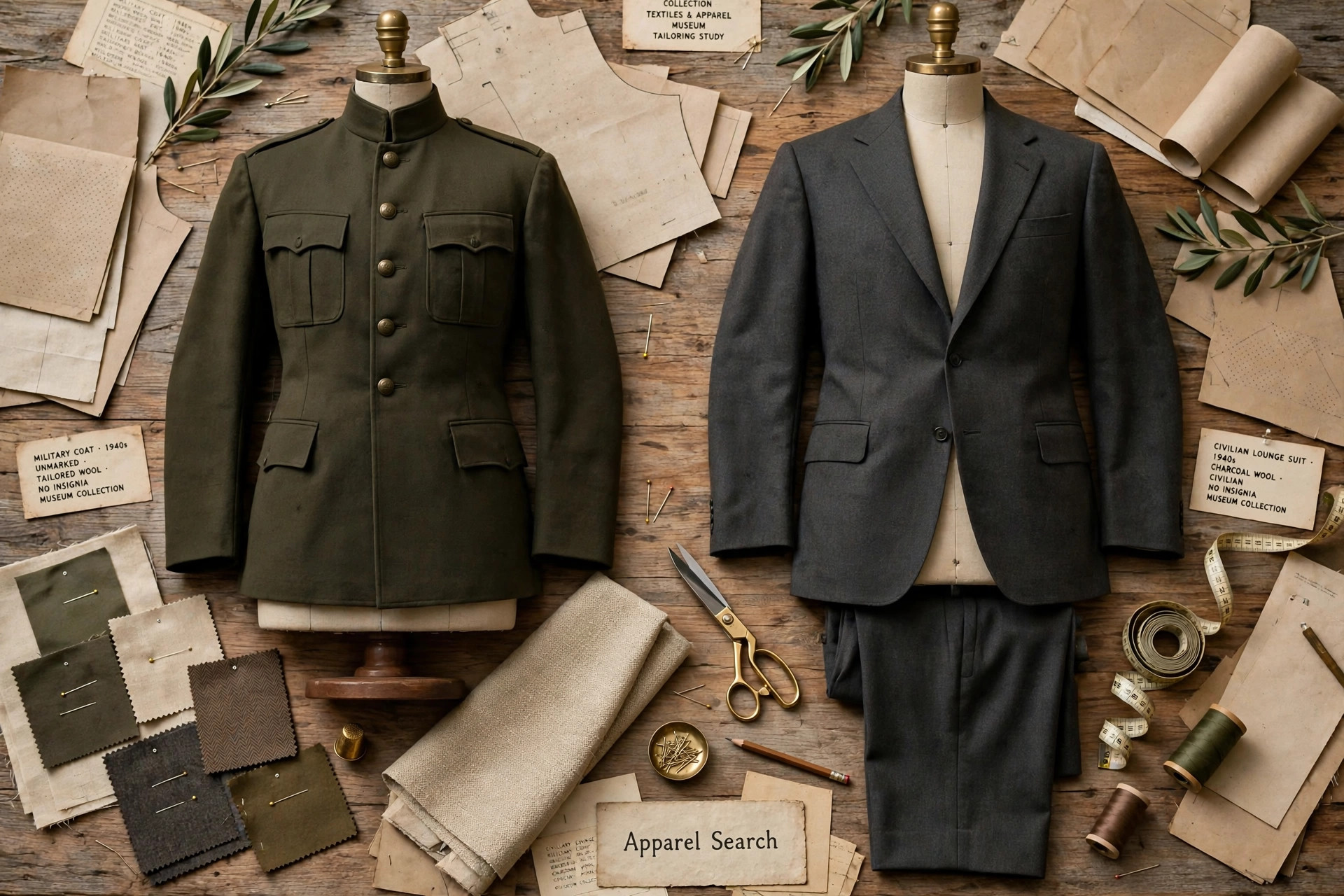
The lounge suit originated in 19th-century Britain as sportswear and country clothing, with roots in early modern court or military clothes. Tailoring recognises the heavily padded military-inspired cut of traditional British tailors as a named style, against the less structured Neapolitan style. The classic British suit's structured shoulder, canvas-built chest and suppressed waist descend from the body-coat tradition that military tailors dominated — the frock coat, probably military in origin, already used a waist seam and side bodies to pull the waist in well below the chest. Canvas fitting creates tailored balance so a jacket need not be buttoned; darts shape the profile; and the frock coat's suppression was panel engineering — a high waist seam with side bodies pulling in the cylindrical drape. The frock coat emerged around 1816, probably of military origin, buttoned to the neck with a standing “Prussian” collar. No source opened here verifies a stitch-by-stitch genealogy from a named regiment or inventor, and none is claimed. Influence also ran both ways — uniforms reflect civilian fashion of their time, the same tailors serving both markets — and Napoleonic-war tailors honed on uniforms added dash to London cutting; the V&A records a Savile Row suit made by three specialists, in coat, trouser and waistcoat making. Henry Poole records that in the 1860s the Prince of Wales ordered a short silk evening coat recorded in the firm's archives as the earliest example of the modern dinner suit — “in the 1860s” deliberately, the firm's tellings giving both 1865 and 1860, the claim attributed rather than asserted.
A Case Study
The Ticket Pocket Is Not a Military Detail
The small extra pocket above the right hip pocket is traditionally called a ticket pocket. It is usually explained as a railway-age convenience for a train ticket, developed from an older country-jacket coin pocket used for tolls on horseback — the detail is British country and railway heritage, not a military one. A leading maker's guide describes it as a place for a ticket or loose change, standard when men began commuting by rail, with the older coin-for-tolls layer behind it; retellings divide between that coin pocket renamed and a straightforward Victorian railway invention, and no museum or primary source opened here settles it. The genuinely military-adjacent pocket is bellows: seen on military and field-style tailoring, lying flat when empty and expanding when filled, now mostly on cargo trousers and workwear. Bellows is the field detail; the ticket pocket is the railway detail, and it must not be listed among the suit's military inheritances.
Private Purchase
The Officer's Bespoke Tradition
Other ranks were issued their uniforms; officers bought theirs. An officer's Service Dress trouser made on 1 September 1942 by Flights Ltd of Camberley, in barathea, finer than other ranks' serge, states the system: officers were expected to pay for their own uniforms and typically had them tailored by private military tailors, the personalised tailor's label a hallmark of that system. Camberley sits adjacent to Sandhurst, a natural hub for outfitters to new officers — Dege's garrison outposts are the same pattern — and officers kept Service Dress as walking-out dress through the Second World War while Battledress was the field uniform. Samuel Brothers describe over 40 years working with Sandhurst, with career-long officer relationships (its Mess Dress and headdress figures are firm-reported), and Kashket & Partners describe a tailor in residence at Sandhurst. No allowance or outfit-cost figure is printed here: no official source opened here verifies one.
Ceremonial Tailoring Today
Who Makes the Guards' Tunics — an Official Answer
A Ministry of Defence Freedom of Information response dated 15 March 2016 states: “The ceremonial uniforms of all seven Guards Regiments are manufactured by Kashket & Partners Ltd,” with cloth codes Foot Guards MAT0014Z Tunic Scarlet, Life Guards MAT0014N Scarlet and Blues and Royals MAT0014J Navy Blue — an official record, not firm marketing. Kashket's own account, consistent with it, claims supply of all ceremonial uniform and most accoutrements, over 50 tailors and artisans, and ownership of Firmin & Sons, the button house; coverage of the 2023 Coronation reported around 6,000 new uniforms prepared with Firmin and Yorkshire mill Hainsworth, numbers attributed to that coverage. Dege & Skinner records Sarah Wilkinson as its number one ceremonial maker and its making of Prince Harry's 2018 Blues & Royals wedding frock coat; the Queen Elizabeth Scholarship Trust independently records her as one of the few tailors able to make a Foot Guards tunic complete with embroidery. Gieves & Hawkes also produces uniforms for the Honourable Corps of Gentlemen at Arms, and Poole's livery department shows the same braid craft sold to great households.
The same firms carried military work into new retail forms, on their own accounts. Gieves & Hawkes records a comprehensive mail-order catalogue in 1910, greatly increased uniform demand in 1914 and 1939, and “Immediate Wear” ready-to-wear by 1939, including for uniforms — firm history, labelled as such. Henry Poole's livery department, recorded by the firm from 1876, employed 50 to 70 artisans producing everything from stable jackets to elaborate state liveries, each household's livery unique, incorporating household colours and heraldic devices wrought into handmade braids in gold and silver — the same braid and embroidery skill set as military ceremonial work, sold to great households. The Royal Warrant Holders Association records that Poole still supplies the Lord Chamberlain's office with court dress, a reminder that court, livery and military ceremonial tailoring remained one connected trade, sharing workrooms, embroiderers and metal-thread skills well into the modern period, rather than three separate crafts that happened to share a street.
Structure in Fashion
The “Military Cut” as a Living Vocabulary
What fashion borrows in cut, not ornament, is a short vocabulary: padded structured shoulder, canvas-built chest, suppressed waist, high armhole, close fit and an upright, on-parade posture — the heavily padded military-inspired British cut is the reference form. The V&A's account of Charles Creed's 1954 suit describes a military precision owing much to traditional men's tailoring, Savile Row detailing forming a very feminine suit. No source opened here verifies a named designer inventing this cut or a single-season origin; the documented pattern is continuous, from military tailors making civilian clothes since 1806 through periodic revivals. The suit was, in large part, cut by the uniform's tailors — by firms whose order books, workrooms, warrant titles and ceremonial contracts kept military and civilian cutting in the same hands for more than two centuries.
Common Questions
Questions & Answers
Did Savile Row begin as military tailoring?
In part — the accurate claim is narrower. Savile Row tailoring grew up on military, court and sporting work together. Several defining houses began as, or built their reputations on, military tailoring: Henry Poole, founded in 1806 and originally specialising in military tailoring, Gieves & Hawkes, formed from a Royal Navy supplier and an Army supplier, and Dege & Skinner. The disciplines of uniform cutting shaped those houses' styles, but military work was not the Row's sole cause.
What did the civilian suit inherit from military tailoring?
Structure, above all. Tailoring recognises a heavily padded military-inspired cut of traditional British tailors, built with canvas fitting and balance and shaped with darts. Its suppressed waist descends from the body-coat tradition military tailors dominated: the frock coat, probably military in origin, already used a high waist seam and side bodies to pull the waist in well below the chest.
Is the ticket pocket a military detail?
No. The small extra pocket above the right hip pocket is traditionally called a ticket pocket. It is usually explained as a railway-age convenience for a train ticket, developed from an older country-jacket coin pocket used for tolls on horseback — the detail is British country and railway heritage, not a military one. Its origin is unsettled even within that civilian story.
Who makes the British Guards' ceremonial uniforms today?
Kashket & Partners Ltd. A Ministry of Defence Freedom of Information response dated 15 March 2016 states that the ceremonial uniforms of all seven Guards Regiments are manufactured by Kashket & Partners Ltd, and gives the cloth codes: Foot Guards Tunic Scarlet, Life Guards Scarlet, and Blues and Royals Navy Blue. That is an official record, not a firm's marketing claim.
More in Military Uniforms
Continue through the Military Uniforms section — the hub maps every guide, and these are the closest companions to this page.
Search Apparel Search