Military Uniforms · United States Dress Uniforms
U.S. Dress Blues & Whites
Three services wear “dress blues,” and no two of them are wearing the same uniform. The Army's midnight blue coat carries a history that runs from Washington's 1779 order through a century as the national colour, a wartime disappearance, a five-year reign as the Army's only service uniform, and a return to formal duty. The Navy splits its dress blues and whites between a double-breasted suit for officers and chiefs and the jumper and Dixie cup of the enlisted crackerjacks. The Marines wear the most photographed dress uniform in America — and the one with the most folklore attached, much of it corrected here by the Corps itself.
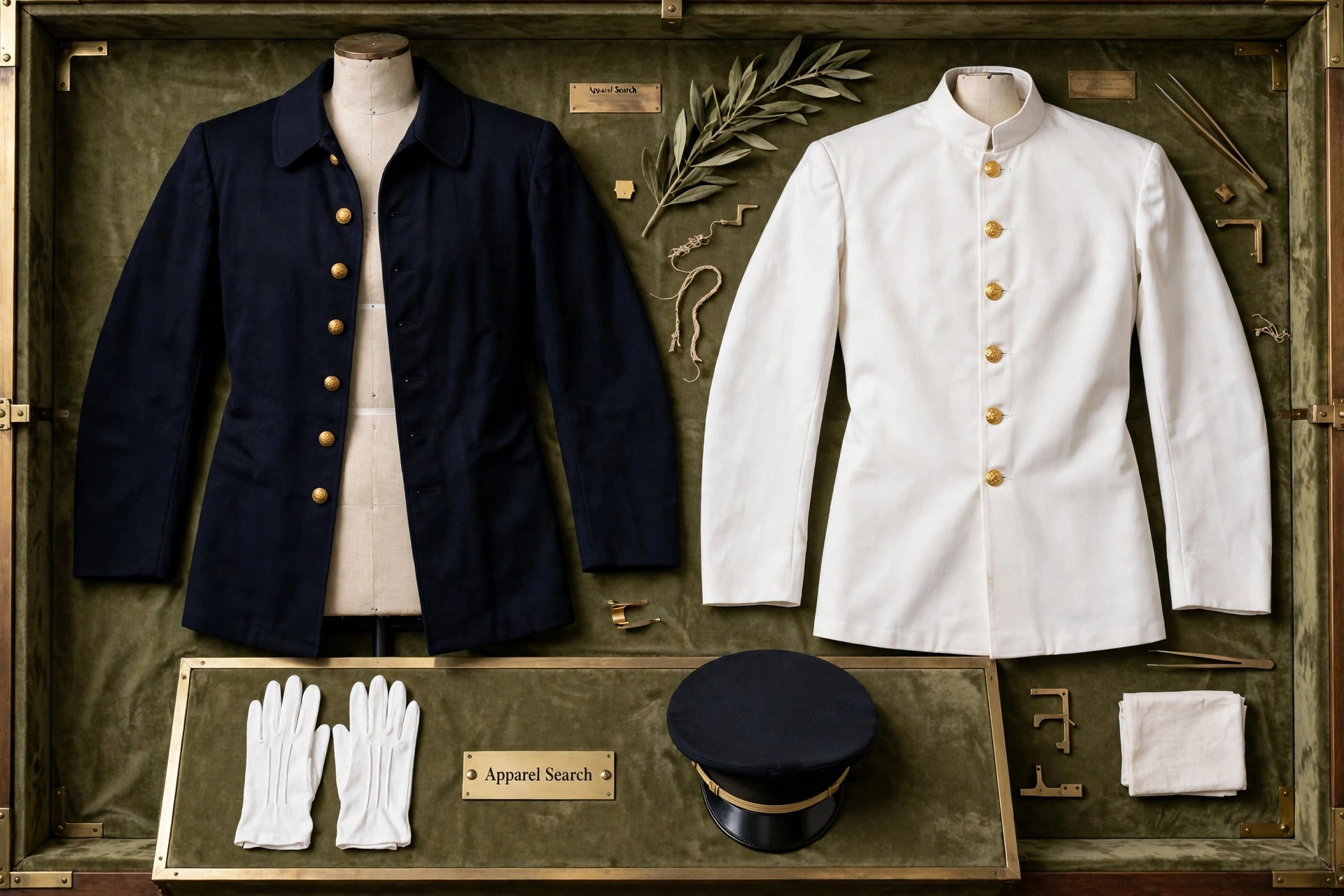
At a Glance
- Army Blue
- Midnight blue coat, lighter blue trousers; blue fixed in 1779, sole service uniform 2015–2020, now formal dress again
- Navy Blue & White
- Officers' and chiefs' suit-style blues and whites; junior enlisted wear the jumper uniform called crackerjacks
- Marine Dress Blues
- Red-trimmed standing collar, scarlet trouser stripe for officers and NCOs, buttons in use since 1804
- Evening dress
- Dinner and mess dress — the ball uniform, equivalent to black tie, or white tie at its most formal
A Warning About the Name
“Dress Blues” Is Not One Uniform
The phrase covers the Army Blue Service Uniform, the Navy's Service Dress Blue and Full Dress Blue — a suit for officers and chief petty officers and a jumper uniform for junior enlisted sailors — and the Marine Corps Dress Blues, an unrelated design sharing only a colour family and a name. This guide names the service and uniform in full at first mention, every time. Each is its service's formal face, for ceremonies, official functions, weddings, funerals and balls — and each carries folklore flagged here where the record does not support it, often using the services' own corrections.
The Army
Army Blue: A Timeline That Must Not Be Compressed
George Washington's General Order of 2 October 1779 fixed blue for all branches of the Continental service, with distinctive linings and facings — artillery blue faced and lined with scarlet with yellow buttons, light dragoons blue faced and lined with white, infantry blue lined with white with white buttons. In the regulations of 1821 dark blue was declared to be the national colour. Civil War soldiers wore a standard dark blue coat and light blue trousers, as did garrison, office and headquarters personnel.
From 1902 to 1917 the Army had three uniforms — olive drab wool for the field, khaki cotton for hot weather, and a blue dress uniform for ceremonies and off-post wear. Blue issuance halted in 1917 because of the exigencies of the First World War. Blue coats and light blue trousers, in modernised open-collar form, were reintroduced for officers in 1937; in the mid-1950s blue was reintroduced as an option for enlisted soldiers and reinstated in 1957 as an optional full dress uniform. In 1954 the Army also introduced an all-ranks “Class A” uniform in Army Green shade 44, adopted to give a distinct military appearance from civilian service workers.
In 2006 Chief of Staff General Peter Schoomaker announced a version of dress blue would become the sole service uniform for all ranks, combining ceremonial, dress and service uniforms through wear stipulations. The blue Army Service Uniform debuted at the 2007 State of the Union Address, began being issued in 2010, and became mandatory in October 2015, when the green Class A was fully retired — blue was the sole service uniform between 2015 and 2020. On Veterans Day 2018 the Army announced a new Army Green Service Uniform based on the Second World War and Korean War “pinks and greens,” as the everyday uniform from 2020; it became available in mid-2020, with soldiers required to purchase it by 1 October 2027. Blue did not end in 2020 — it changed role, returning to formal dress use. Today's Army Blue is a midnight blue coat with lighter blue trousers (midnight blue with gold braid for generals), a gold-braid trouser stripe for non-commissioned and commissioned officers, white shirt and black four-in-hand tie.
The Navy
Navy Dress Blues, Dress Whites and Crackerjacks
The Navy has three dress categories, from least to most formal — service, full and dinner dress. Service dress, whose civilian equivalent is a business suit, is worn for official functions, official travel and reporting to a command. Service Dress Blue may be worn year-round; Service Dress White is reserved for summer or tropical zones; ribbons are worn over the left breast pocket in all variations.
For officers and chiefs, Service Dress Blue is a dark navy blue, nearly black, suit coat and trousers (or optional skirt), white shirt and black tie; the men's jacket is double-breasted with six gold-coloured buttons, rank shown by gold sleeve stripes for officers and rating badges and service stripes for chiefs, with the white combination cap. Service Dress White is a high stand-collared white tunic with shoulder boards (metal anchor collar devices for chiefs), white trousers and white shoes — informally “chokers.” The material, formerly cotton, is now “Certified Navy Twill”; women's uniforms changed to this pattern in early 2017, with full replacement by the end of January 2020. Full Dress adds full-size medals instead of ribbons, for changes of command, retirements, commissionings, decommissionings, funerals and weddings. Dinner Dress features a short mess jacket worn open with a black bow tie and gold cummerbund, equivalent to black tie; Formal Dress, with white waistcoat and bow tie, is equivalent to white tie and prescribed only for officers and chiefs.
Junior enlisted Service Dress Blues are the classic sailor suit, called “crackerjacks” after the sailor-suited figure on Cracker Jack packaging: a navy wool pullover jumper with a “tar-flap” collar with three rows of white stripes and two white stars, striped cuffs, a black neckerchief tied in a square knot, flared “bell bottom” trousers and the white “Dixie cup” hat. The Navy first prescribed enlisted uniforms in 1817; by 1841 blue woollen frocks had white collars and cuffs, which came off in 1859, and in 1866 two stars were added to the collar — that frock is the jumper's ancestor. By the end of the First World War the white hat had settled into the Dixie cup shape. From October 2015 the white jumper gained navy piping, stars and a yoke, making it a “photo-negative” of the blue jumper.
Folklore, Flagged
Sailor Stories the Record Does Not Support
Tradition says the 13 buttons stand for the 13 colonies and the black neckerchief mourns Lord Nelson; Navy historians find no record for either — the button count grew from seven in the 1860s for fit and symmetry, and the neckerchief was working dress before it was ceremonial. Even the bell-bottom's purpose is unrecorded: a 1954 Navy publication admitted the real reason for the cut is not known. One account has the broadfall designed in 1864 with seven buttons, six added in 1894; another dates an 11-button broadfall to 1899 — none ties the count to the colonies, and the Nelson story has “no records to support it.”
The Marine Corps
Marine Dress Blues and Their Legends, Corrected by the Corps
A red-trimmed standing collar, white gloves, a brass belt buckle, a scarlet trouser stripe and six gold buttons — Marine Dress Blues are the image many Americans picture for “man in uniform,” said to be steeped in nearly 241 years of tradition. The first blue uniforms, coinciding with the Corps' establishment in July 1798, were hand-me-downs modified from a Legion of the United States rifleman's uniform: “plain short coats of blue, with a red belt, edged with red… with blue pantaloons edged with red, and red vests.” The gold buttons, bearing the eagle and anchor with an arc of 13 stars, have been part of the uniform since 1804; the eagle, globe and anchor emblem was adopted in 1868. At Marine Corps Balls, weddings and official functions, officers and NCOs wear the scarlet stripe — 1½ inches wide for NCOs, 2 inches for officers. Officers carry a Mameluke-hilted sword honouring Lieutenant Presley O'Bannon's 1805 march to Derna, the “shores of Tripoli”; the current NCO sword was authorised by the sixth Commandant, Colonel John Harris, the first specified NCO sword having been issued by Commandant Archibald Henderson in 1826.
The scarlet “blood stripe” is traditionally said to honour the Marines who fell at Chapultepec in 1847. The Marine Corps itself now corrects the story: the stripe was part of the uniform years before Chapultepec — it followed the rule that trouser stripes match the jacket's red facings — and the Corps today pledges it to all its fallen, in every battle before and since. Sergeants already wore a dark blue stripe edged in red at Chapultepec; truly red stripes were added in 1892. The quatrefoil is traditionally explained as an identification mark for Marine sharpshooters in the rigging; historians note it was a fashionable French military ornament of the early 19th century, copied by the Army as well. The standing collar represents the high leather stock, which did inspire “leatherneck” — but it was never worn to fend off sword cuts; it was worn to make the Marine hold his head up straight. Many legends were assembled by Commandant John A. Lejeune's public-affairs team after the First World War.
Other Services & Occasions
Coast Guard, Air Force, Space Force — and When Dress Is Worn
Coast Guard Service Dress Blue, introduced in 1972 with transition completed in 1974, is a blue four-pocket jacket with slightly darker trousers, all personnel in the same colour; Full Dress Blue adds full-size medals, white gloves and, for officers, a sword. Air Force blue service dress dates to 1949, the first version in “Uxbridge Blue,” the current version introduced in the 1990s. The Space Force prototype, unveiled on 21 September 2021, was the first U.S. service dress designed “female first,” its six buttons and hexagonal name tag representing the sixth service; its interim dress was the Air Force's 1994 pattern — the modern echo of the Marines' 1798 hand-me-downs. On occasions: Army Blue is now primarily for ceremonial occasions or formal social situations; Navy Full Dress covers changes of command, retirements, commissionings, decommissionings, funerals and weddings; Marines wear dress blues at Corps Balls, weddings and official functions; and across services the evening order — Navy Dinner Dress, Air Force mess dress for dinings-in, dinings-out and the Air Force Ball — is the ball uniform, answering to black tie.
Common Questions
Questions & Answers
Is “dress blues” one uniform shared by all the services?
No. The phrase covers three unrelated designs that share only a colour family and a name: the Army Blue Service Uniform, the Navy's Service Dress Blue and Full Dress Blue — a suit for officers and chiefs and a jumper uniform for junior enlisted sailors — and the Marine Corps Dress Blues. Each service's uniform has its own cut, history and rules for when it is worn.
Did the Army stop wearing blue in 2020?
No — the blue uniform changed role rather than ending. The blue Army Service Uniform was the sole service uniform from 2015 to 2020. The Army Green Service Uniform, announced on Veterans Day 2018 and available from mid-2020, became the everyday service uniform, and the Army Blue Service Uniform returned to its former use as a formal dress uniform for ceremonial occasions and formal social situations.
Do the 13 buttons on Navy trousers stand for the 13 colonies?
Tradition says the 13 buttons stand for the 13 colonies and the black neckerchief mourns Lord Nelson; Navy historians find no record for either. The button count grew from seven in the 1860s for fit and symmetry, and the neckerchief was working dress before it was ceremonial. Even the bell-bottom's purpose is unrecorded: a 1954 Navy publication admitted the real reason for the cut is not known.
Does the Marine blood stripe commemorate Chapultepec?
That is the traditional explanation, but the Marine Corps itself now corrects it. The stripe was part of the uniform years before the battle of Chapultepec in 1847 — it followed the rule that trouser stripes match the jacket's red facings — and the Corps today pledges it to all its fallen, in every battle before and since. The stripe is 1½ inches wide for NCOs and 2 inches wide for officers.
More in Military Uniforms
Continue through the Military Uniforms section — the hub maps every guide, and these are the closest companions to this page.
Search Apparel Search