The Governing Rule
A Necklace and a Neckline Are Two Lines — Make Them Agree
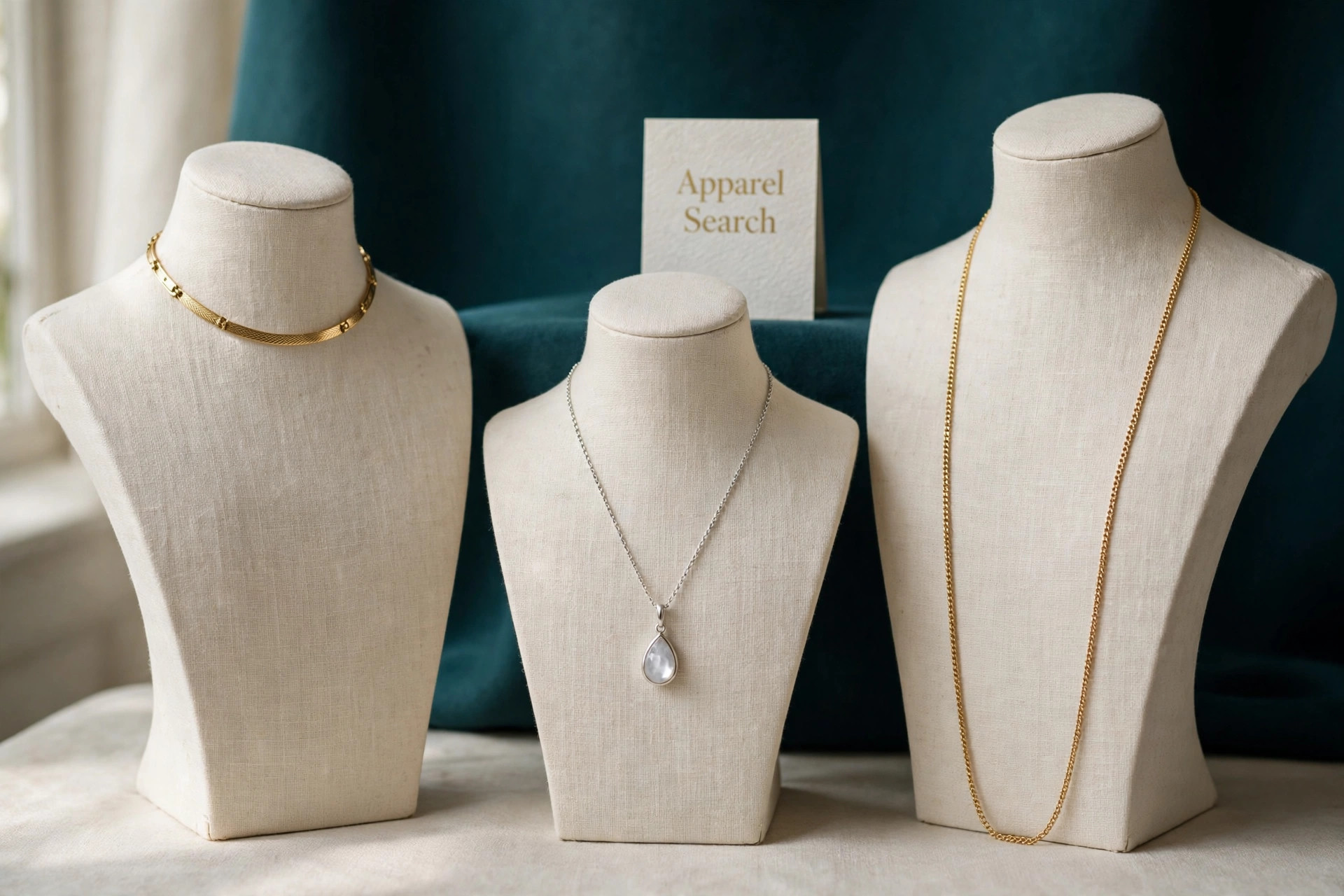
Every neckline draws a line across the chest, and every necklace draws another. A pairing works when the two lines agree — the necklace echoes the neckline’s shape and sits clearly inside it on the skin, or drops clearly below it onto the fabric. It fails in the strip between: a chain landing exactly on the edge slides on and off it all day and looks like an accident.
Read the neckline’s shape, pick a length from the chart that places the necklace decisively, then check the pendant’s landing spot. Wearing several at once follows the same rule, as the necklace layering guide sets out; the earrings that complete the picture are in the companion earrings for your face shape guide.
The Length Chart
From Choker to Opera: The Standard Lengths
| Length | Chain | Where it lands |
|---|---|---|
| Choker | 14–16 in | Tight to the base of the neck; the pairing for open and strapless necklines. |
| Princess | 17–19 in | On the collarbone or just below; the most versatile length, and the usual pendant length. |
| Matinee | 20–24 in | At or above the bust; the over-the-fabric length for crew and turtleneck tops. |
| Opera | 28–36 in | Below the bust; worn singly or doubled into two strands. |
| Rope | 36 in and up | Long and fluid; knotted, doubled or layered rather than worn full-length. |
Lengths are measured end to end including the clasp, and the same chain lands higher on a larger frame — test with a piece of string before buying a fixed-length piece, as the necklace lengths page recommends.
Neckline by Neckline
The Right Length and Shape for Each Neckline
V-Neck
Echo the angle: a pendant on a 16- to 18-inch chain following the V, stopping an inch or two above its point. A drop pendant sharpens the echo.
Avoid: round necklaces and chokers cutting across the V.
Crew Neck
Go decisively over it: a matinee-length pendant or longer chain worn on the fabric, or a short collar necklace sitting above the edge like a second neckline.
Avoid: princess lengths landing on the crew edge.
Scoop Neck
Fill the curve with a curve: a princess-length necklace following the scoop’s arc just inside it, or a multi-strand or bib style filling the open space.
Avoid: a long straight pendant that ignores the curve.
Strapless
The whole chest is open, so the necklace owns it: a choker or short princess length keeps the line close to the neck and the shoulders clean. Statement pieces work here as nowhere else.
Avoid: mid-lengths ending halfway down the bare chest.
Turtleneck
Long is the answer: matinee to opera lengths worn over the knit, with a pendant or heavier chain that holds its line against the fabric — the necklace decorates the garment, not the skin.
Avoid: chokers and short chains colliding with the collar.
Boat Neck
The wide, shallow line wants length for contrast: a long single strand or opera length dropping a vertical through the boat neck’s horizontal sweep.
Avoid: short wide necklaces repeating the horizontal.
Halter
The straps already draw a strong V, so keep any necklace fine and short inside it — or, more often, skip it and move the jewelry to the ears.
Avoid: anything crossing or tangling with the straps.
Square Neck
Answer angles with a short pendant or princess length inside the square’s frame; an angular pendant echoes the corners, a round one softens them.
Avoid: long necklaces breaking out of the frame.
Sweetheart
Follow the curve with a short necklace — a princess length with a gentle arc, or a pendant centred in the dip — keeping the piece on the skin above the edge.
Avoid: straight chokers that fight the curve, and drops falling over the edge.
Pendant Placement
Where the Pendant Should Land
A pendant is a full stop: it marks the end of the necklace’s line, so its landing spot is the decision. Rule one: it should rest in the middle of the space it decorates — centred in an open neckline with clear skin above and below, or centred on the chest over a closed one. Rule two: never let it sit exactly on the neckline’s edge, where it slides, twists and snags. Rule three: echo the neckline’s geometry — pointed pendants in V-necks, round pendants in scoops and sweethearts, angular pendants in square necklines.
Scale matters too: a pendant should read at conversational distance without outweighing the neckline, staying well inside its width. The jewelry sizing and wearing guide covers the same proportion logic for rings and bracelets.
Knowing When to Stop
When to Skip a Necklace Entirely
Some necklines are already the decoration. Beading, embroidery or lace at the neck, a dramatic halter strap, a bow at the throat, and embellished collars all compete with a necklace — and usually win, leaving the chain looking like clutter.
Skipping the necklace is not skipping jewelry. Move the emphasis toearrings matched to your face shape or to a bracelet, and the outfit keeps one focal point — the one the designer put there. When in doubt, take the necklace off and look again: if nothing feels missing, nothing was.
Questions
Common Questions
What necklace length goes with a V-neck?
A pendant on a 16- to 18-inch chain that follows the V’s own angle and stops an inch or two above its point. The necklace should echo the neckline’s shape and sit clearly inside it — a chain that ends exactly at the point, or falls past it onto the fabric, fights the line instead of finishing it.
Where should a pendant sit?
In the middle of the space it decorates: centred in an open neckline with clear skin above and below it, or centred on the chest over a closed neckline like a turtleneck. The two placements to avoid are a pendant resting exactly on the neckline’s edge and one stranded just below the chin, where a too-short chain leaves it looking lost.
When should you not wear a necklace?
When the neckline is already the decoration: heavy embellishment, beading or lace at the neck, a dramatic halter strap, or a high collar with its own detail. A necklace competing with the garment’s own neckline divides attention and usually tangles with it. Move the jewelry to the ears or wrist instead — the outfit keeps one focal point.
More to Explore
Search Apparel Search