Apparel Search Style Guides
Sunglasses for Your Face Shape
Identify your face shape, choose the frame geometry that balances it, and read the three little numbers that decide fit — the complete method for buying sunglasses that suit you.
Sunglasses suit a face for the same reason clothes suit a body: balance. A frame works when its lines answer the face's lines — angles where the face is round, curves where the face is angular, and a size matched to the face's scale. That is the whole theory, and it is the same one behind dressing for your body type: identify the dominant geometry, then choose the piece that balances it rather than repeating it. This guide takes the six common face shapes one at a time, then covers the part shape advice often skips — measuring the frame itself, because a perfect shape in the wrong size still fits badly.
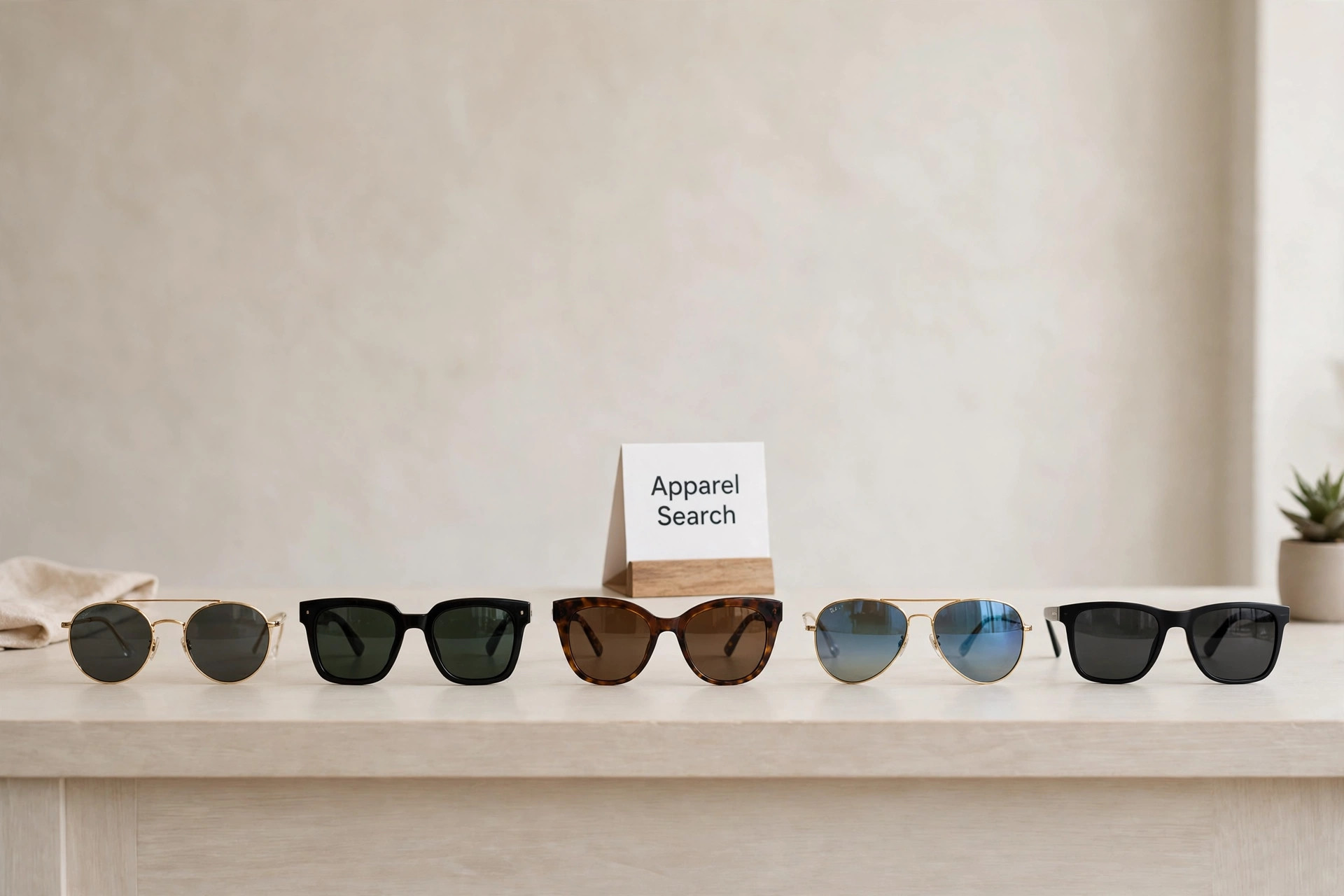
Work Out Your Face Shape
Pull your hair back, look straight into a mirror (or a front-facing photo), and compare three widths — forehead, cheekbones and jaw — along with the face's overall length. Forehead and jaw about equal with the cheekbones widest suggests one family; a jaw that is clearly the widest or most angular feature suggests another. Six shapes cover most faces: oval (balanced, slightly longer than wide), round (width and length close, soft curves), square (strong straight jaw, broad forehead), heart (wide forehead tapering to a narrow chin), diamond (narrow forehead and jaw, wide cheekbones) and oblong (noticeably longer than wide). If you land between two, follow the stronger feature — the shape rules are about emphasis, and the dominant feature is what the frames need to answer.
Shape by Shape: The Frames That Balance
Angles are the answer. Rectangular and square frames, especially with a strong brow line, add the definition a round face lacks and make it read longer and slimmer. Look for frames wider than they are tall, with clear corners. Avoid small round frames and soft ovals, which echo the face's curves and emphasize fullness.
Curves are the answer. Round and oval frames soften a strong jaw and broad forehead, and thinner rims keep the look light. Frames that sit slightly higher on the face draw the eye up and balance the jaw. Avoid boxy, sharp-cornered frames that double the face's angles, and heavy dark rims that add weight at the brow.
The balanced shape, and the easy brief: most frames work. The job is proportion, not correction — keep the frame about as wide as the broadest part of the face and avoid extremes in either direction. Very oversized frames overwhelm the balance, and very small ones look lost; everything between is a matter of taste.
Balance a wide forehead and narrow chin by keeping the top of the frame light and adding a little presence low. Aviators, rimless styles, light-colored or thin upper rims, and frames slightly wider at the bottom all work. Avoid heavy top-heavy frames, strong brow bars and dark chunky uppers, which pile emphasis onto the forehead.
The cheekbones are the feature; the forehead and jaw are both narrow. Oval and gentle cat-eye frames soften the cheekbones' angles, and rimless or fine-rimmed styles keep attention on the eyes rather than the width at the cheeks. Avoid narrow frames that make the eye line look closer-set, and anything that adds width at the cheek level.
The goal is width, to break up length. Tall lenses, deep frames, wide temples with decoration or contrast at the arms, and wrap styles all shorten the read of a long face. Avoid small, short frames — they emphasize length by contrast — and narrow rectangles that sit in the middle of the face without changing its proportions.
Then Measure the Frame Itself
Shape matching gets you to the right family; measurements get you a pair you can wear all day. Three things decide fit. Frame width: the frame should roughly match the width of your face at the temples — extending a few millimetres beyond is fine, but a frame far narrower pinches and one far wider slides. Bridge fit: the bridge should rest on the nose without squeezing or perching; if a pair slides down constantly, the bridge is too wide or the nose pads need adjusting. The three numbers: most arms are printed with a size such as 52-20-140 — lens width, bridge width and temple (arm) length in millimetres. If a pair you own fits well, copy its numbers when shopping; they transfer between brands far more reliably than small/medium/large labels. Lens height matters for coverage: taller lenses shield more of the eye area, which is why the oblong recommendations above double as good sun protection.
Protection Comes Before Style
Whatever the shape or size, everyday sunglasses should block essentially all ultraviolet light — look for a UV400 rating or a 100% UVA/UVB protection claim. Dark lenses without UV protection are worse than none, because the dimming lets the pupil open while the radiation still gets in. Treat the rating as the first specification and the face-shape advice as the second.
Shop Sunglasses
Ready to shop? Product links are kept in one place on the Apparel Search shopping guide:
Shop Sunglasses on AmazonThis link opens the Apparel Search shopping guide for Amazon, where the product links are kept in one place.
Common Questions
How do I measure my face for sunglasses?
Measure across your face at the temples — the widest point, roughly at brow level — with a soft tape or a ruler in the mirror. Compare it with the frame's total width, which sellers list or which you can estimate from the lens width and bridge printed on the arm. A frame that matches your temple width within a few millimetres will sit straight without pinching or sliding; much narrower reads as too small, much wider overwhelms the face and slips.
What if my face falls between two shapes?
Most faces do. Work from the dominant feature rather than the label: a strong jaw pulls the recommendations toward the square column even on a long face, and a notably wide forehead pulls toward the heart column. If you are between round and oval, you have the easiest brief of all — nearly every frame works, so choose on proportion and lens height. The shape categories are a way to organize the balance rules, not a diagnosis.
Do oversized frames suit a small face?
Within limits. The governing rule is proportion: the frame should not extend far beyond the width of your face or drop well below your cheekbones, or it will slide, dominate and look borrowed. Slightly oversized — a few millimetres beyond the temples, lenses a little taller than standard — can look deliberate and gives excellent sun coverage. The same applies in reverse: petite frames on a broad face read as pinched and leave the eyes' edges exposed to glare.
Are polarized lenses worth the extra cost?
For driving, water and snow, usually yes: polarization cuts reflected glare rather than just dimming light, so eyes tire more slowly and detail survives in bright conditions. Two honest cautions: polarized lenses can make some phone, dashboard and instrument screens hard to read at certain angles, and they do not by themselves guarantee UV protection — check for the UV400 or 100% UVA/UVB rating separately, whichever lens type you choose.