Cat Sweaters
Soft sweaters for hairless, short-haired and elderly cats — and honest guidance on the cats that would rather go without.
Cat sweaters divide opinion because cats divide on the subject: some settle into a soft knit as if it were a second skin, and others deliver a verdict of theatrical collapse the moment the neckline passes their ears. This guide is written for the cats in the first group — the ones that genuinely benefit from the warmth or coverage a sweater provides — and it is honest about the second group, whose owners are better served by the alternatives at the end of the page. It expands on the sweater coverage in the wider cat clothing guide.
The short version: a cat sweater is a health and comfort garment first and a photo opportunity a distant second. Fit follows the chest-first method in the pet clothing sizes and measuring guide, with the cat-specific rule that sweaters should always err on the roomy side.
Which Cats Benefit From a Sweater
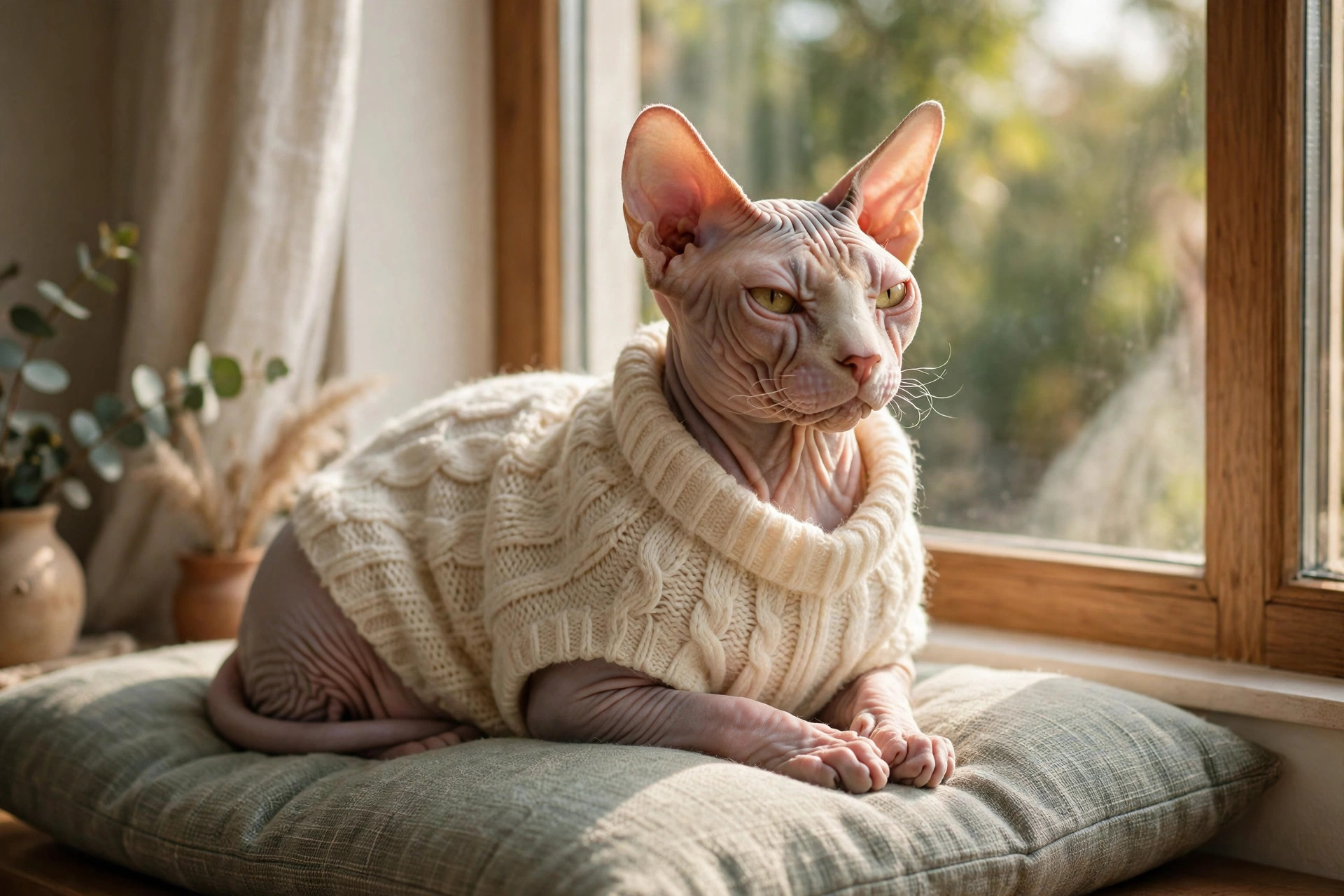
Hairless breeds top the list. Sphynx and other hairless or nearly hairless cats have no coat to trap warm air, and in a cool house a soft sweater is close to a necessity in winter — most hairless cats seek out warm laps, radiators and sunbeams with an urgency that tells owners everything. Fine-coated breeds such as Cornish and Devon rexes, and short-haired cats in cold climates, benefit on the same principle in milder form.
Age and health create the other candidates. Elderly cats regulate body temperature less well and feel cold in joints and along the spine; a light sweater in a chilly room is genuine comfort. Cats recovering from surgery, or being treated for skin conditions, may need coverage that keeps them from licking or scratching a site — the role a sweater or recovery suit plays, with the veterinarian's agreement. Kittens, sick cats and underweight rescues round out the group: for them, warmth is part of care.
Knowing When a Cat Says No
Most healthy, fully coated adult cats neither need nor want a sweater, and forcing the issue buys stress, not warmth. The signs of refusal are unmistakable once an owner knows them: freezing in place, the sideways 'sweater flop' onto one side, frantic backing-up, flattened ears, hiding, frantic over-grooming of the garment's edges, or a normally placid cat becoming vocal and evasive at the sight of it.
A cat showing those signs should have the sweater removed and the experiment ended for the day — and if the pattern repeats across two or three gentle attempts, ended altogether. The exception is medical need, where the answer is not to abandon coverage but to switch form: a veterinary recovery suit, lighter and closer-fitting than a fashion sweater, is accepted by many cats that reject knitwear.
Types and Fabrics
Cat sweaters are built smaller and lighter than dog sweaters, and the best of them share three traits: smooth inside seams that will not catch on skin or sparse coats, a stretchy knit that moves with a cat's unusually mobile shoulders, and a neckline that slips on without a fight. Soft acrylic and cotton-blend knits dominate for washability; fine fleece suits hairless cats because it has no loops for claws to snag. Wool is warm but can irritate bare skin and is best used lined or on coated cats.
Avoid anything with dangling ties, sewn-on buttons within chewing reach, loose weave a claw can hook, or a hood — hoods on cats obstruct ears and peripheral vision and are refused almost universally. For post-surgical use, purpose-made recovery suits with snap fastenings along the back are a category of their own and fit the role better than a fashion sweater stretched into service.
Fit and Safety Rules
Fit a cat sweater the way the measuring guide prescribes — chest first — then apply the cat amendments. Two fingers should slide under the neck and chest without effort; the sweater should end before the hips so it cannot bunch around the hind legs; and the front leg openings must leave the full shoulder rotation a cat uses for jumping and grooming completely free. A sweater that reaches the litter box area will be soiled and then hated, so keep coverage ahead of the hindquarters.
Sessions should start at five supervised minutes with treats and build slowly; a cat that is still wearing its sweater calmly after an hour of normal activity has accepted it. Never leave a dressed cat unsupervised — a sweater caught on furniture is a panic and injury risk — and never leave one on overnight. Store sweaters where the cat cannot drag them into play, since loose knit plus claws ends in tangles.
Alternatives to a Sweater
For the many cats that decline knitwear, warmth can be provided environmentally instead. Heated pet pads and self-warming beds give a hairless or elderly cat a warm station to return to; fleece blankets in the cat's established sleeping spots do much of the same work at no cost in tolerance. Raising the temperature of the one room the cat favors, sealing drafts at floor level, and offering a covered bed or cave all help.
The principle to keep is that the cat's comfort is the goal and the sweater only one route to it. A hairless cat that accepts a sweater gets portable warmth everywhere in the house; a cat that refuses one but sleeps on a heated pad is equally well served. Owners of sweater-accepting cats will find the dog-side comparison in the dog sweaters guide a useful reminder of how differently the two species approach the same garment.
Shop Cat Sweaters
Shop Cat Sweaters on AmazonApparel Search may earn a commission from qualifying purchases made through links on this page.
Common Questions
Do hairless cats really need sweaters?
In a cool house, generally yes. Hairless breeds such as the sphynx have no coat to hold warm air against the skin and lose heat quickly — hence their famous devotion to radiators and laps. A soft, smooth sweater in winter is comfort equipment for them, not decoration; heated beds are the alternative for cats that refuse clothing.
How long can a cat wear a sweater?
Start with five supervised minutes and build up over days. Cats that accept sweaters can wear them for a few hours of normal indoor activity, but a dressed cat should never be left unsupervised and should not sleep in a sweater overnight. Remove it at any sign of stress, overheating or entanglement.
Why does my cat fall over when I put a sweater on it?
It is a common reaction to unfamiliar pressure around the torso: many cats freeze or tip sideways as if the garment has switched off their balance. Treat it as a refusal. Take the sweater off, and if coverage is genuinely needed, try a lighter, closer recovery suit instead — or provide warmth with a heated bed and skip clothing.
What is the best fabric for a cat sweater?
A soft, smooth knit with no loose loops — cotton or acrylic blends and fine fleece are the usual choices. The inside should be seam-smooth against skin or a sparse coat, and the fabric should stretch enough not to restrict the shoulders. Avoid dangling parts, chewable buttons and hoods.
Can a sweater replace a cone after surgery?
A purpose-made recovery suit sometimes can, for incisions the suit fully covers, and many cats tolerate one far better than a cone. A fashion sweater is not designed for the job and can rub or ride off the site. Ask the veterinarian which option suits the incision, and check the site daily either way.