Pet Costumes Guide
Costumes for holidays, birthdays, photos and parades — how to choose outfits a pet can move, breathe and relax in.
Halloween may be the costume industry's loudest week, but pet costumes earn their keep all year: Christmas photographs, birthday and gotcha-day parties, weddings where the dog carries the rings, charity parades, team colors on game day. This guide covers the types of costume available, the occasions that call for them, and — most importantly — the safety and fit rules that keep dress-up fun for the animal wearing the outfit. It complements the dedicated dog Halloween costumes and cat Halloween costumes pages.
The governing principle of this guide, and of the Pet Clothing Guide as a whole, is that the pet's comfort outranks the photograph. A costume a dog forgets it is wearing produces better pictures and a better party than an elaborate outfit on a miserable animal — and most pets, honestly assessed, do best at the simple end of the range described below.
Costumes All Year, Not Just Halloween
The calendar offers a costume occasion in almost every month. Winter brings holiday sweaters, reindeer antlers for the Christmas card photograph, and New Year party hats. Spring offers Easter pastels and wedding season — dogs as ring bearers and flower-dog attendants are now a standard feature, usually in a bow tie, floral collar or simple cape rather than a full outfit. Summer adds Independence Day colors, team kits during sporting tournaments, and birthday and gotcha-day parties, where a party hat or a printed bandana does the honors.
Autumn, of course, is Halloween, the one season with its own dedicated guides for dogs and cats on Apparel Search. Year-round, the quietest costume use is the charitable one: dressed-up dogs draw crowds and donations at shelter fundraisers and parade walks, and a dog that enjoys attention is doing genuine good in a superhero cape.
Costume Types, From Simple to Elaborate
At the simple end sit neckwear costumes — a dog bandana in a themed print, a bow tie on the collar, a ruffled or jeweled collar cover. These change the pet's look completely while asking almost nothing of the pet, and they are the right ceiling for cats and for costume-shy dogs. Capes and back pieces — superhero capes, saddles with tiny riders, wings — strap around the chest and back, leave the legs and head free, and photograph brilliantly; they suit most tolerant dogs.
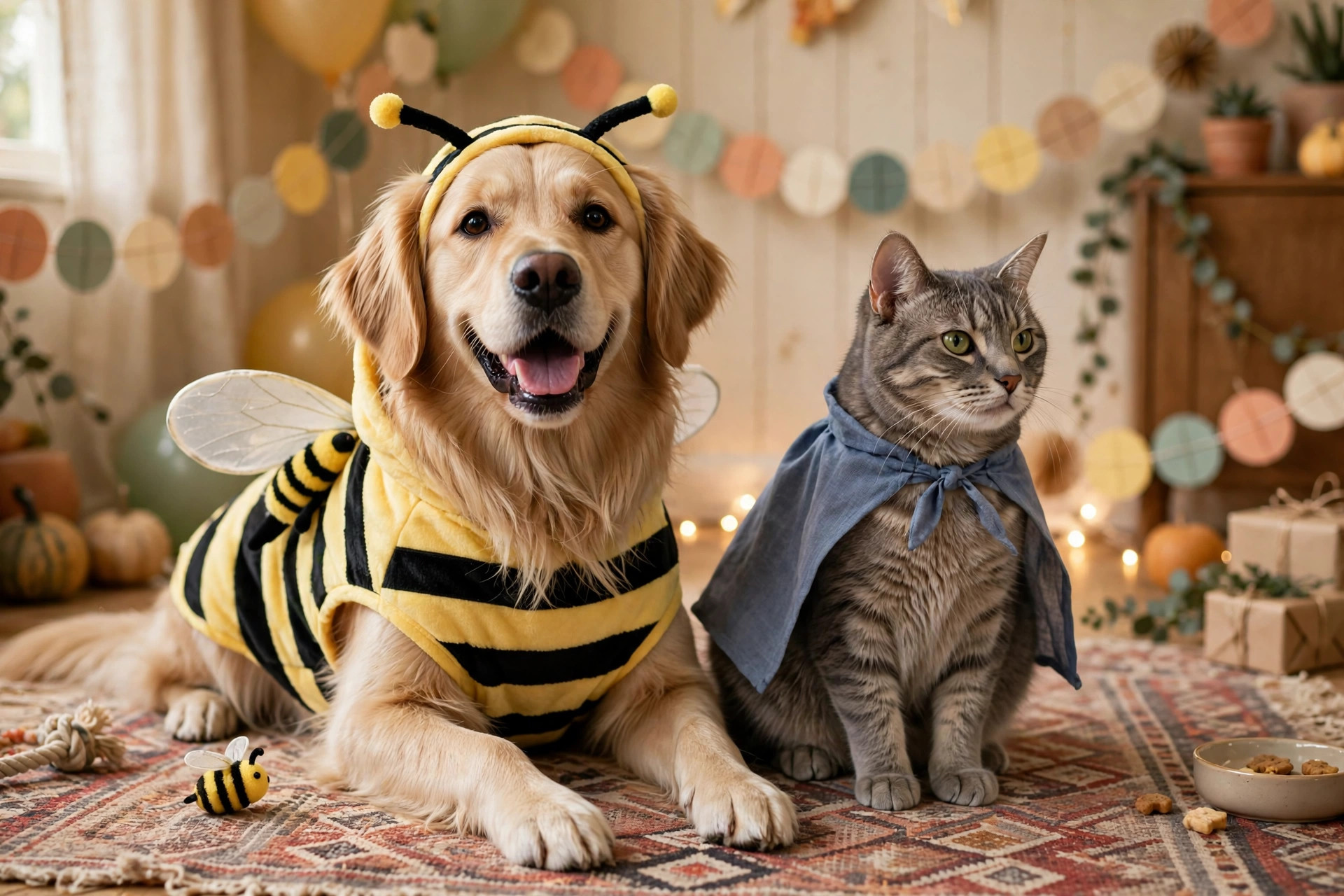
Full-body costumes add leg coverings, hoods or headpieces: the lion's mane, the bumblebee with bobbing antennae, the hot dog with bun sides. These are the outfits that win contests and the ones most often refused — headpieces in particular cross the line for many animals. Matching owner-and-pet sets are a growing category for photographs and parties; the pet's half follows the same rules as any other costume, and its simplicity matters more than the match.
Safety First
Every costume, however simple, should pass five checks. Vision and breathing: nothing may cover the eyes, nose or mouth, and headpieces must leave the ears free and the airway open. Chewing: no small sewn-on parts, dangling bells, buttons or foam pieces a pet can worry off and swallow. Movement: the pet must walk, sit, lie down and use the toilet normally — costumes that bind the legs or cross the belly tightly are out.
Heat: full costumes insulate like a coat, so indoor parties in warm rooms call for short wear and water breaks, and summer costumes should be neckwear-only. Supervision: a costumed pet is never left alone, both because of entanglement and because a costume that was tolerated at minute five may be chewed at minute forty. Any pet showing the stress signals in the cat clothing guide — freezing, hiding, frantic removal attempts — comes out of the costume immediately, photographs or not.
Fit, Acclimation and Knowing When to Stop
Costumes are sized like clothing, by the chest-first method in the pet clothing sizes and measuring guide — with the caveat that costume sizing runs notoriously variable between makers, so measurements matter even more than usual. A costume should fasten securely enough not to rotate into the pet's face or under its legs, while passing the two-finger check at every strap; elastic that grips is a common hidden flaw.
Acclimation beats ambush. Let the pet sniff the costume days before the event, drape it briefly during calm moments with treats, and build to a short dress rehearsal at home. On the day, put the costume on shortly before it is needed rather than hours ahead, keep the wearing session short and festive, and retire it while the pet is still happy. Some pets will never accept more than a bandana — accepting that gracefully is part of the guide's advice, and the bandana, worn cheerfully, always beats the masterpiece worn in misery.
Shop Pet Costumes
Shop Pet Costumes on AmazonApparel Search may earn a commission from qualifying purchases made through links on this page.
Common Questions
How long can a pet wear a costume?
For most pets, a costume session should be short — long enough for the photograph, the party entrance or the parade, usually well under an hour, and always supervised. Remove the costume at the first signs of stress, overheating or persistent attempts to get it off, and give the pet breaks with the costume off between activities.
What makes a pet costume unsafe?
Anything that covers the eyes, nose or mouth; small or dangling parts a pet can chew off and swallow; straps or fabric that bind the legs, throat or belly; and heavy full-body construction in warm rooms, which can overheat the pet. Headpieces that block the ears or peripheral vision are the most commonly refused items of all.
Are costumes okay for cats?
For some cats, in their lightest forms: a soft cape, a collar accessory, or a brief, calm photo session in a simple outfit. Many cats refuse costumes outright, and that refusal should be respected — never force a struggling or freezing cat to stay dressed. The cat Halloween costumes page on Apparel Search covers the cat-specific options and limits.
How do I size a pet costume?
Measure the chest, back length and neck as for any pet garment, and compare against that costume maker's own chart — costume sizing varies even more between brands than ordinary pet clothing. Between sizes, choose the one that fastens without straining and cannot rotate over the pet's face or under its legs.
What is the easiest first costume for a dog?
A bandana or a collar accessory such as a bow tie. It changes the dog's look completely for photographs and parties while asking almost nothing of the dog — no leg openings, no headpiece, nothing to fit but the neck. A dog that wears a bandana happily may graduate to a cape; a dog that dislikes the bandana has answered the costume question.