The Revival
The 2026 Dot Revival
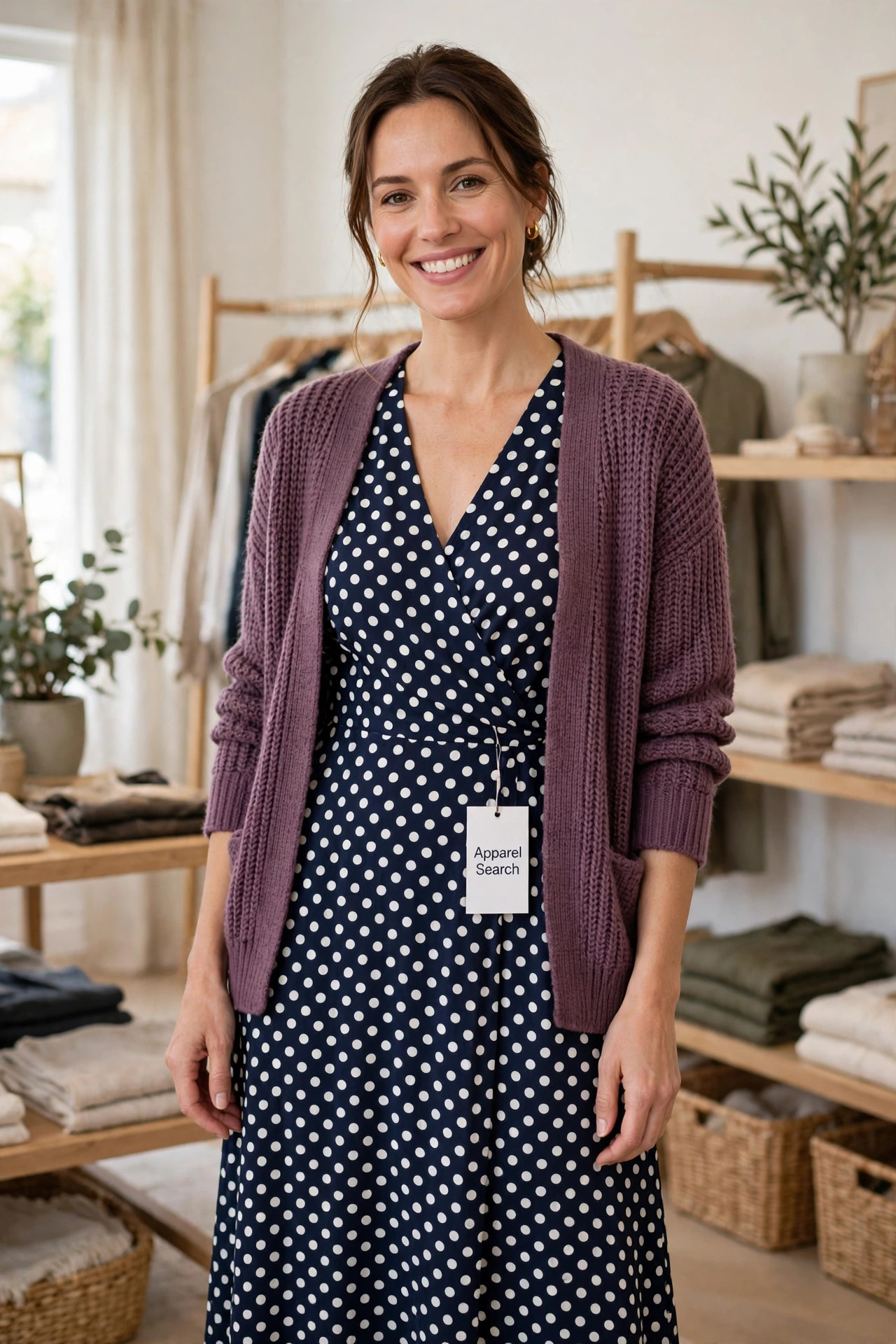
Polka dots never fully leave, but 2026 has pushed them back to the front of the rail: dot dresses in shop windows, dot skirts styled with plain knitwear, and coordinated dot sets worn as a modern alternative to a suit. The revival’s twist is range — the same print appears as a tiny pin dot on a work blouse and as an oversized graphic dot on an evening dress, often in the same collection.
The classic reference is still navy with white dots, or its reverse, and the glossary entry for the polka dot pattern explains the print itself. What has changed is the styling around it: dots are now worn with tailoring, with denim and even with other quiet patterns, rather than only in the retro, full-skirted way the print is sometimes remembered. Treat dots as a flexible print first and a vintage reference second, and the revival makes sense.
Size and Colour
Dot Size and Colour Do the Talking
Dot size sets the volume. Pin dots — small, close and regular — read almost as texture and are the easiest to wear in conservative settings. Medium dots, roughly the size of a coin, are the everyday standard on dresses and blouses. Large dots are graphic and playful; they need a clean silhouette, because the print is already doing the decorating. Spacing matters too: widely spaced dots feel airier and more modern, tightly packed dots feel denser and more formal.
Colour sets the mood. Navy and white is crisp and nautical, black and ivory is the dressiest and most graphic, burgundy and cream is softer and suits autumn — see the burgundy outfits guide for that palette in plain form. Pastel dots feel springlike, while a single bright colour on a dark ground is the evening version. If you are unsure, match the dot outfit’s colours to colours you already wear as solids; the print will slot into your wardrobe instead of sitting apart from it.
Garments and Work
Dresses, Skirts, Co-ords — and Dots at Work
The dot dress is the revival’s headline: a midi wrap, shirt or fit-and-flare shape in medium dots needs nothing more than plain shoes. Dot skirts are the flexible option, worn with a fine knit, a plain tee in summer or a tailored blazer. Coordinated sets — a dot top with a matching skirt or trousers — give the impact of a dress with the mixing options of separates, and each piece can later be worn with plain partners. Dot blouses remain the quiet entry point, tucked into plain trousers or a skirt.
For work, tone the same ideas down rather than abandoning them. Pick the smaller scale, the restrained pairing and the tailored shape: a pin-dot blouse under a suit, a small-dot shirt dress with a solid belt and plain pumps, or a dot skirt kept company by an entirely plain top half. Avoid head-to-toe large dots in a formal office, keep jewellery simple, and let one dot garment lead. Done that way, dots read as polished pattern — no different in principle from a fine stripe — which is exactly how the pattern earns its place in a working wardrobe.
Occasions
Choosing Dots for the Occasion
Occasion is mostly a question of scale and contrast. For weddings and parties, medium dots in a soft pairing — ivory on blush, cream on burgundy, white on navy — sit comfortably between festive and elegant, especially on a midi dress with plain shoes and a small bag. Avoid white-ground dots with a white dress code clash at weddings where white is reserved, just as you would with any pale dress; choose the coloured-ground version instead.
For evenings, dots go graphic: larger scale, stronger contrast, perhaps black on ivory or ivory on black, on a simpler and shorter shape. For daytime and weekends, almost anything goes, including the dot co-ord worn as separates — the top with jeans, the skirt with a plain tee. For family photographs and formal portraits, choose the smaller scale, because large dots can dominate a picture and date it. The print stays the same; only the dial moves. Learning to turn that dial — size down and contrast down for formality, size up for play — is the single skill that makes dots a permanent wardrobe tool rather than a passing trend purchase.
Questions
Common Questions
Are polka dots in fashion in 2026?
Yes. Polka dots have returned as a leading print for 2026, worn on dresses, skirts, blouses and coordinated sets, in both the classic navy and white combination and in larger, bolder scales and stronger colour pairings than the last revival.
What size polka dot is most flattering?
There is no single flattering size, but medium dots spaced evenly are the most versatile: they read as pattern rather than texture or costume. Very small pin dots suit work and formal wear, while large dots suit simpler shapes and shorter garments.
How do you wear polka dots to work?
Choose small or medium dots in a restrained colour pairing such as navy and white, black and ivory or burgundy and cream, keep the garment shape tailored, and pair it with plain shoes, a solid blazer and simple jewellery.
More to Explore
Search Apparel Search