The Method
The Method: Colour, Scale, Hero
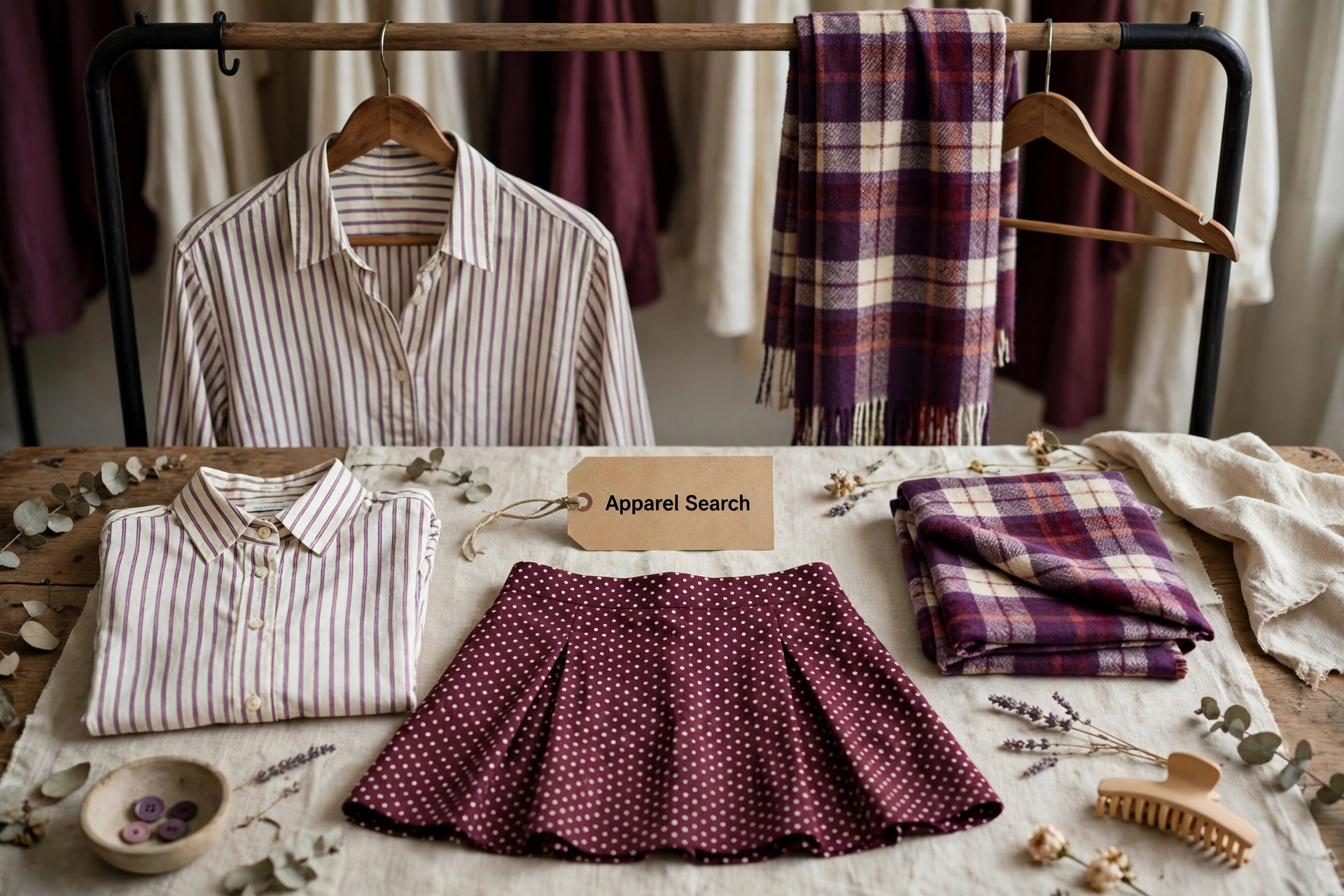
Pattern mixing looks spontaneous on the people who do it well, but it runs on three rules that anyone can apply. First, a shared colour story: the two patterns must have at least one colour in common, and ideally belong to the same small palette — navy, white and burgundy, or plum, ivory and black. Second, scale contrast: one pattern is clearly larger, the other clearly smaller, so the eye can tell them apart at a glance. Third, one hero print: a single pattern leads and is larger, bolder or on the bigger garment, while the second pattern supports it.
The fourth, supporting idea is that a simple stripe counts as a neutral. A Breton stripe or a fine pinstripe behaves like a plain background with texture, which is why stripe-plus-almost-anything is the beginner’s mix. Start from the guides to striped outfits and polka dot outfits and you already own the easiest pairing in the method.
Do and Don't
Do This, Not That
The rules are easier to remember as pairs. Work through a rail with these contrasts in mind before you commit to an outfit.
Do
Do build both patterns from one palette of two or three colours. Do separate the scales — a large plaid with a small dot, a wide stripe with a fine check. Do give the hero print the larger garment, such as a dress or blazer, and the supporting print the smaller one, such as a shirt, scarf or skirt. Do add a solid piece — trousers, a jacket, shoes — to give the eye somewhere to rest.
Don’t
Don’t pair two prints of the same scale; equal dots and equal checks blur into visual noise. Don’t mix two unrelated colour stories and hope energy will carry it. Don’t let two hero prints compete on equal-sized garments. Don’t add a patterned accessory to a two-pattern outfit unless it repeats a colour and shrinks the scale again.
Notice that every “don’t” is the same failure in a different form: competition. Mixing works when the patterns are related but not equal — related by colour, unequal by scale and by importance.
Worked Examples
Worked Examples
Example one — stripe and dot. A navy and white Breton top (the neutral, medium scale) with a burgundy skirt in small ivory dots (the hero colour, small scale). The shared thread is the deep, muted palette; a plain burgundy or navy shoe finishes it. Example two — plaid and stripe. A burgundy and ivory plaid blazer (hero, large scale) over a fine navy and white striped shirt (support, small scale), with plain dark trousers as the resting piece. The shirt’s stripe echoes the blazer’s ivory band, which is the colour link that makes it work — the same plaid family styled solo in the plaid outfits guide.
Example three — knit and print. A Fair Isle sweater, whose pattern is busy but contained in the yoke, with a small-check or plain skirt and a striped scarf in the sweater’s colours; the Fair Isle outfits guide shows the sweater side, and the knit patterns guide covers its relatives. In every example the recipe is identical: pick the hero, find a partner that shares its colours, separate the scales, and add something plain. Once that sequence is a habit, mixing stops being a risk and becomes a way to get more outfits from the clothes already in the wardrobe.
A Starter Rail
A Starter Rail: Five Pieces, Many Mixes
If mixing still feels theoretical, build the smallest rail that demonstrates it: a navy Breton top, a small-dot blouse in burgundy and ivory, a plaid blazer that contains burgundy or navy, a plain pair of dark trousers, and a plain skirt in one of the shared colours. From those five pieces you can make the stripe with the plain skirt, the dot blouse with the trousers, the blazer over either plain bottom — and then the two true mixes: the stripe under the blazer, and the dot blouse with the blazer, both held together by the shared colours.
Notice what the rail excludes: no second hero print, no colour outside the story, no two pieces of the same scale. That restraint is not a limitation; it is the method made physical. Every additional patterned piece you buy later can be tested against the rail with three questions — does it share the colours, does its scale differ from its intended partner, and does it know whether it leads or supports? A piece that answers all three will mix. A piece that answers none belongs to a different wardrobe story, however much you like it in the shop.
Questions
Common Questions
What is the simplest pattern mix that works?
A stripe with a dot or a floral is the simplest reliable mix. Keep both patterns in the same colour family, make one scale clearly larger than the other, and let the stripe act as the neutral background pattern.
How many patterns can one outfit have?
Two is the comfortable maximum for most outfits and most people. A third pattern can work as a small accent such as a scarf or a shoe, but only when all three share a tight colour story and the scales are clearly different.
Why do my mixed patterns clash?
Usually for one of three reasons: the colours do not share a common thread, the two prints are the same scale so they compete, or both prints are equally loud so neither leads. Fix the colour story first, then separate the scales, then quieten one print.
More to Explore
Search Apparel Search