Of all the places a fashion house could turn up, the surface of the Moon is the least expected — and yet the next astronauts to walk there are planned to do it inside a suit whose outer layer was co-developed by Prada. The suit is the AxEMU, the Axiom Extravehicular Mobility Unit, built by the Houston aerospace company Axiom Space under contract to NASA. Prada's role is the part of the garment a clothing person understands best: the materials, the construction and the cover layer that has to survive the most hostile fitting room in existence.
This feature separates what is confirmed from what is planned: what Prada actually does on the program, what the suit is designed to do, how it is being tested, and where NASA's revised Artemis schedule leaves the first landing.
A fashion house goes to the Moon
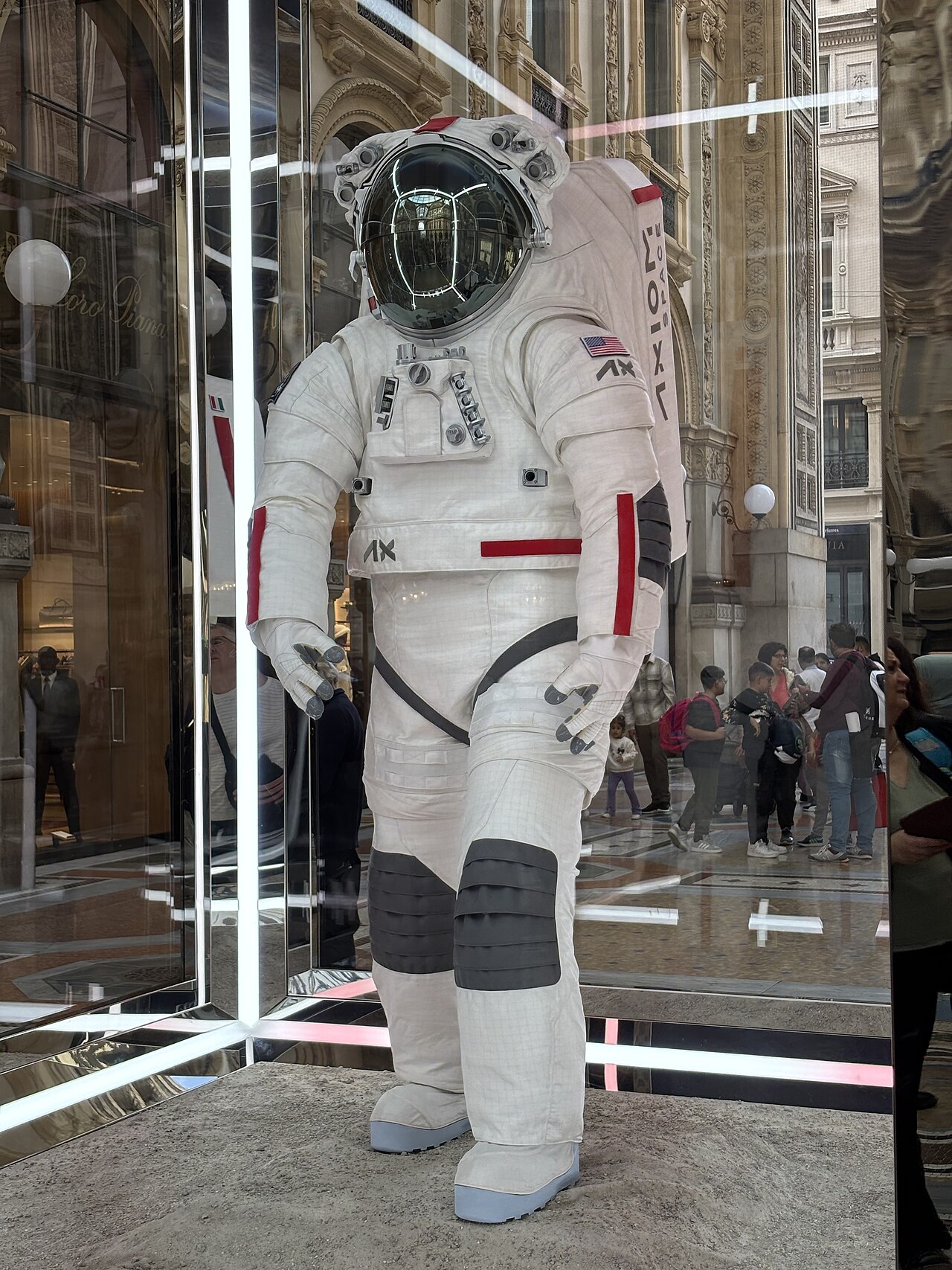
Axiom Space and Prada announced their collaboration in October 2023, and revealed the flight design of the AxEMU a year later, on October 16, 2024, during the International Astronautical Congress in Milan. The setting was a statement in itself: after the congress unveiling, the suit went on public display in the Galleria Vittorio Emanuele II, the glass-vaulted 19th-century shopping gallery where Mario Prada opened the company's first store in 1913. A spacesuit, presented as an object of design, in the temple of Milanese retail.
The program behind it is serious. Axiom Space holds NASA's contract to provide the spacesuits and spacewalk systems for the agency's return to the lunar surface — the first crewed Moon landing since Apollo 17 in December 1972. The AxEMU advances the design of NASA's own xEMU, the Exploration Extravehicular Mobility Unit prototype NASA developed in-house before turning lunar suits over to commercial providers.

What Prada actually does
It is worth being precise, because the headlines were not. Prada did not “design the spacesuit” in the sense of engineering it. Axiom Space is the suit's builder and systems integrator: the life-support backpack, the pressure garment, the avionics and the program management are Axiom's, developed under NASA's requirements and review. What Axiom said, when the partnership was announced, is that Prada's design team would work alongside Axiom's engineers on the outer layer of the suit — and that is exactly the contribution the two companies described again at the unveiling.
The outer layer of a lunar suit is not a shell in the fashion sense; it is the garment's armor. It must resist abrasion from lunar dust — a gritty, electrostatically clinging regolith that Apollo astronauts found worked its way into everything — manage the thermal swing between sunlight and shadow, protect the pressure bladder beneath it, and flex at shoulders, elbows, hips and knees thousands of times without failing. Prada brought to that problem a fashion house's genuine specialties: deep knowledge of high-performance materials, and production craft — cutting, seaming and assembling complex soft goods to exacting tolerances. Axiom's president Matt Ondler said the two companies' elite teams had “redefined spacesuit development,” and Prada Group's Lorenzo Bertelli framed the project as the house going beyond its limits into a new kind of partnership between creativity and engineering.
There is precedent in Prada's own history for technical work of this kind: through its Luna Rossa sailing program, the house has spent decades developing high-performance garments and materials for one of the most demanding environments in sport. The step from an America's Cup deck to the lunar surface is enormous, but the discipline — materials that must perform, seams that must not fail — is recognizably the same trade.
The suit itself
The AxEMU is designed for the lunar south pole, where NASA's Artemis landings are targeted — terrain of permanent shadow and permanent sunlight, with temperature extremes beyond anything Apollo faced at the equator. Against that brief, the suit's published design goals read like a specification for the ultimate technical garment:
Endurance. The suit is designed to support spacewalks of at least eight hours on the lunar surface. Mobility. It advances the xEMU with increased flexibility and range of motion, so astronauts can kneel, bend and work geological tasks rather than merely walk. Fit. Where Apollo suits were built for a narrow band of male bodies, the AxEMU is designed to fit a broad range of crew members, women and men — a sizing problem the apparel industry knows intimately. Life support. The backpack carries regenerable carbon-dioxide removal and advanced cooling technology, the suit's own climate system. And the white outer layer: the flight suit's cover is white, to reflect heat and guard against dust. The dark cover layer on the Milan display suit was for the unveiling; Axiom and Prada were explicit that the lunar suit will be white.
The cover layer as a garment
It helps to think about what the outer layer must survive, because it explains why a clothing company is in the room. Lunar dust is not beach sand: it is ground-up rock, sharp as broken glass because no wind or water has ever rounded it, and it clings electrostatically to everything it touches. Apollo's suits came home with seals abraded and fabric worn by seventeen days of cumulative dust exposure; a suit meant for repeated surface missions must shed it, seal against it and endure being brushed and worked in it. The cover layer is also the suit's public face and its thermal skin, and it has to flex at the shoulder, elbow, hip and knee through thousands of cycles without cracking, fraying or delaminating — a brief written in the language of garment failure, answered with the tools of garment making: fiber selection, weave and coating, seam placement and construction.
The fit problem is equally a clothing problem. Following the xEMU lineage it advances, the AxEMU is built around a hard upper torso that the astronaut enters from the rear, with soft arms and legs sized to the wearer — and it is designed from the outset for a far wider range of bodies than the Apollo generation's suits, including the women of the Artemis astronaut corps. Sizing a life-support garment for many bodies, so that each wearer gets a working fit rather than an approximate one, is the apparel industry's oldest problem, restated at the highest possible stakes.
Testing: the suit goes swimming
Spacesuits are rehearsed underwater, where buoyancy can simulate the Moon's one-sixth gravity. The AxEMU has been through extensive testing, including runs in NASA's Neutral Buoyancy Laboratory in Houston and a pressurized simulation conducted with NASA and SpaceX that Axiom described as the first integrated test of its kind since the Apollo era. Development continues toward the program's design reviews and qualification — the unglamorous, essential middle of any garment's life, at aerospace scale.

Where the program stands: confirmed vs. planned
Because space schedules move, this page keeps the two apart. Confirmed: the partnership exists and the flight design has been unveiled; the suit is in development and testing under Axiom's NASA contract; NASA has restructured how it buys lunar suits, moving from its in-house xEMU to commercial providers, with Axiom supplying the lunar surface suit. Planned, and subject to change: the mission the suit will debut on. At the unveiling, that was Artemis III, then scheduled as the first landing. NASA has since revised the Artemis sequence — Artemis III is now planned as an Earth-orbit demonstration flight in 2027, testing the commercial landers, and the first crewed landing of the program is now assigned to Artemis IV, targeted for 2028. The AxEMU remains the suit built for that return to the surface. When it flies, an Italian fashion house's materials and construction work will be part of the most technically demanding garment ever worn.
Prada is not the only clothing name in the new space age. SpaceX's cabin suit was designed by a Hollywood costume designer — read the SpaceX flight suit story — and Virgin Galactic's private-astronaut spacewear system was created with Under Armour. Our hub guide, Spacesuits: How Space Clothing Is Built and Worn, puts all of them in the longer history of the garment, and our Prada brand guide covers the house's earthly collections.
Common Questions
Did Prada design the whole Moon suit?
No. The AxEMU is Axiom Space's suit: Axiom leads the engineering, the life-support systems and the overall program under its NASA contract. Prada's design and engineering teams worked with Axiom on the suit's outer layer — the cover garment the world sees — contributing expertise in high-performance materials, construction and production techniques. The partnership, announced in October 2023 and unveiled in Milan in October 2024, is a collaboration between a fashion house and an aerospace company, not a fashion house building a spacecraft component alone.
When will astronauts wear the Prada-Axiom suit on the Moon?
The suit is being built for NASA's return to the lunar surface. When Axiom and Prada unveiled the design in October 2024, the target mission was Artemis III, then planned as the first crewed landing since Apollo 17. NASA has since revised the Artemis sequence: Artemis III is now planned as an Earth-orbit demonstration flight in 2027, and the first crewed landing of the program moves to Artemis IV, targeted for 2028. The AxEMU remains the suit intended for that landing. Schedules in human spaceflight change often, and the dates should be read as targets, not promises.
Why is the flight suit white when the unveiled suit looked dark?
The suit displayed in Milan wore a dark cover layer for the unveiling. The flight configuration's outer layer is white, for the same reason Moon suits have been white since Apollo: white reflects the intense, unfiltered sunlight on the lunar surface, helping protect the astronaut from extreme heat, and it sheds and shows abrasive lunar dust. Axiom and Prada stated at the unveiling that the lunar-surface suit will use the white material.
Where was the Prada-Axiom suit unveiled?
In Milan, during the 75th International Astronautical Congress, on October 16, 2024. After the unveiling, the suit was put on public display from October 18, 2024 in the Galleria Vittorio Emanuele II — Milan's historic shopping gallery — a short walk from Prada's own first store, which opened in the same gallery in 1913.
Related Reading
Search Apparel Search